Connect with us

Education

FG unveils entrepreneurship certification in 14 varsities

Published

on

The Federal Government has unveiled the Entrepreneurship, Innovation and Business Incubation Certification programme in 14 universities, with plans to expand it to all federal universities by 2027 and all federal tertiary institutions by 2028.

The Minister of Education, Maruf Alausa, disclosed this on Friday in Abuja during the official unveiling of the initiative, describing it as a major shift in Nigeria’s education system toward innovation, entrepreneurship, and job creation.

“Today marks not just the launch of a programme, but the beginning of a new paradigm in Nigeria’s education system, one that shifts our young people from job-seekers to job-creators, from passive learners to active innovators, and from graduates to nation builders,” he said.

He noted that the programme comes at a critical time when the country must harness the potential of its youthful population while addressing the limitations of traditional education models.

Alausa warned that rapid technological changes are disrupting industries and widening the gap between education and employability if proactive measures are not taken.

“The world is changing rapidly. Technology is reshaping industries, and many traditional jobs are disappearing. Even as new opportunities emerge, if we do not prepare our young people adequately, we risk widening the gap between education and employability,” he said.

He explained that the EIBIC programme is designed to embed entrepreneurship across disciplines, citing ongoing efforts at the University of Lagos as a model.

According to the minister, the programme will equip students with practical competencies in innovation, business planning, financial literacy, and venture development, enabling them to build sustainable enterprises even before graduation.

See also  Nigeria losing top professors to foreign varsities, ASUU laments

He further linked the initiative to President Bola Tinubu’s economic vision, describing it as part of a broader strategy to build a knowledge-driven and innovation-led economy.

“EIBIC aligns with our national priorities. This initiative aligns perfectly with the vision of His Excellency, President Bola Tinubu, under the Renewed Hope Agenda to build a resilient, knowledge-driven, and innovation-led economy,” Alausa said.

According to the minister, the programme will be implemented in phases, beginning with 14 universities, including the University of Lagos, Ahmadu Bello University, University of Jos, Bayero University Kano, Uthman Danfodio University, University of Benin, University of Port Harcourt, Obafemi Awolowo University, University of Ibadan, University of Maiduguri, Abubakar Tafawa Balewa University, University of Nigeria, Nsukka, Nnamdi Azikiwe University, and University of Abuja.

He added, “Today, EIBIC is being rolled out in 14 universities. By next year, all federal universities will be onboarded, including some federal polytechnics and Colleges of Education. By the end of 2028, all our federal tertiary institutions will be fully onboarded.”

The minister also highlighted the Student Venture Capital Grant introduced by the ministry, revealing strong interest among Nigerian youths.

“On Sunday, we will be choosing 63 people who will benefit from the Student Venture Capital Grant. Guess how many people applied? 36,000 young entrepreneurs applied,” he said.

Alausa directed vice-chancellors of participating institutions to fast-track the approval of the programme within their respective senates.

“I am directing you all on or before the end of April; all your senators must approve this programme. This is a directive that I am not going to take lightly. I will call, and there will be consequences because we are in a hurry to get this programme to our youth,” he warned.

See also  FG to unveil ₦50m grant for STEMM students

Earlier, the Chairman of the EIBIC Planning and Monitoring Committee and Vice-Chancellor of the University of Jos, Prof. Tanko Ishaya, described the initiative as a major step toward aligning education with national economic goals.

“This landmark initiative by the Minister marks a transformative leap in repositioning Nigerian education as a true driver of national economic development,” he said.

Ishaya noted that the programme complements existing funding opportunities for student entrepreneurs.

He added that the initiative would strengthen the link between academic learning and market needs while fostering innovation and enterprise among students.

“By focusing on practical skills acquisition, innovation-driven thinking, and structured incubation, it is not just satisfying individuals. It is building a new generation of job creators, innovators, and industrial leaders,” Ishaya said.

The launch attracted key stakeholders from across the education sector, with expectations that the EIBIC programme will play a critical role in reducing youth unemployment and driving sustainable economic growth in Nigeria.

The EIBIC programme is a mandatory entrepreneurship development initiative designed for students in tertiary institutions. It runs concurrently with academic programmes, starting from the first year through to graduation.

The structure includes early exposure through orientation programmes, continuous entrepreneurship training, and access to incubation, mentorship, and funding opportunities.

Students are guided through a structured pathway from idea development to venture creation, to enable them to build sustainable businesses even before graduation.

Upon completion, participants receive an additional certification in entrepreneurship alongside their academic degrees.

punch.ng

FOLLOW US ON:

FACEBOOK

TWITTER

PINTEREST

TIKTOK

YOUTUBE

LINKEDIN

Continue Reading
Click to comment

Leave a Reply

Your email address will not be published. Required fields are marked *

Education

Abia varsity chancellor tasks new veterinary doctors on food safety, public health

Published

on

The Vice-Chancellor of Michael Okpara University of Agriculture, Umudike, Prof. Ursula Ngozi Akanwa, has charged new veterinary doctors of the University to uphold the ethics and values of their profession while ensuring food safety and safeguarding public health.

Prof. Akanwa gave the charge while addressing graduands of Doctor of Veterinary Medicine (DVM) during the 12th Induction and Oath-taking Ceremony organised by the University in collaboration with the Veterinary Council of Nigeria (VCN) on Wednesday.

The VC, represented by the Deputy Vice-Chancellor Academic, Prof. Nneoma Elechi Obasi, said the induction confers legal rights on the graduands to practice Veterinary Medicine and places on them the responsibility of safeguarding animal health, food systems and public health.

“Today is not merely ceremonial; it marks the transition of our graduands into professionals entrusted with the health of animals, the safety of our food systems and the protection of public health,” she said.

She stressed that the ceremony reflects the University’s mandate to produce professionals with competence, character and conscience, describing the new veterinarians as critical to agricultural growth and national food security.

The VC also commended the Veterinary Council of Nigeria for granting full accreditation to the University’s Veterinary programme and acknowledged the partnerships with industry operators that support practical training of MOUAU Vet. students.

On its part, the Veterinary Council of Nigeria, led by its President, Prof. Mathew Adamu and Ag. Registrar, Dr. Oladotun Fadipe, while issuing practising licenses to the graduands, congratulated the University for regularly churning out quality DVM Graduands, who are found worthy in learning and character.

See also  Nigeria losing top professors to foreign varsities, ASUU laments

A total of 48 DVM Graduands were inducted into the profession, with Dr Chimezie Amarachi Blessing emerging as the overall best graduating student, and Dr Aniorji Sandra Chinonso won the Farm Alert Award.

punch.ng

FOLLOW US ON:

FACEBOOK

TWITTER

PINTEREST

TIKTOK

YOUTUBE

LINKEDIN

INSTAGRAM

Continue Reading

Education

School closures threaten national stability, FG warns

Published

on

The Secretary to the Government of the Federation, Dr George Akume, on Wednesday warned against the continued closure of schools due to insecurity, saying it poses a serious threat to Nigeria’s education system and long-term national stability.

Akume said shutting down schools in unsafe areas not only disrupts learning but also deepens the country’s education crisis.

A statement by Akume’s media aide, Yomi Odunuga, said the SGF spoke in Abuja at the first triannual meeting of the Nigerian Inter-Religious Council, held under the theme, “Religious Literacy for National Cohesion.”

The SGF called for the strengthening of government policies on safe schools and violence-free learning environments.

“The SGF also raised concerns over insecurity in the education sector, warning that attacks on schools and prolonged closures in unsafe areas continue to worsen Nigeria’s education crisis.

“He said government policies on safe schools and violence-free learning environments must be strengthened to protect children and ensure uninterrupted learning,” the statement partly read.

According to him, it was impossible to encourage children to learn when schools were not secure.

“A child cannot learn fraternity in fear; a nation cannot preach literacy while schools are under threat,” he said.

Akume emphasised that while religious studies are already part of the school curriculum, priority must now be placed on improving teaching quality through better-trained educators, enhanced learning materials and value-based education that promotes tolerance and responsible citizenship.

Beyond education, the SGF urged religious and traditional leaders to play a more active role in preventing violence and fostering unity as the country prepares for the 2027 general elections.

See also  How A Classmate’s Question At Harvard Forced Me To Dump Banking For Politics – Abia Governor, Alex Otti

He said faith-based and traditional institutions must lead efforts in grassroots mobilisation, youth education and peace-building to counter misinformation, stereotypes and identity-based divisions that often trigger conflict.

“The 2027 general elections are fast approaching, and religious and traditional leaders have a moral responsibility to strengthen collaboration, promote tolerance and ensure peaceful coexistence in their communities,” Akume said.

He warned against the manipulation of religion and identity for political or economic gains, noting that such actions often fuel violence and social unrest.

Akume also stressed the importance of combining religious literacy with media and information literacy to combat the spread of falsehoods and hate speech, referencing Nigeria’s collaboration with the United Nations Educational, Scientific and Cultural Organisation on promoting responsible information sharing.

He added that the Federal Government had put measures in place to support religious and traditional institutions in sustaining peace and security ahead of the elections.

The SGF expressed optimism that deliberations at the NIREC meeting would yield practical solutions to strengthen national cohesion, while urging stakeholders to prioritise education and literacy as key tools for peace-building and development.

punch.ng

FOLLOW US ON:

FACEBOOK

TWITTER

PINTEREST

TIKTOK

YOUTUBE

LINKEDIN

INSTAGRAM

Continue Reading

Education

FG loans N11.8bn to 6,842 tertiary institution workers

Published

on

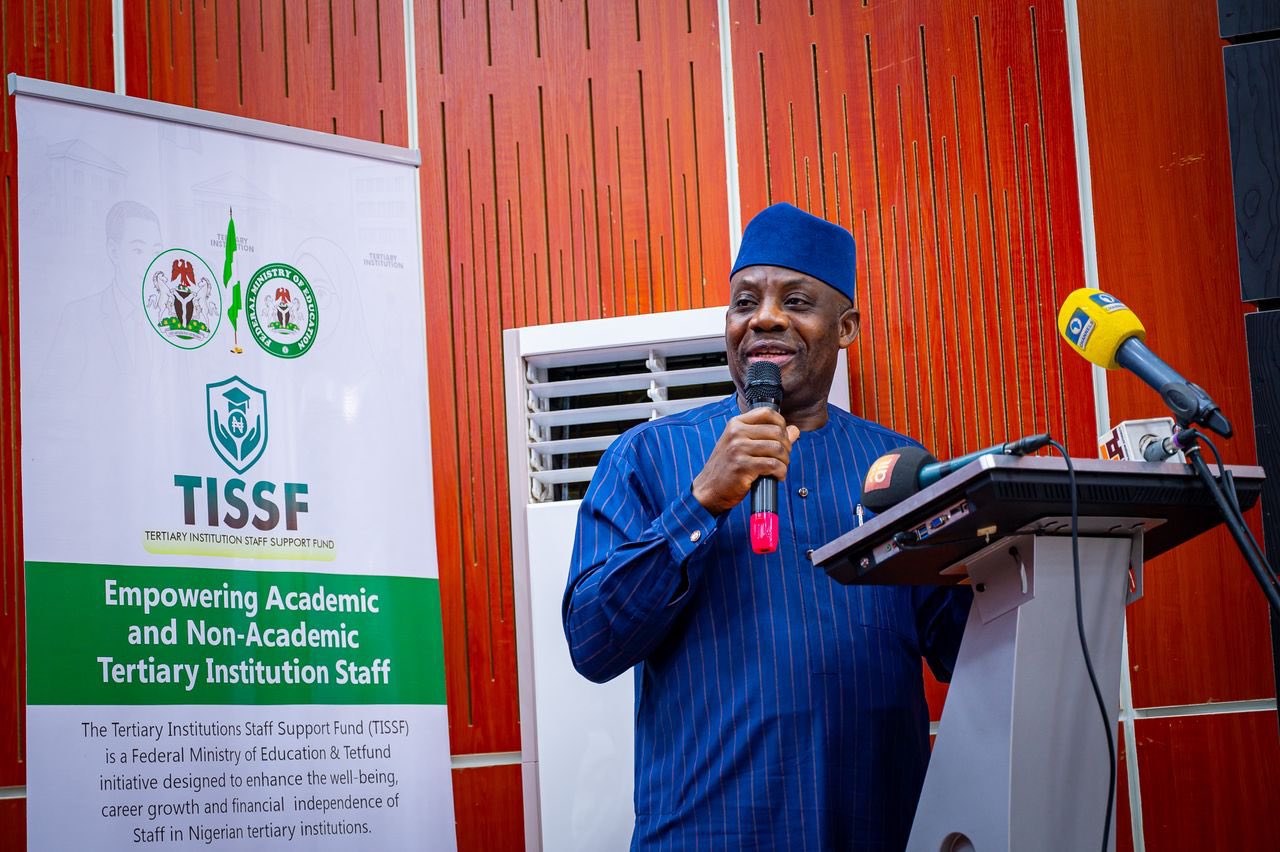
The Federal Government has disbursed N11.8bn to 6,842 academic and non-academic staff across Nigerian tertiary institutions under the Tertiary Institutions Staff Support Fund.

The beneficiaries span 141 institutions, including federal universities, polytechnics, and colleges of education.

The TISSF, launched in August 2025, is a Federal Ministry of Education and TETFund-funded programme dedicated to enhancing the well-being, career development and financial stability of tertiary institution staff across Nigeria.

The joint initiative of the FME and TETFund aims to deliver zero per cent interest loans to enhance the welfare, career development and financial stability of tertiary institution staff.

The fund provides interest-free loans of up to N10m to eligible academic and non-academic staff.

Data published on the website of the Federal Ministry of Education, obtained by our correspondent, showed that there have been 34,000 verified applicants from 219 institutions so far.

Staff members of federal universities constitute the highest number of applicants (59 per cent), followed by those of polytechnics (23 per cent) and colleges of education (18 per cent).

Also under the Nigeria Education Sector Renewal Initiative, 240 e-tricycles are reported to have been distributed across 12 institutions.

Key facts published on the website include: “Loans up to N10m per staff (0% interest); N11.8bn disbursed to 6,842 beneficiaries from 141 institutions.

“34,000 verified applicants from 219 institutions; Federal universities (59%), polytechnics (23%), COEs (18%); minimum five years to retirement required for eligibility.”

Other ongoing programmes under the initiative include the EduRevamp Teacher Platform, a digital training system introduced earlier this year to strengthen educators’ skills, and the School Safety Portal, developed in partnership with the Nigeria Security and Civil Defence Corps to improve security management in schools.

See also  How A Classmate’s Question At Harvard Forced Me To Dump Banking For Politics – Abia Governor, Alex Otti

The ministry said the EduRevamp platform, launched at the first National Teacher Summit in January 2026, has recorded “37,000 registered users, with 18,000 teachers fully enrolled in its training modules.”

The platform provides audio and video lessons, case studies and certification opportunities for continuous professional development.

The School Safety Portal, created under the School Safety Act of 2025, currently contains data on more than 156,000 geolocated schools.

punch.ng

FOLLOW US ON:

FACEBOOK

TWITTER

PINTEREST

TIKTOK

YOUTUBE

LINKEDIN

INSTAGRAM

Continue Reading

Trending