
Connect with us

Business

Nigeria, UAE Ports Group Sign Landmark MoU On Maritime Development

Published

on

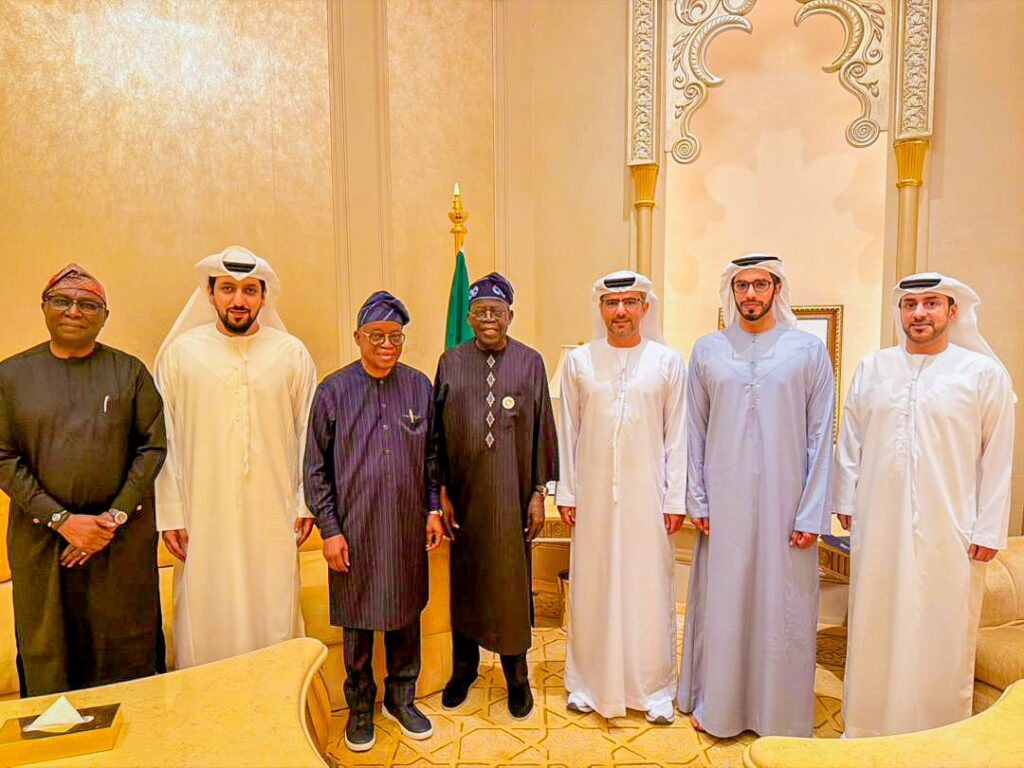
Nigeria’s Federal Ministry of Marine and Blue Economy and Abu Dhabi Ports Group have signed a landmark Memorandum of Understanding (MoU) aimed at strengthening cooperation in ports development, maritime logistics, and digital transformation.

The agreement, signed on the sidelines of the recently concluded Abu Dhabi Sustainability Week, marks a major milestone in Nigeria–UAE economic relations and underscores both nations’ commitment to advancing mutual trade and investment interests.

Minister of Marine and Blue Economy, Adegboyega Oyetola, led the Nigerian delegation, while the chairman of Abu Dhabi Ports Group, H.E. Mohamed Hassan, represented the Group’s management team. The Director General/Chief Executive Officer of the Nigerian Maritime Administration and Safety Agency (NIMASA), Dr. Dayo Mobereola, was also in attendance.

According to a statement issued by Osagie Edward, deputy director and head of Public Relations at NIMASA, the MoU “forms part of broader trade and investment engagements between the Federal Republic of Nigeria and the United Arab Emirates.”

Following the signing, the Nigerian delegation briefed President Bola Tinubu, on the strategic importance of the partnership, which is expected to catalyse growth in Nigeria’s maritime and blue economy sectors.

The agreement, which had been under consideration for more than two decades, is seen as a renewed commitment by both countries to deepen economic ties, enhance port infrastructure, and promote sustainable development within the maritime industry.

FOLLOW US ON:

FACEBOOK

TWITTER

PINTEREST

TIKTOK

YOUTUBE

LINKEDIN

TUMBLR

INSTAGRAM

See also  Nigerian billionaire Tonlagha hires lobbyists to push Nigeria-US ties
Continue Reading
Click to comment

Leave a Reply

Your email address will not be published. Required fields are marked *

Business

Africa urgently needs more fish farms, says UN

Published

on

Africa needs to urgently expand its fish-farming sector to meet its food needs, the head of the UN’s fisheries division said Tuesday, even as its latest report found record production levels globally.

Fish and seafood is now a $184-billion trade, according to the State of World Fisheries and Aquaculture report by the United Nations’ Food and Agriculture Organization (FAO), launched at the Our Ocean Conference in Kenya.

Fish-farming, or “aquaculture”, overtook traditional “capture” fishing as a source of food production in 2021 and has continued to grow — surpassing 100 million tonnes for the first time in 2024, the latest year for data.

But Africa is lagging behind the rest of the world, with only 18 percent of its fish coming from farms, compared to around half elsewhere.

Sub-Saharan Africa’s fish production will need to grow by 68 percent between now and 2050 to keep up with its rapidly growing population, the FAO said.

“It’s an opportunity waiting to be exploited… but it’s whether the timing is sufficiently fast to catch up with that demand,” Manuel Barange, director of the FAO’s fisheries division, told AFP.

“Aquaculture can actually be a game-changer,” he said. “If we manage to develop aquaculture in Africa, there’s a lot of opportunities.”

But governments urgently need to create regulations and incentives to attract investors, Barange added.

More than 700 different species of fish are raised for consumption on aquaculture farms around the world and the FAO argues it is a more predictable and sustainable approach than traditional fishing at sea.

See also  Dangote unveils plan for multi-billion-dollar Olokola seaport

It is also more manageable in the face of climate change, which is causing rapid changes in the volumes and locations of ocean fish.

Climate change is “a disruptor of everything that we do,” said Barange.

More work is also needed to reduce over-fishing: the report found that only 62 percent of global fisheries were sustainably fished.

The 11th edition of the Our Ocean Conference began in the Kenyan port city of Mombasa on Tuesday — its first time in Africa — bringing together politicians, NGOs, investors and innovators.

Since its first edition in 2014, organisers boast that it has led to more than 2,900 commitments valued at over $169 billion, covering marine conservation, sustainable fisheries, climate adaptation, security and pollution reduction.

punch.ng

FOLLOW US ON:

FACEBOOK

TWITTER

PINTEREST

TIKTOK

YOUTUBE

LINKEDIN

INSTAGRAM

Continue Reading

Business

Dangote refinery slashes petrol gantry price by N75/litre; read details

Published

on

Dangote Petroleum Refinery has reduced the gantry price of Premium Motor Spirit (petrol) by N75 per litre

In a circular to fuel marketers on Monday, the refinery said the adjustment followed the de-escalation of the tension in the Middle East, which had impacted energy prices in the past three months.

“Following the de-escalation of tensions in the Middle East, which has impacted energy prices. We wish to inform you that we have reviewed our premium motor spirit gantry/coastal price,” the circular stated.

It added that the new gantry price is now N1,175 per litre, down from N1,250, while the coastal price per metric tonne has been reduced from N1,595,790 to N1,495,215.

The refinery said the new rates will take effect from midnight.

“Kindly note that all outstanding unloaded gantry volumes will be repriced at the new rate effective 12:00 AM, June 16, 2026.

“We sincerely appreciate your continued patronage and assure you of our unwavering commitment to reliable product supply and excellent service delivery,” the circular noted.

According to Petroleumprice.ng, the Dangote refinery is now the cheapest petrol, as many marketers sold it for around N1,240 on Monday.

The latest reduction comes amid easing tensions in the global oil market following reports of ongoing negotiations between the United States and Iran over the reopening of the Strait of Hormuz.

Oil prices, which had surged to about 83 per barrel as of Monday after Trump announced the signing of the deal.

Crude oil, the major feedstock for fuel production, had risen sharply since the outbreak of hostilities between the United States and Iran on February 28. During the three-month conflict, crude prices climbed above 120 per barrel, triggering higher fuel prices.

See also  First Abu Dhabi Bank to open Nigerian office in sub-Saharan push

In Nigeria, petrol prices rose from about N830 per litre to around M1,300 per litre during the period. Diesel and aviation fuel prices also recorded significant increases.

With crude prices now retreating, the adjustment by the Dangote refinery is expected to bring further relief in domestic fuel prices.

The PUNCH reports that oil prices continued their downward trend on Monday following the signing of a ceasefire agreement between the United States and Iran to end hostilities in the Middle East and reopen the Strait of Hormuz.

According to Oilprice.com, Brent crude, the global benchmark, dropped from 83 per barrel on Monday.

The US and Iran said they reached an agreement on Sunday to end the war, a development that further pushed down oil prices.

The PUNCH reported on Monday that petrol could drop to as low as N900 per litre in the coming days if the peace deal between the United States and Iran materialised.

With US President Donald Trump announcing the signing of the peace deal and a partial reopening of the Strait of Hormuz, oil prices further crashed, fuelling speculation of more fuel price reductions in the coming days, should the crisis fully de-escalate.

Nigerians are waiting for more drops in petrol prices. However, a Dangote Petroleum Refinery official, while saying petrol could fall to N900 per litre, cautioned that the refinery still had the “expensive crude” in its tanks.

punch.ng

FOLLOW US ON:

FACEBOOK

TWITTER

PINTEREST

TIKTOK

YOUTUBE

LINKEDIN

INSTAGRAM

Continue Reading

Business

Domestic gas sales rise 30% on reforms – Report

Published

on

Nigeria’s domestic gas market recorded a significant increase in sales, rising by about 30 per cent between January 2022 and January 2025, driven by reforms under the Petroleum Industry Act 2021 and recent executive orders by President Bola Tinubu, according to a legal analysis by Tope Adebayo LP.

The Lagos-based full-service law firm said in a statement made available to our correspondent that the reforms have improved regulatory clarity, fiscal attractiveness and investor confidence across the gas value chain, even as infrastructure gaps and implementation challenges continue to slow the pace of growth.

It stated that Nigeria, which holds more than 206 trillion cubic feet of proven gas reserves, has long struggled to convert its resource base into domestic energy supply due to underinvestment, weak infrastructure and gas flaring.

According to data cited in the report, domestic gas sales rose from 49.3bscf in January 2022 to 64.2bscf in January 2025, reflecting the gains attributed to ongoing reforms under the PIA.

The report noted that the legislation marked a turning point for the sector.

“The PIA represents the most comprehensive reform of Nigeria’s petroleum sector in decades and has established a stronger foundation for domestic gas development through regulatory clarity, pricing liberalisation mechanisms, infrastructure support and enhanced investment incentives,” the firm stated in a report titled ‘From Policy to Practice: Legal and Regulatory Drivers of Nigeria’s Domestic Gas Market Under the PIA and Recent Executive Orders’.

It explained that structural reforms under the Act, including the creation of separate regulatory authorities for upstream and midstream/downstream operations, have helped to improve oversight and reduce regulatory bottlenecks.

See also  Audit uncovers over N61bn payment breaches in NNPCL

The analysis also highlighted the Domestic Gas Delivery Obligation framework as a key intervention aimed at boosting supply to strategic sectors such as power generation and industry. The framework includes enforceable penalties for non-compliance.

It further noted improvements in gas utilisation and supply performance, alongside modest reductions in gas flaring and the expansion of the Nigerian Gas Flare Commercialisation Programme, which it said has seen multiple flare sites auctioned for monetisation projects.

Beyond production measures, the PIA, it stated, introduced open-access provisions for infrastructure, partial liberalisation of gas pricing and the establishment of the Midstream and Downstream Gas Infrastructure Fund to support investments in processing, transportation and distribution.

The law firm maintained that recent executive orders and presidential directives have also strengthened the investment climate through tax incentives, faster contracting timelines and more flexible local content implementation.

“These interventions signal a deliberate effort by the government to improve project economics and enhance Nigeria’s competitiveness as a destination for gas investments,” Tope Adebayo LP noted.

However, the firm warned that policy gains alone are insufficient to deliver the market’s full potential.

“Large-scale outcomes remain constrained by persistent infrastructure gaps, payment risks within the power sector, legacy debts, and implementation inefficiencies. The transition from policy to practice is clearly underway, but it remains incomplete,” it stated.

According to the analysis, achieving a fully functional and scalable domestic gas market will require sustained investment in pipelines, processing facilities, transportation networks and distribution systems, alongside stronger institutional coordination and consistent regulatory execution.

The report stated that the foundations had been laid, but long-term success would depend on effective implementation and continued market reforms. It added that, to unlock the full promise of the Decade of Gas initiative, Nigeria must bridge the gap between legal design and operational reality.

See also  Dangote unveils plan for multi-billion-dollar Olokola seaport

punch.ng

FOLLOW US ON:

FACEBOOK

TWITTER

PINTEREST

TIKTOK

YOUTUBE

LINKEDIN

INSTAGRAM

Continue Reading

Trending