Human rights groups, activists and social media users have condemned the Lagos State Police Command and the Lagos State Government over the arrest and the use of force on residents who protested the demolition of their homes across parts of the state on Wednesday.
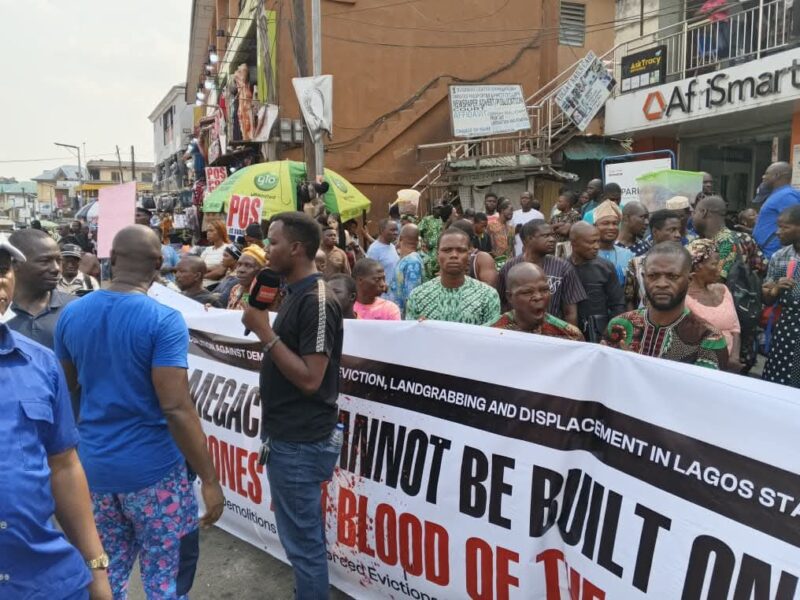
The condemnation followed the police’s deployment of tear gas to disperse hundreds of demonstrators who converged in Ikeja to protest what they described as their displacement without adequate compensation or relocation.
The protesters, drawn from Makoko, Oworonshoki, Owode-Onirin, Oko Baba and other communities, carried placards bearing inscriptions such as: “A megacity cannot be built on the bones and blood of the poor,” “Urban poor is not a crime,” “Stop killing us,” “Justice for Owode-Onirin traders,” and “Lagos is not for the rich alone.” They also chanted solidarity songs.
The protest began in the morning and gathered momentum at the Ikeja Under Bridge, where demonstrators converged before marching towards the Lagos State House of Assembly in Alausa.
At different points, the protesters demanded proper relocation plans if the government was determined to demolish their homes, as well as compensation for residents who reportedly lost their lives during previous demolitions.
On arrival at the Assembly gate, the demonstrators were stopped by the Commissioner of Police, Moshood Jimoh, who informed them that they would not be allowed access into the legislative complex.
The police chief’s stance drew resistance from the protest leaders, who insisted they would not leave unless granted entry to engage directly with the lawmakers.
As tension mounted, some lawmakers stepped outside to address the protesters, but the move was rejected, with demonstrators insisting that a dialogue could only take place within the Assembly premises.
Moments later, the standoff degenerated into chaos as police officers fired tear gas canisters to disperse the crowd.
Thick smoke engulfed the area, triggering panic and forcing protesters to flee in different directions. Several people sustained injuries, while journalists covering the protest also scrambled for safety.
A PUNCH videographer, Sulaiman Adeniyi, collapsed after inhaling tear gas fumes, while a nursing mother was seen shielding her baby as she ran to safety. One protester sustained a leg injury after being hit by a tear gas canister. Some police officers were also seen retreating from the smoke.
Defending the police action in an interview with News Central Television, shared on the station’s verified X handle, Jimoh said the protest infringed on the rights of other road users.
He alleged that protesters blocked the highway, threw pebbles at him and verbally abused him.
“Peaceful protest is allowed, but when it blocks a public highway, it becomes dangerous to lives, including those of the protesters themselves,” Jimoh said.
“I cannot allow vehicles to run over protesters under my watch. After four lawmakers addressed them and they still refused to disperse, I warned them to leave the highway. Instead, they pushed my officers, causing them to fall on their rifles.
“We used minimal force —tear gas— so millions of Nigerians who use that road could go to work.”
However, an activist, Ms Yemi Adamolekun, who was present at the protest, faulted the police account.
She said the protesters were peaceful and denied claims that they blocked the road or attacked the commissioner.
“They were calm, and at the point tear gas was fired, they were being asked to sit down so water and snacks could be shared.
“The police had already blocked the lane closest to the Assembly. These people are homeless—where exactly do you expect them to go? Saying they blocked the road is false,” she said.
Adamolekun added that the confrontation could have been avoided if the protesters had been allowed into a designated area within the Assembly complex.
Also reacting, the President of the Committee for the Defence of Human Rights, Debo Adeniran, condemned the use of force in dispersing the protesters, describing it as a violation of citizens’ constitutional rights.
He said peaceful protests should be met with dialogue, not repression, and called for sanctions against officers who fired tear gas.
Similarly, the Lagos State Coordinator of the Take-It-Back Movement, Oluwatosin Adeyemi, condemned the police action in a statement.
“Rather than listen to the legitimate cries of the people, the police responded with tear gas, brutality and arrests. Several protesters were injured, including one of the protest leaders, Comrade Hassan Taiwo Soweto,” he said.
“Peaceful protest is not a crime. The use of force against unarmed residents demanding justice is unacceptable.”
The group called for the release of protesters allegedly arrested during the protest.
On social media, Nigerians also expressed outrage over the incident.
Ogedegbenge Olusegun wrote on Facebook, “Look at how the government treats citizens like criminals in their own country.”
On X, @Okoroaforlaura tweeted, “Allow them to protest. This is democracy, not dictatorship.”
Confirming the arrest of some of the protesters, the state Police Public Relations Officer, Abimbola Adebisi, said two individuals—Taiwo Hassan and Dele Frank—were arrested for conspiracy and conduct likely to breach public peace.
She corroborated the Commissioner of Police’s claim that the protesters barricaded the road, adding that the two arrested persons would be charged in court.
She said, “As a result of these unlawful acts by the violent protesters, Taiwo Hassan (male, adult) and Dele Frank (male, adult) were subsequently arrested at the scene of the protest by the police for conspiracy and conduct likely to cause a breach of the peace, threatening violence and instigating disorder, inciting the public to cause a breakdown of law and order, obstruction of traffic flow, and unlawfully restraining road users from access, contrary to the Criminal Law of Lagos State.
“They are currently undergoing investigation and will be charged to court within the time limit provided by law. A white Toyota Canta vehicle with registration number Lagos LND 968 YL, fitted with multiple loudspeakers and two generator sets and allegedly used to block the highway, was intercepted and recovered as an exhibit.
“A coffin allegedly carried by the protesters to cause fear and apprehension in the minds of the public and to disturb public peace was also recovered.”
Meanwhile, the Lagos State House of Assembly denied ignoring the protesters despite being on recess.
In a statement by the Chairman, House Committee on Information, Strategy and Security, Stephen Ogundipe, the Assembly said lawmakers attempted to engage the protesters, but dialogue was rejected.
“Four lawmakers were mobilised to engage the protesters in good faith. However, they insisted on forceful entry into the Assembly complex,” the statement read.
The House added that one protest leader became verbally abusive, accusing the commissioner (of police) of murder —an allegation it described as reckless and unfounded.
Efforts to get reactions from the Commissioner for Information and Strategy, Gbenga Omotoso, and the Governor’s Chief Press Secretary, Gboyega Akosile, were unsuccessful as of the time of filing this report.
punch.ng
FOLLOW US ON: