Connect with us

News

Nigeria, Britain set for fresh security alliance

Published

on

President Bola Tinubu on Wednesday stated that the country’s collaboration with the United Kingdom in addressing insecurity remained crucial, adding that he planned to discuss Nigeria’s counter-terrorism initiatives and challenges to regional stability during his meeting with British Prime Minister Keir Starmer on Thursday (today).

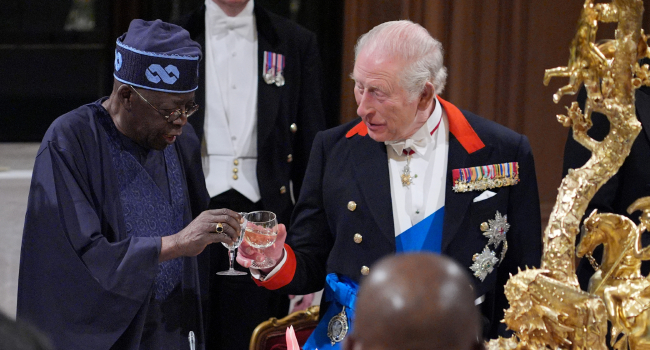
The President made the disclosure on Wednesday night at a state banquet hosted by King Charles III at Windsor Castle, marking the first time a Nigerian leader has addressed a gathering at the historic British royal residence.

Wednesday’s dinner which began at 09:00pm (local time) was part of activities lined up for Tinubu’s ongoing state visit to the United Kingdom.

On security cooperation, the President disclosed that he would discuss Nigeria’s counter-terrorism efforts and regional stability challenges during his meeting with Prime Minister Keir Starmer on Wednesday.

“Our West African region faces complex terrorism challenges with roots in the Sahel. Nigeria carries an enormous responsibility to help safeguard regional stability.

“In confronting these threats, partnership with the United Kingdom remains essential and I look forward to my meeting with Prime Minister Keir Starmer tomorrow (today),” Tinubu said.

The President added that the United Kingdom provided him refuge during the military dictatorship of former head of state, Gen. Sani Abacha.

He said the Metropolitan Police placed his residence under surveillance for protection following threats from agents of the military junta.

In an expression of gratitude, Tinubu described the UK’s support during what he called “the dark years of military dictatorship” as deeply humbling, noting that the solidarity remains etched in Nigeria’s collective memory.

See also  Sowore Condemns US Airstrikes In Nigeria, Warns Of Sovereignty Breach

He said, “Your Majesty, I wish to express Nigeria’s deep gratitude to this great nation for the refuge and support it extended during the dark years of military dictatorship.

“Like many Nigerians involved in the pro-democracy struggle, I found safety here, and I recall that my residence was placed under Metropolitan Police surveillance for protection following threats from agents of the junta.

“That solidarity remains etched in our collective memory, and it is deeply humbling for me to stand before Your Majesty today as the President of a democratic Nigeria.”

The President’s comments refer to his years in exile during the military regime of General Sani Abacha in the 1990s, when he fled Nigeria as a pro-democracy activist and member of the National Democratic Coalition, which campaigned against military rule.

Tinubu was among several Nigerian pro-democracy activists who sought refuge in Western countries during the period, which was marked by severe human rights violations, including the execution of environmental activist Ken Saro-Wiwa and eight other Ogoni leaders in 1995.

In his speech at the banquet, which was attended by King Charles III, Queen Camilla, Prince William, the Prince of Wales, and Catherine, the Princess of Wales, Tinubu emphasised the enduring bonds between Nigeria and the United Kingdom.

He described his appearance at Windsor Castle, which has served the British Crown for nearly a millennium, as particularly historic, noting that he is the first Nigerian leader to speak at the venue.

“As the first Nigerian leader to speak here at Windsor Castle, which has served the British Crown for nearly a millennium, is particularly historic,” he stated.

See also  FATF removes Nigeria from global financial watchlist

The President traced the historical and institutional connections between both nations, noting that Nigeria’s courts draw upon legal traditions rooted in English common law, while parliamentary institutions reflect constitutional practices that evolved in Britain over centuries.

“In Nigeria, elements of these traditions continue to inform the institutional foundations of our own republic.

“Our courts draw upon legal traditions rooted in English common law.

“Our parliamentary institutions reflect constitutional practices that evolved here over centuries,” he said.

Tinubu also highlighted the significant contributions of the Nigerian diaspora community in the United Kingdom, particularly in the National Health Service.

“Within the National Health Service, Nigerian doctors and nurses play an indispensable role in delivering healthcare.

“Nigerian-trained doctors are among the largest groups of international medical professionals serving the NHS,” he stated.

He cited sports personalities of Nigerian heritage who have excelled in the UK, including rugby player Maro Itoje, footballers Bukayo Saka and Eberechi Eze, and champion boxer Anthony Joshua, as illustrations of the “remarkable human connection” between both countries.

He emphasised Nigeria’s role within the Commonwealth of Nations, describing the country as one of the largest nations within the 56-member organisation under King Charles III’s leadership.

“As one of the largest nations within the Commonwealth, Nigeria looks forward to contributing constructively to the continued growth and vitality of this global community,” he stated.

Despite security challenges, the President expressed optimism about Nigeria’s future, describing the nation as one of “diverse and vibrant people, of young people dreaming big, of entrepreneurs with a global outlook, and of a hopeful people determined to realise their full potential.”

See also  PHOTOS: "I'm Still Alive" - Daniel Oniko Denies Death Rumour

He proposed a toast “to the special bond between Nigeria and the United Kingdom, and to the bright future that we shall build together.”

The state visit, which runs from March 18 to 19, is the first by a Nigerian President to the UK in 37 years, with the last being in 1989 when former military President Ibrahim Babangida was hosted by Queen Elizabeth II.

The visit is expected to result in several memoranda of understanding and agreements covering trade, investment, defence, and cultural cooperation, including a £746m financing deal for the refurbishment of Lagos Port Complex and Tin Can Island Port.​​​​​​​​​​​​​​​​

punch.ng

FOLLOW US ON:

FACEBOOK

TWITTER

PINTEREST

TIKTOK

YOUTUBE

LINKEDIN

Continue Reading
Click to comment

Leave a Reply

Your email address will not be published. Required fields are marked *

News

Nigerians have constitutional right to self-defence from insecurity — Bwala

Published

on

The Special Adviser to President Bola Tinubu on Policy Communication, Daniel Bwala, says Nigerians are constitutionally empowered to self-defence themselves against attackers, including in situations involving lethal threats, while maintaining that the government is working to address insecurity across the country.

Bwala stated this during an interview on Arise Television on Wednesday.

He was reacting to recent violent incidents in the country, including the killings in Esiele community in Orire Local Government Area of Oyo State and the abduction of teachers and pupils of LA Primary School.

The presidential aide said the Nigerian Constitution guarantees citizens the right to self-defence.

“The constitution has guaranteed to every citizen of Nigeria the right to self-defence; you have the right to defend yourself,” he said.

“When your right, my right, and that of my neighbour is put together, it becomes collective rights to defend ourselves and Nigerians have the right to defend themselves.

“If you come to my house to try to kill me, any lethal weapon I use to defend myself is guaranteed by the Constitution,” he added.

Bwala, however, noted that firearm possession remains regulated by law.

He said, “Nigerians don’t have the right to bear certain arms unless those arms are permitted but the collective people can come together to apply to the government for the right to coordinate themselves.”

Explaining the government’s position on insecurity, Bwala said criminality is a global challenge but insisted that collective action is necessary to address it.

“Solution is what we all look to; evil men operate anywhere in the world, no matter how tight you are as a government.

See also  Court orders speedy trial for alleged coup plot, tribunal resumes May

“You do your best and expect that with the help of God and collective participation of the people through collective intelligence, we will be able to put an end to it,” he said.

On public reactions to recurring attacks, he said citizens will continue to express frustration.

“I know the Nigerian people will continue to complain. For example, no matter how we say that we are sorry and the incident happens again, people will complain, cry and mourn because it’s the lives of the Nigerian people that are taken away by the evil element. We will put an end to this as a people,” he said.

Bwala also linked rising insecurity to election cycles and societal pressures.

“Every eve of elections in Nigeria from 2014, 2018, 2022, and now 2026, you will see that crisis increases because of the idea of a crisis economy. A lot of people take advantage of that but the will and spirit of the collective people is what will put an end to this situation,” he said.

He further noted the role of local vigilance groups and security collaboration.

“As a people, we have vigilantes, and in Borno State, we have paramilitary organisations that provide intelligence to law enforcement,” he said.

punch.ng

FOLLOW US ON:
FACEBOOK

TWITTER

PINTEREST

TIKTOK

YOUTUBE

LINKEDIN

INSTAGRAM

Continue Reading

News

Pan-African initiative targets safer, inclusive AI systems

Published

on

African policymakers, technology experts and civil society leaders have launched a continent-wide initiative aimed at strengthening ethical oversight of artificial intelligence (Ai) as governments and businesses accelerate the adoption of emerging technologies across critical sectors of the economy.

The Policy Innovation Centre, in partnership with the Africa Hub for Innovation & Development and with support from Luminate, has unveiled the Pan-African AI Ethics and Governance Fellowship, a programme designed to build institutional capacity for safer, more inclusive and accountable AI systems across Africa.

The initiative comes as artificial intelligence technologies gain traction in healthcare, agriculture, education, financial services and public administration across the continent, raising both optimism about economic transformation and concerns over governance, accountability and social harm.

Organisers said the fellowship seeks to address widening fears around algorithmic bias, misuse of personal data, weak regulatory oversight and the risk of excluding vulnerable communities from the benefits of AI-driven innovation.

The 12-week virtual fellowship will convene more than 50 mid- to senior-level professionals drawn from government agencies, regulatory institutions, academia, civil society organisations, the media and private sector companies across Africa. Participants will undergo expert-led training sessions, mentorship programmes and policy labs focused on developing practical governance tools tailored to African realities.

The Executive Director of the Policy Innovation Centre, Dr Osasuyi Dirisu, said the programme was created to ensure Africa plays a more active role in shaping how AI systems are governed and deployed rather than merely adapting external regulatory models developed elsewhere.

“This Fellowship is designed to move beyond conversations on AI and focus on building practical governance capacity across African institutions,” Dirisu said during the launch event. “We are raising the next generation of African leaders who will sit at the intersection of AI system development in Africa and ensure that these systems are inclusive, ethical, and serve the public good.”

See also  Mass movement: Peter Obi, Kwankwaso exit rocks ADC, 18 lawmakers join NDC

The fellowship reflects a broader shift among African governments and institutions seeking to balance rapid technological adoption with safeguards capable of protecting citizens from unintended consequences associated with AI systems.

Across the continent, policymakers are increasingly grappling with questions around automated decision-making, surveillance technologies, misinformation, data ownership and labour displacement as global competition around AI intensifies.

While several African countries have announced national AI strategies or digital transformation frameworks in recent years, implementation remains fragmented and regulatory capacity uneven. Experts warn that without stronger governance institutions; African economies could become vulnerable to exploitative technology practices and excessive dependence on foreign AI systems.

The Chief Executive Officer of the Africa Hub for Innovation & Development, Dr Kunle Kakanfo, said the fellowship was also intended to foster collaboration among African professionals working on similar governance challenges across different jurisdictions.

“The fellowship for us is not just about leadership development in AI ethics and governance; it’s also about making significant connections, cross-country networks, and being able to cross-breed experience,” Kakanfo said. “This fellowship would be a catalytic platform that is able to help us drive the needed change that we need within AI ethics and governance on the continent.”

The launch further reinforces Nigeria’s growing role in the continent’s technology policy ecosystem as the country seeks to position itself as a regional hub for digital innovation and AI governance discussions.

Speaking at the event, National Director of the National Centre for Artificial Intelligence and Robotics, Dr Olubunmi Ajala, described the programme as part of Africa’s strategic response to one of the most transformative technological shifts of modern times.

See also  Mohbad’s father demands prosecution of daughter in law, auxiliary nurse, others

“This is a deliberate, organised, and urgent response of Africa to one of the most consequential technological revolutions in human history,” Ajala said. “If we don’t do what we need to do in terms of governance and ethics, the problems will go beyond technology failures, and some of the damages could be colossal.”

His remarks echo growing international debate over the societal risks posed by generative AI systems and advanced machine learning technologies, particularly around transparency, accountability and concentration of power among a small number of global technology firms.

Participants in the fellowship said they viewed the initiative as an opportunity to bridge the widening gap between innovation and regulation across Africa’s rapidly evolving digital economy.

Head of Product at Auto Check Africa, Ayobola Adedayo, said she hoped the programme will deepen her understanding of AI governance and help shape more responsible adoption of emerging technologies across Nigeria and the wider continent.

A Kenyan technology journalist participating in the fellowship, Carol Odero, said discussions around AI governance were becoming increasingly urgent as innovators and policymakers debate how much regulation emerging technologies require.

“I have spent a lot of time with innovators who think that AI should be left to run wild, that it is not something to govern because it is still so new,” Odero said. “But I would like to show them that there is a different path, and I’m hoping to get that out of the fellowship.”

Organisers said the programme will contribute to building a long-term network of African AI governance practitioners capable of influencing policy reforms, strengthening institutional oversight and promoting more equitable AI systems across the continent.

See also  Bandits Do Not Represent Any Religion, They Are Common Criminals – Tambuwal

The initiative also reflects growing recognition among African institutions that governance frameworks will play a critical role in determining whether AI technologies deepen existing inequalities or become tools for inclusive development.

The Policy Innovation Centre, an initiative of the Nigeria Economic Summit Group, said the fellowship aligns with its broader mission of supporting evidence-based policymaking and behavioural innovation across Africa’s public and private sectors.

punch.ng

FOLLOW US ON:

FACEBOOK

TWITTER

PINTEREST

TIKTOK

YOUTUBE

LINKEDIN

INSTAGRAM

Continue Reading

News

Borno gov vows safe return of 48 abducted school children

Published

on

The Borno State Governor, Babagana Zulum, has assured residents of Mussa community in Askira Uba Local Government Area, where terrorists abducted 48 school children, that all efforts were being intensified to secure the safe release of the victims.

The governor gave the assurance on Tuesday during a visit to Uba town to sympathise with parents of schoolchildren.

Addressing the gathering, the governor conveyed his heartfelt sympathy to the Emir, the parents of the abducted children, and the entire people of the Uba Emirate over the unfortunate incident.

“I want to convey my deepest sympathy to the Emir of Uba, parents of the abducted children, and the entire people of Uba Emirate over the recent unfortunate incident,” Zulum said.

“Let me assure you that the Federal Government under the distinguished leadership of President Bola Ahmed Tinubu, the Nigerian Armed Forces, and the Borno State Government will do everything possible to secure the release of the children,” he assured.

The governor commended the military and other security agencies for taking proactive measures to prevent further deterioration of the security situation in the area.

He disclosed that the Brigade Commander, Commanding Officer, Divisional Police Officer, and other heads of security establishments had already been deployed to strengthen security and facilitate the safe return of the abducted children.

Governor Zulum also pledged to fortify security in Askira, Uba, and adjoining communities to prevent a recurrence of similar incidents.

“We have made frantic efforts to stabilise Askira, Uba, and adjoining communities through reinforcing security in these areas,” he said.

See also  Mass movement: Peter Obi, Kwankwaso exit rocks ADC, 18 lawmakers join NDC

The governor appealed to the abductors to release the innocent children, noting that they were minors who required the care and protection of their parents.

He further called on residents of the Uba Emirate and the entire people of Borno State to intensify prayers, especially during the first 10 days of the holy month of Dhul Hijjah.

Speaking during the visit, the Emir of Uba, Alhaji Ali Ibn Isma’ila Mamza II revealed that the incident occurred on Friday, 15 May, when 48 persons were abducted in Mussa community, including 37 primary school pupils, six secondary school students, and five other residents.

The monarch commended Governor Zulum for his unwavering commitment to addressing insecurity, uniting the people of the state, and supporting the emirate.

Also speaking, a representative of the Mussa community, Dr. Chinapi Amanja, appreciated the governor’s visit and acknowledged the deployment of senior military officers and other security personnel to the area.

punch.ng

FOLLOW US ON:

FACEBOOK

TWITTER

PINTEREST

TIKTOK

YOUTUBE

LINKEDIN

INSTAGRAM

Continue Reading

Trending