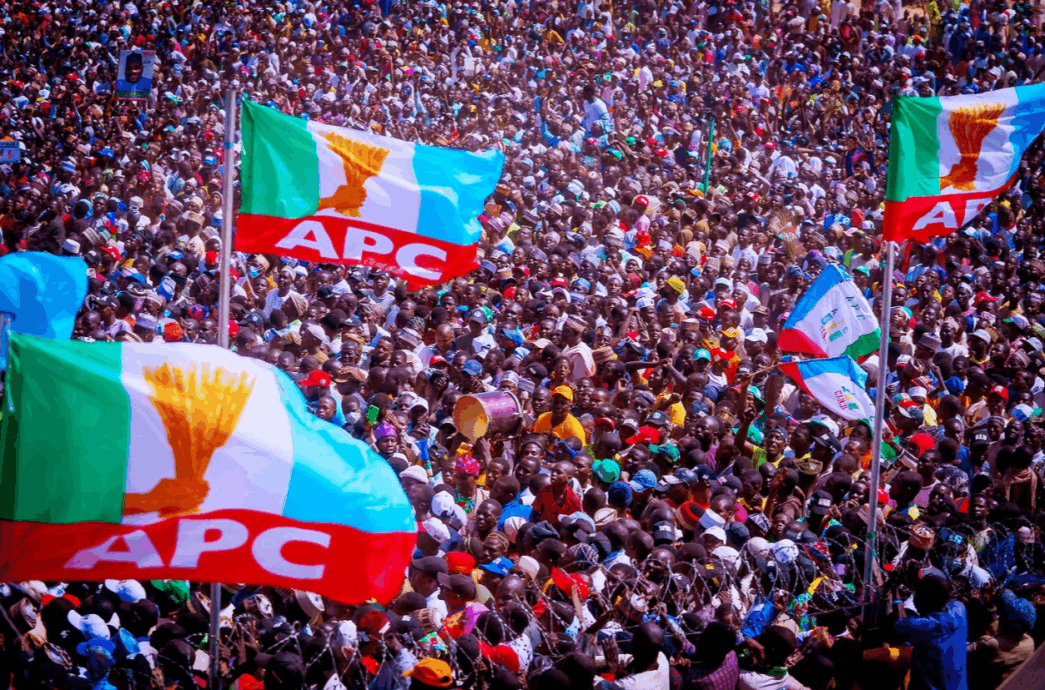
Uncertainty may be mounting within the ruling All Progressives Congress (APC) over its preferred consensus strategy for the 2027 elections, with party sources indicating that direct primaries may be adopted in states where “agreements prove difficult.”
It was gathered that the party may abandon its consensus strategy in some states as deepening rivalries and stalled negotiations threaten party cohesion.
Instead, the party is considering adopting direct primaries to ensure peace among the warring camps in the affected state chapters.
This is happening as the deadline set by the Independent National Electoral Commission for political parties to submit the list of candidates nears.
As such, barring any last-minute change of mind, the APC is set to unveil its timetable for the primary elections for aspirants seeking to contest in the 2027 National Assembly, governorship and presidential elections.
Multiple APC chieftains confirmed to The PUNCH that the National Chairman of the party, Nentawe Yilwatda, ran the timetable by President Bola Tinubu over the weekend.
Having been cleared by the President, the party is set to unveil it on Monday (today), all things being equal.
The party is racing to conclude all primary elections and submit the list of candidates to INEC before the deadline set by the commission.
While consensus candidates for governorship positions have been concluded in Lagos, Oyo and Ogun states, the party is yet to reach a solid agreement on consensus governorship candidates in other states, especially those where the governors are in their second term.
Findings show the APC is still struggling to strike a deal on its consensus governorship candidates in Nasarawa, Kwara, Adamawa, Yobe and Bauchi. There are indications that the President may step in to resolve the impasse in Nasarawa, Kwara and Adamawa States.
Although consensus governorship candidates are yet to be announced in other states like Borno and Yobe, party sources said the party is not expecting hitches in the two states.
A top APC chieftain, who is close to the development, said, “Consultations and negotiations are still ongoing on coming up with consensus governorship candidates in other states aside from Lagos, Ogun and Oyo that have been concluded.
“We are giving preference to the governors. The incumbent governors will be allowed to choose their successors. However, where there are disagreements with the governor’s candidate, as is the case in some states currently, we will go into direct primaries.”
Other party chieftains told The PUNCH that while governors defecting to the APC will be allowed to choose their successors, APC chieftains in the state would be allowed to nominate candidates for NASS positions.
It was, however, learnt that the concessions differ from state to state.
Meanwhile, The PUNCH also learnt that the APC has not given up on wooing Bauchi State Governor Bala Mohammed into its fold. It was learnt that there are plans for a 70/30 sharing formula.
Multiple party chieftains told The PUNCH that while consensus remains the preferred option, the leadership is prepared to switch to direct primaries where agreements collapse.
A senior APC source said, “Consultations and negotiations are still ongoing in many states, but the reality is that consensus cannot be forced. We are giving preference to incumbent governors to guide the choice of their successors because they understand the local dynamics. However, where there are disagreements with the governor’s preferred candidate, and stakeholders refuse to align, we will have no option but to go into direct primaries to allow a more open contest.”
Another official added, “The party cannot afford a situation where imposition leads to rebellion. If people feel excluded or short-changed, it could trigger defections or anti-party activities. So, in states where consensus is proving difficult, direct primaries may be the safer and more democratic route.”
In Bauchi, political uncertainty has intensified amid succession anxieties and rumours of defection by Governor Bala Mohammed. Although the speculation gained widespread traction, the governor dismissed it emphatically.
A Sallah visit by Oyo State Governor Seyi Makinde and former Bayelsa governor Seriake Dickson was seen as reinforcing his position, though fresh rumours have continued to circulate.
Within the APC, internal divisions persist despite the emergence of new state executives. Key figures—including Foreign Affairs Minister Yusuf Tuggar, Health Minister Ali Pate, and Senator Shehu Buba—are linked to the 2027 race. While Tuggar and Pate are “believed to be nursing governorship ambitions,” neither has made a formal declaration.
In a move observers interpret as early mobilisation, Buba recently distributed operational vehicles across party structures, a strategy “aimed at consolidating support ahead of the 2027 elections.” Meanwhile, the African Democratic Congress is gaining traction, with figures such as former Air Chief Sadique Abubakar and ex-senator Halliru Jika aligning with the party.
Despite this, the situation remains fluid. A party insider admitted, “The uncertainty around the governor’s political future has made it difficult for both the PDP and APC to plan effectively. Everyone is waiting to see where he finally stands.”
Within the APC, internal divisions among key figures—including Tuggar, Pate and Senator Buba have further complicated consensus efforts.
“It is not easy to build consensus in a situation where you have multiple strong aspirants with national influence and independent structures,” a chieftain said. “Each of them believes he has a legitimate claim to the ticket, and that naturally creates tension.”
In Gombe, however, the APC appears to be making progress toward a consensus arrangement.
Succession planning within the APC appears more structured, with Governor Muhammadu Yahaya said to be working toward a consensus candidate. A party insider disclosed that “there will be consensus among the party’s aspirants,” adding that the governor “has a clear idea of who may succeed him, despite concerns about loyalty.”
Transport Minister Saidu Ahmed Alkali is among those tipped to run. Though his aide, Umar Jibrila, said, “Honestly, I can’t confirm the decision of my boss… he should announce his next move” upon returning to the state. Other names in circulation include Umaru Kwairanga, Usman Kumo, Muhammad Magaji, and former minister Isa Pantami.
Other names in circulation include Yunusa Yakubu, a businessman said to be close to the governor, and Aminu Yuguda, the state Accountant-General, whose role in the current administration is seen as strategic.
Also in the mix is Jamilu Ishiyaku, a long-time governorship aspirant who recently returned to the APC after previously defecting. He was known to have supported Governor Yahaya during the 2023 election.
In Yobe, the debate over consensus is more delicate, with stakeholders divided over its implications.
A party source explained, “On the surface, everything looks calm, but beneath that calm, there are intense consultations, quiet rivalries and strategic alignments. People are talking, negotiating and positioning themselves.”
Supporters of consensus argue that it is necessary to preserve unity. “Consensus reduces the risk of internal fractures, minimises the cost of campaigns and allows the party to present a united front ahead of the general election,” one stakeholder said.
However, critics are wary. “The danger is that if people feel sidelined or forced out, it could backfire. Some aspirants may defect or quietly work against the party. That is the risk you take when consensus is not genuinely agreed upon,” another source warned.
Notwithstanding, political activity is intensifying ahead of Governor Mai Mala Buni’s exit in 2027, with the APC weighing consensus against direct primaries. The debate is shaped by power dynamics involving former governor Ibrahim Gaidam, whose influence remains decisive.
Buni recently reaffirmed loyalty to Gaidam, signalling what insiders describe as a “likely power structure” for succession. Analysts say any aspirant will require Gaidam’s backing to secure the party’s ticket.
Former Senate President Ahmad Lawan and Senator Ibrahim Bomai are among those speculated to be interested, though their absence at a recent APC congress has raised questions. Other contenders, including former minister Abubakar Aliyu and Senator Musa Mustapha, are seen as building quiet alliances.
Also in the mix is Baba Malam Wali, whose long administrative experience as Secretary to the State Government has earned him visibility and influence. Other figures such as Jibril Maigari and Lawan Kolo Gaidam have also been linked to the race.
While proponents argue that consensus would “reduce the risk of internal fractures” and present a united front, critics warn it could “alienate aspirants who feel sidelined,” potentially triggering defections.
The situation is also unclear in Nasarawa, where party chieftains are still consulting widely before deciding on the mode of primaries. A top stakeholder said Governor Abdullahi Sule is engaging aspirants and party leaders to build consensus.
“The truth is that nobody wants to speak prematurely on this matter. The governor is expected to meet with all the governorship aspirants and also engage other political leaders. The idea is to listen to everyone and arrive at a decision that will be acceptable to the majority,” he said.
He added, “We are optimistic that all the necessary meetings will have been concluded by the end of April. At that point, the party will be in a better position to clearly state the direction it intends to take.”
Zoning remains a contentious issue. “For the governor, zoning is not just politics; it is about honouring an existing understanding that ensures fairness and balance in the state,” the source noted.
But Sule’s announcement of Senator Aliyu Wadada as his anointed candidate has changed the dynamics in the state. Regardless, a former Inspector-General of Police and APC governorship aspirant, Mohammed Adamu, said he expects Governor Sule to fulfil his promise to adopt direct primaries in selecting the party’s governorship candidate.
Adamu stated this during a recent interview, where he emphasised that the mode of primary election would be critical in ensuring a transparent and credible process.
The ex-police chief noted, “On the primary, the governor has made a public statement that Nasarawa State will adopt direct primaries, which is okay for everybody. We want direct primaries. We will be vigilant, open our eyes and make sure the primaries are free and fair.”
He also argued against zoning, noting that governors emerged in the state on the basis of zoning.
He said, “Politics is about interests. Anything that you feel will favour you, as a politician, you go for it. In Nasarawa State, there is nothing like zoning. Zoning has never taken place. In 1999, when the state was created, the state needed a civilian governor and needed someone who had political experience, so Abdullahi Adamu was brought in under the Peoples Democratic Party.
“When Adamu completed his term, they were looking for someone within the PDP, but couldn’t find anyone and then went to the All Nigeria Peoples Party, and picked Aliyu Akwe, who was a contemporary of Abdullahi Adamu. When they brought him, they made him decamp from the ANPP to the PDP. It wasn’t because of zoning, because PDP never had zoning at that time. Tanko Al-Makura came from a different party, Congress for Progressive Change. He defeated Aliyu Akwe. None of CPC or PDP came with zoning.
“When Tanko was going, he supported the current governor, Abdullahi Sule. Now that Sule is going, Abdullahi Adamu wants the governorship to come to his side, and he has the right to agitate for it. My zone, Nasarawa South, argues that any competent person in the state should vie for the position, that there is nothing like zoning.
‘’So, whether you’re from Nasarawa West, South or North, anyone interested should come out and contest. But the governor, in his wisdom, felt that he should support somebody from Nasarawa West, and that does not stop any other person from contesting.”
The former IGP also aligned with the provisions of the Electoral Act, noting that indirect primaries had effectively been ruled out.
He said he did not expect the adoption of a consensus arrangement in the state, insisting that direct primaries remained the most credible option.
“The Electoral Act does not recognise indirect primaries. It is when you have indirect primaries that they manipulate the delegates, when a few people represent a large number of people. That has been eliminated.
“No governor will carry five people saying they represent my local government and hide them somewhere, bring them out on election day and ask them to vote for a certain aspirant. The Electoral Act allows consensus and direct. For direct primaries, you go to the electorate, and that is where I went.
“Consensus will never take place in Nasarawa State because when one out of many aspirants disagrees with the consensus, you go for direct primaries. So whoever came up with the idea of removing indirect primaries must have contested and suffered from indirect primaries.”
Alleged attempts to impose a candidate in Adamawa have triggered strong resistance and raised fears of a major crisis.
The National Security Adviser, Nuhu Ribadu, is said to have faced stiff resistance in his attempt to impose his favourite candidate on the party.
Governor Ahmadu Fintiri was said to have forcefully rejected such moves, warning of the consequences.
“Imposition of a candidate on members of a political party is worse than a military coup. It destroys the very tenets of democracy, discourages genuine participation and creates resentment that can damage the party beyond repair,” he said during a stakeholders’ meeting.
According to insiders, efforts to secure support for a “consensus arrangement” ended in stalemate.
“One of the biggest concerns is the strategy being discussed behind the scenes—asking aspirants to step down under pressure or threatening disqualification. That kind of approach may appear subtle, but it can provoke a serious backlash,” a source said.
The same situation was being experienced in Kwara, where consensus appears particularly difficult due to multiple power blocs and competing ambitions.
Investigations by The PUNCH reveal that, unlike the relatively coordinated South-West political machinery, Kwara’s APC is grappling with deep-seated factional interests, personal ambitions and ideological divides that may make consensus not only difficult, but potentially destabilising.
A chieftain of the APC in the state, Alhaji Babatunde Waheed, said it would be difficult for anyone to impose a consensus candidate on the party without protests.
“There is no single power centre that can impose consensus without resistance. Every major aspirant has a structure, and more importantly, has backers who are unwilling to step down,” he said.
At least four distinct power blocs are already jostling for control of the party’s 2027 governorship ticket, including aspirants such as Saliu Mustapha and Yahaya Seriki, who both contested against the current governor in 2019, former APC chairman in the state, Bashir Bolarinwa and opposition forces linked to Bukola Saraki, whose shadow continues to loom over the state’s political landscape.
Governor AbdulRahman AbdulRazaq has publicly distanced himself from allegations of anointing a successor.
“For those who will contest and whoever eventually emerges, it is not about anyone anointing anybody. We are not here to build a dynasty; we are here to build a legacy. Whoever succeeds me must emerge through a credible and transparent process and should be ready to improve on what we have done,” he said.
A political observer, Ranti Adesola, said, “In this kind of environment, asking people to step down for consensus is not realistic, as everyone believes he stands the better chance of emerging as the candidate.
“We are back to the same scenario in 2019, where all the gladiators didn’t step down for each other and also went to claim victory after the primaries, but the result was not announced until three days in Abuja.”
The race remains largely undeclared in Borno, though political heavyweights are believed to be positioning behind the scenes. Governor Babagana Zulum is said to have shown “a lack of interest in anointing a successor,” even as Vice President Kashim Shettima and former governor Ali Modu Sheriff are expected to influence the process.
Unlike other states, analysts say “the likelihood of a consensus candidate is slim,” citing the number of influential actors involved.
Insiders hinted that the governor’s preferred successor may be his Commissioner for Education, Lawan Wakilbe, or one of his top-performing agency heads, Bukar Bababe, Executive Secretary of the Borno Geographical Information Service.
However, the sources noted that neither figure is believed to have a close personal relationship with the Vice President, unlike potential contenders such as the senator representing Borno Central, Kaka Shehu Lawan, and the Minister of Agriculture, Abubakar Kyari, who are widely expected to join the race.
Given the current dynamics, observers say the chances of a consensus candidate emerging within the party appear slim, as, unlike in previous cycles, several influential figures now command significant local and national clout.
punch.ng
FOLLOW US ON: