Connect with us

Business

FirstHoldCo Seeks Shareholders Approval on N1 Trillion Capital Base in Bold Balance Sheet Fortification

Published

on

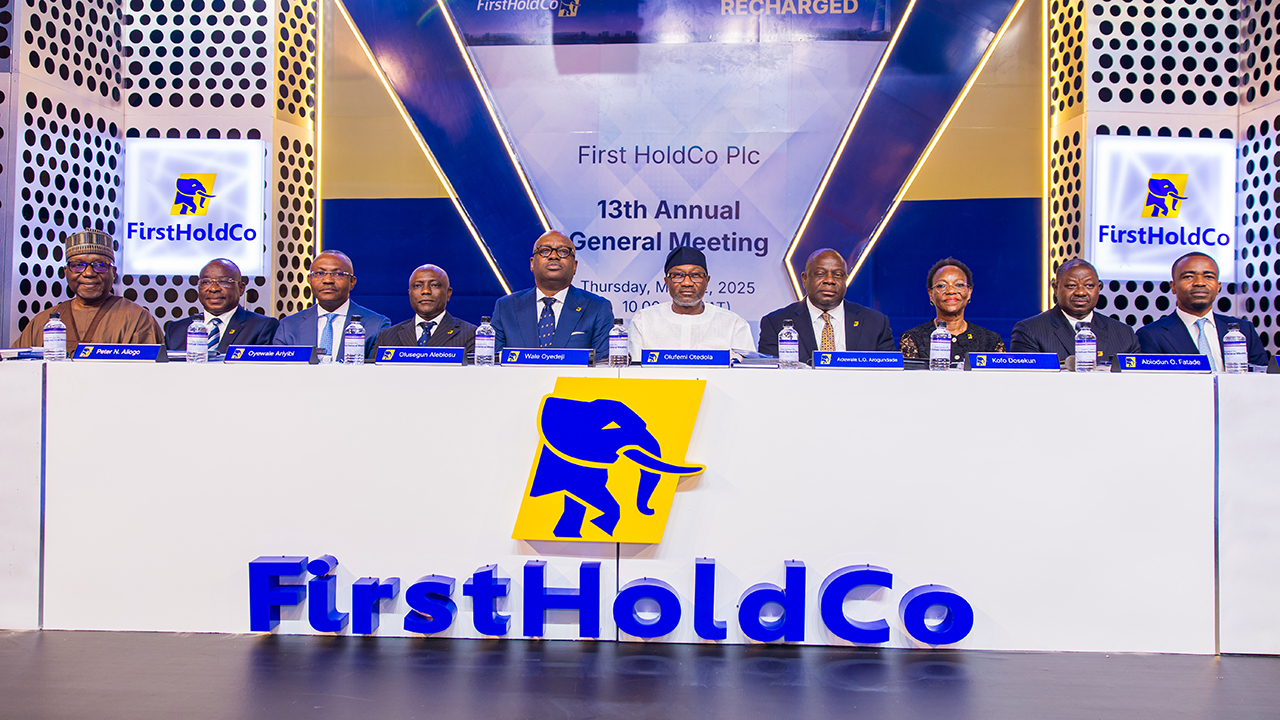
FirstHoldCo Plc, the parent entity of Nigeria’s oldest commercial lender (First Bank), is moving to double the regulatory capital ceiling for international banks, signaling a new phase of aggressive expansion and balance sheet fortification.

In a notice for its 14th Annual General Meeting (AGM) scheduled for May 29, 2026, the group proposed a special resolution to raise up to N253.099 billion in fresh capital, aiming to reach a N1 trillion paid-up capital base—comprising share capital and share premium.

“The capital raise transaction shall be implemented by one or more transactions, through the issuance of shares, by way of a public offering, private placement, rights issue, bonus issues, scrip dividend, or other equity instruments in the Nigerian or international capital markets, at price(s) to be determined by way of a book building process or any other valuation method or combination of methods, in such tranches, series or proportions and at such periods or dates, coupon or interest rates, within such maturity periods and upon such other terms and conditions as may be determined by the Board of Directors (the “Directors”), subject to obtaining the approvals of the relevant regulatory authorities,” FirstHoldCo said in the statement on the NGX.

The move comes just months after its banking subsidiary, First Bank of Nigeria, successfully met the Central Bank of Nigeria’s (CBN) current N500 billion minimum threshold for international authorization. By targeting N1 trillion, FirstHoldCo is positioning itself to lead an industry-wide “up-tiering” that Chairman Femi Otedola argues is essential for institutions operating in an economy striving for a $1 trillion GDP.

Otedola’s N1 Trillion Vision

See also  Dangote-NNPC deal hits great turbulence, see details

The proposed capital raise is more than a regulatory box-ticking exercise; it is a strategic statement of intent. Otedola has publicly called for the CBN to raise the minimum requirement for international banking licenses from N500 billion to at least N1 trillion. He argues that a modern Nigerian economy cannot rely on “weakly capitalized banks” and that stronger capital bases will drive better governance and prevent institutions from being “run like personal estates”.

FirstHoldCo has utilized a multi-pronged approach to shore up its equity, including a rights issue, private placements, and the divestment of its merchant banking subsidiary, FBNQuest. The group recently completed a N45 billion private placement in March 2026. The new N253 billion raise, once finalized, is expected to bridge the gap toward the N1 trillion target, effectively resetting the competitive benchmark for “FUGAZ” peers (Zenith, UBA, GTCO, and Access).

Profitability as a Capital Magnet

While the capital raise targets long-term stability, FirstHoldCo’s Q1 2026 performance provides the immediate fundamental justification for investor appetite. The group reported a 72% year-on-year surge in Profit Before Tax (PBT) to N321.1 billion, eclipsing the growth rates of its tier-1 rivals.

Crucially, FirstHoldCo has emerged as the industry leader in capital efficiency. Its Return on Equity (ROE) stood at 31.6% (annualised) for the quarter, the highest among the FUGAZ cohort, outperforming Zenith (24.9%) and GTCO (24.8%). This “phoenix-like” recovery follows a massive N826 billion legacy debt cleanup in late 2025, which has liberated the balance sheet to capture high-yield private sector credit opportunities.

Leadership and Governance Pivot

The strategic shift is being spearheaded by a revamped leadership team, with Wale Oyedeji serving as Group Managing Director of FirstHoldCo and Olusegun Alebiosu leading as the CEO of the flagship banking subsidiary, First Bank. Alebiosu, a former Chief Risk Officer, has focused heavily on asset recovery, clawing back N19 billion in delinquent loans in Q1 2026 alone—a 1,570% increase that has turned risk management into a significant revenue stream.

See also  Investors lose fresh N1.17tn as bearish trading resumes

Under Otedola’s chairmanship, the group has also tightened internal prudential standards and appointed new boards for non-banking subsidiaries to enhance corporate governance.

punch.ng

FOLLOW US ON:

FACEBOOK

TWITTER

PINTEREST

TIKTOK

YOUTUBE

LINKEDIN

INSTAGRAM

Continue Reading
Click to comment

Leave a Reply

Your email address will not be published. Required fields are marked *

Business

Shell, banks launch $3bn financing for oil contractors

Published

on

Shell Nigeria Exploration and Production Company Limited has partnered with nine Nigerian banks to launch a $3bn contract finance facility aimed at improving access to credit for indigenous oil and gas contractors executing projects for the company.

According to a statement, the financing scheme, unveiled on Thursday, is designed to provide credit support to local contractors handling projects for SNEPCo and will be available in both naira and United States dollars.

The participating banks are First Bank, Guaranty Trust Bank, Zenith Bank, Access Bank, United Bank for Africa, Stanbic IBTC, Standard Chartered Bank, First City Monument Bank, and Fidelity Bank.

Speaking at the signing of the Memorandum of Understanding in Lagos, the Managing Director of SNEPCo, Ronald Adams, said the initiative aligns with the objectives of the Nigerian Oil and Gas Industry Content Development Act by promoting greater in-country value retention.

“The initiative reflects the spirit of the Nigerian Oil and Gas Industry Content Development Act, which is aimed at in-country value retention. Our partner banks offer capital and discipline.

“SNEPCo brings contracts and domiciliation of payments that de-risk lending.

On their part, the contractors provide performance. Each is accountable to the others, and the mutual accountability gives the arrangement its strength,” he said.

The Vice President, Finance, Shell Nigeria, CJ Akwaeze, said the financing scheme demonstrates Shell’s commitment to supporting the growth of oil and gas operations in Nigeria.

The Chairman of the Petroleum Technology Association of Nigeria, Wole Ogunsanya, who was represented by Dr Joan Faluyi, described the facility as a major boost for indigenous contractors.

See also  Investors lose fresh N1.17tn as bearish trading resumes

Ogunsanya lauded the initiative as a “gateway to unlocking contractor financing issues, which will also drive efficiency in contract execution.”

Representatives of the participating banks also commended SNEPCo for introducing the financing arrangement, saying the partnership would strengthen local contractors, and pledged their continued support for the initiative.

SNEPCo said Nigerian companies have continued to play significant roles in its operations and project delivery. It noted that earlier this year, 43 wholly Nigerian companies participated in the turnaround maintenance exercise at the Bonga Floating Production Storage and Offloading vessel out of the 53 companies involved in the exercise.

According to the company, the Contract Finance Facility is expected to further strengthen the capacity of Nigerian companies and enhance value delivery in the operations of Nigeria’s premier deepwater producer.

punch.ng

FOLLOW US ON:
FACEBOOK

TWITTER

PINTEREST

TIKTOK

YOUTUBE

LINKEDIN

Continue Reading

Business

Nigeria faces lubricant squeeze as imports tighten globally

Published

on

Nigeria may face a lubricant supply squeeze in the coming months as tightening global base oil supplies and rising prices limit imports into West Africa, according to a report by global energy and commodity intelligence firm Argus.

The report, based on insights from Argus’ Head of Base Oil Pricing, Gabriella Twinning, said lower availability of base oils and rising global prices linked to disruptions caused by the US-Iran conflict are reducing offers into the West African market despite the announcement of a peace deal.

It noted that West Africa remains heavily dependent on imported base oils, with average annual imports standing at about 135,752 tonnes over the past five years. According to the report, the Dangote refinery expansion includes a base oil production unit, but the facility has yet to commence operations, leaving the region dependent on imports.

“Lower availability of base oils and rising global prices due to the continued disruption associated with the US-Iran war are curbing offers into the West African market despite a peace deal announcement,” Twinning stated.

On the region’s dependence on imports, Twinning said West Africa is a net importer of base oils, with average imports of around 135,752 tonnes annually over the past five years.

The report disclosed that the last major shipments arrived in March, warning that replacement cargoes are unlikely to be available from exporting countries throughout the summer. “The last large shipments arrived in March, and replenishment cargoes look unavailable from exporting nations over the summer,” she stated.

Explaining the supply constraints, Twinning said, “Bulk European Group I volumes, usually used for engine, marine and industrial oil lubricants and greases, are unavailable following PK Orlen’s five-week maintenance shutdown and restart at the end of May.

See also  JUST IN: Striking nurses suspend industrial action – Health Minister

“Bulk volumes out of the US are also limited as refiners service domestic demand and stockpile volumes for hurricane season. Crude changeovers at some Group I US refineries are also hampering output.”

The report noted that Nigerian buyers could switch to alternative grades where product formulations permit. “Nigerian buyers could purchase Group II heavy grades as alternatives to Group I where formulations allow. These are more readily available outside Asia. However, Asian sellers are prioritising higher prices from blenders in South America,” Twinning said.

She further stated that volumes from Russia had also declined as several refineries undergo repair works. According to her, higher spot prices are also discouraging purchases into the region.

“Rising spot prices to record highs in June since the start of the conflict will also make any cargo unattractive to West African buyers given the complicated payment process,” Twinning said.

Warning of the implications for the local market, she added that West African blenders would need to increase ex-tank prices and bid levels to compete with buyers in other regions.

“Demand is rising despite the rainy season, when transport and logistics typically slow. This is because no replenishment cargoes have arrived since March and tanks are running dry,” she noted.

punch.ng

FOLLOW US ON:

FACEBOOK

TWITTER

PINTEREST

TIKTOK

YOUTUBE

LINKEDIN

Continue Reading

Business

African startups raise $3.9bn as funding rebounds – Report revealed

Published

on

African startups raised $3.9bn across 506 deals in 2025, signalling a recovery in fundraising activity after earlier market challenges, according to a new report by Bloomwit Africa.

The report stated that technology funding exceeded $4bn through a combination of equity and debt financing, representing an estimated 25 per cent year-on-year increase, with venture debt emerging as a significant source of capital.

Bloomwit Africa, a foremost PR and communications firm, stated in its report that the positive trend extended into 2026, with startup funding reaching $705m in the first quarter, up 26.5 per cent year-on-year, as investment activity spread across key markets, including Egypt, South Africa, Kenya and Nigeria.

According to the report, “the improvement in funding reflects growing investor interest in Africa’s technology ecosystem despite global funding pressures that have affected venture capital markets in recent years.”

The report noted that increasing use of venture debt alongside equity financing is providing startups with additional funding options, while investment activity continues to broaden beyond a few traditional markets.

It added that the wider geographical spread of funding across leading African economies suggests a more diversified investment landscape as investors seek opportunities across the continent.

The report stated that sustained capital inflows into technology startups could support innovation, business expansion, and job creation, while strengthening Africa’s position as an emerging destination for venture investment.

punch.ng

FOLLOW US ON:

FACEBOOK

TWITTER

PINTEREST

TIKTOK

YOUTUBE

LINKEDIN

See also  Emir Sanusi begins classes as 200-level Law student in Kano, see pictures
Continue Reading

Trending