Connect with us

Business

Marketers fear scarcity as cooking gas hits N1,500/kg

Published

on

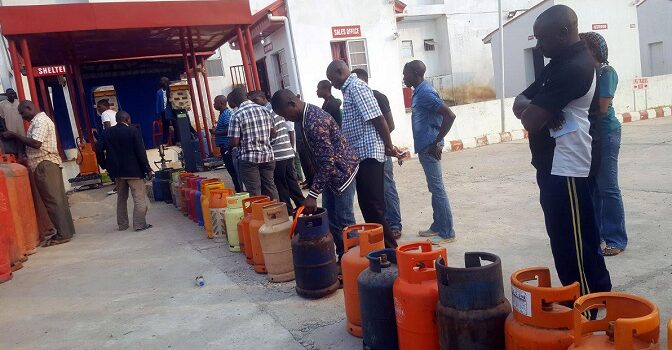
The Nigerian Association of Liquefied Petroleum Gas Marketers has raised the alarm over the erratic supply and rising cost of Liquefied Petroleum Gas, otherwise known as cooking gas, warning that the situation could trigger scarcity and worsen hardship for millions of Nigerians.

The association said cooking gas is now selling for over N1,500 per kilogramme, while marketers currently pay between N25.2m and N26.2m for 20 metric tonnes of the product, depending on location. The product is sold at between N1,600 and N2,000 by many other dealers.

Checks by our correspondent on Sunday confirmed that the essential commodity jumped from less than N1,000/kg recently to around N1,500 or more, depending on the location.

In a statement jointly signed by the National President of NALPGAM, Edu Inyang, and the Executive Secretary, Mr Bassey Essien, the association described the development as “sad and rather very pathetic”.

“The citizens of Nigeria have woken up to buy cooking gas, which should be a social item, at a prohibitive cost of over N1,500 per kg, while the marketers are made to pay as much as N25,200,000 or, depending on the location, N26,200,000 for 20 metric tonnes of cooking gas.

“We feel that if the situation is not immediately checked, the citizens may rise against the owners of gas filling stations,” the marketers expressed fears.

They said the development had brought untold hardship to millions of Nigerian households, small businesses, food vendors, and low-income families who rely on LPG for daily cooking and livelihood.

See also  CBN reduces interest rate to 27%

According to the association, the situation is “seriously eroding the substantial progress made by the government” on the usage of clean energy in the country. The group maintained that its members across the country were facing difficulties sourcing LPG due to “persistent supply shortages, high depot prices, logistics bottlenecks and uncontrollable rising operational costs”.

“We observe that where product is available, it is sold at rates far beyond the reach of average Nigerians,” the association stated.

NALPGAM warned that the crisis was undermining years of progress achieved through Federal Government policies and investments aimed at deepening LPG penetration and promoting clean cooking energy.

“While millions of Nigerians have embraced cooking gas as a result of the national clean energy transition agenda, it is sad to state that those gains are at risk as households are struggling to refill cylinders, small businesses are folding under rising energy costs, while many families are reverting to firewood and charcoal despite the serious implications for public health, environmental degradation, and deforestation,” it said.

The association further warned that failure to urgently address the crisis could lead to “accelerated food inflation, the collapse of small-scale LPG retail businesses, job losses, reduced investor confidence, and a significant setback to Nigeria’s clean energy and climate commitments”.

NALPGAM called on the Federal Government, the Ministry of Petroleum Resources, the Nigerian Midstream and Downstream Petroleum Regulatory Authority, the Nigerian National Petroleum Company Limited, domestic producers, terminal operators, international suppliers, and other stakeholders to take urgent and coordinated steps to stabilise the market before it degenerates further.

See also  Petrol remains pricey as crude crashes to $73

The association recommended immediate measures to improve the availability and accessibility of LPG nationwide. It also called for increased domestic LPG allocation to the Nigerian market, transparent distribution of available supply, reduction of bottlenecks in importation and distribution, and interventions to stabilise retail prices.

It requested investment in storage and distribution infrastructure as well as policies that support affordability and sustainability in the sector. “We cannot stand by and watch millions of Nigerian families suffer in silence while access to clean cooking energy becomes increasingly difficult and unaffordable.

“For years, the government and industry operators have worked to move Nigerians away from unsafe fuels. Those gains are now under serious threat. “Households cannot refill cylinders, small businesses are struggling to survive, and vulnerable households are returning to firewood and charcoal with dire health and environmental consequences.

“We therefore make a passionate and patriotic appeal to the Federal Government for urgent intervention to stabilise supply and pricing. NALPGAM is ready to collaborate to have lasting solutions, but decisive action is needed now,” the statement said.

punch.ng

FOLLOW US ON:

FACEBOOK

TWITTER

PINTEREST

TIKTOK

YOUTUBE

LINKEDIN

INSTAGRAM

Continue Reading
Click to comment

Leave a Reply

Your email address will not be published. Required fields are marked *

Business

Dangote beats US, ships N757bn jet fuel to Europe – Report reveals

Published

on

Dangote Petroleum Refinery exported about 466,000 metric tonnes of jet fuel to Europe in June, valued at an estimated N757bn, overtaking shipments from the United States and others.

This is as Nigerian jet fuel exports to the continent reached their highest level since the country became a net exporter of aviation fuel in 2024.

According to a market report by S&P Global Commodity Insights, the refinery’s exports came as the European jet fuel market turned increasingly bearish following a sharp decline in prices from the highs recorded during the Middle East conflict.

The report stated that flows of jet fuel from Nigeria to Europe rose from 232,000 metric tonnes in May to 466,000 metric tonnes in June, the highest volume exported from the country to Europe since Nigeria became a net exporter of jet fuel in 2024, when the Dangote Refinery commenced aviation fuel production.

The June export volume is equivalent to about 582.5 million litres of jet fuel. At an estimated domestic value of N1,300 per litre, the shipment is worth about N757.25bn.

On the other hand, aviation fuel exports from the United States fell sharply in the past months. The report showed that jet fuel exports from the United States to Europe declined steadily over the same period, falling from a record 818,000 metric tonnes in April to 560,000 metric tonnes in May and further to 399,000 metric tonnes in June, leaving Nigeria as a bigger supplier to Europe during the month.

Commenting on the market, a trader attributed the oversupply partly to increased shipments from Dangote and the United States. “Jet is oversupplied because of high local refinery production; refineries pushed back maintenance to make the most of the high prices.

See also  Petrol remains pricey as crude crashes to $73

“The US and Dangote also shipped large volumes. Now there are some flows resuming through the Suez, too, from the UAE, but let’s see how it goes,” the trader was quoted as saying.

The report noted that the European jet fuel forward curve had weakened significantly after reaching record highs during the Middle East war, as traders now anticipate an oversupplied summer market amid weaker-than-expected aviation demand.

According to Platts, part of S&P Global Commodity Insights, the Northwest Europe jet CIF cargo financial assessment for July dropped to $981.75 per metric tonne on June 30, down sharply from the all-time high of $1,694.25 per metric tonne recorded on March 30.

Similarly, the August contract declined from $1,507.50 per metric tonne on March 30 to $968.25 per metric tonne by June 30.

The report added that Europe could receive even more jet fuel supplies in the coming months as the East-West arbitrage remains attractive, encouraging exporters in the Middle East and India to ship cargoes westward.

While flows from the United Arab Emirates and Kuwait were absent in June, shipments from Saudi Arabia increased to about 106,000 metric tonnes, up from 7,000 metric tonnes in May, while exports from India rose from 129,000 metric tonnes to 197,000 metric tonnes over the same period.

Despite the current oversupply, two European jet fuel traders reportedly told Platts that market conditions would depend largely on developments in the Strait of Hormuz and the pace at which Middle Eastern refineries recover from disruptions caused by the recent conflict.

See also  Marketers raise petrol prices amid drop in crude cost

They also noted that stronger summer travel demand and refiners’ growing preference to maximise diesel production over jet fuel could gradually help rebalance the aviation fuel market.

Data from the Nigerian Midstream and Downstream Petroleum Regulatory Authority showed that the Dangote refinery exported an estimated 1.66 billion litres of refined petroleum products in April 2026.

This was during the mounting tensions in the Middle East that caused disruption to global fuel supply routes.

An analysis of the NMDPRA’s April 2026 fact sheet showed that the country exported about 513 million litres of premium motor spirit, popularly called ‘petrol’; 534 million litres of automotive gas oil, also known as diesel; and 615 million litres of aviation fuel within the month in April.

The Dangote refinery is the only major functional refinery in Nigeria that currently produces enough refined petroleum products for both local consumption and export.

Nigeria has become a net petrol exporter for the first time in decades due to rising output from the Dangote refinery. The refinery had earlier exported about 434 million litres of petrol in March after domestic production exceeded local consumption levels.

The latest figures underscore Nigeria’s gradual transition from a major importer of refined petroleum products to an export hub within Africa. It was observed that jet fuel exports may rise further with the instability caused by the Middle East crisis, which disrupted traditional supply chains serving Europe and other regions.

punch.ng

FOLLOW US ON:

FACEBOOK

TWITTER

PINTEREST

TIKTOK

YOUTUBE

LINKEDIN

Continue Reading

Business

Shell, banks launch $3bn financing for oil contractors

Published

on

Shell Nigeria Exploration and Production Company Limited has partnered with nine Nigerian banks to launch a $3bn contract finance facility aimed at improving access to credit for indigenous oil and gas contractors executing projects for the company.

According to a statement, the financing scheme, unveiled on Thursday, is designed to provide credit support to local contractors handling projects for SNEPCo and will be available in both naira and United States dollars.

The participating banks are First Bank, Guaranty Trust Bank, Zenith Bank, Access Bank, United Bank for Africa, Stanbic IBTC, Standard Chartered Bank, First City Monument Bank, and Fidelity Bank.

Speaking at the signing of the Memorandum of Understanding in Lagos, the Managing Director of SNEPCo, Ronald Adams, said the initiative aligns with the objectives of the Nigerian Oil and Gas Industry Content Development Act by promoting greater in-country value retention.

“The initiative reflects the spirit of the Nigerian Oil and Gas Industry Content Development Act, which is aimed at in-country value retention. Our partner banks offer capital and discipline.

“SNEPCo brings contracts and domiciliation of payments that de-risk lending.

On their part, the contractors provide performance. Each is accountable to the others, and the mutual accountability gives the arrangement its strength,” he said.

The Vice President, Finance, Shell Nigeria, CJ Akwaeze, said the financing scheme demonstrates Shell’s commitment to supporting the growth of oil and gas operations in Nigeria.

The Chairman of the Petroleum Technology Association of Nigeria, Wole Ogunsanya, who was represented by Dr Joan Faluyi, described the facility as a major boost for indigenous contractors.

See also  Over 4,600 tricycles, 100,000 vehicles run on CNG in Nigeria – Official

Ogunsanya lauded the initiative as a “gateway to unlocking contractor financing issues, which will also drive efficiency in contract execution.”

Representatives of the participating banks also commended SNEPCo for introducing the financing arrangement, saying the partnership would strengthen local contractors, and pledged their continued support for the initiative.

SNEPCo said Nigerian companies have continued to play significant roles in its operations and project delivery. It noted that earlier this year, 43 wholly Nigerian companies participated in the turnaround maintenance exercise at the Bonga Floating Production Storage and Offloading vessel out of the 53 companies involved in the exercise.

According to the company, the Contract Finance Facility is expected to further strengthen the capacity of Nigerian companies and enhance value delivery in the operations of Nigeria’s premier deepwater producer.

punch.ng

FOLLOW US ON:

FACEBOOK

TWITTER

PINTEREST

TIKTOK

YOUTUBE

LINKEDIN

Continue Reading

Business

Nigeria faces lubricant squeeze as imports tighten globally

Published

on

Nigeria may face a lubricant supply squeeze in the coming months as tightening global base oil supplies and rising prices limit imports into West Africa, according to a report by global energy and commodity intelligence firm Argus.

The report, based on insights from Argus’ Head of Base Oil Pricing, Gabriella Twinning, said lower availability of base oils and rising global prices linked to disruptions caused by the US-Iran conflict are reducing offers into the West African market despite the announcement of a peace deal.

It noted that West Africa remains heavily dependent on imported base oils, with average annual imports standing at about 135,752 tonnes over the past five years. According to the report, the Dangote refinery expansion includes a base oil production unit, but the facility has yet to commence operations, leaving the region dependent on imports.

“Lower availability of base oils and rising global prices due to the continued disruption associated with the US-Iran war are curbing offers into the West African market despite a peace deal announcement,” Twinning stated.

On the region’s dependence on imports, Twinning said West Africa is a net importer of base oils, with average imports of around 135,752 tonnes annually over the past five years.

The report disclosed that the last major shipments arrived in March, warning that replacement cargoes are unlikely to be available from exporting countries throughout the summer. “The last large shipments arrived in March, and replenishment cargoes look unavailable from exporting nations over the summer,” she stated.

Explaining the supply constraints, Twinning said, “Bulk European Group I volumes, usually used for engine, marine and industrial oil lubricants and greases, are unavailable following PK Orlen’s five-week maintenance shutdown and restart at the end of May.

See also  CBN reduces interest rate to 27%

“Bulk volumes out of the US are also limited as refiners service domestic demand and stockpile volumes for hurricane season. Crude changeovers at some Group I US refineries are also hampering output.”

The report noted that Nigerian buyers could switch to alternative grades where product formulations permit. “Nigerian buyers could purchase Group II heavy grades as alternatives to Group I where formulations allow. These are more readily available outside Asia. However, Asian sellers are prioritising higher prices from blenders in South America,” Twinning said.

She further stated that volumes from Russia had also declined as several refineries undergo repair works. According to her, higher spot prices are also discouraging purchases into the region.

“Rising spot prices to record highs in June since the start of the conflict will also make any cargo unattractive to West African buyers given the complicated payment process,” Twinning said.

Warning of the implications for the local market, she added that West African blenders would need to increase ex-tank prices and bid levels to compete with buyers in other regions.

“Demand is rising despite the rainy season, when transport and logistics typically slow. This is because no replenishment cargoes have arrived since March and tanks are running dry,” she noted.

punch.ng

FOLLOW US ON:

FACEBOOK

TWITTER

PINTEREST

TIKTOK

YOUTUBE

LINKEDIN

Continue Reading

Trending