Connect with us

Business

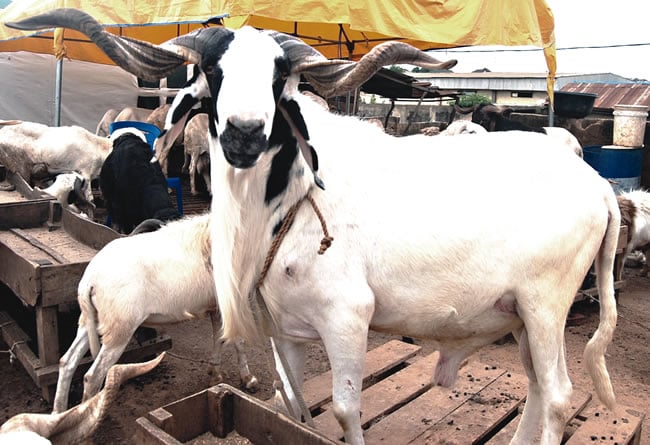
Muslims groan as price of ram hits roof ahead of the Eid-el-Adha celebration

Published

on

Ahead of the Eid-el-Adha celebration, prices of rams and cows have risen sharply across markets in the country.

Chairman of the Lagos State Butchers’ Association, Alhaji Ismail Babalola Afisuru, said the price of a medium-sized ram now ranges between N400,000 and N800,000, while bigger sizes sell for as much as N2.5 million.

Many Nigerians expressed fears that worsening economic hardship may prevent them from observing the traditional sacrifice of rams and cows during the festive period.

A number of factors have been blamed for the high cost of the sacrificial animal, which is an integral part of the spiritual celebration.

In several states north and south, potential ram buyers are stunned by the huge cost of the animal necessary for the festival that is coming up on Wednesday worldwide.

Our correspondents across the country report their findings from markets in various states of the federation:

Lagos State

According to Alhaji Afisuru, cows currently cost between N2 million and N4.5 million, depending on size.

“As we approach the Ileya festival, the prices of rams and cows are becoming unbearable. Many Muslims can no longer afford them,” he said.

“The minimum price for a small ram is not less than N400,000, while medium and large sizes sell for between N800,000 and N2.5 million. Cows are also sold between N2 million and N4.5 million,” he added.

Afisuru attributed the rising cost of cows to low supply, alleging that livestock dealers from the northern parts of the country are focusing more on supplying rams because of increased demand during the festive period.

“This is a seasonal business. The dealers from the North want to maximise profit by supplying more rams while reducing the supply of cows. This has largely contributed to the high cost of cows,” he said.

He appealed to the government to address insecurity in parts of Northern Nigeria to ease transportation and livestock supply.

“We are appealing to the government to ensure peace in troubled areas in the North so that traders can travel safely and purchase livestock without difficulties,” he added.

Abuja

At the popular Kugbo Ram Market in Abuja visited by Saturday Tribune, the price of big rams ranges between N450,000 to N1.2 million and the smaller ones between N300,000 and N150,000.

Some intending buyers who spoke to Saturday Tribune complained bitterly about the price of the rams which they said is above their reach.

Umar Lukman told our correspondent that he would either settle for a goat or share the price of the ram with another customer who would be willing to.

He said he came to the market with a budget to buy a N200,000 ram.

“The prices of the rams are not affordable for me this year and maybe I’ll have to settle for a goat or if I see anyone that we can pool resources together to get a ram of about N400,000. We understand the situation of things in the country but I never knew I would get a befitting ram at around N200,000 because that is what I brought here. May we celebrate many more of Eid el Kabir and may Almighty Allah spare our lives to celebrate many more,” Lukman said.

See also  Dangote refinery, engineers on warpath over fresh redeployment

A ram seller, Abdullahi Abdurahaman, while giving reasons for the rise in the price of the rams, said they had to take into consideration the money used in transporting the rams to the market and the feeds for the livestock. He stated that the fuel price hike also contributes greatly to the price of the rams compared to last year.

How much did we sell last year if you remember? Then petrol price was around N700 and N750 but today it is sold between N1,350 and N1,400, so what do you expect? We are not happy either, because it has affected our sales. People are complaining and there is little we could do. Remember, we also have to factor the price of the feeds into what we are selling,” he stated.

Kano State

Livestock traders disclosed that the price of a small ram now ranges from ₦250,000 to ₦450,000, while cows are being sold for between ₦850,000 and ₦1.5 million, depending on their size and breed.

Findings from an investigation conducted across Tarauni and parts of Kano metropolis showed a sharp increase in the prices of livestock compared to previous years, placing the animals beyond the reach of many low and middle-income earners.

Residents interviewed blamed the situation on inflation, rising food prices, and the removal of fuel subsidy, which they said has worsened the economic condition of ordinary citizens.

Alhaji Murtala Ahmed, resident of Hotoro, lamented that his family, which usually buys at least one ram every Sallah, may not be able to afford one this year.

“We used to buy at least one ram every year for Sallah, but this time the prices are beyond our reach,” he said.

Another resident, Alhaji Yahya Muhammad, in Kano city, described the development as painful, noting that the rising cost of transportation and basic commodities has affected both buyers and sellers.

Several civil servants also complained that their monthly salaries can no longer meet basic family needs, making it difficult to purchase sacrificial animals for the celebration.

Livestock dealers, however, defended the increase in prices, attributing it to high transportation costs, insecurity along cattle routes, and the increasing cost of animal feed.

Oyo State

Ram sellers at UMC, Oke-Ado in Ibadan, expressed concern over low patronage.

Saturday Tribune observed at the market that buyers were not turning up in expected large numbers despite the availability of rams.

Findings revealed that ram prices currently range between N300,000 and N600,000, depending on the size and breed.

At the Railway Line at Iyaganku, and Liberty Stadium Road, traders complained that interested buyers were left helpless when they find that rams are costlier than their budget.

They cited high cost of transportation occasioned by energy costs.

Sellers explained that transporters charge between N10,000 and N15,000 for each ram brought into Ibadan from northern Nigeria.

Ram traders, Ishola Ganiyu and Olawale Roheem, blamed the poor sales on the general economic hardship in the country.

See also  Cash rush: ATM withdrawals jump 198% to N36tn

Sokoto

Both ram sellers and buyers in Sokoto lamented low patronage and the high cost of livestock in the market.

At the popular Kara Market in Sokoto on Friday, Saturday Tribune found that an average ram which sold for less than N150,000 last year now costs about N250,000 in the market.

Alhaji Imran Shehu, a ram seller in the market, described the current prices as unavoidable.

According to him, “The high cost of rams is due to many factors, including insecurity and the high cost of animal feed, among others. Most of the people who sell rams to us have been displaced by insurgency. The few who are still in the business are barely operating because of fear. This is apart from the high cost of feeds.”

Mallam Ismail Haruna, a buyer who also spoke with our correspondent, said the high cost of rams had forced many families to rethink plans to slaughter rams this year.

Kwara

Ram sellers in parts of Kwara State blamed insecurity in the country and the high cost of transportation, occasioned by increased fuel prices, for the exorbitant cost of rams.

Saturday Tribune gathered that the prices of sizeable rams start from between N170,000 and N250,000 in some popular markets such as Mandate, Zango, Fate and Asa Dam areas of Ilorin, while bigger ones sell for between N500,000 and N1 million.

The ram sellers expressed worry over low patronage ahead of the Eid-el-Kabir celebrations, attributing it to the prevailing economic situation in the country.

The Vice Chairman of the Ram Sellers Association, Agric Branch, Ilorin, Ibrahim Wasiu, blamed the low patronage to the low purchasing power of customers, saying the increase in the pump price of petroleum products, insecurity and delays in salary payments had negatively affected sales.

Also speaking, Abdulmalik Olawale said in addition to insecurity, bad roads had prevented livestock farmers from visiting the rural markets.

He appealed to the government to provide security in rural communities to prevent livestock farmers from relocating to other countries.

Ondo State

Checks at ram markets at Ilesha Garage and Agape Junction at Road Block in Akure showed that small-sized goats now sell for between ₦120,000 and ₦250,000, while medium-sized rams cost between ₦300,000 and ₦700,000 depending on breed and size.

Large and well-bred rams, which are usually preferred by wealthy families and groups, were found selling for as high as ₦800,000 to about ₦1 million.

Some of the dealers attributed the increase in prices of the rams to the high cost of transportation, insecurity along major supply routes from the northern part of the country, and the rising cost of animal feed and general inflation affecting the economy.

One of the ram sellers at the Agape junction, identified simply as Ibrahim, said traders were also struggling with low patronage as many families could no longer afford the prices unlike the previous years.

He noted that despite the rising prices, Muslim faithful have continued to troop to markets in search of affordable for rams.

See also  Schools, markets open as IPOB ends Monday sit-at-home

One of the faithful seen at the ram market, Alhaji Adams, expressed optimism that the prices of the rams will still fall some days before Salah.

Plateau State

The high cost of rams has forced many people to abandon the idea of buying rams this year for the celebration.

Saturday Tribune findings in Jos, Plateau State, revealed that a medium-sized ram, which sold for N250,000 last year, now costs about N350,000, while the prices of bigger sizes range between N500,000 and N1 million.

A ram merchant, Abdullahi Sule, revealed that many people are reluctant to buy rams this year due to the high prices and the country’s economic challenges.

According to him, there is a possibility that some rams may be returned to the farms or that prices may drop a few days before the festival.

He said many middle-aged civil servants have abandoned plans to buy rams and are turning to other alternatives for the celebration.

Ebonyi State

Livestock dealers across major cattle markets in Ebonyi State raised concerns over poor patronage and skyrocketing prices of rams, goats and cows, warning that many Muslim faithful may be unable to perform the traditional Sallah sacrifice this year due to economic hardship.

They said the sharp rise in the prices of rams, goats and cows is due to high cost of transportation and the exit of Fulani herders from Nigeria for the situation.

Chairman of the Goat Market in Abakaliki, Mallam Ahmadu Sariki, described this year’s patronage as “very dull,” noting that many Muslim families can no longer afford livestock for the Eid-el-Kabir celebration.

“Before now, patronage used to be encouraging, but this year it is very poor. Last year, patronage was about 80 per cent, but this year it is just 20 per cent,” he stated.

He explained that the prices of rams now range from N350,000 upward, compared to between N290,000 and N350,000 recorded last year.

“The family that used to buy three rams before can hardly afford one now. We are calling on the government to pay salaries promptly and assist Nigerians so they can celebrate Sallah comfortably,” he appealed.

Also speaking, the Chairman of the Cattle Market in Abakaliki, Alhaji Ali Gambo, said the high cost of cows and transportation had significantly affected sales.

“Sallah celebration is incomplete without rams or goats here in Ebonyi State. But because there are not many wealthy Muslims in the state, people now prefer smaller animals.”

He disclosed that a big cow which previously sold for about N900,000 now goes for between N1.5 million and N1.7 million and attributed the increase to the migration of Fulani cattle dealers out of Nigeria to neighbouring countries such as Chad and Cameroon.

“The Fulani herders have left Nigeria and are staying outside the country. This has contributed to the scarcity and increase in prices,” he said.

tribuneonlineng.com

FOLLOW US ON:

FACEBOOK

TWITTER

PINTEREST

TIKTOK

YOUTUBE

LINKEDIN

INSTAGRAM

Continue Reading
Click to comment

Leave a Reply

Your email address will not be published. Required fields are marked *

Business

Domestic gas sales rise 30% on reforms – Report

Published

on

Nigeria’s domestic gas market recorded a significant increase in sales, rising by about 30 per cent between January 2022 and January 2025, driven by reforms under the Petroleum Industry Act 2021 and recent executive orders by President Bola Tinubu, according to a legal analysis by Tope Adebayo LP.

The Lagos-based full-service law firm said in a statement made available to our correspondent that the reforms have improved regulatory clarity, fiscal attractiveness and investor confidence across the gas value chain, even as infrastructure gaps and implementation challenges continue to slow the pace of growth.

It stated that Nigeria, which holds more than 206 trillion cubic feet of proven gas reserves, has long struggled to convert its resource base into domestic energy supply due to underinvestment, weak infrastructure and gas flaring.

According to data cited in the report, domestic gas sales rose from 49.3bscf in January 2022 to 64.2bscf in January 2025, reflecting the gains attributed to ongoing reforms under the PIA.

The report noted that the legislation marked a turning point for the sector.

“The PIA represents the most comprehensive reform of Nigeria’s petroleum sector in decades and has established a stronger foundation for domestic gas development through regulatory clarity, pricing liberalisation mechanisms, infrastructure support and enhanced investment incentives,” the firm stated in a report titled ‘From Policy to Practice: Legal and Regulatory Drivers of Nigeria’s Domestic Gas Market Under the PIA and Recent Executive Orders’.

It explained that structural reforms under the Act, including the creation of separate regulatory authorities for upstream and midstream/downstream operations, have helped to improve oversight and reduce regulatory bottlenecks.

See also  N1.8tn debt: Reps signal imminent contractor payments

The analysis also highlighted the Domestic Gas Delivery Obligation framework as a key intervention aimed at boosting supply to strategic sectors such as power generation and industry. The framework includes enforceable penalties for non-compliance.

It further noted improvements in gas utilisation and supply performance, alongside modest reductions in gas flaring and the expansion of the Nigerian Gas Flare Commercialisation Programme, which it said has seen multiple flare sites auctioned for monetisation projects.

Beyond production measures, the PIA, it stated, introduced open-access provisions for infrastructure, partial liberalisation of gas pricing and the establishment of the Midstream and Downstream Gas Infrastructure Fund to support investments in processing, transportation and distribution.

The law firm maintained that recent executive orders and presidential directives have also strengthened the investment climate through tax incentives, faster contracting timelines and more flexible local content implementation.

“These interventions signal a deliberate effort by the government to improve project economics and enhance Nigeria’s competitiveness as a destination for gas investments,” Tope Adebayo LP noted.

However, the firm warned that policy gains alone are insufficient to deliver the market’s full potential.

“Large-scale outcomes remain constrained by persistent infrastructure gaps, payment risks within the power sector, legacy debts, and implementation inefficiencies. The transition from policy to practice is clearly underway, but it remains incomplete,” it stated.

According to the analysis, achieving a fully functional and scalable domestic gas market will require sustained investment in pipelines, processing facilities, transportation networks and distribution systems, alongside stronger institutional coordination and consistent regulatory execution.

The report stated that the foundations had been laid, but long-term success would depend on effective implementation and continued market reforms. It added that, to unlock the full promise of the Decade of Gas initiative, Nigeria must bridge the gap between legal design and operational reality.

See also  NNPC boosts Dangote refinery crude supply to seven cargoes – Sources

punch.ng

FOLLOW US ON:

FACEBOOK

TWITTER

PINTEREST

TIKTOK

YOUTUBE

LINKEDIN

INSTAGRAM

Continue Reading

Business

Nigerians, others buy $3.1bn airtime on credit

Published

on

Mobile phone subscribers in Nigeria and other emerging markets borrowed airtime worth $3.18bn on credit in 2025, with Africa accounting for more than 94 per cent of the total, according to the latest financial statements of fintech firm Optasia.

The company’s 2025 consolidated financial statements showed that airtime advances granted through telecom operators rose to $3.18bn last year from $2.83bn in 2024, reflecting a 12.3 per cent increase.

Optasia stated, “Airtime credit services represent service fees charged on airtime credit amounting to $3,176.34m (2024: $2,829.2m) granted to subscribers of the telecom operators during the year.”

Using the exchange rates disclosed in the financial statements, the airtime advances amounted to about N4.61tn in 2025 in naira terms, up from approximately N4.38tn in 2024.

Despite the growth in dollar terms, the naira value rose by a slower pace as the exchange rate strengthened to N1,450.58/$ at the end of 2025 from N1,547.30/$ a year earlier.

The report showed that Africa remained the dominant market for the service, accounting for $2.99bn, or 94.2 per cent, of all airtime credit disbursed in 2025. This was up from $2.53bn recorded in 2024. Europe and Asia accounted for $96.1m, while the Middle East contributed $87.7m.

The figures highlight the growing dependence of millions of mobile users across Africa on small-value digital credit products, particularly in economies where access to formal financial services remains limited, and household purchasing power is under pressure.

Optasia, which provides airtime advances and nano-loan services through partnerships with mobile network operators and financial institutions, said its technology platform assesses subscribers’ behaviour and determines their eligibility for credit.

According to the company, the platform handles “scoring, financial decisioning and disbursements” by analysing subscribers’ credit history and other relevant data before determining the amount of advance that can be granted.

The report explained that the company also assumes part of the credit risk associated with the service. “As part of the airtime credit service, the Group also commits to indemnify the MNO for the amount of advance so granted, in case the subscriber fails to pay the same within a specified period of time from the date of grant of advance,” it stated.

Beyond airtime lending, the company recorded a sharp increase in nano-loan transactions during the year. Its Mobile Financial Services segment facilitated nano-loans worth $2.30bn in 2025, more than double the $967.9m recorded in the previous year.

Africa accounted for $1.41bn, representing 61.4 per cent of the total, while Europe and Asia contributed $888.9m. The company said the loans were provided through arrangements involving telecom operators and financial institutions, with its proprietary platform supporting credit scoring, approvals, disbursements and collections.

The growth in airtime lending and nano-loan transactions boosted the firm’s earnings during the year. Revenue rose by 75.5 per cent to $265.36m in 2025 from $151.19m in 2024. Mobile Financial Services contributed $167.53m to revenue, while airtime credit services generated $96.86m.

See also  Cash rush: ATM withdrawals jump 198% to N36tn

Africa remained the company’s biggest revenue source, contributing $234.81m, or 88.5 per cent of total revenue, compared with $121.31m in the previous year. Europe and Asia generated $25.43m, while the Middle East accounted for $5.12m.

Profit after tax increased to $43.13m from $36.23m in 2024, while total assets more than doubled to $302.17m from $141.79m.

The company described itself as “an analytics technology services provider in the fintech sector offering its services to large mobile telecom operators to provide airtime/data credit, micro- and nano-cash loans to underbanked populations in the emerging markets.”

According to the financial statements, Optasia operates across more than 25 countries, including Nigeria, South Africa, Ghana, Tunisia, Algeria, Zambia, Uganda, Rwanda, Ethiopia, Egypt, Benin, Côte d’Ivoire, Liberia, Lesotho, Mozambique, Pakistan, Bangladesh, Myanmar, Indonesia, Malaysia, Qatar, Brazil, Greece, Cyprus and the United Arab Emirates.

However, the report showed that Africa remained the dominant market for the firm, with operations in 16 African countries, including Nigeria, South Africa, Ghana, Egypt, Ethiopia, Algeria and Zambia.

The financial statements also showed that Optasia has a direct operating presence in Nigeria through two wholly owned subsidiaries, Nairtime Nigeria Limited and Xtra MFS Nigeria Limited.

Both entities are listed as Nigerian subsidiaries, with Optasia holding a 100 per cent beneficial ownership stake in each company. Nairtime Nigeria Limited was incorporated in 2012, while Xtra MFS Nigeria Limited was incorporated in 2019.

Although the company did not disclose separate revenue or profit for its Nigerian operations, the report suggests that Nigeria remains one of its more significant African markets. The report showed that Nigeria was material to Optasia’s foreign exchange exposure, with the Nigerian naira listed among the currencies that expose the group to currency risk.

Under its financial risk management note, the company stated that it was exposed to currency risk on revenues, expenses and intercompany transactions denominated in currencies outside its functional currency.

It listed the Nigerian naira alongside the euro, Congolese franc, Tanzanian shilling, South African rand, Zambian kwacha and Ghanaian cedi. As of December 31, 2025, Optasia reported total naira-denominated assets of N19.72bn and naira-denominated liabilities of N357.09m, leaving a net naira exposure of N19.37bn.

This was lower than the N25.03bn net naira exposure recorded in 2024, when naira-denominated assets stood at N25.11bn and liabilities at N81.01m. The decline means the group’s net naira exposure fell by N5.66bn, or 22.6 per cent, year-on-year.

However, the remaining N19.37bn exposure still makes Nigeria one of the company’s major currency-risk markets, meaning movements in the naira can affect the value of its earnings, assets and liabilities when translated into dollars.

Optasia also disclosed that a five per cent movement in the dollar against the naira would have affected equity by $668,000 in 2025, compared with $809,000 in 2024. This means the company’s sensitivity to naira movement reduced during the year, in line with the fall in its net naira exposure.

At the end of 2025, Nigeria accounted for $7.73m in gross trade receivables, more than double the $3.80m recorded a year earlier. The increase of 103.6 per cent was one of the strongest among the group’s disclosed markets, indicating a substantial rise in transaction activity and outstanding balances linked to Nigerian operations.

See also  Bank recapitalisation: Local investors provide 72% of N4.6tn

The report also highlighted the company’s exposure to Nigeria’s financial system through naira-denominated credit facilities obtained from local banks. According to the financial statements, Optasia maintained an invoice discounting facility and a cash-backed term loan facility in Nigeria, both denominated in naira and carrying interest rates of 30 per cent per annum.

While the facilities were not utilised as of December 31, 2025, they demonstrate the company’s access to local currency funding to support its operations in the country. Nigeria also featured prominently in the company’s discussion of its investment in Quickcheck Holding Limited, a digital lending business in which Optasia holds a 10.05 per cent stake.

The report noted that Quickcheck is “primarily exposed to operations in Nigeria”, making developments in the Nigerian economy important to the investment’s performance.

In its assessment of the investment, the company pointed to policy measures introduced by the Central Bank of Nigeria and broader economic reforms as factors supporting a more stable operating environment.

The report stated that recent policy actions by the CBN, alongside improved oil revenues and narrowing foreign exchange risk spreads, were early indicators of macroeconomic stabilisation.

It added that these developments could help strengthen local-currency earnings and reduce the impact of foreign exchange volatility on businesses operating in Nigeria.

The report further shows that telecom-linked lending is becoming an increasingly important source of short-term financing for underbanked consumers, particularly in Africa, where mobile phone penetration significantly exceeds access to formal banking services.

However, the rapid growth of digital lending also carries rising credit risks. The company’s provision for expected credit losses on financial guarantee contracts climbed to $65.21m in 2025 from $33.42m a year earlier, reflecting the growing exposure associated with airtime advances and nano-loan products.

Despite the higher risk provisions, the strong growth in transactions, revenue and profitability indicates that demand for small-ticket digital credit remains robust across the markets in which the company operates.

However, in Nigeria, Optasia faces a push by the Federal Government to open the country’s airtime credit and data advance market to indigenous fintech firms.

Reports claimed that the Presidency backed regulatory efforts championed by the Federal Competition and Consumer Protection Commission to dismantle what it described as Optasia’s 12-year dominance of the sector, arguing that broader participation would promote competition, support local content development and reduce capital flight.

According to recent reports, the FCCPC convinced the Presidency that the current market structure had limited opportunities for Nigerian firms while enabling significant profit repatriation abroad.

See also  Ending fuel subsidy was tough but necessary — Tinubu

However, the FCCPC has distanced itself from reports that it recommended the opening of the airtime credit market to nine new operators or submitted the names of local fintech firms to the Presidency for approval.

In a statement issued recently, FCCPC Director of Corporate Affairs, Ondaje Ijagwu, said the commission was neither aware of nor involved in the claims attributed to it, describing reports linking it to the alleged approvals as inaccurate.

“The commission wishes to state clearly that it is not aware of, and was not involved in, the claims attributed to it in the report absolutely,” Ijagwu said.

The reports had alleged that President Bola Tinubu approved plans to restructure the airtime credit market and endorsed the participation of nine Nigerian fintech firms.

However, the FCCPC maintained that it had no involvement in any such approvals and noted that the regulatory framework under which the firms were reportedly approved remains suspended.

According to the commission, implementation and enforcement of the DEON Consumer Lending Regulations 2025 were halted following an interim injunction granted by the Federal High Court in Lagos on April 15, 2026, in a suit filed by the Wireless Application Service Providers Association of Nigeria.

The commission said it remained bound by the court order pending the determination of the substantive case, which is scheduled for further hearing on July 20, 2026.

The FCCPC’s position leaves unresolved the basis of the earlier reports that detailed alleged policy proposals, market reforms and a list of companies said to have been approved to participate in the airtime credit market.

The Presidency has yet to publicly comment on whether any directive relating to the DEON framework or the sector was issued, further depending the controversy around airtime lending.

The controversy began in April when MTN, Airtel, Glo and T2mobile suspended airtime credit offerings following an FCCPC directive requiring compliance with the DEON framework.

The commission had classified airtime credit as a form of consumer lending, bringing it under regulations originally designed to address abuses by digital lending platforms. The move sparked a regulatory dispute with the NCC, which oversees telecommunications services under the Nigerian Communications Act 2003.

However, airtime and data credit services gradually have been restored across Nigeria’s telecommunications networks after weeks of disruption that affected millions of subscribers.

The Association of Licensed Telecommunications Operators of Nigeria earlier applauded the FCCPC for suspending the enforcement of the Digital, Electronic, Online, or Non-traditional Consumer Lending regulations against telecommunications operators, describing the move as a major boost for regulatory certainty and investor confidence in the sector.

punch.ng

FOLLOW US ON:

FACEBOOK

TWITTER

PINTEREST

TIKTOK

YOUTUBE

LINKEDIN

INSTAGRAM

Continue Reading

Business

Banks earn N225bn from ATM, e-banking charges

Published

on

Nigerian banks generated N224.69bn from electronic banking services and ATM/card-related charges in the first quarter of 2026, representing a 12.56 per cent increase from N199.61bn recorded in the corresponding period of 2025, an analysis of the unaudited financial statements of 11 listed lenders has shown.

The increase came as banks continued to deepen digital banking adoption and electronic payment services, with income from e-banking channels accounting for a significant share of non-interest revenue during the period under review.

Findings by The PUNCH showed that electronic banking and ATM/card management fee income rose by N25.06bn year-on-year, from N199.61bn in Q1 2025 to N224.67bn in Q1 2026. A breakdown showed that income from electronic banking and e-business activities increased by 11.57 per cent to N177.97bn from N159.52bn recorded a year earlier.

Similarly, earnings from ATM and card management fees climbed by 16.48 per cent to N46.70bn from N40.09bn in Q1 2025.

The growth in digital banking revenue coincided with a broader increase in banking sector fee income. The PUNCH earlier reported that the total fee and commission earnings of the 11 lenders rose by 13.64 per cent to N984.47bn from N866.30bn. Also, account maintenance fee income increased by 14.07 per cent to N209.18bn from N183.37bn.

Among the lenders reviewed, Access Holdings recorded the highest earnings from e-banking services, generating N55.71bn in Q1 2026. UBA followed with N46.93bn, while Ecobank earned N35.53bn from card management fees. GTCO posted N21.90bn in e-business income, and Zenith Bank generated N21.54bn from electronic product fees.

Other notable contributors included First Holdco with N20.75bn, Wema Bank with N6.10bn, Fidelity Bank with a combined N8.81bn from ATM charges and e-banking commissions, Stanbic IBTC with N4.33bn from card-based commissions and electronic banking fees, Sterling Financial Holdings with N2.89bn, and Jaiz Bank with N187.05m.

See also  See how Dangote refinery and marketers fuel deal crashed

An analysis of growth rates showed that Fidelity Bank recorded the strongest expansion in digital banking-related income. The lender’s combined ATM charges and e-banking commissions rose by 164.9 per cent to N8.81bn from N3.08bn in the corresponding period of 2025, driven largely by a 240.8 per cent jump in ATM charges.

GTCO followed with a 68.64 per cent increase in e-business income to N21.90bn from N12.99bn. Stanbic IBTC’s combined card-based commission and electronic banking income rose 52.8 per cent to N4.33bn, while Zenith Bank’s fees on electronic products increased by 58.91 per cent to N21.54bn.

Sterling Financial Holdings recorded a 22.15 per cent increase in e-business commissions and fees, while Access Holdings posted a 15.2 per cent rise in channels and e-business income to N55.71bn.

However, some lenders recorded declines in digital banking-related income. Wema Bank posted the sharpest decline, with fees on electronic products dropping by 50.68 per cent to N6.10bn from N12.37bn.

Stanbic IBTC’s electronic banking fees declined by 20.57 per cent to N865m, while UBA’s electronic banking income slipped marginally by 1.91 per cent to N46.93bn. Ecobank’s card management fees also declined slightly by 1.52 per cent to N35.53bn.

Further analysis showed that digital banking channels accounted for a significant portion of banks’ fee income. At Access Holdings, e-banking income contributed 27.2 per cent of total fee and commission earnings of N205.03bn. GTCO derived 27.27 per cent of its fee income from e-business services, generating N21.90bn out of N80.31bn total fee income.

UBA’s electronic banking income represented 37.82 per cent of its N124.07bn fee and commission revenue, making it the bank’s largest fee-generating line item. First Holdco generated 21.59 per cent of its fee income from electronic banking services, while Zenith Bank earned 25.4 per cent of its fee and commission income from electronic product fees.

See also  After N2.83trn Loss, Analysts See Stock Market Staying Cautious This Week

Ecobank’s card management fees accounted for 14.94 per cent of total fee income, while Wema Bank’s electronic product fees contributed 35.08 per cent despite the sharp decline recorded during the quarter.

Stanbic IBTC’s combined card-based commission and electronic banking income represented 5.21 per cent of total fee income, while Sterling Financial Holdings generated 17.13 per cent of fee income from e-business commissions and fees.

The strong performance of digital banking income comes amid signs of improving economic activity, according to analysts.  Nigeria’s private sector expanded to a nine-month high in May 2026, with the Stanbic IBTC Purchasing Managers’ Index rising to 54.1 points on the back of stronger demand, increased output and improved logistics.

The growth also aligns with ongoing reforms in the banking sector. Earlier this year, the Central Bank of Nigeria said financial-sector reforms, including the recapitalisation programme and efforts to stabilise the foreign exchange market, were strengthening the foundations of the economy and positioning banks to support long-term growth.

Payment digitalisation drive

Digitalisation of financial services has also become a major policy conversation across Africa, with development institutions increasingly linking digital payments and electronic banking adoption to economic formalisation, financial inclusion and government revenue mobilisation.

In its Africa Economic Outlook 2026 report, the African Development Bank said digitalisation was helping countries lower the cost of business registration, reporting and payments, making it easier for firms and individuals operating outside the formal economy to participate in regulated financial systems.

The report noted that countries with higher usage of digital public administration services tend to record stronger domestic revenue mobilisation and lower levels of informality.

See also  NNPC boosts Dangote refinery crude supply to seven cargoes – Sources

According to the AfDB, digital platforms improve taxpayer registration, enhance transaction traceability and strengthen compliance monitoring, enabling governments to capture previously unregistered economic activities without increasing tax rates.

The bank stated that digitalisation also improves administrative efficiency, reduces leakages and broadens the tax base, creating a sustainable pathway for strengthening domestic resource mobilisation and fiscal capacity.

Beyond revenue generation, the AfDB said digitalisation promotes economic and financial inclusion by providing informal businesses with access to digital payment platforms and financial services.

The report stated that digital financial tools enable small businesses to build transaction histories, reduce information gaps with lenders and gain access to savings, credit and risk-management products.

The AfDB explained that these developments help improve the resilience and productivity of micro, small and medium-sized enterprises while encouraging gradual migration from the informal to the formal economy.

The growing contribution of e-banking, card services and other digital channels to banks’ fee income reflects the broader shift toward digital finance across Africa, as consumers and businesses increasingly rely on electronic payment systems for everyday transactions.

Continue Reading

Trending