Connect with us

Business

High borrowing costs threaten banks’ credit expansion – CBN

Published

on

The decisions of the Central Bank of Nigeria’s (CBN) Monetary Policy Committee continue to shape financial market dynamics, presenting a difficult balance between sustaining naira stability and stimulating economic growth. Although exchange rate stability remains the apex bank’s primary focus, the prolonged high-interest-rate environment is increasingly slowing corporate lending and credit growth, JIDE AJIA reports

Following the CBN’s Monetary Policy Committee decision to halt its aggressive rate-hiking cycle, investment analysts at Meristem Securities Limited have cautioned that the broader economy faces a protracted period of tight credit. While the hold maintains the Monetary Policy Rate at an elevated 26.50 per cent, the domestic financial architecture is bracing for the fallout of a prolonged “higher-for-longer” yield environment.

Restrictive real-sector financing

The MPC’s choice to anchor its policy on renewed inflationary pressures, persistent food price increases, and global commodity risks means businesses and consumers will continue to face steep hurdles when accessing capital. For Nigerian corporates looking to fund capital expenditure or expand operations, the maths simply does not add up at current interest thresholds, forcing a widespread pause on growth initiatives. Households are similarly scaling back discretionary borrowing. The analyst note underscores this systemic slowdown: “The high cost of borrowing is expected to keep credit creation relatively weak, as both lenders and borrowers remain cautious amid still-tight financial conditions.”

The broader economic implications are significant, as restricted credit directly impacts domestic productivity. However, there is a silver lining for macro stability. Meristem analysts point out that the rigid posture will help defend the local currency, noting, “For businesses and households, financing conditions remain restrictive, limiting borrowing appetite and slowing expansion decisions, although exchange rate stability should continue to reduce some pressure from imported inflation.”

See also  Vehicle imports jump 67% in three months

Banks pursue yields

The high-interest-rate landscape presents a starkly bifurcated reality for commercial lenders, fundamentally altering their revenue models. On one hand, elevated rates should continue to support robust interest income, particularly from investment securities and repriced variable-rate risk assets. On the other hand, this high cost of borrowing acts as a severe headwind for credit expansion. Because both lenders and borrowers are operating with extreme caution to avoid asset quality deterioration, actual credit creation will remain sluggish. Consequently, earnings growth across the banking sector is expected to skew heavily towards treasury-related income from fixed-income portfolios rather than broad-based loan expansion.

Meristem’s banking sector analysis highlights this structural divergence: “For banks, elevated rates should continue to support interest income, particularly from investment securities and repriced risk assets. However, the high cost of borrowing is expected to keep credit creation relatively weak, as both lenders and borrowers remain cautious amid still-tight financial conditions. This means earnings growth across the sector is likely to remain skewed toward treasury-related income rather than broad-based loan expansion.”

CBN defends policy

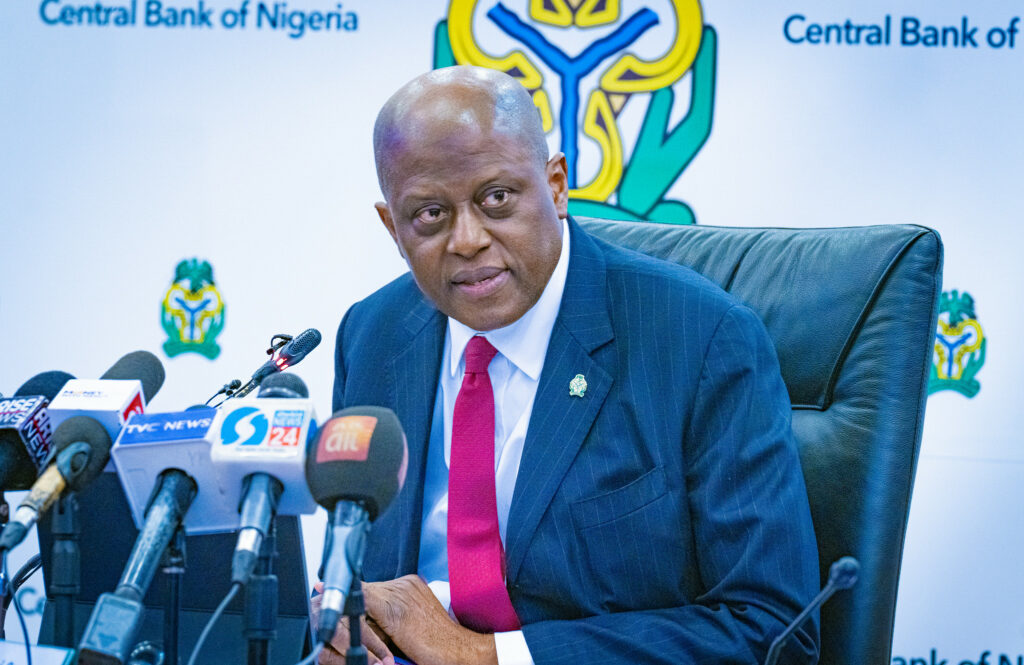
Defending the central bank’s decision to keep parameters tight despite the anxieties of the organised private sector regarding the cost of capital, the CBN Governor, Olayemi Cardoso, during his post-meeting briefing in Abuja, stressed that maintaining exchange rate stability remains paramount to curbing core inflation. Cardoso said, “It is key that the centrepiece of our toolkit is ensuring that our foreign exchange rate remains stable. Although inflation has risen marginally for two consecutive months, largely induced by external shocks, the MPC recognised its transitory nature and remained confident that the current macroeconomic environment is sufficiently robust to support a return to disinflation.”

See also  15% tariff: Nigerians to pay N1tn extra for petrol yearly

With credit expansion heavily choked off in the real economy, idle institutional liquidity is increasingly pooling back into safe-haven government instruments. Softer corporate loan demand means banks and asset managers will continue channelling excess cash back into primary auctions. Despite these capital inflows, intense sovereign borrowing needs and persistent inflation risks will likely keep bond and Treasury bill yields highly competitive, preventing any sharp downward adjustments in the near term.

For equity investors, the strategy must become hyper-selective. Meristem analysts advise that market participants pivot towards defensive, fundamentally strong counters capable of weathering a high-cost environment, concluding that, “In the fixed-income market, softer loan demand is expected to keep liquidity flowing into Treasury Bills and Bonds, supporting demand at primary auctions and limiting sharp upward pressure on yields in the near term…

In equities, investor interest is likely to remain concentrated in fundamentally strong counters with resilient earnings and attractive dividend prospects… Going forward, the MPC is expected to maintain a cautious stance until inflation moderates more convincingly and exchange rate stability becomes more firmly established.”

punch.ng

FOLLOW US ON:

FACEBOOK

TWITTER

PINTEREST

TIKTOK

YOUTUBE

LINKEDIN

INSTAGRAM

Continue Reading
Click to comment

Leave a Reply

Your email address will not be published. Required fields are marked *

Business

FG tells marketers to reflect global oil price drop in petrol prices

Published

on

Minister of State for Petroleum Resources, Sen. Heineken Lokpobiri, has directed petroleum marketers to immediately reflect the recent decline in global oil prices by reducing the pump prices of Premium Motor Spirit (PMS) and other petroleum products.

Lokpobiri gave the directive at the 2026 Nigerian Midstream and Downstream Petroleum Regulatory Authority (NMDPRA) General Counsel and Legal Advisers Forum on Monday in Abuja.

The forum is themed “Beyond Compliance Certainty and Investment Confidence in Nigeria’s Petroleum Sector.”

Lokpobiri said that with the de-escalation of tensions between Iran and the United States, there was an expectation that the prices of PMS and other petroleum products would be adjusted downward accordingly.

He expressed concern that the anticipated reduction had yet to be reflected at the pumps, stressing that while market forces under the deregulated regime would ultimately restore price equilibrium, marketers should not exploit the situation to make excessive profits.

The minister said the regulator had a statutory responsibility to ensure that deregulation did not become an avenue for profiteering, adding that this must be carried out in line with the provisions of the Petroleum Industry Act (PIA 2021).

“For too long, the dominant question in our regulatory conversations has been: are operators complying? That question matters. It will always matter. But it is no longer sufficient.

“The more consequential question today is this: are our regulatory authorities doing their job? Is it clear, consistent and predictable enough to give investors the confidence they need to commit capital, not just for one cycle, but for the long term?

See also  Lagos govt begs medical doctors to suspend three-day warning strike

“Compliance is the foundation. Regulatory certainty is the ceiling we must now be building toward,” he said.

Lokpobiri, while urging marketers to comply with the principles of fair pricing to ensure that consumers benefit from the prevailing market realities, urged regulators to move beyond compliance by promoting regulatory certainty to attracting long-term investments.

“The sector is now fully deregulated, a bold reform that President Bola Tinubu had the courage to implement. That decision paved way for the operationalisation of the Dangote Refinery and other refinery projects currently underway.

“It also ensured that artificial scarcity has become a thing of the past.

“You can attest to the fact that since 2023 there has been availability of products in country even with the recent challenges posed by the US-Israeli /Iranian conflict.

“Beyond allowing prices to be determined by market forces, the question is: what is the regulator doing to ensure that consumers receive the correct quantity of product?

“When someone pays for 10 litres of PMS, they should receive exactly 10 litres, not less,” he warned.

Lokpobiri said while compliance with regulations remained fundamental, investors were increasingly interested in jurisdictions with clear, consistent and predictable regulatory frameworks.

He described general counsel as strategic partners whose responsibilities extend beyond interpreting laws to shaping investment decisions, improving regulatory design and supporting national development.

According to him, legal advisers should provide constructive feedback whenever regulations or guidelines create uncertainty that could discourage investment.

He said Nigeria’s petroleum sector was entering a new phase characterised by expanding domestic refining capacity, increased private sector participation and emerging opportunities across the midstream and downstream segments.

See also  15% tariff: Nigerians to pay N1tn extra for petrol yearly

According to him, attracting investments will require policy consistency, transparent regulation, efficient dispute resolution and strong collaboration among government, regulators, industry operators and legal practitioners.

He expressed confidence that the recommendations from the forum would contribute to improving governance, regulatory certainty and investment confidence in Nigeria’s petroleum sector. (NAN)

punch.ng

FOLLOW US ON:

FACEBOOK

TWITTER

PINTEREST

TIKTOK

YOUTUBE

LINKEDIN

Continue Reading

Business

Olodo uprising: Tinubu aide faults critics of First Lady’s Akara, Kuli kuli comment

Published

on

The Special Assistant to President Bola Tinubu on Social Media, Dada Olusegun, has defended First Lady Oluremi Tinubu’s recent empowerment of micro-traders, saying criticisms of the initiative are driven by ignorance of her record and the role of Nigeria’s informal economy.

In a statement shared on Monday, Olusegun described the backlash over the First Lady’s focus on traders such as akara and kulikuli sellers as a “performative circus of selective amnesia.”

He argued that critics had ignored the numerous interventions carried out by the Renewed Hope Initiative across healthcare, women’s empowerment, support for military widows and persons living with disabilities.

The First Lady, Senator Oluremi Tinubu
The First Lady of Nigeria, Senator Oluremi Tinubu

According to him, the First Lady’s interventions extend beyond petty traders, citing her donation of ₦1bn to the National Cancer Fund for cervical cancer screening and another ₦1bn for tuberculosis diagnostic equipment in Abuja in 2025.

He also referenced the disbursement of ₦250,000 each to 1,709 widows and orphans of fallen military personnel in 2023, as well as ₦200,000 business grants to persons living with disabilities across the 36 states and the Federal Capital Territory.

Olusegun further highlighted the Renewed Hope Initiative’s partnership with the Tony Elumelu Foundation, which targeted 18,500 women nationwide with ₦50,000 grants and the distribution of equipment, including industrial grinding machines, freezers and generators.

He further criticised what he described as an “Olodo uprising” on social media, accusing critics of reacting to trends without researching the facts.

“This entire controversy perfectly mirrors what is now happening with the broader ‘Olodo uprising” across our social platforms. We live in an era where people jump on trending hashtags and soundbites without dedicating a single minute to researching context. Memes are manufactured in seconds; accurate history takes time to read.

See also  Reps query foreign airlines’ N18.98bn debt, give FAAN two-week recovery deadline

“When the critics are done making their superficial memes, writing cynical captions, and circulating ignorant narratives, the reality on the ground will remain unchanged. They would be better off advising their constituents to find credible means to key into these ongoing government initiatives,” he stated.

He maintained that empowering small-scale traders should not be viewed as “weaponising poverty.”

“According to various economic metrics, the informal sector contributes over 50 per cent of Nigeria’s GDP and accounts for over 80 per cent of employment. The akara fryer, the kulikuli processor, and the petty trader are not just marginal actors; they are the literal shock absorbers of our micro-economy.

“When you give a micro-grant or operational tools to an akara seller, you are not validating poverty; you are reducing immediate operational capital friction, securing food chains at the grassroots, and expanding household income. Mocking these initiatives as ‘petty’ shows a deep-seated contempt for the actual working class of Nigeria,” he said.

Olusegun also defended the political value of grassroots empowerment, saying such interventions create trust among beneficiaries.

He cited the TraderMoni and MarketMoni programmes introduced during former President Muhammadu Buhari’s administration under then Vice President Yemi Osinbajo as examples of initiatives that directly impacted market traders.

“The opposition often wonders why the poorest segments of the population continually familiarise themselves with the All Progressives Congress during elections. The answer is simple: the party meets them at their point of immediate need,” he said.

Olusegun added that Tinubu’s record as former First Lady of Lagos State, a three-term senator and now First Lady of the Federation showed a consistent commitment to structured empowerment programmes.

See also  FG sets Dec 20 deadline to pay contractors

“She will not be distracted by digital static from doing what she has mastered over decades: empowering the poorest among us, one structured intervention at a time,” he said.

punch.ng

FOLLOW US ON:

FACEBOOK

TWITTER

PINTEREST

TIKTOK

YOUTUBE

LINKEDIN

Continue Reading

Business

Dangote refinery imports first UAE crude cargoes

Published

on

The Dangote Refinery has purchased two cargoes of crude oil from the United Arab Emirates, marking its first-ever procurement of Middle Eastern crude as it expands its feedstock sources amid persistent domestic supply constraints.

According to a report by S&P Global Commodity Insights, the two cargoes will be the first sourced by the 700,000-barrels-per-day refinery from any Middle Eastern supplier, signalling a shift from its traditional reliance on Nigerian, African, and United States crude grades.

The report said the purchases followed the resumption of oil exports from the Middle East after the United States and Iran reached an interim peace agreement that restored confidence in shipping through the Strait of Hormuz.

The refinery, designed primarily to process Nigeria’s light sweet crude, has increasingly diversified its crude slate as operations ramp up. S&P Global reported that an agreement between the refinery and the Nigerian National Petroleum Company had guaranteed the supply of between 13 and 15 cargoes of Nigerian crude monthly in naira, helping the refinery reduce its foreign exchange exposure.

However, the arrangement has faced challenges due to inadequate crude availability and operational issues at export terminals. According to the report, Dangote Refinery Chief Executive Officer David Bird had previously disclosed that these constraints had compelled the company to seek additional crude sources outside Nigeria.

The report added that the refinery’s expansion plans would further increase its crude requirements. Dangote plans to double the refinery’s processing capacity to 1.4 million barrels per day by the end of 2028, a level that would enable it to process about 80 per cent of Nigeria’s recent crude oil production in a single day.

See also  Vehicle imports jump 67% in three months

Speaking earlier this year, Bird said the refinery intended to increase the share of heavier crude grades in its feedstock mix. “We definitely want to heavy up the barrel,” Bird said in April.

He added, “We will be in the crude blending game. So you can easily imagine at 1.4 million b/d we could process 30 per cent Middle Eastern grades on each train.”

According to S&P Global, the refinery has been broadening the range of crude grades it processes as part of its ambition to operate as a fully merchant refinery. The report noted that in 2025, about 70 per cent of the refinery’s crude imports came from Nigeria, while 24 per cent originated from the United States.

punch.ng

FOLLOW US ON:

FACEBOOK

TWITTER

PINTEREST

TIKTOK

YOUTUBE

LINKEDIN

Continue Reading

Trending