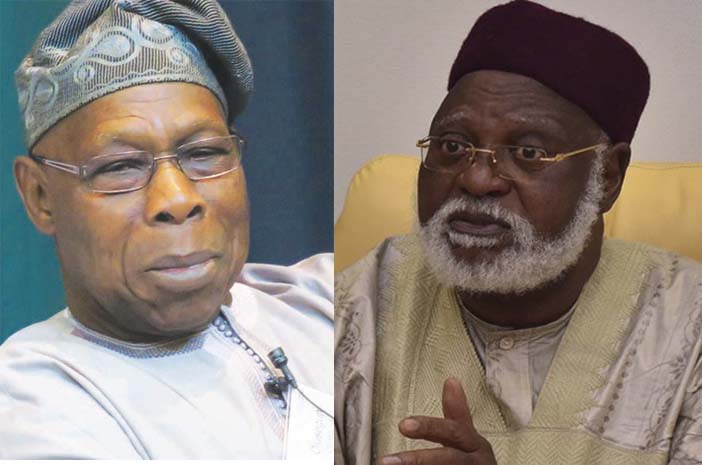
Former Head of State, Gen Abdulsalami Abubakar (retd.), has disclosed that when Gen Olusegun Obasanjo came to see him after his release from prison in 1998, he advised him point-blank to abandon the idea of contesting the presidential election.
He said he told him at the time to go home, thank God he was alive, and forget about becoming President.
Abdulsalami also revealed that at the same meeting, he talked Obasanjo out of filing a lawsuit against the Federal Government over his wrongful imprisonment, warning him that the court process was uncertain and offering instead to explore compensation for the collapse of his business during his years in detention.
The accounts are contained in Chapter 22 of Abdulsalami’s 264-page, 27-chapter autobiography titled ‘Call of Duty,’ obtained by our correspondent at the public presentation of the book at the Aso Rock Villa, Abuja.
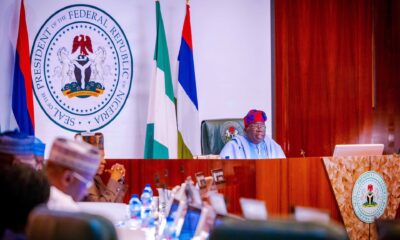
The presentation was held to mark the former Head of State’s 84th birthday and was attended by President Bola Tinubu, who was represented by Vice President Kashim Shettima as the special guest of honour.
Describing the encounter, Adulsalami wrote that Obasanjo came to him with two issues after his release: his intention to sue the government and the invitation from the Peoples Democratic Party to contest the presidency.
“I was forthright with him. One, I advised him that he should not take the government to court because it might not augur well.
“For one, he would not know how long it would take the court to give judgment. I told him that, as a government, we would try to see what could be done about his business in the form of compensation.
“The court process was uncertain, I told him. I tried to dissuade him from pursuing the litigation option, and he agreed with me,” he wrote.
Abdulsalami continued, “On the invitation by the PDP that he should run in the presidential race, I advised him to return home and thank God that he was still alive after all he had gone through in four years. I told him point-blank that he should forget about contesting to be President.
“He took a deep sigh and said he was going to think about it and revert. He never got back to me. He can confirm this encounter.”
The former head of state argued that the fact that Obasanjo ultimately contested and won the election should not be taken as evidence that his administration was behind the candidacy.
“I tell people till today that my administration had nothing to do with the presidential ambition of General Obasanjo.
“It may be hard to believe, but we did not endorse him, and we did not work for him. It was a conjecture.
“As I have said several times, as a government, we decided to release all political prisoners. We did not pick and choose. We did not single any individual out for favour. General Obasanjo was one of those prisoners who regained freedom,” he stated.
According to him, “Some said because we granted him a pardon, which allowed him to run for office, that meant we were working for him.
“But we released and pardoned scores of political prisoners. It was because General Obasanjo ended up as the President that people overlooked the other prisoners that were pardoned as well.”
Abdulsalami also acknowledged that there were reports of retired Generals working behind the scenes to persuade Obasanjo to run, believing he could unite Nigerians at that critical moment. But he distanced himself and his government from those efforts.
“There were reports that some retired Generals worked behind the scenes to persuade General Obasanjo to run because they believed he was the one who could unite Nigerians at that critical time, given his experience, network and knowledge.
“I read the reports, too. I was also aware of efforts made by some people to ensure that somebody who was nationally acceptable was elected as President.
“Those were private initiatives and had nothing to do with our government or me,” he wrote.
In the chapter, Abdulsalami also gave an account of how he deliberately bent the electoral rules to ensure the Alliance for Democracy, the party formed by NADECO and the Afenifere Yoruba socio-cultural organisation, was registered as a political party, even though it failed to meet the criteria his administration had set.
He said that by the criteria for party registration, which required presence in two-thirds of the 36 states, legal registration, offices in the FCT and state capitals, and a constitution, the Peoples Democratic Party and the All Peoples Party were clearly the top two, while the AD could realistically only win the six south-western states.
He said, “We had to apply some wisdom and flexibility. As projected, the AD eventually didn’t meet the criteria for the registration of political parties. We tinkered with the rules and said any party that came third would be registered. That was how AD scaled through.
“We did not want to create a system in which the South-West would feel marginalised. Whatever decision we took was for the peace and progress of the country. If tinkering with the rule we made ourselves would give respite to Nigerians, why not?
“The rules were made by humans and for humans. The idea was to give peace a chance and to ensure that there was equity and justice.”
Abdulsalami also explained why Nigeria’s return to civilian rule came in May 1999 rather than October 1998, the date Abacha had announced before his death.
He said the October date was never feasible, as his administration scrapped Abacha’s entire transition programme as lacking credibility, adding that May 1999 was ultimately determined not by political calculation but by a request from the judiciary.
According to him, “My first suggestion was that we should draw up a six-month transition plan. That would have seen us hand over to a democratically elected President by March 1999.
“However, when I called for a meeting with the military echelon and the judiciary, Justice Muhammadu Uwais, then Chief Justice of Nigeria, said he would need at least sixty days after the elections to ensure that all the judicial matters brought to the courts were dispensed with before inauguration.
“That was how we arrived at May 1999. It was a function of a judicial request and my desire to make the transition process as short as possible. Six months was the fastest we could do to organise elections and give the political parties the time to set up and prepare.”
He disclosed that he faced pressure from multiple directions not to hand over at all, including from some of his own military colleagues, from some West African Heads of State, from segments of the international community, and even from some NADECO members who felt they had been caught flat-footed by the speed of the transition and wanted more time.
“Initially, there was intense pressure from some of my colleagues, some Heads of State in the West African sub-region and some in the international community that it was too soon to transition to democracy.
“Surprisingly, there were pressures from some NADECO members too. Two to three months into my administration, some NADECO members realised that I was sincere about the handover date, and they saw themselves as short-changed because they were not politicking as they should have done.
“They felt they had missed the train and wanted to come on board, which made them request more time to get their act together,” he wrote.
He said when NADECO came to him requesting an extension, he turned the tables on them, demanding that they write a formal letter requesting the extension and call a press conference publicly endorsing the request, which they declined.
“I promised that if they did that, I would grant an extension. But they never did. I knew they wouldn’t. We went ahead with our programme,” Abdulsalami wrote.
He said some of his military colleagues were also hostile to handing over to civilians, but that he was personally unmoved by any temptation to stay.
“For me, I was not in any way tempted to stay longer in office. I had made up my mind. By the time I took over the reins of power, the country was on the edge.
“There was extreme pressure from NADECO, G-34, and other political players for the military to go.
“Nigeria was at a breaking point. The military needed to relinquish power,” he wrote.
On the eve of the May 29, 1999, handover, Abdulsalami said he slept soundly, noting that the only nights he had not slept since taking power were the first few nights.
“I slept well that night. I always slept well, apart from the day I assumed power when I didn’t sleep a wink for days.
“Thereafter, I always slept well, even though I worked round the clock at times. But that was a choice. I had no anxieties whatsoever on the eve of the handover. I had made up my mind to relinquish power within the shortest possible time, and I didn’t have any issues that I was about to leave power.
“Rather, I was happy that as much as possible, we had brought peace to the country and stabilised the military too,” he wrote.
He added that on the morning of May 29, 1999, he took Obasanjo on a familiarisation tour of the Presidential Villa, introduced him to staff, and, after the handover ceremony, drove back to Minna, his personal belongings having already been moved out a week earlier.
“As we drove through towns and villages, people gathered by the roadside to wave to us. It was quite a sight. I was a very happy man,” he wrote.
punch.ng
FOLLOW US ON: