Connect with us

News

Implement policies that reduce poverty – Emir Sanusi tells govt

Published

on

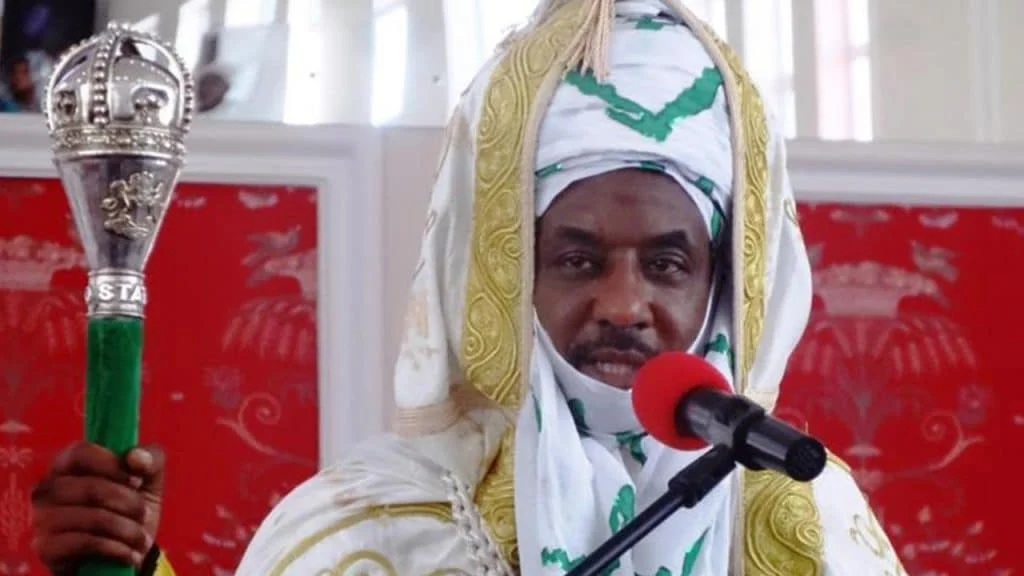
The Emir of Kano, Muhammadu Sanusi II, has urged Nigerian leaders to focus on economic policies that improve people’s lives, saying policies should be judged by how they affect citizens’ welfare.
Speaking at a conference in Kano on Thursday, the emir said the country needs policies that reduce poverty, raise living standards and encourage inclusive growth.

Represented by the Danmadamin Kano and a Professor of Economics at Bayero University, Kano, Abubakar Aliyu Sanusi, the monarch described the event as timely because of Nigeria’s current economic and political challenges.

He said, “Economic policies should be assessed based on their impact on the welfare of citizens. Any economic policy that does not improve the welfare of the people is inherently ineffective.”

Sanusi also called on leaders to learn from history, strengthen institutions and promote justice, saying no country can build a better future without addressing unresolved problems from the past.

He listed insecurity, corruption, poverty and poor infrastructure as some of Nigeria’s biggest challenges. He also urged politicians to move away from selfish politics and focus on serving the people.

“Power-sharing should not only be about geographical rotation but about ensuring that credible, competent and compassionate leaders emerge to serve the people,” he said.

The emir appealed to Nigerians, regardless of their religion or political affiliation, to embrace unity, tolerance and shared responsibility in building the country.

He added that although Nigeria has made progress since independence, it still struggles with political instability, ethnic and religious tensions, insecurity and economic hardship.

See also  3,715 PHCs inactive in 19 states and FCT

FOLLOW US ON:

FACEBOOK

TWITTER

PINTEREST

TIKTOK

YOUTUBE

LINKEDIN

INSTAGRAM

Continue Reading
Click to comment

Leave a Reply

Your email address will not be published. Required fields are marked *

News

FG targets eradication of sheep, goat disease by 2030

Published

on

The Federal Government has reaffirmed its commitment to eradicating Peste des Petits Ruminants, a highly contagious viral disease affecting sheep and goats, by 2030, saying intensified surveillance, vaccination and cross-border collaboration remain central to achieving the target.

The assurance was given by the Permanent Secretary of the Federal Ministry of Livestock Development, Chinyere Akujobi, at the opening of a two-day Stakeholders’ Workshop on the Review and Update of Nigeria’s National Strategic Plan for the Control and Eradication of Peste des Petits Ruminants in Abuja.

The Deputy Director of Information and Public Relations at the ministry, Henrietta Okokon, disclosed this in a statement on Friday.

Akujobi described the eradication of PPR as both an animal health priority and a national development goal, noting that eliminating the disease would reduce poverty, improve rural livelihoods, increase livestock productivity and expand trade opportunities.

According to her, “Nigeria has remained fully committed to the global goal, under the leadership of the Food and Agriculture Organisation and the World Organisation for Animal Health, to eradicate PPR by 2030.

“We have implemented a range of interventions, including disease surveillance, laboratory strengthening, outbreak investigations, targeted vaccination campaigns, stakeholder engagement, and capacity-building programmes aimed at reducing the burden of PPR while improving disease reporting and response systems.”

She said small ruminants serve as the primary economic safety net for millions of households, making their protection critical to the Federal Government’s agricultural transformation agenda.

Akujobi noted that PPR remains one of the most economically devastating transboundary diseases affecting sheep and goats across Africa, Asia and parts of the Middle East.

See also  #FreeNnamdiKanu: Protest wave hits Abuja, paralyses S’East states

“This disease continues to threaten livelihoods, reduce household incomes and constrain the growth of the livestock sector. Given that Nigeria has Africa’s largest population of small ruminants, estimated at over 200 million sheep and goats, and shares major transboundary trade corridors with Niger, Benin, Cameroon and Chad, strengthening our control measures is imperative,” she said.

She explained that the workshop was convened to develop an evidence-based National Strategic Plan for 2026–2030 that would integrate veterinary services with cross-border trade standards and risk mitigation policies.

Akujobi also commended development partners, regional technical organisations and national experts for supporting efforts to eliminate the disease, adding that the ministry would prioritise a fully costed implementation plan backed by a sustainable resource mobilisation strategy.

The statement also quoted the Chief Veterinary Officer of Nigeria, Samuel Anzaku, as saying the country had made significant progress in animal disease control but needed to update its National Strategic Plan to align with the Global PPR Eradication Programme, the Performance Monitoring and Assessment Tool roadmap benchmarks and ECOWAS regional coordination mechanisms.

According to him, the revised strategy should incorporate recent epidemiological and laboratory data, refine disease hotspot mapping, adopt risk-based vaccination strategies and strengthen laboratory-epidemiology linkages.

“This structural update is vital to advancing Nigeria into PMAT Stage 2 and beyond, ensuring that every public and private investment delivers measurable scientific progress towards achieving a PPR-free nation,” he said.

Also speaking, the representative of the African Union Inter-African Bureau for Animal Resources, Dr Perdita Hilary Lopes, described the eradication of PPR as a strategic investment in resilient livestock systems, poverty reduction, women’s economic empowerment, youth employment, sustainable rural development and improved food systems across Africa.

See also  Senator decries prolonged incarceration of inmates over inability to pay fines

She added that achieving a PPR-free Africa by 2040 would contribute significantly to the aspirations of Agenda 2063, the Comprehensive Africa Agriculture Development Programme and the Sustainable Development Goals.

The renewed push follows earlier efforts by the Federal Ministry of Livestock Development to strengthen Nigeria’s campaign against PPR. In January, the ministry inaugurated a 33-member National Technical Working Group on the control and eradication of the disease to coordinate national response efforts.

At the time, the Minister of Livestock Development, Idi Maiha, described PPR as one of the most devastating transboundary animal diseases affecting sheep and goats, warning that it threatens the livelihoods of pastoralists and smallholder farmers, undermines food security and limits livestock trade.

Nigeria’s eradication drive aligns with the global campaign led by the Food and Agriculture Organisation and the World Organisation for Animal Health to eliminate PPR by 2030. As part of the regional effort, Abuja hosted a West African surveillance workshop in December 2025, where veterinary authorities and technical experts reviewed risk-based surveillance and cross-border coordination strategies aimed at accelerating progress towards the eradication target.

punch.ng

FOLLOW US ON:

FACEBOOK

TWITTER

PINTEREST

TIKTOK

YOUTUBE

LINKEDIN

Continue Reading

News

Camilla Alhassan, Ghanaian TikToker jailed for claiming President Mahama sacrificed 32 cows

Published

on

A Ghanaian court has sentenced TikToker Camilla Alhassan to one year in prison after she admitted to publishing false claims that President John Mahama sacrificed 32 cows in a ritual to secure victory in the country’s 2024 presidential election, BBC reports on Friday.

Alhassan, 43, was convicted of offensive conduct and publication of false news over a series of videos she posted on TikTok last month and earlier this month.

In the videos, she alleged, without evidence, that the president carried out the ritual to help him win the election.

She also claimed that the government’s distribution of sanitary pads to flood victims was intended to cover up the alleged act.

The court rejected her plea for a lighter sentence, ruling that a prison term was necessary to discourage the growing spread of misinformation on social media.

BBC reports that prosecutors told the court that Alhassan, who has more than 70,000 followers on TikTok, made false and defamatory allegations against the president through videos that were widely shared online.

Her conviction has reignited debate in Ghana over the challenge of tackling misinformation while protecting freedom of expression.

The case is the latest involving a social media influencer in the West African country.

In September last year, TikToker David Kwodwo Prah Afful, popularly known as Kwame Nkrumah II, was jailed for seven months after he was convicted of making death threats against Mahama and members of parliament in a viral video.

The Mahama administration has repeatedly warned against the spread of false information online.

See also  3,715 PHCs inactive in 19 states and FCT

Last year, the president said authorities would track down and prosecute individuals responsible for spreading falsehoods, hate speech and messages capable of causing fear and panic.

The government is also considering legislation aimed at tackling misinformation while preserving constitutional protections for freedom of expression.

punch.ng

FOLLOW US ON:

FACEBOOK

TWITTER

PINTEREST

TIKTOK

YOUTUBE

LINKEDIN

Continue Reading

News

Kemi Badenoch backs FIFA probe, says Argentina politicised football over Falklands banner

Published

on

Conservative Party leader Kemi Badenoch has insisted that the Falkland Islands are “British” and accused Argentina of exploiting football to make a political statement after its players displayed a banner asserting the country’s claim to the disputed territory following their World Cup semi-final victory over England.

Her remarks came as FIFA confirmed its independent disciplinary committee was assessing match reports and the surrounding circumstances to determine whether Argentina breached its rules prohibiting political messages on the field of play.

Backing calls for an investigation, UK Prime Minister Keir Starmer’s government maintained that the Falklands’ status was not up for debate.

Downing Street said, “The World Cup might not be ours, but the Falkland Islands definitely are,” while Business Minister Peter Kyle described the banner display as “an egregious violation” of FIFA rules and said, “Politics needs to be separate from football.”

Reacting in a video posted on X on Friday, Badenoch said, “The Falkland Islands are British. The Conservatives will always defend them. We know that political messaging and slogans are banned by FIFA, so they absolutely should investigate. It was a very silly banner.

“The fact is the Falkland Island are British and the Conservatives will never stop defending the Falklands. We did it before and we’d do it again.”

Argentina’s players unfurled a banner reading “Las Malvinas son Argentinas” (The Falklands are Argentine) after their 2-1 victory over England in Atlanta, reigniting the long-running sovereignty dispute between Britain and Argentina.

The Falkland Islands, a British Overseas Territory in the South Atlantic, have remained at the centre of competing claims for decades. The dispute culminated in the 1982 Falklands War, a 74-day conflict in which 649 Argentines, 255 British servicemen and three islanders were killed.

See also  Northern elders, govs plan regional development council

Similar incident in 2014

FIFA has previously punished Argentina over a similar incident.

In 2014, the Argentine Football Association was fined after the national team displayed the same banner before an international friendly against Slovenia, with the governing body ruling that the act breached its regulations on political messages and team misconduct.

Badenoch also used the controversy to criticise the Labour government over its Chagos Islands agreement, arguing that the Conservatives would never take the same approach to the Falklands.

She said, “Unlike Labour who gave away British territory in the Chagos Island, we will never do that. That match was a great game watching our players, but very painful to watch.

“I have a nine year old who was utterly bereft at the loss, winning for so long and only to lose at the end.

“Winning a football match, I would say to Argentinians does not mean you can have the Falklands, so hands off.”

Badenoch’s criticism refers to the UK’s agreement to transfer legal sovereignty over the Chagos Archipelago to Mauritius while retaining UK and US military access to Diego Garcia under a long-term lease.

The agreement, announced in principle in 2024, followed years of international legal and diplomatic pressure over Britain’s administration of the islands.

Whether Britain “gave away” the Chagos Islands depends on the perspective. Critics, including Badenoch, describe the agreement as surrendering British territory, while supporters argue it is a negotiated settlement that protects UK and allied security interests by preserving the strategically important Diego Garcia military base while resolving the long-running sovereignty dispute.

See also  PHOTOS & VIDEO: 2 shot de@d as Kenyan security forces fire in the air to disperse crowd at viewing of Raila Odinga's body

PUNCH Online reported in May 2025 that a British court paved the way for a government deal on returning the remote Chagos Islands to Mauritius, lifting a temporary ban that had forced an 11th-hour halt to an accord being signed.

Argentina await sanction

Meanwhile, the nation awaits FIFA verdict.

Also, AFP quoted Argentina’s President Javier Milei as describing the display “perfectly valid and legitimate.”

“It’s a feeling that exists within all Argentines,” he told El Observador radio station.

“The Malvinas are Argentine, we’re going to recover them, and we will do it through diplomatic means,” said Milei.

Argentina’s vice president, Victoria Villarruel, upped the tensions ahead of Wednesday’s kick-off by dubbing the English “usurping pirates”.

After the World Cup match, Argentina’s Foreign Minister Pablo Quirno said Buenos Aires had filed a formal protest over a British warship near the Falkland Islands.

Quirno voiced on X “the strongest rejection” of Britain’s HMS Medway’s “unconsulted and illegal” passage through Argentine territorial waters.

punch.ng

FOLLOW US ON:

FACEBOOK

TWITTER

PINTEREST

TIKTOK

YOUTUBE

LINKEDIN

Continue Reading

Trending