Connect with us

Business

Tax revenue hits N27tn after 113% surge – Report

Published

on

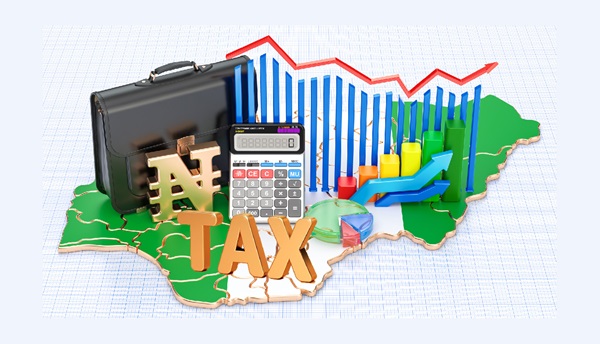
Nigeria’s tax collections have surged by 113 per cent in less than three years, rising from N12.3tn in 2023 to N27.1tn as of July 2026, the Nigeria Revenue Service has said.

The revenue authority attributed the sharp increase to the digitisation of the tax system, the enactment of four new tax reform laws, the transformation of the revenue service and an executive order aimed at closing loopholes in the tax system.

The NRS, in an internal report on the state of the Nigerian economy obtained by The PUNCH on Sunday, insisted that the country was moving from a period of severe macroeconomic distress towards a more stable and resilient economy following the implementation of a series of difficult reforms by the President Bola Tinubu administration.

“Tax collections more than doubled from N12.3tn in 2023 to N27.1tn as of July 2026 with the “digitisation of tax systems, four new tax reform laws, the transformation of the revenue service and an executive order that closed loopholes in the system.

“The Nigerian economy has moved decisively from acute macroeconomic distress toward a more stable and increasingly resilient footing,” the revenue service said.

The NRS attributed the development to what it described as Tinubu’s economic management acumen and determination to implement reforms under his administration’s Renewed Hope Agenda.

According to the report, the administration inherited four major economic distortions which had continued to undermine government revenue and economic growth.

It identified the challenges as “a fiscally unsustainable fuel subsidy regime, an opaque forex system that discouraged investment, a non-performing oil sector, and a tax base ‘far below its potential’.”

The revenue authority said the initial impact of the reforms created significant economic difficulties but maintained that the country’s major economic indicators had subsequently begun to improve.

It cited falling inflation, a turnaround in the balance of payments, increased crude oil production, the emergence of Nigeria as a net exporter of petroleum products and the more than doubling of tax collections as evidence of the recovery.

See also  PHOTOS: FAAN Launches Nigeria’s First Fully Electric Airport Shuttle

The report also highlighted an increase in the minimum wage, saying it had doubled between 2023 and 2026.

It further cited estimates by the United Nations Children’s Fund showing that the number of out-of-school children had declined from 20 million to 18.3 million following government policies and incentives.

The NRS said the government’s naira-for-crude arrangement with the Dangote Petroleum Refinery and other domestic refineries had contributed to a major shift in Nigeria’s petroleum trade position.

According to the report, the arrangement had helped Nigeria move from being a net importer of petroleum products to becoming a net exporter after decades of dependence on imports.

It noted that Ghana had recently decided to pursue a similar policy in its petroleum sector. The report also said crude oil production had increased from about 1.2 million-1.3 million barrels per day in 2023 to 1.73 million barrels per day by July 2026.

It said the latest output was equivalent to 104 per cent of Nigeria’s OPEC quota. The increase in production is significant for government revenue because crude oil remains the country’s largest source of foreign exchange and a major contributor to public finances.

The NRS also pointed to developments in the capital market as another indication of improving economic confidence. It said the market capitalisation of the Nigerian Exchange had risen from N30.36tn in 2023 to N161tn in 2026, describing the increase as a source of wealth creation for millions of Nigerians who invest in the stock market.

The report attributed the market rally partly to improved macroeconomic credibility, the recapitalisation of banks and a growing pool of domestic institutional investment.

Nigeria’s external reserves also rose sharply during the period under review. According to the NRS report, reserves increased from an unrestricted $3.99bn in 2023 to $51.9bn as of July 2026, which it described as a 17-year high.

See also  US-Iran war: Marketers, Dangote trade words over petrol price

The country’s balance of payments also moved from a $3.34bn deficit to a $2.38bn surplus in the first quarter of 2026, the report stated. Nigeria’s trade position similarly recorded a significant improvement, moving from a marginal surplus of N44.7bn to N7.55tn in the first quarter of 2026.

The composition of exports also showed some changes, with exports of other oil products, excluding crude, rising by 51 per cent year-on-year to N6.78tn during the first quarter.

The revenue service said improved investor confidence was also reflected in capital importation. Annual capital importation rose from $3.9bn in 2023 to $23.22bn in 2025, while inflows reached $10.37bn in the first quarter of 2026 alone.

The report said foreign portfolio investment had been particularly strong, while foreign direct investment had also improved. The increase in capital inflows, according to the NRS, reflected stronger investor confidence as economic reforms reshaped the operating environment.

The revenue service further highlighted the expansion of the compressed natural gas programme as part of the government’s response to the removal of the petrol subsidy.

According to the report, Nigeria had no large-scale CNG programme three years ago and depended heavily on imported petrol and diesel. By 2026, however, more than 100,000 vehicles had reportedly been converted to CNG, with more than $2bn in investment mobilised and over 10,000 jobs created.

The NRS estimated that CNG could reduce running costs by between 40 and 60 per cent compared with petrol. It said some commercial drivers had seen their monthly fuel bills fall from about N50,000 to N18,000 after converting their vehicles.

On agriculture and food security, it recalled that the administration declared a state of emergency on food security in July 2023 and subsequently introduced measures including the release of strategic grain reserves, the establishment of a N100bn National Agricultural Development Fund, fertiliser distribution and an agricultural mechanisation programme.

See also  Dangote refinery eyes $2bn in historic listing – Report

Federal agricultural allocation rose from N228.4bn in 2023 to N826.5bn in the 2025 budget, according to the report. The NRS said food prices had fallen by about 50 per cent by March 2026, citing the Ministry of Agriculture.

However, it acknowledged that agriculture would require several planting seasons before increased government support could translate fully into higher production.

On public debt, the NRS acknowledged that Nigeria’s total debt stock had increased substantially, from N87.4tn in 2023 to N159.28tn in late 2025. However, it argued that the more important measure was the country’s debt relative to the size of its economy.

According to the report, the debt-to-GDP ratio declined from 38 per cent in 2023 to 35.5 per cent in 2025 and 32.3 per cent in 2026. The revenue service described the decline as the first sustained reduction in the ratio in more than a decade.

It also said debt servicing as a proportion of government revenue had declined from 68 per cent to an International Monetary Fund-projected 53 per cent.

The NRS said the combination of higher tax collections, increased oil production, stronger capital inflows, rising reserves and improved trade and balance of payments positions pointed to an economy that was gradually emerging from the severe pressures that followed the government’s early reforms.

The report nevertheless acknowledged that the gains came after what it described as “painful” adjustments and stressed that continued implementation of the reforms would be required to consolidate the recovery.

Source: punchng.com

FOLLOW US ON:

FACEBOOK

TWITTER

PINTEREST

TIKTOK

YOUTUBE

LINKEDIN

INSTAGRAM

Continue Reading
Click to comment

Leave a Reply

Your email address will not be published. Required fields are marked *

Business

Whatsapp to begin charging businesses per message from October 1

Published

on

Meta, the parent company of WhatsApp, will begin charging businesses for certain messages sent through the WhatsApp Business Platform from October 1, 2026.

This was disclosed in a WhatsApp Business Platform pricing update in July 2026.

The new charges will be applied to companies using the official WhatsApp Business Platform, formerly known as the WhatsApp Business API, to manage customer conversations at scale.

Banks, fintechs, e-commerce companies, telecoms operators, logistics firms and large retailers that rely on the platform for customer service and transactional communication are among those that could be affected.

However, the development will not affect ordinary WhatsApp users or most small businesses using the standard WhatsApp Business app on their phones.

Under the current system, when a customer sends a message to a business, a 24-hour customer service window opens. During that period, businesses can respond with free-form service messages and certain utility messages without paying Meta.

However, from October 1, Meta will begin charging businesses on a per-message basis for service messages sent during the customer service window.

Meta, in its developer documentation, said, “Effective October 1, 2026, Meta will charge on a per-message basis for all service messages, consistent with how Meta charges for template messages. These messages have not been charged since November 1, 2024.”

The company added, “Effective October 1, 2026, Meta will charge on a per-message basis for utility messages sent in response to users (within an open 24-hour customer service window). These messages have not been charged since July 1, 2025.”

Utility messages include communications such as payment confirmations, order updates and delivery notifications.

See also  Dangote now supplies 92% of petrol as FG pauses imports

Meta also warned businesses and Solution Providers about the need to add a payment method ahead of the new charges.

It said, “For any Solution Provider or directly-integrated businesses that does not have a payment method on file by September 30, 2026, Meta will stop delivering service messages as of when they become charged on October 1, 2026.”

For Nigerian businesses, a chargeable utility or service message is expected to cost about $0.0101 per message, equivalent to roughly ₦14 based on an exchange rate of about ₦1,340 to the dollar.

Marketing messages are considerably more expensive, at about $0.062 per message, or approximately ₦84 at the same exchange rate.

The charges are Meta’s fees and do not necessarily represent the total amount a business will pay. Companies using Business Solution Providers or third-party platforms to access the WhatsApp Business Platform may incur additional provider charges.

FOLLOW US ON:

FACEBOOK

TWITTER

PINTEREST

TIKTOK

YOUTUBE

LINKEDIN

INSTAGRAM

Continue Reading

Business

FG reaffirms partnership with Taraba to unlock economic potential

Published

on

The Federal Government has reaffirmed its commitment to working with the Taraba State Government to unlock the state’s vast potential in agriculture, energy, tourism, infrastructure and mineral resources.

The Minister of Information and National Orientation, Mohammed Idris, stated this on Thursday in Jalingo at the Gala night to mark the Taraba State’s 35th anniversary and the official unveiling of the Taraba Regional Development Master Plan.

He described the newly unveiled Taraba Regional Development Master Plan as an important blueprint for sustainable growth.

Idris, who conveyed the greetings of President Bola Tinubu and the Federal Executive Council to the government and people of Taraba State, said the state’s 35th anniversary offered an opportunity not only to celebrate its progress since creation in 1991, but also to define a clear pathway for its future.

He commended Governor Agbu Kefas of Taraba for adopting a long-term development framework, saying the success of the Master Plan would ultimately depend on sustained implementation and its impact on the lives of citizens.

“The success of this Master Plan will not be measured by the ceremony at which it is unveiled, but by the roads built, businesses created, jobs generated, communities connected and lives improved,” the minister said.

Idris described Taraba as one of Nigeria’s most promising economic frontiers, with enormous opportunities in agriculture and agro-processing, livestock, hydropower, tourism, manufacturing and mineral development.

He praised the Kefas Administration for its investments in education, healthcare, infrastructure, security and economic development, particularly its policy of free and compulsory primary and secondary education.

He said the evidence was in the provision of more than N1.8 billion in 2026 to cover NECO, BECE and NABTEB examination registration for public-school students.

See also  14 banks have met CBN’s new capital requirement

The minister also highlighted the approximately 268 million dollars financing agreements signed between Taraba State and the ECOWAS Bank for Investment and Development for an integrated industrial park, 10,000 hectares of irrigated rice production and processing, and a 50-megawatt solar power plant in Jalingo.

He said the investments represented the kind of initiatives required to convert the state’s natural advantages into production, value addition, employment and sustainable economic growth.

Idris said Tinubu’s administration was complementing the state’s development drive through major federal infrastructure projects.

“These include the Gembu–Mbamnga–Yang (Lip) Road, the Bali–Serti–Gashaka–Gembu Road, interventions on the Jalingo–Mutum Biyu–Tella–Wukari corridor, as well as further work on the Mayo Selbe–Gembu, Mutum Biyu–Garba Chede and Jalingo–Numan roads.

“These are more than roads. They are investments in connectivity, trade, tourism, agriculture, security and the movement of people and goods,” he said.

The minister also reaffirmed the federal government’s commitment to harnessing Taraba’s agricultural, energy and mineral potential, including the strategic Mambilla Hydroelectric Power Project.

On security, Idris said the federal government was advancing reforms toward the establishment of State Police to bring policing closer to communities while ensuring professionalism, accountability and safeguards against abuse.

He said such a framework could be particularly beneficial to Taraba because of its vast terrain and dispersed border communities, where local knowledge, intelligence gathering and rapid response were critical to effective policing.

The minister also cited the establishment of the Nigerian Army’s 10 Division, headquartered in Jalingo, with operational responsibility for Taraba and Adamawa States, as evidence of the federal government’s commitment to strengthening security in the region.

“Security and development must go together. People cannot invest, farmers cannot move their produce, tourists cannot visit and businesses cannot grow where communities feel unsafe,” Idris said.

See also  UN deputy chief urges countries to prioritise economic opportunities for women

He said the federal government’s economic reforms were designed to create a stronger fiscal foundation for development, noting that the removal of petrol subsidy had mobilised N15.8 trillion in additional resources for the Federation between June 2023 and December 2025.

According to him, approximately N5.4 trillion accrued to the federal government while about N10.4 trillion went to states and local governments, providing additional resources for infrastructure, education, healthcare, security and human capital development.

Idris said the federal government remained opposed to a return to the previous subsidy regime, stressing that the priority was to consolidate the gains of reform, protect vulnerable Nigerians and ensure that additional public resources translated into tangible improvements in citizens’ lives.

He emphasised that development must ultimately be people-centred, creating opportunities for young people, expanding women’s economic participation, supporting farmers and small businesses, and connecting communities to markets and public services.

The minister also pledged stronger collaboration between the Federal Ministry of Information and National Orientation and the Taraba State Ministry of Information and Re-Orientation to ensure citizens understand and embrace the objectives of the Master Plan.

“The vision contained in this Master Plan must go beyond government offices. It must reach the farmer, the entrepreneur, the student, the trader and communities across Taraba.

“This is because a plan for Taraba must ultimately be a plan owned by the people of Taraba,” he said.

Idris congratulated Kefas, the government, and the people of Taraba State on the state’s 35th anniversary, describing the occasion as both a celebration of Taraba’s history and a renewed commitment to its future.

See also  Without Ooni’s Intervention, Refinery Couldn’t Have Been Built — Dangote

“35 years of history. A new blueprint for the future. And a renewed commitment to building the Taraba we want and the Nigeria we deserve,” the minister said.

In his remarks, Kefas also called for continuity in governance, acknowledging the contributions of former military administrators and elected governors to Taraba State’s development.

He said his administration was committed to building on previous achievements, correcting what needed to be corrected, completing worthy projects and opening new frontiers for future generations.

He stressed that the development of Taraba must remain bigger than any government, political party, ethnic group or individual, urging former leaders to continue contributing their experience and institutional knowledge to the peace, unity and prosperity of the state.

“Government must be a continuum. Development must be cumulative. Taraba is bigger than any government, any administration, any political party, any ethnic group, or any individual,” Kefas said.

He added that the ultimate credit for development belongs to the people of Taraba State.

Present at the event were the former Governor of Taraba State, Rev. Jolly Nyame; Secretary to the Government of Taraba State, Chief G.T. Kataps; Director-General of the Nigerian Television Authority, Salihu Dembos; and  Director-General of the Federal Radio Corporation of Nigeria, Dr Mohammed Bulama.

Others were the Managing Director of the Nigerian Ports Authority, Dr Abubakar Dantsoho; as well as other distinguished government officials, traditional leaders, members of the diplomatic and business communities, and other dignitaries.

NAN

Source: punchng.com

FOLLOW US ON:

FACEBOOK

TWITTER

PINTEREST

TIKTOK

YOUTUBE

LINKEDIN

INSTAGRAM

Continue Reading

Business

CBN cuts T-bill rate amid N3.63tn demand

Published

on

Investors are increasingly positioning for longer-term returns in Nigeria’s fixed-income market, with the latest treasury bills auction showing an overwhelming preference for the one-year government security.

At the Central Bank of Nigeria’s (CBN) primary market auction on Wednesday, investors submitted N3.63tn for the 364-day T-bill, representing 95.9 per cent of the N3.79tn total bids received across the three maturities.

The demand came despite the CBN lowering the stop rate on the one-year instrument by 44 basis points to 17.15 per cent, from 17.59 per cent at the previous auction.

The auction results point to a significant shift in investor appetite towards longer-dated government securities, even as demand for shorter-tenor instruments remained subdued.

The CBN had offered N700bn across the three maturities, comprising N100bn each for the 91-day and 182-day bills and N500bn for the 364-day bill.

However, total subscriptions reached approximately N3.79tn, more than five times the amount offered.

The PUNCH that the 364-day instrument was the clear outlier at the auction, receiving bids equivalent to 7.26 times the amount offered.

The CBN ultimately allotted N638.19bn, exceeding the N500bn offer by N138.19bn. Despite the additional allotment, only about 17.6 per cent of total bids submitted for the instrument were accepted.

Investors quoted yields between 16.00 per cent and 19.05 per cent, but the CBN settled at 17.15 per cent, suggesting that the level of demand allowed the regulator to reject more expensive bids.

The development is significant because the CBN achieved a lower borrowing rate even after receiving exceptionally strong demand for the security.

See also  Without Ooni’s Intervention, Refinery Couldn’t Have Been Built — Dangote

The contrast was stark at the shorter end of the curve. The 91-day bill attracted N103.32bn in subscriptions against N100bn offered. The CBN allotted N89.10bn at an unchanged stop rate of 16.30 per cent.

The 182-day bill performed even more weakly, attracting only N52.93bn against N100bn on offer. The CBN allotted N35.59bn, while the stop rate remained at 16.50 per cent.

Secondary-market yields for the three instruments stood above their respective auction stop rates, at 17.45 per cent for the 91-day bill, 17.05 per cent for the 182-day bill and 17.24 per cent for the 364-day bill.

According to a financial sector analyst, Jimbe Asalor, the concentration of bids in the one-year instrument suggests investors may be placing greater value on locking in relatively attractive yields over a longer period rather than repeatedly rolling over shorter-term securities.

He noted that the latest auction also demonstrates “the CBN’s ability to borrow more cheaply when demand is concentrated around a particular maturity.”

He added that by accepting N638.19bn on the 364-day bill at 17.15 per cent, the CBN borrowed above its initial offer while simultaneously cutting the rate by 44 basis points.

“The nine-basis-point difference between the auction stop rate and the 17.24 per cent secondary-market yield also indicates that the one-year segment is now trading relatively close to market expectations.”

A Lagos-based consultant economist, Chukwunonso Iheoma, said if the preference for longer-dated treasury bills persists, the development could provide further support for a gradual decline in government borrowing costs while strengthening expectations of eventual interest-rate cuts.

See also  NBS announces 4.23% economic growth, labour disagrees

Source: punchng.com

FOLLOW US ON:

FACEBOOK

TWITTER

PINTEREST

TIKTOK

YOUTUBE

LINKEDIN

INSTAGRAM

Continue Reading

Trending