
Connect with us

Business

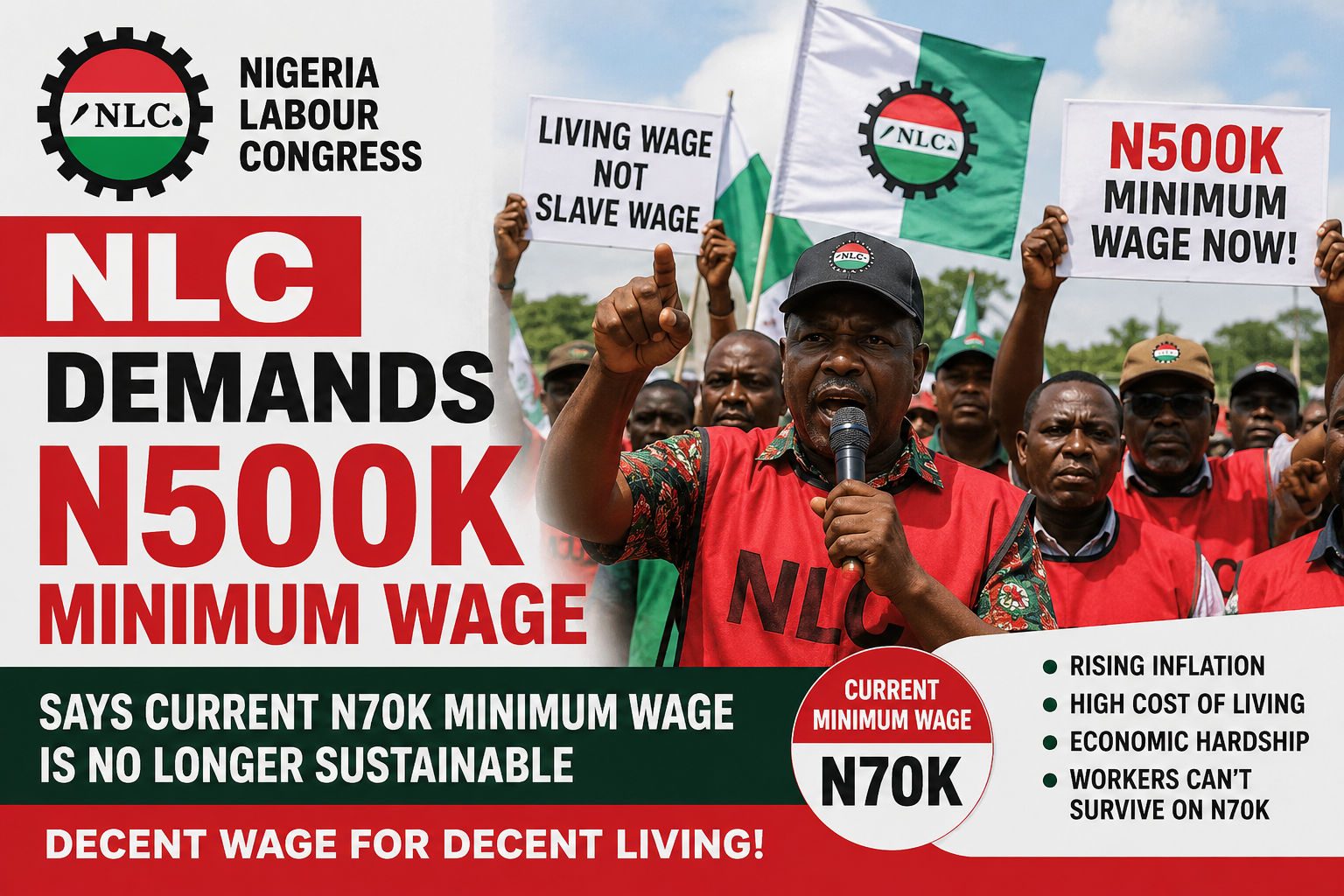
NLC demands N500k minimum wage, says current N70k minimum wage is no longer sustainable

Published

on

The Nigeria Labour Congress (NLC) says it will soon begin negotiations with the Federal Government for a new national minimum wage, insisting that the current N70,000 wage is no longer sustainable.

Speaking at the Rights of Workers Summit in Birnin Kebbi on Thursday, NLC President Joe Ajaero, represented by Deputy President Audu Titus Amba, said workers should prepare for fresh negotiations.

He argued that the current minimum wage could no longer meet workers’ basic needs amid rising inflation and the increasing cost of living.

“Anything less than N500,000 cannot cater for workers. The current minimum wage is due for review, and we will soon begin negotiations with the government,” he said.

Also speaking, Trade Union Congress (TUC) President Festus Osifo, represented by Secretary-General Nuhu Toro, said worsening economic conditions had eroded workers’ purchasing power.

He cited rising food prices, transport fares, rent and inflation as factors making the current wage inadequate.

President Tinubu signed the current national minimum wage bill into law on July 29, 2024, raising it from N30,000 to N70,000 per month. The legislation followed negotiations with organized labor and included a provision to review the wage structure every three years.

FOLLOW US ON:

FACEBOOK

TWITTER

PINTEREST

TIKTOK

YOUTUBE

LINKEDIN

INSTAGRAM

See also  NNPC, partners advance $21bn Bonga offshore project
Continue Reading
Click to comment

Leave a Reply

Your email address will not be published. Required fields are marked *

Business

FG reaffirms partnership with Taraba to unlock economic potential

Published

on

The Federal Government has reaffirmed its commitment to working with the Taraba State Government to unlock the state’s vast potential in agriculture, energy, tourism, infrastructure and mineral resources.

The Minister of Information and National Orientation, Mohammed Idris, stated this on Thursday in Jalingo at the Gala night to mark the Taraba State’s 35th anniversary and the official unveiling of the Taraba Regional Development Master Plan.

He described the newly unveiled Taraba Regional Development Master Plan as an important blueprint for sustainable growth.

Idris, who conveyed the greetings of President Bola Tinubu and the Federal Executive Council to the government and people of Taraba State, said the state’s 35th anniversary offered an opportunity not only to celebrate its progress since creation in 1991, but also to define a clear pathway for its future.

He commended Governor Agbu Kefas of Taraba for adopting a long-term development framework, saying the success of the Master Plan would ultimately depend on sustained implementation and its impact on the lives of citizens.

“The success of this Master Plan will not be measured by the ceremony at which it is unveiled, but by the roads built, businesses created, jobs generated, communities connected and lives improved,” the minister said.

Idris described Taraba as one of Nigeria’s most promising economic frontiers, with enormous opportunities in agriculture and agro-processing, livestock, hydropower, tourism, manufacturing and mineral development.

He praised the Kefas Administration for its investments in education, healthcare, infrastructure, security and economic development, particularly its policy of free and compulsory primary and secondary education.

He said the evidence was in the provision of more than N1.8 billion in 2026 to cover NECO, BECE and NABTEB examination registration for public-school students.

See also  Dangote Refinery appoints new CEO David Bird

The minister also highlighted the approximately 268 million dollars financing agreements signed between Taraba State and the ECOWAS Bank for Investment and Development for an integrated industrial park, 10,000 hectares of irrigated rice production and processing, and a 50-megawatt solar power plant in Jalingo.

He said the investments represented the kind of initiatives required to convert the state’s natural advantages into production, value addition, employment and sustainable economic growth.

Idris said Tinubu’s administration was complementing the state’s development drive through major federal infrastructure projects.

“These include the Gembu–Mbamnga–Yang (Lip) Road, the Bali–Serti–Gashaka–Gembu Road, interventions on the Jalingo–Mutum Biyu–Tella–Wukari corridor, as well as further work on the Mayo Selbe–Gembu, Mutum Biyu–Garba Chede and Jalingo–Numan roads.

“These are more than roads. They are investments in connectivity, trade, tourism, agriculture, security and the movement of people and goods,” he said.

The minister also reaffirmed the federal government’s commitment to harnessing Taraba’s agricultural, energy and mineral potential, including the strategic Mambilla Hydroelectric Power Project.

On security, Idris said the federal government was advancing reforms toward the establishment of State Police to bring policing closer to communities while ensuring professionalism, accountability and safeguards against abuse.

He said such a framework could be particularly beneficial to Taraba because of its vast terrain and dispersed border communities, where local knowledge, intelligence gathering and rapid response were critical to effective policing.

The minister also cited the establishment of the Nigerian Army’s 10 Division, headquartered in Jalingo, with operational responsibility for Taraba and Adamawa States, as evidence of the federal government’s commitment to strengthening security in the region.

“Security and development must go together. People cannot invest, farmers cannot move their produce, tourists cannot visit and businesses cannot grow where communities feel unsafe,” Idris said.

See also  Vehicle imports slide 10% on weak consumer spending

He said the federal government’s economic reforms were designed to create a stronger fiscal foundation for development, noting that the removal of petrol subsidy had mobilised N15.8 trillion in additional resources for the Federation between June 2023 and December 2025.

According to him, approximately N5.4 trillion accrued to the federal government while about N10.4 trillion went to states and local governments, providing additional resources for infrastructure, education, healthcare, security and human capital development.

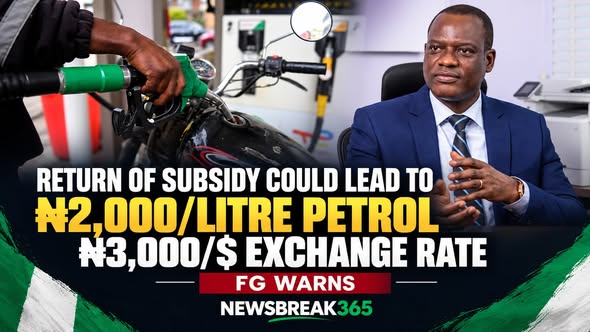
Idris said the federal government remained opposed to a return to the previous subsidy regime, stressing that the priority was to consolidate the gains of reform, protect vulnerable Nigerians and ensure that additional public resources translated into tangible improvements in citizens’ lives.

He emphasised that development must ultimately be people-centred, creating opportunities for young people, expanding women’s economic participation, supporting farmers and small businesses, and connecting communities to markets and public services.

The minister also pledged stronger collaboration between the Federal Ministry of Information and National Orientation and the Taraba State Ministry of Information and Re-Orientation to ensure citizens understand and embrace the objectives of the Master Plan.

“The vision contained in this Master Plan must go beyond government offices. It must reach the farmer, the entrepreneur, the student, the trader and communities across Taraba.

“This is because a plan for Taraba must ultimately be a plan owned by the people of Taraba,” he said.

Idris congratulated Kefas, the government, and the people of Taraba State on the state’s 35th anniversary, describing the occasion as both a celebration of Taraba’s history and a renewed commitment to its future.

See also  Embraer grows profit 38% to $218.6m in Q2

“35 years of history. A new blueprint for the future. And a renewed commitment to building the Taraba we want and the Nigeria we deserve,” the minister said.

In his remarks, Kefas also called for continuity in governance, acknowledging the contributions of former military administrators and elected governors to Taraba State’s development.

He said his administration was committed to building on previous achievements, correcting what needed to be corrected, completing worthy projects and opening new frontiers for future generations.

He stressed that the development of Taraba must remain bigger than any government, political party, ethnic group or individual, urging former leaders to continue contributing their experience and institutional knowledge to the peace, unity and prosperity of the state.

“Government must be a continuum. Development must be cumulative. Taraba is bigger than any government, any administration, any political party, any ethnic group, or any individual,” Kefas said.

He added that the ultimate credit for development belongs to the people of Taraba State.

Present at the event were the former Governor of Taraba State, Rev. Jolly Nyame; Secretary to the Government of Taraba State, Chief G.T. Kataps; Director-General of the Nigerian Television Authority, Salihu Dembos; and  Director-General of the Federal Radio Corporation of Nigeria, Dr Mohammed Bulama.

Others were the Managing Director of the Nigerian Ports Authority, Dr Abubakar Dantsoho; as well as other distinguished government officials, traditional leaders, members of the diplomatic and business communities, and other dignitaries.

NAN

Source: punchng.com

FOLLOW US ON:
FACEBOOK

TWITTER

PINTEREST

TIKTOK

YOUTUBE

LINKEDIN

INSTAGRAM

Continue Reading

Business

CBN cuts T-bill rate amid N3.63tn demand

Published

on

Investors are increasingly positioning for longer-term returns in Nigeria’s fixed-income market, with the latest treasury bills auction showing an overwhelming preference for the one-year government security.

At the Central Bank of Nigeria’s (CBN) primary market auction on Wednesday, investors submitted N3.63tn for the 364-day T-bill, representing 95.9 per cent of the N3.79tn total bids received across the three maturities.

The demand came despite the CBN lowering the stop rate on the one-year instrument by 44 basis points to 17.15 per cent, from 17.59 per cent at the previous auction.

The auction results point to a significant shift in investor appetite towards longer-dated government securities, even as demand for shorter-tenor instruments remained subdued.

The CBN had offered N700bn across the three maturities, comprising N100bn each for the 91-day and 182-day bills and N500bn for the 364-day bill.

However, total subscriptions reached approximately N3.79tn, more than five times the amount offered.

The PUNCH that the 364-day instrument was the clear outlier at the auction, receiving bids equivalent to 7.26 times the amount offered.

The CBN ultimately allotted N638.19bn, exceeding the N500bn offer by N138.19bn. Despite the additional allotment, only about 17.6 per cent of total bids submitted for the instrument were accepted.

Investors quoted yields between 16.00 per cent and 19.05 per cent, but the CBN settled at 17.15 per cent, suggesting that the level of demand allowed the regulator to reject more expensive bids.

The development is significant because the CBN achieved a lower borrowing rate even after receiving exceptionally strong demand for the security.

See also  Trade minister reveals Nigeria is exploring alternative markets as US tariffs takes effect

The contrast was stark at the shorter end of the curve. The 91-day bill attracted N103.32bn in subscriptions against N100bn offered. The CBN allotted N89.10bn at an unchanged stop rate of 16.30 per cent.

The 182-day bill performed even more weakly, attracting only N52.93bn against N100bn on offer. The CBN allotted N35.59bn, while the stop rate remained at 16.50 per cent.

Secondary-market yields for the three instruments stood above their respective auction stop rates, at 17.45 per cent for the 91-day bill, 17.05 per cent for the 182-day bill and 17.24 per cent for the 364-day bill.

According to a financial sector analyst, Jimbe Asalor, the concentration of bids in the one-year instrument suggests investors may be placing greater value on locking in relatively attractive yields over a longer period rather than repeatedly rolling over shorter-term securities.

He noted that the latest auction also demonstrates “the CBN’s ability to borrow more cheaply when demand is concentrated around a particular maturity.”

He added that by accepting N638.19bn on the 364-day bill at 17.15 per cent, the CBN borrowed above its initial offer while simultaneously cutting the rate by 44 basis points.

“The nine-basis-point difference between the auction stop rate and the 17.24 per cent secondary-market yield also indicates that the one-year segment is now trading relatively close to market expectations.”

A Lagos-based consultant economist, Chukwunonso Iheoma, said if the preference for longer-dated treasury bills persists, the development could provide further support for a gradual decline in government borrowing costs while strengthening expectations of eventual interest-rate cuts.

See also  World Bank loans drive Tinubu’s social spending agenda

Source: punchng.com

FOLLOW US ON:

FACEBOOK

TWITTER

PINTEREST

TIKTOK

YOUTUBE

LINKEDIN

INSTAGRAM

Continue Reading

Business

Nigeria’s external reserves hit $53.11bn, near 2009 record

Published

on

Nigeria’s external reserves have climbed to $53.11bn, representing their highest level in more than 17 years and bringing the country close to the reserve peak recorded in 2009.

Data from the Central Bank of Nigeria showed that reserves stood at $53.112bn as of 24 August, 2026. The figure is the highest since 12 January, 2009, when the reserves reached $53.25bn.

The latest position leaves Nigeria’s reserves just $142m short of the January 2009 level, indicating a significant recovery in the country’s external liquidity position.

The reserve buildup has accelerated since June. CBN data showed that reserves increased from $49.96bn on 3 June to $53.11bn on 24 August, representing a gain of about $3.15bn.

Reserves also rose from $51.53bn on 3 July to $53.11bn by 24 August. The position crossed the $52bn threshold on 27 July and subsequently increased to $52.86bn on 21 August.

The sustained accumulation has been supported partly by stronger oil earnings and increased dollar inflows into the economy.

Analysts say the stronger reserve position gives the country a larger cushion against external shocks and supports efforts to improve confidence in the foreign exchange market.

The buildup is occurring alongside the CBN’s tight monetary policy stance, which is aimed at containing inflation and supporting broader macroeconomic stability.

According to an Abuja-based economist, Chukwunmonso Iheoma, “The rise in reserves strengthens Nigeria’s capacity to manage external pressures and provides greater confidence in the foreign exchange market.”

He warned that the focus now should be on ensuring that the accumulation is supported by sustainable dollar inflows rather than temporary factors.

See also  Embraer grows profit 38% to $218.6m in Q2

Earlier on 19 August, the acting Director, Corporate Communications and Investor Relations Department at the CBN, Hakama Sidi-Ali, had explained that over the past 34 months, the Governor of the CBN, Olayemi Cardoso, had led bold reforms to establish the much-needed foundation for Nigeria’s next economic phase, promoting inclusive growth and job creation to alleviate poverty.

Sidi-Ali listed some of the reforms to include the unification and greater transparency of the foreign exchange market; successful banking sector recapitalisation, which, according to her, has fundamentally strengthened the resilience, capacity and competitiveness of the Nigerian banking industry.

Others are the launch of the non-resident BVN to connect Nigerians abroad with local banking services; the B-Match System for forex trading; unveiling of the Nigeria Payments System Vision 2028; and introduction of a 75 per cent Cash Reserve Ratio on non-Treasury Single Account public sector deposits to enhance liquidity management and curb inflationary risks, among other reforms.

Source: punchng.com

FOLLOW US ON:

FACEBOOK

TWITTER

PINTEREST

TIKTOK

YOUTUBE

LINKEDIN

INSTAGRAM

Continue Reading

Trending