Connect with us

News

Immigration moves to digitise border management, boost security

Published

on

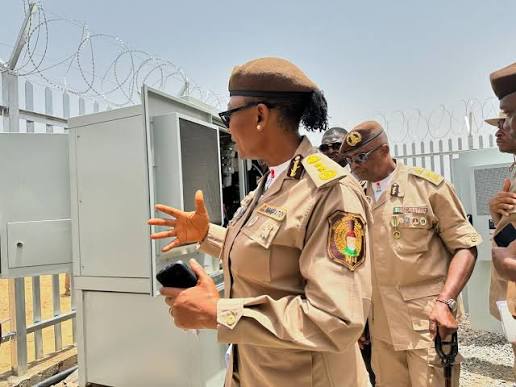
The Nigeria Immigration Service says the service is accelerating the use of digital identity systems, automated border controls and intelligence-led surveillance as part of efforts to tighten Nigeria’s borders without undermining legitimate movement and cross-border trade.

The Comptroller-General of the NIS, Kemi Nandap, disclosed this on Monday in Lagos at the 2026 conference of the African Borderlands Research Network.

The conference, themed “The Connected Borderlands: Socio-Cultural Integration and the Centrality of Policy, Research, and Security,” brought together researchers, policymakers, security practitioners and development partners to examine the changing security and socio-economic dynamics of Africa’s border regions.

Nandap said Nigeria’s approach to border management was being reshaped by changing migration patterns, regional integration, expanding cross-border commerce and increasingly sophisticated security threats.

She argued that borders could no longer be treated simply as lines separating countries, given the extent to which communities, families, cultures and economies operate across them.

According to her, the challenge for governments was to secure borders while ensuring that legitimate travellers, traders and communities were not unnecessarily restricted.

“Borders should no longer be viewed merely as geographical lines separating sovereign states, but as dynamic spaces where families, communities and cultures interact and where legitimate trade and movement take place,” she said.

Nandap identified human trafficking, migrant smuggling, identity fraud, organised crime, terrorism and cyber-enabled offences among the threats increasingly exploiting cross-border networks.

“Addressing them requires us to work differently and, importantly, to work together,” she said.

She said the NIS was consequently combining the professional expertise of its personnel with digital technology, intelligence gathering and inter-agency cooperation to detect and respond to threats more effectively.

See also  Lagos Renames Streets After Tinubu, Olamide, 9ice, Bukayo Saka [Full List]

Nigeria, she noted, had been moving towards technology-driven border administration for nearly two decades, becoming the first African country to introduce the electronic passport in 2007.

The NIS boss said the country had since upgraded its e-Passport system with enhanced biometric and security features, while digitising several stages of passport processing, including applications, payments and identity verification.

She said the centralisation of passport personalisation had also strengthened the integrity of the production process, while Nigeria’s participation in the International Civil Aviation Organisation’s Public Key Directory had enhanced the international verification of its electronic passports.

Nandap added that contactless biometric passport services were being deployed to make passport services more accessible to Nigerians outside the country without compromising security requirements.

At the country’s international airports, she said, automated border control systems, including electronic gates, were also being deployed to speed up passenger processing through biometric verification.

The service is also investing in surveillance equipment, command and control systems, communications infrastructure and integrated data platforms covering Nigeria’s land, air and maritime borders, she said.

Nandap, however, cautioned against treating technology as an end in itself.

“Their fundamental purpose is to enhance the capacity of our officers to make timely and well-informed decisions, identify emerging risks at an earlier stage and improve operational coordination, and facilitate the seamless movement of legitimate travellers while safeguarding national security,” she said.

She maintained that technology would not eliminate the need for competent immigration personnel, stressing the importance of professional judgement, experience and integrity in border operations.

See also  Wike vs Soldier: Officer Yerima broke no law – Minister, Matawalle

Beyond technology and institutional cooperation, Nandap called for stronger partnerships with communities living along Nigeria’s borders, describing them as an important source of local intelligence and strategic partners in border management.

The Chairman of ABORNE, Prof Paul Nugent, said borderlands had repeatedly become focal points of government security interventions during health emergencies and periods of regional instability.

He cited the Ebola outbreak, COVID-19 pandemic and regional insurgencies as examples of crises that had resulted in border restrictions and, in some cases, prolonged closures.

Nugent said ABORNE was seeking to narrow the gap between academic research and policymaking by bringing researchers into closer engagement with border agencies, policymakers and practitioners working in border communities.

He also urged a shift away from portraying African borderlands primarily as zones of insecurity and disorder, arguing that many had developed into centres of commerce, urban innovation and cultural exchange.

Prof Anthony Asiwaju, a former Director of the Centre for African Regional Integration and Border Studies, also commended the conference for promoting research and policy discussions around the future of African borderlands.

Source: punchng.com

FOLLOW US ON:

FACEBOOK

TWITTER

PINTEREST

TIKTOK

YOUTUBE

LINKEDIN

INSTAGRAM

Continue Reading
Click to comment

Leave a Reply

Your email address will not be published. Required fields are marked *

News

Trump dismisses report China gave Iran intel before US base attack

Published

on

US President Donald Trump on Sunday downplayed reports that Chinese entities supplied Tehran with satellite images of a military base in Jordan before and after an Iranian strike killed three US soldiers.

“You know, when they say that China spies on us, I say you’re right, and we spy on them too,” Trump told reporters aboard Air Force One a day after The Wall Street Journal reported Beijing’s intelligence sharing.

“That’s what we do. They basically do what we do,” Trump said.

The incident could deepen tensions between Washington and Beijing ahead of a planned state visit by Chinese President Xi Jinping to the White House on September 24.

On July 17, Iran launched missile strikes on the Muwaffaq Salti Air Base in Jordan, which houses US forces. Three US Army soldiers were killed.

Unnamed American officials cited in the Journal’s reporting did not name the Chinese entities involved, and did not suggest that Beijing was directly to blame.

Chinese officials asked for proof of the transfer of satellite imagery when prodded by the US officials, and refused to acknowledge that Chinese companies were involved in providing Tehran with satellite images, the Journal reported late Friday.

Trump has warned Beijing not to sell weapons to Iran, and in May, Washington sanctioned three China-based satellite companies for enabling Iran’s military operations.

China is a top economic partner of Iran, buying much of its oil output, and also an important diplomatic backer.

Still, Trump said of Xi on Sunday that “he’s behaved reasonably well, and we behave reasonably well.”

See also  Ghanaian Protest: Branding Nigerians As Criminals Amounts To Defamation – Obono-Obla Blows Hot

Asked if he would ever allow Chinese cars to be sold in the United States, Trump said, “I haven’t. I’m the one that kept them out. The tariffs kept them out.”

AFP

Source: punchng.com

FOLLOW US ON:

FACEBOOK

TWITTER

PINTEREST

TIKTOK

YOUTUBE

LINKEDIN

INSTAGRAM

Continue Reading

News

Fani-Kayode demands justice as two more Nigerians killed in South Africa

Published

on

Nigerian High Commissioner-designate to South Africa, Chief Femi Fani-Kayode, has demanded urgent action by the South African Government to protect Nigerians and bring perpetrators of killings involving Nigerian nationals to justice.

Fani-Kayode, reacting to the recent killings of Bishop Michael Taiwo Fakunle and James Uchechukwu Nwankwo in Johannesburg in a statement made available to Tribune, said he was “mortified and deeply shocked” by the developments, warning that Nigeria’s patience over the situation was wearing thin.

Fakunle was allegedly shot dead at his home in Johannesburg on September 4 after receiving a series of threats, while Nwankwo reportedly died on September 5 following what Fani-Kayode described as “gruesome interrogation techniques” by officers of the South African Police Service (SAPS).

According to the High Commissioner-designate, the two deaths bring to eight the number of Nigerians allegedly murdered in South Africa this year, with four of the cases involving South African police officers.

“Bishop Fakunle and Mr. Nwankwo are the seventh and eighth Nigerians to have been murdered in South Africa this year alone. No less than four amongst the eight were murdered by South African police officers,” he said.

Fani-Kayode further claimed that more than 100 Nigerians had been killed in South Africa since 2022, including over 30 allegedly killed by personnel of the SAPS and the South African Defence Force.

He expressed concern that, despite repeated complaints by the Nigerian authorities, no person had been arrested, detained, prosecuted or brought to justice in connection with the alleged killings.

“What is most disturbing is the fact that in spite of our constant expressions of concern about this disturbing state of affairs, not one person has been arrested, detained, prosecuted or brought to justice for any of these heinous crimes,” he said.

See also  Ghanaian Protest: Branding Nigerians As Criminals Amounts To Defamation – Obono-Obla Blows Hot

“This is unacceptable.”

Fani-Kayode called on the South African Government to intensify efforts to protect Nigerian nationals and ensure that those responsible for their deaths were prosecuted.

“We call on the South African Government to do far more to protect our nationals and to bring those that have killed or are planning to kill them to justice,” he said.

“No-one deserves to be targeted and murdered simply because they are Nigerian.”

He said the Nigerian community in South Africa was “deeply disturbed” by the developments and living in fear over what could happen next, adding that the Nigerian Mission in the country was equally concerned.

The High Commissioner-designate also condemned what he described as a fresh deadline issued to African nationals, including Nigerians, to leave South Africa by September 30.

According to him, the deadline was issued by South African non-governmental organisations which he accused of being “brazenly racist, xenophobic and Afrophobic” and of threatening Nigerian and other African nationals who failed to comply.

“We call on the South African Government to protect our people from the excesses of these racist organisations and their misguided members and to apply the full weight of the law against them for their lawless behaviour,” he said.

He also urged the South African authorities to prosecute individuals responsible for allegedly “traumatising, terrorising, torturing and killing” Nigerians.

Fani-Kayode said Nigeria remained committed to strengthening relations with South Africa but warned that continued killings and discrimination against Nigerians could undermine bilateral ties.

“Whilst we seek to establish stronger and deeper ties with the South African Government, one thing remains clear. If this vicious cycle of discrimination against and killing of our nationals does not stop, there will be consequences,” he said.

See also  El-Rufai alleges plot to stall release

“Simply put, our patience is wearing thin.”

He added: “South Africans are not targeted and killed in Nigeria by our people or our security forces. The least the South African Government can do is to reciprocate this gesture, protect our nationals and address our legitimate concerns.”

Fani-Kayode condoled with the families and associates of the two deceased Nigerians, praying that the souls of Fakunle and Nwankwo would rest in peace.

Source: tribuneonlineng.com

FOLLOW US ON:

FACEBOOK

TWITTER

PINTEREST

TIKTOK

YOUTUBE

LINKEDIN

INSTAGRAM

Continue Reading

News

My Feelings Toward Nigeria Have Changed, I Do Not Want To Go Back – Chimamanda

Published

on

Nigerian author, Chimamanda Ngozi Adichie, has said her feelings toward Nigeria have changed.

It was reports that the renowned author stated this during an interview with The New York Times while speaking on the loss of her 21-month-old son, Nkanu.

According to her, the loss has changed how she feels about her home country.

Asked whether Nigeria still felt like somewhere close to her heart, the author gave a blunt response.

“My feelings toward Nigeria have changed.

“I do not want to go back to Nigeria,” she said.

Nkanu, one of Adichie’s twin boys, died in December 2025 following a medical emergency at Euracare in Nigeria.

Recalling the incident, Adichie said a doctor approached her in a state of panic after the procedure.

“He was very calm, and he said to me, ‘Well, look, they gave him too much Propofol.’ Those were his exact words, which I will never forget until the day I die,” she recalled.

Adichie had in June publicly raised allegations of medical negligence concerning the treatment her son received at the hospital.

Speaking about the possibility of returning to Nigeria, Adichie said her children could be the only reason she would consider doing so.

She said her daughter still regarded Nigeria as her “happy place”.

Before her son’s death, Adichie said Nigeria remained deeply connected to her identity and writing, describing it as the place where she received “everything” that enabled her to become a writer.

However, the pain of losing her son has altered that connection.

See also  Shark kills man off Sydney beach

“I mean, it is so surreal, all of this. I still can’t believe we’re talking about my son who died.

“You’re going through something, but you also feel like you’re outside of it,” she said.

FOLLOW US ON:

FACEBOOK

TWITTER

PINTEREST

TIKTOK

YOUTUBE

LINKEDIN

INSTAGRAM

Continue Reading

Trending