Connect with us

Lifestyle

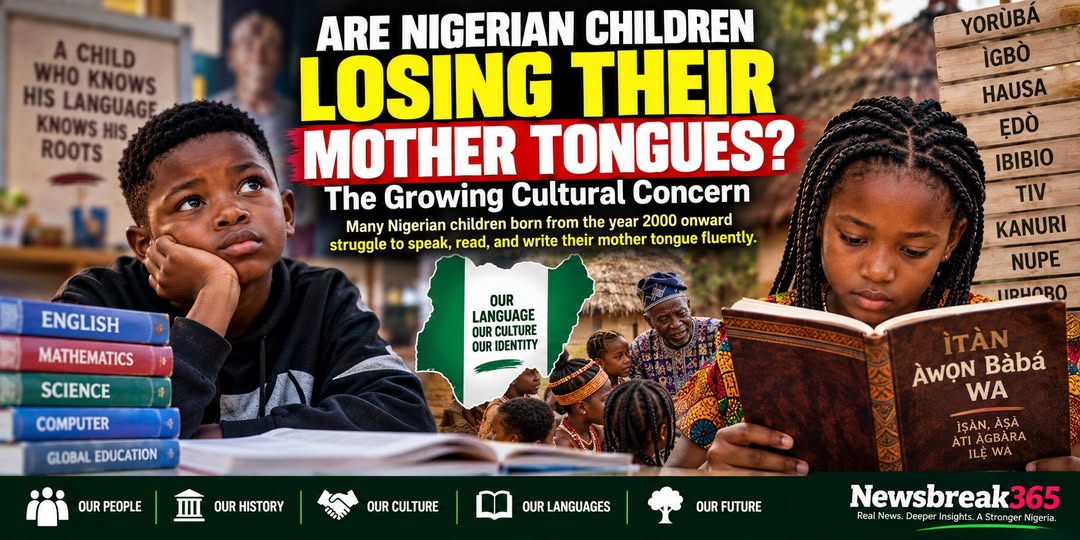
Are Nigerian Children Losing Their Mother Tongues? The Growing Cultural Concern

Published

on

By Newsbreak365

A generation that can speak English fluently but struggles with its indigenous language could face a serious cultural disconnect.

Nigeria is one of the most linguistically diverse countries in the world, with hundreds of indigenous languages spoken across its different regions and communities. Yet, an increasing number of young Nigerians appear to be growing up with limited ability to speak, read or write the language of their parents and grandparents.

For many children born from the year 2000 onward, English has become the dominant language of education, social interaction and, increasingly, communication at home.

English is undoubtedly important. It provides access to education, employment, business and communication across Nigeria and beyond. However, the growing preference for English should not necessarily come at the expense of Nigeria’s indigenous languages.

When a child cannot speak their mother tongue

Language is more than a means of communication.

It carries a people’s history, culture, traditions, values, proverbs, stories, names and worldview.

A child who cannot communicate comfortably in the language spoken by their grandparents may also struggle to understand some of the cultural meanings contained within those traditions.

Consider the traditional proverbs passed down from one generation to another. Many of them contain lessons about wisdom, family, respect, responsibility and human behaviour. When young people lose the language through which these ideas were traditionally expressed, some of that cultural knowledge can become harder to pass on.

This does not mean that every child who speaks English more fluently than an indigenous language has lost their cultural identity. Culture is complex, and people can maintain strong cultural connections in different ways.

See also  Folorunso “Foley” Okenla: The Honest Footballer Who Defied Fate

But the decline in everyday use of indigenous languages is something worth discussing.

Why are young Nigerians losing fluency?

There are several possible reasons.

1. English dominates education

For many Nigerian children, English is the primary language used in school. From textbooks and examinations to classroom discussions, English occupies a major position in formal education.

As a result, children may spend more hours every day using English than their indigenous language.

2. Parents sometimes prefer English at home

Some parents deliberately speak English to their children because they believe it will help them perform better academically or communicate more effectively in the modern world.

While that motivation is understandable, it can unintentionally reduce a child’s exposure to their indigenous language.

3. Urbanisation and mixed-language families

Nigeria’s cities bring together people from different ethnic and linguistic backgrounds. In families where parents speak different indigenous languages, English or Nigerian Pidgin may become the common language.

This can make it more difficult for children to become fluent in either parent’s mother tongue.

4. Technology and popular culture

Children today consume enormous amounts of content through smartphones, television, YouTube, TikTok and other digital platforms.

Much of the content they encounter is produced in English or other globally dominant languages. Without enough indigenous-language content, children may naturally spend less time hearing and using their ancestral languages.

Speaking is not enough

There is also an important difference between speaking an indigenous language and being able to read and write it.

Some Nigerians can communicate fluently in their mother tongue but cannot read or write it because they never learned it formally.

See also  WHAT HAPPENED TO THE AFRICAN FAMILY? — ARE WE LOSING THE VALUES THAT HELD US TOGETHER?

That creates another challenge: even when people speak their language, they may struggle to preserve written stories, historical accounts, traditional literature and educational materials in that language.

Preserving indigenous languages therefore requires more than encouraging children to speak them.

They should also have opportunities to read, write, learn and create content in those languages.

Parents have an important role

The home may be one of the most important places where language preservation begins.

Parents and grandparents can speak their indigenous language with children during everyday activities rather than treating it as something reserved for special occasions.

Children can also learn through:

Traditional stories and folktales
Proverbs and songs
Indigenous-language books
Family conversations
Cultural events
Local-language television and digital content
Reading and writing lessons
Conversations with grandparents and older relatives

The goal should not be to reject English.

The goal should be bilingual or multilingual competence rather than replacing one language with another.

A Nigerian child can learn excellent English while also being proud and fluent in Yoruba, Igbo, Hausa, Efik, Edo, Tiv, Ibibio, Nupe, Urhobo, Kanuri or another indigenous language.

Our languages are part of our heritage

Nigeria’s linguistic diversity is one of its greatest cultural assets.

Every indigenous language represents generations of human experience. Within those languages are expressions, names, jokes, songs, proverbs and ways of describing the world that may not have direct equivalents in another language.

When a language becomes less widely spoken, that cultural knowledge can become increasingly difficult to pass on.

That is why the conversation should not be about choosing between English and indigenous languages.

See also  Nollywood actor Lateef Adedimeji, wife welcome triplet sons

Nigeria does not have to choose one or the other.

We can raise children who speak English confidently while also knowing the language of their parents and grandparents.

The question for Nigerian parents

The responsibility does not belong to parents alone. Schools, governments, communities, writers, filmmakers, technology companies and content creators can all contribute to keeping indigenous languages relevant to younger generations.

But parents have a particularly powerful advantage: children learn the language they hear and use every day.

If we want our indigenous languages to survive, we must make them part of everyday life.

The question is therefore not simply whether today’s children can speak English.

The bigger question is:

Will tomorrow’s generation still be able to speak the languages that connect them to their cultural roots?

What do you think?

Are Nigerian parents doing enough to teach their children their mother tongue?

Is the dominance of English responsible for the decline in indigenous-language fluency, or are there other factors that deserve more attention?

Tell us your opinion in the comments.

And if you believe Nigerian indigenous languages should be preserved for future generations, share this article with your family and friends.

Our languages are more than words. They carry our history, our culture and our identity.

FOLLOW US ON:

FACEBOOK

TWITTER

PINTEREST

TIKTOK

YOUTUBE

LINKEDIN

INSTAGRAM

Continue Reading
Click to comment

Leave a Reply

Your email address will not be published. Required fields are marked *

Lifestyle

Growing Old Does Not Automatically Make You Wise: Even Fools Grow Old

Published

on

Age is inevitable, but wisdom is a choice. Having grey hair, wrinkles, and decades of experience does not automatically make someone intelligent, mature, or worthy of admiration. Sometimes, the oldest people in the room are still the ones who have learned the least from life.**

There is an uncomfortable truth that many people do not want to hear: growing old does not necessarily mean growing wise. Time adds years to our lives, but it does not automatically add understanding, intelligence, humility, or good judgment.

Society has created an unwritten rule that older people must always be respected, listened to, and treated as authorities simply because they have lived longer. While respecting older people is important, we must stop pretending that age alone is proof of wisdom.

Some people have spent 60, 70, or even 80 years on this earth without making meaningful progress in their thinking. They have watched generations come and go, experienced different stages of life, witnessed countless mistakes, and yet continue repeating the same foolish behaviours.

They have grey hair but still harbour jealousy. They have wrinkles but lack compassion. They have decades of experience but refuse to accept correction. They demand respect while showing little respect for others.

**What exactly is the achievement in growing old if you have refused to grow mentally?**

## Age Is Not a Certificate of Wisdom

One of the biggest mistakes people make is assuming that someone who is older must automatically know better.

Unfortunately, that is not always true.

See also  Declare Your Lineage – Royal Family Tells Musician KWAM 1 Over His Interest In Becoming Next Awujale Of Ijebuland

There are elderly people who are wise, humble, generous, patient, and knowledgeable. Their life experiences have taught them valuable lessons, and their behaviour reflects those lessons.

But there are also elderly people who remain arrogant, manipulative, dishonest, intolerant, and stubborn. They use their age as a weapon to silence younger people and prevent anyone from questioning their behaviour.

They believe that because they were born earlier, their opinions must be superior.

But wisdom does not work that way.

A younger person who learns from mistakes, listens to advice, treats people fairly, and thinks critically may demonstrate greater wisdom than someone who has lived twice as long but refuses to learn anything.

## Some People Grow Older Without Growing Better

Age should bring reflection. It should teach people patience, understanding, emotional maturity, and the importance of treating others with dignity.

However, some people become older without becoming better human beings.

They remain trapped in outdated beliefs, unnecessary pride, bitterness, and the mentality that they are always right.

They cannot apologise because they believe apologising makes them weak. They cannot accept correction because they consider disagreement disrespectful. They cannot admit their mistakes because their ego has become bigger than their wisdom.

Instead of becoming examples for younger generations, they become warnings about the dangers of allowing pride and ignorance to control one’s life.

**Living for many years is not the same as learning from those years.**

## Respect Should Come With Character, Not Just Age

This does not mean younger people should disrespect older people. Respect, courtesy, and appreciation for life experience remain important values.

See also  WHAT HAPPENED TO THE AFRICAN FAMILY? — ARE WE LOSING THE VALUES THAT HELD US TOGETHER?

However, respect should not be confused with blind obedience.

Being older does not give anyone permission to insult others, intimidate younger generations, promote harmful behaviour, or demand unquestionable authority.

True elders are not remembered merely for how long they lived. They are remembered for the lessons they taught, the lives they influenced, the wisdom they demonstrated, and the positive examples they left behind.

A person who has lived for 80 years but has never learned humility may have more birthdays than someone who is 30, but that does not automatically make them wiser.

## The Brutal Truth: Even Fools Grow Old!

Everybody who lives long enough will eventually grow old. But not everybody will develop wisdom.

Some people accumulate years without accumulating knowledge. Others accumulate experiences without understanding the lessons those experiences were supposed to teach.

The difference between getting older and becoming wiser is the willingness to learn, reflect, accept correction, and change.

Do not be impressed by grey hair alone. Look at someone’s character, behaviour, judgment, and the lessons their life demonstrates.

Because, at the end of the day, **age is a gift of time, but wisdom is the reward of learning.**

Even fools grow old!

## What Do You Think?

Should older people automatically receive respect simply because of their age, or should respect be earned through good character, behaviour, and wisdom?

Can a 30-year-old genuinely be wiser than someone who is 70?

Is society sometimes too quick to excuse bad behaviour simply because the person involved is elderly?

Share your honest opinion. This is a conversation worth having.

See also  Lady sues Peller, demands N395m for filming her without consent

**Newsbreak365 – Bringing you the conversations that matter.**


Continue Reading

Lifestyle

Empty Drums Make the Loudest Noise: Why People With Nothing to Offer Often Make the Most Noise

Published

on

Some people have mastered the art of making noise without having anything meaningful to show for it. They brag about imaginary achievements, make promises they cannot fulfil, criticise everyone around them, and behave as though they are more important than everybody else. But when reality demands evidence, their true worth becomes exposed.**

There is an old saying that never loses its relevance: *Empty drums make the loudest noise.*

Interestingly, this proverb describes a certain category of people whose greatest achievement appears to be talking about themselves.

They want everybody to know how wealthy they are, how influential they have become, how many connections they have, and how much they can accomplish. Yet, when someone genuinely needs their assistance, their confidence suddenly disappears.

They make big promises but deliver little. They advertise their generosity but rarely demonstrate it. They talk about success but have very little substance behind their words.

**The tragedy is that they mistake making noise for making progress.**

## They Talk Big, But Their Actions Tell a Different Story

Some people can spend hours explaining how powerful, successful, intelligent, and connected they are.

They will tell you about the people they know, the opportunities they control, and the things they supposedly own.

But ask them to demonstrate even a fraction of what they claim, and suddenly, excuses begin to appear.

Their mouths are full of promises, but their hands are empty.

They want applause for things they have not accomplished and recognition for achievements that exist only in their conversations.

See also  Colonel Ahmed Usman (20 August 1951 - 14 April 2021)

## They Criticise Everyone Because They Have Nothing Better to Show

One disturbing characteristic of empty barrels is their obsession with other people’s lives.

They have an opinion about everybody’s mistakes, failures, relationships, financial situation, and personal decisions.

They are quick to expose another person’s weaknesses but completely blind to their own shortcomings.

They spend so much time discussing other people’s progress that they forget to work on their own.

Instead of building something meaningful, they dedicate their energy to pulling others down.

## Real Value Does Not Need Constant Advertisement

There is a difference between someone who genuinely has substance and someone who desperately wants to appear important.

People with genuine achievements do not need to turn every conversation into an opportunity to impress others.

They understand that character, integrity, consistency, generosity, and results speak louder than endless self-praise.

Real success is not measured by how loudly someone announces it. It is measured by what they have actually accomplished and the positive difference they make.

**A person who constantly announces their greatness may be trying too hard to convince others of something they have not even convinced themselves of.**

## Stop Being Impressed by Noise

Not everybody who speaks confidently knows what they are talking about.

Not everybody who promises assistance has the intention or ability to help.

Not everybody who dresses like a millionaire has the character of a successful person.

And not everybody who constantly talks about their achievements has anything substantial to show.

Learn to judge people by their actions, not their advertisements.

See also  Don’t Look Down on Others Because of Your Wealth or Position

Do not confuse arrogance with confidence, noise with intelligence, or empty promises with genuine commitment.

Sometimes, the loudest person in the room has the least to offer.

## Final Thoughts: Less Noise, More Substance!

Life is too short to spend it competing over who can talk the loudest.

Instead of constantly telling people how great you are, build something that speaks for itself.

Instead of making promises, deliver results.

Instead of criticising everybody, work on improving yourself.

And instead of demanding respect, develop the character that deserves it.

**Remember: An empty drum can attract attention with its noise, but attention is not the same as value.**

**THE BIG QUESTION:** Are the loudest people really the most successful, or are some simply using noise to hide their lack of substance?

What is your experience? Have you encountered people who talk big but deliver absolutely nothing? Share your thoughts in the comments.

—

*Newsbreak365 — Bringing You Stories, Opinions and Perspectives That Matter.*


Continue Reading

Lifestyle

When Help Becomes a Weapon: The People Who Remind You of Their Kindness Just to Make You Feel Worthless

Published

on

Not everyone who helps you genuinely wants to see you succeed. Some people offer assistance today so they can use it as a weapon against your dignity tomorrow.**

There is a particular kind of humiliation that comes from receiving help from someone who never allows you to forget it.

They give you money, buy you food, pay your bills or support you during difficult moments. At first, you see their actions as kindness. You appreciate their generosity and remain grateful for everything they have done.

But as time passes, something changes.

Every conversation becomes an opportunity to remind you of their sacrifices. Every disagreement becomes a reason to bring up the money they gave you. Every gathering becomes an opportunity to announce to other people how much they have done for you.

Suddenly, your personal struggles become public entertainment.

**Is that generosity, or is it a calculated attempt to control another human being?**

## When generosity becomes public humiliation

Some people cannot help you privately. They want an audience.

They want your family, friends, neighbours and even strangers to know that they once rescued you from a difficult situation.

They repeatedly announce:

– “I was the one feeding you when nobody cared.”
– “I gave you money when you had nothing.”
– “Without me, you wouldn’t have survived.”
– “Look at everything I have done for you!”

Their intention appears to be more than reminding you of their kindness. They want to establish a position of superiority over you.

They want everyone to see themselves as the generous benefactor and you as the helpless individual who cannot survive independently.

See also  Lady sues Peller, demands N395m for filming her without consent

Unfortunately, some people measure their importance by how dependent they can make others feel.

## They don’t want you to forget your struggles

The most disturbing part is that some people seem uncomfortable when the person they once helped begins to stand on their own feet.

Instead of celebrating your progress, they remind you of your past.

You could get a better job, start a business, become financially independent or improve your circumstances, but they still want to introduce you as the person they once helped.

Why?

Because your independence threatens the position of superiority they have built around your dependence.

They may have helped you when you were struggling, but that does not give them permanent ownership of your life.

**Helping someone should never become a lifetime licence to humiliate them.**

## Gratitude should not mean surrendering your dignity

Let’s make something clear: Being grateful is important.

If someone genuinely supports you during difficult times, appreciating that person is the right thing to do.

However, gratitude and humiliation are two different things.

You can appreciate someone’s generosity without accepting public embarrassment. You can acknowledge their sacrifices without allowing them to control your decisions. You can remember their kindness without being reminded of it every week.

A good deed should not become a chain around another person’s neck.

True generosity does not need constant public announcements to prove its value.

## The painful truth: Some people want appreciation, others want control

There is a difference between someone who helps because they genuinely care and someone who helps because they want to feel superior.

See also  Folorunso “Foley” Okenla: The Honest Footballer Who Defied Fate

The first person celebrates your independence.

The second person constantly reminds you that you once needed them.

The first person wants to see you rise.

The second person may prefer that you remain beneath them so they can continue feeling important.

And perhaps the greatest lesson is this: Never allow someone’s financial assistance to convince you that your dignity has no value.

You may have needed help yesterday, but that does not mean you are destined to remain dependent tomorrow.

**Remember: You can owe someone gratitude without owing them your freedom, your silence or your self-respect.**

## The Big Question: Is It Really Kindness?

If someone gives you money, feeds you, pays your bills and supports you during difficult times, but constantly uses those actions to embarrass you before other people, should you still consider that person genuinely generous?

Or does helping someone become meaningless when it is repeatedly used to destroy their confidence and dignity?

Perhaps it is time we had an honest conversation about the difference between genuine kindness and generosity used as a tool for control.

**What do you think?**

1. Should people who help others be allowed to remind them publicly of everything they have done?
2. Is it better to struggle alone than depend on someone who constantly humiliates you?
3. Do some people genuinely help others, or do they sometimes help just to feel superior?

Share your opinion. This conversation deserves an honest debate.

—

**Newsbreak365 Editorial | Human Behaviour, Relationships and Society**


Continue Reading

Trending