Connect with us

Lifestyle

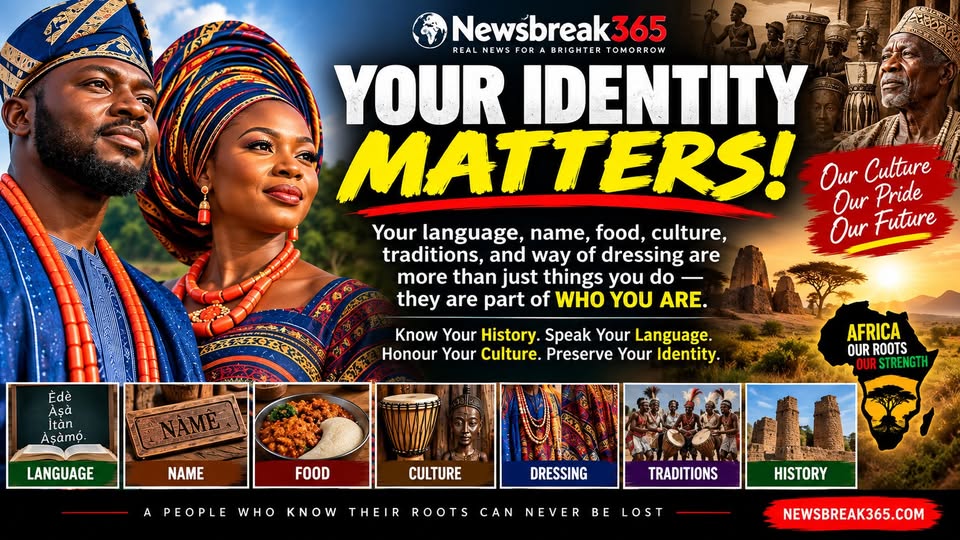
Your Language, Name and Culture Are Your Identity: Why We Must Preserve Our Roots

Published

on

By Newsbreak365 | Culture & Heritage

Your language. Your name. Your food. Your traditions. Your history. Your culture. These are more than ordinary things—they can be powerful expressions of your identity.

In today’s rapidly changing world, people are increasingly exposed to different cultures, languages, lifestyles, and beliefs. This cultural exchange can be valuable, but it also raises an important question:

As we embrace the modern world, are we losing touch with our roots?

Your Culture Is Part of Your Identity

Identity is shaped by many things, including family, experiences, values, history, language, and culture.

For many Africans, cultural identity is expressed through traditional names, indigenous languages, food, clothing, music, dance, festivals, storytelling, greetings, family traditions, and community values.

These traditions connect generations.

A grandmother teaching her grandchildren an indigenous language is not simply teaching them words. She may also be passing down stories, proverbs, history, humour, and knowledge that could otherwise disappear.

Never Be Ashamed of Your Name

Names can carry history and meaning.

Across many African communities, names may reflect family circumstances, hopes for a child, ancestral connections, significant events, religious beliefs, or cultural traditions.

Unfortunately, some people grow up feeling pressured to hide or change traditional names because they believe foreign or Western names are more acceptable.

There is nothing wrong with having a name from another culture. But there is also nothing wrong with proudly carrying a traditional African name.

Your name can be a connection to your family and your heritage.

Speak Your Language

Language is one of the strongest tools for preserving culture.

See also  NHIA expands healthcare access for vulnerable Nigerians

When an indigenous language disappears from everyday use, more than vocabulary can be lost. Proverbs, songs, oral history, expressions, traditional knowledge, and unique ways of describing the world can disappear with it.

Parents have an important role to play.

If you know your ancestral language, speak it with your children. Teach them simple words. Explain the meanings of traditional expressions. Encourage them to ask questions.

Learning another language should not require forgetting your own.

You can speak English, French, Dutch, or any other language while still proudly speaking your mother tongue.

Food Can Keep Heritage Alive

Walk into an African home and you may discover that culture is also served on a plate.

Traditional meals often carry memories of childhood, family gatherings, celebrations, weddings, festivals, and community life.

Whether it is amala and ewedu, pounded yam and egusi, jollof rice, moi moi, suya, okra soup, or other traditional dishes, food can create a powerful connection to heritage.

Teaching children how traditional meals are prepared is another way of keeping cultural knowledge alive.

Clothing Tells a Story

Traditional clothing can also express identity.

African fabrics, designs, colours, beads, headwear, jewellery, and ceremonial clothing can communicate where someone comes from and the occasion being celebrated.

Wearing modern clothes does not mean traditional clothing has to disappear.

There is room for both.

You can dress for the modern world while still celebrating the clothing and fashion traditions of your ancestors.

Embracing Modernity Does Not Mean Abandoning Your Roots

This is perhaps the most important point.

Preserving culture does not mean refusing to change.

See also  We don’t want to see you in Edo, gov’s aide warns Davido

You can live in Europe, America, Asia, or anywhere else in the world and still maintain a connection with your heritage.

You can use smartphones, work in modern industries, travel internationally, speak multiple languages, and embrace new ideas while still respecting your ancestral traditions.

Progress and cultural preservation can exist together.

What Happens When a Generation Forgets?

Every culture changes over time. That is normal.

But when people deliberately abandon their language, history, names, traditions, and cultural practices because they are ashamed of them, something important can be lost.

Imagine a generation that can no longer speak the language of its grandparents.

Imagine children who know almost nothing about their ancestral communities.

Imagine traditional songs, stories, names, recipes, and customs disappearing because nobody took the time to pass them on.

That is why cultural preservation matters.

Preserve Your Culture for the Next Generation

Parents, grandparents, teachers, historians, community leaders, and young people all have a role to play.

We can preserve our heritage by:

Teaching children indigenous languages.
Documenting family and community history.
Teaching children the meanings behind traditional names.
Preparing and passing down traditional foods.
Supporting cultural festivals and events.
Preserving traditional music, stories, and art.
Teaching younger generations about their ancestral communities.
Encouraging pride without promoting hatred or disrespect toward other cultures.

You do not have to hate another culture to love your own.

Respecting other people’s identities should not require abandoning yours.

Know Your History. Speak Your Language. Honour Your Culture.

Culture is not simply something inherited from the past.

It is something that each generation decides whether to preserve, adapt, or allow to disappear.

See also  Lord Frederick Lugard and the Amalgamation of Nigeria.

The question is not whether culture will change—it will.

The question is:

What valuable parts of our culture will we make sure survive?

Your language can connect you to your ancestors.

Your name can carry your family’s story.

Your food can preserve memories.

Your clothing can express heritage.

Your traditions can connect generations.

Your history can teach future generations where they came from.

If You Don’t Preserve Your Culture, Who Will Preserve It for the Next Generation?

Know your history.
Speak your language.
Honour your culture.
Be proud of your heritage.
Preserve your identity.

What part of your culture do you believe the next generation must never lose?

Share your thoughts in the comments.

FOLLOW US ON:

FACEBOOK

TWITTER

PINTEREST

TIKTOK

YOUTUBE

LINKEDIN

INSTAGRAM

Continue Reading
Click to comment

Leave a Reply

Your email address will not be published. Required fields are marked *

Lifestyle

Why Did Women Stop Wearing the Under-Skirt? The Fashion Tradition Many People Remember

Published

on

There was a time when wearing an under-skirt, half-slip or petticoat beneath a dress or skirt was considered a normal part of a woman’s everyday dressing.

For many women of older generations, especially in Africa, the under-skirt was not simply a fashion accessory. It could provide an extra layer beneath dresses, improve how clothing fell, reduce transparency and help create a more modest appearance.

Today, however, the garment is far less common in everyday fashion. So, what happened?

A Fashion Tradition That Has Faded

Fashion has changed dramatically over the decades. Clothing styles have become more fitted, lighter and more casual, while modern underwear and garment materials have also evolved.

Many dresses and skirts are now manufactured with built-in lining, making an additional under-skirt unnecessary in some cases. Modern shapewear, slips and other alternatives have also taken the place of the traditional half-slip for some women.

Convenience is another factor. Many people simply prefer wearing fewer layers, particularly in warm climates.

What About Our Mothers and Grandmothers?

For older generations, the under-skirt may bring back memories of a very different era of dressing.

In many families, girls were taught that certain clothing should be worn with an additional layer underneath. It was associated with modesty, neatness and proper dressing.

But younger generations have grown up with very different fashion influences. Social media, global fashion trends and changing attitudes toward clothing have all contributed to the decline of some traditional dressing practices.

Is the Under-Skirt Making a Comeback?

Interestingly, fashion often comes full circle.

See also  Phebean Ajibola Ogundipe: The Educator Who Shaped English Learning in Nigeria

Vintage and retro styles regularly return, and garments that once seemed outdated can become fashionable again. Slips and petticoats have also appeared in different forms in contemporary fashion.

Whether the traditional under-skirt will return as an everyday item remains uncertain. But one thing is clear: many people still remember it.

What Do You Think?

Did your mother or grandmother wear an under-skirt?

Do you remember seeing women wearing them when you were growing up?

And do you think this old-fashioned garment should make a comeback, or has modern fashion simply moved on?

Share your memories and opinions in the comments.

NewsBreak365 — Stories, Culture & Conversations That Matter.

FOLLOW US ON:

FACEBOOK

TWITTER

PINTEREST

TIKTOK

YOUTUBE

LINKEDIN

INSTAGRAM

Continue Reading

Lifestyle

Are Nigerian Children Losing Their Mother Tongues? The Growing Cultural Concern

Published

on

By Newsbreak365

A generation that can speak English fluently but struggles with its indigenous language could face a serious cultural disconnect.

Nigeria is one of the most linguistically diverse countries in the world, with hundreds of indigenous languages spoken across its different regions and communities. Yet, an increasing number of young Nigerians appear to be growing up with limited ability to speak, read or write the language of their parents and grandparents.

For many children born from the year 2000 onward, English has become the dominant language of education, social interaction and, increasingly, communication at home.

English is undoubtedly important. It provides access to education, employment, business and communication across Nigeria and beyond. However, the growing preference for English should not necessarily come at the expense of Nigeria’s indigenous languages.

When a child cannot speak their mother tongue

Language is more than a means of communication.

It carries a people’s history, culture, traditions, values, proverbs, stories, names and worldview.

A child who cannot communicate comfortably in the language spoken by their grandparents may also struggle to understand some of the cultural meanings contained within those traditions.

Consider the traditional proverbs passed down from one generation to another. Many of them contain lessons about wisdom, family, respect, responsibility and human behaviour. When young people lose the language through which these ideas were traditionally expressed, some of that cultural knowledge can become harder to pass on.

This does not mean that every child who speaks English more fluently than an indigenous language has lost their cultural identity. Culture is complex, and people can maintain strong cultural connections in different ways.

See also  Phebean Ajibola Ogundipe: The Educator Who Shaped English Learning in Nigeria

But the decline in everyday use of indigenous languages is something worth discussing.

Why are young Nigerians losing fluency?

There are several possible reasons.

1. English dominates education

For many Nigerian children, English is the primary language used in school. From textbooks and examinations to classroom discussions, English occupies a major position in formal education.

As a result, children may spend more hours every day using English than their indigenous language.

2. Parents sometimes prefer English at home

Some parents deliberately speak English to their children because they believe it will help them perform better academically or communicate more effectively in the modern world.

While that motivation is understandable, it can unintentionally reduce a child’s exposure to their indigenous language.

3. Urbanisation and mixed-language families

Nigeria’s cities bring together people from different ethnic and linguistic backgrounds. In families where parents speak different indigenous languages, English or Nigerian Pidgin may become the common language.

This can make it more difficult for children to become fluent in either parent’s mother tongue.

4. Technology and popular culture

Children today consume enormous amounts of content through smartphones, television, YouTube, TikTok and other digital platforms.

Much of the content they encounter is produced in English or other globally dominant languages. Without enough indigenous-language content, children may naturally spend less time hearing and using their ancestral languages.

Speaking is not enough

There is also an important difference between speaking an indigenous language and being able to read and write it.

Some Nigerians can communicate fluently in their mother tongue but cannot read or write it because they never learned it formally.

See also  I’m not in supremacy battle with any monarch- Alaafin

That creates another challenge: even when people speak their language, they may struggle to preserve written stories, historical accounts, traditional literature and educational materials in that language.

Preserving indigenous languages therefore requires more than encouraging children to speak them.

They should also have opportunities to read, write, learn and create content in those languages.

Parents have an important role

The home may be one of the most important places where language preservation begins.

Parents and grandparents can speak their indigenous language with children during everyday activities rather than treating it as something reserved for special occasions.

Children can also learn through:

Traditional stories and folktales
Proverbs and songs
Indigenous-language books
Family conversations
Cultural events
Local-language television and digital content
Reading and writing lessons
Conversations with grandparents and older relatives

The goal should not be to reject English.

The goal should be bilingual or multilingual competence rather than replacing one language with another.

A Nigerian child can learn excellent English while also being proud and fluent in Yoruba, Igbo, Hausa, Efik, Edo, Tiv, Ibibio, Nupe, Urhobo, Kanuri or another indigenous language.

Our languages are part of our heritage

Nigeria’s linguistic diversity is one of its greatest cultural assets.

Every indigenous language represents generations of human experience. Within those languages are expressions, names, jokes, songs, proverbs and ways of describing the world that may not have direct equivalents in another language.

When a language becomes less widely spoken, that cultural knowledge can become increasingly difficult to pass on.

That is why the conversation should not be about choosing between English and indigenous languages.

See also  Lord Frederick Lugard and the Amalgamation of Nigeria.

Nigeria does not have to choose one or the other.

We can raise children who speak English confidently while also knowing the language of their parents and grandparents.

The question for Nigerian parents

The responsibility does not belong to parents alone. Schools, governments, communities, writers, filmmakers, technology companies and content creators can all contribute to keeping indigenous languages relevant to younger generations.

But parents have a particularly powerful advantage: children learn the language they hear and use every day.

If we want our indigenous languages to survive, we must make them part of everyday life.

The question is therefore not simply whether today’s children can speak English.

The bigger question is:

Will tomorrow’s generation still be able to speak the languages that connect them to their cultural roots?

What do you think?

Are Nigerian parents doing enough to teach their children their mother tongue?

Is the dominance of English responsible for the decline in indigenous-language fluency, or are there other factors that deserve more attention?

Tell us your opinion in the comments.

And if you believe Nigerian indigenous languages should be preserved for future generations, share this article with your family and friends.

Our languages are more than words. They carry our history, our culture and our identity.

FOLLOW US ON:

FACEBOOK

TWITTER

PINTEREST

TIKTOK

YOUTUBE

LINKEDIN

INSTAGRAM
Continue Reading

Lifestyle

Heal From Your Past So You Don’t Punish a Good Person for Someone Else’s Pain

Published

on

Sometimes, the person standing before you is not the person who hurt you. Yet, if you have not healed from your past, you may end up treating them as though they are.

Past experiences can leave deep emotional scars. Betrayal, heartbreak, rejection, abandonment, lies and disappointment can change the way a person approaches relationships.

After being hurt, it is understandable to become more cautious. You may find it difficult to trust again or become afraid of becoming vulnerable.

But there is an important lesson everyone should remember:

A good person should not be punished for the mistakes of someone from your past.

Your Past Can Influence Your Present

When someone has experienced repeated disappointment, they may begin expecting the worst from everyone.

Someone who was cheated on may suspect their new partner of cheating.

Someone who was constantly lied to may question even the truth.

Someone who was abandoned may push people away before they have the opportunity to leave.

Someone who was treated badly may become defensive even when someone else is genuinely trying to love and support them.

These reactions may come from pain rather than bad intentions. However, unresolved pain can still damage a healthy relationship.

Not Everyone Is Your Ex

One of the most important things to understand when entering a new relationship is that a new person deserves to be judged by their own actions, not by the actions of someone who came before them.

Your previous partner may have betrayed you, but that does not automatically mean your new partner will do the same.

See also  Folorunso “Foley” Okenla: The Honest Footballer Who Defied Fate

Someone may have broken your trust, but that does not mean everyone you meet is dishonest.

Someone may have taken advantage of your kindness, but that does not mean you should close your heart to every person who genuinely cares about you.

People are individuals.

Don’t make someone innocent carry the punishment for another person’s mistakes.

Healing Does Not Mean Forgetting

Healing does not mean pretending that the pain never happened.

It does not mean allowing people to hurt you repeatedly.

It does not mean ignoring red flags or trusting everyone blindly.

Healing means learning from what happened without allowing it to control every new relationship.

You can remember what happened and still choose to move forward.

You can protect yourself without building walls around your heart.

You can be cautious without becoming cruel.

Most importantly, you can recognize that your past is part of your story, but it does not have to control your future.

Don’t Push Away Someone Who Is Trying to Love You

Sometimes, a person spends so much time protecting themselves from being hurt that they eventually push away the very person who genuinely cares about them.

They constantly test their partner.

They assume the worst.

They create arguments over things that have nothing to do with their current relationship.

They refuse to communicate because they are afraid of being vulnerable.

Eventually, the good person may become exhausted and walk away.

And sometimes, only after losing them does the wounded person realize:

“They were not the person who hurt me.”

See also  Phebean Ajibola Ogundipe: The Educator Who Shaped English Learning in Nigeria

That realization can come too late.

Give Good People a Fair Chance

Everyone deserves to be treated according to who they are and what they do—not according to someone else’s mistakes.

If someone consistently shows you honesty, respect, kindness and genuine love, allow their actions to speak for themselves.

Don’t let yesterday make you blind to what is happening today.

Of course, trust should be earned, and healthy boundaries are important. But there is a difference between protecting yourself and punishing someone who has done nothing wrong.

The Lesson

Before you enter a new relationship, friendship or important connection, take time to examine your wounds.

Ask yourself:

Am I responding to this person’s actions—or am I reacting to something someone else did to me?

That question can change everything.

Your healing is not only about making yourself feel better. It can also prevent you from transferring your pain onto innocent people.

Heal from your past, so you don’t punish a good person for the pain someone else caused you.

Because sometimes, the person you are pushing away is not your enemy.

They may simply be someone who came into your life hoping to love you better.

Final Thought

Don’t allow a painful chapter of your life to determine the ending of your entire story.

Learn from the past. Set healthy boundaries. Forgive where necessary. Give yourself time to heal.

And when a genuinely good person comes into your life, don’t make them pay a debt they never owed.

Heal. Grow. Forgive. Love wisely. And give good people a fair chance.

See also  We don’t want to see you in Edo, gov’s aide warns Davido

FOLLOW US ON:

FACEBOOK

TWITTER

PINTEREST

TIKTOK

YOUTUBE

LINKEDIN

INSTAGRAM

Continue Reading

Trending