Connect with us

Lifestyle

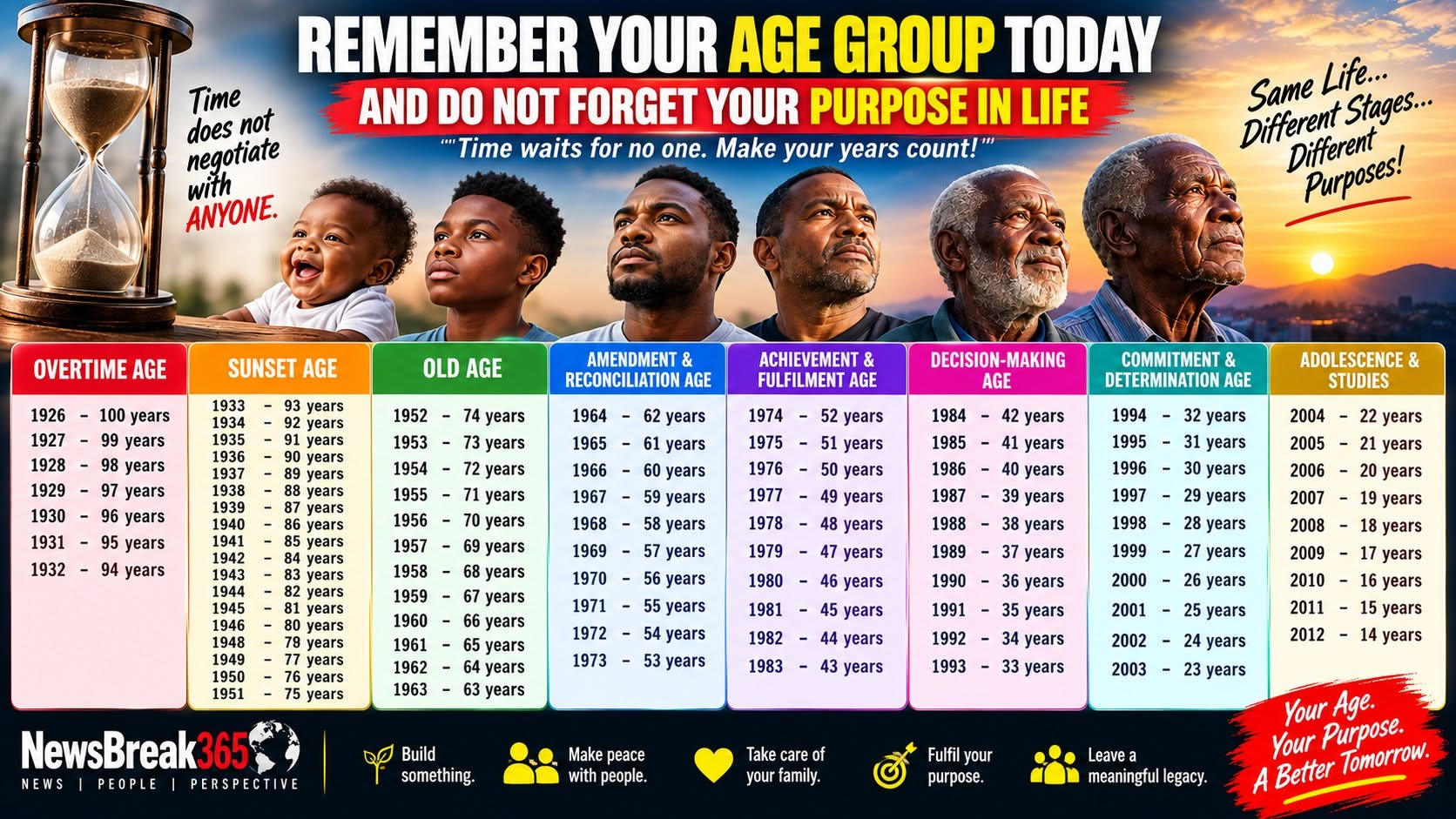
REMEMBER YOUR AGE GROUP TODAY, AND DO NOT FORGET YOUR PURPOSE IN LIFE.

Published

on

🚨 STOP SCROLLING! YOUR AGE IS NOT JUST A NUMBER — IT IS A WARNING! ⏳

REMEMBER YOUR AGE GROUP TODAY, AND DO NOT FORGET YOUR PURPOSE IN LIFE.
Some people are 50 but still behave as if they have unlimited time.

Some are 40 and still waiting for life to begin.

Some are 30 and wasting their best years chasing things that will not matter in the end.

And some are already 60, 70 or 80, looking back and wishing they had made different decisions.

TIME DOES NOT NEGOTIATE WITH ANYONE.

Look at the year you were born and calculate your age:

⏳ OVERTIME AGE

1926 — 100 years
1927 — 99 years
1928 — 98 years
1929 — 97 years
1930 — 96 years
1931 — 95 years
1932 — 94 years

🌅 SUNSET AGE

1933 — 93 years
1934 — 92 years
1935 — 91 years
1936 — 90 years
1937 — 89 years
1938 — 88 years
1939 — 87 years
1940 — 86 years
1941 — 85 years
1942 — 84 years
1943 — 83 years
1944 — 82 years
1945 — 81 years
1946 — 80 years
1947 — 79 years
1948 — 78 years
1949 — 77 years
1950 — 76 years
1951 — 75 years

👴🏽 OLD AGE

1952 — 74 years
1953 — 73 years
1954 — 72 years
1955 — 71 years
1956 — 70 years
1957 — 69 years
1958 — 68 years
1959 — 67 years
1960 — 66 years
1961 — 65 years
1962 — 64 years
1963 — 63 years

See also  SOME PEOPLE ARE NEVER SATISFIED WITH WHAT THEY HAVE

🤝🏽 AMENDMENT & RECONCILIATION AGE

1964 — 62 years
1965 — 61 years
1966 — 60 years
1967 — 59 years
1968 — 58 years
1969 — 57 years
1970 — 56 years
1971 — 55 years
1972 — 54 years
1973 — 53 years

🏆 ACHIEVEMENT & FULFILMENT AGE

1974 — 52 years
1975 — 51 years
1976 — 50 years
1977 — 49 years
1978 — 48 years
1979 — 47 years
1980 — 46 years
1981 — 45 years
1982 — 44 years
1983 — 43 years

🧠 DECISION-MAKING AGE

1984 — 42 years
1985 — 41 years
1986 — 40 years
1987 — 39 years
1988 — 38 years
1989 — 37 years
1990 — 36 years
1991 — 35 years
1992 — 34 years
1993 — 33 years

💪🏽 COMMITMENT & DETERMINATION AGE

1994 — 32 years
1995 — 31 years
1996 — 30 years
1997 — 29 years
1998 — 28 years
1999 — 27 years
2000 — 26 years
2001 — 25 years
2002 — 24 years
2003 — 23 years

📚 ADOLESCENCE & STUDIES

2004 — 22 years
2005 — 21 years
2006 — 20 years
2007 — 19 years
2008 — 18 years
2009 — 17 years
2010 — 16 years
2011 — 15 years
2012 — 14 years

⚠️ HERE IS THE REAL QUESTION:

What are you doing with the years you have left?

Are you building something?

Are you making peace with people?

Are you taking care of your family?

See also  Oba Adeyinka Oyekan II (1911–2003): The Long-Reigning Oba of Lagos

Are you fulfilling your purpose?

Are you preparing for the future?

Or are you wasting your precious time on gossip, hatred, jealousy, unnecessary arguments and trying to impress people who may not even care about you?

One day, your age will no longer be a number on a birthday cake. It will become a testimony of how you spent your time.

⏰ You cannot stop time.
💰 You cannot buy yesterday back.
❤️ You cannot always repair relationships later.
🌍 And you do not know exactly how much time you have left.

So, live wisely. Love deeply. Forgive quickly. Build something meaningful. Find your purpose and pursue it.

DON’T WAIT UNTIL YOU ARE OLD TO REALISE THAT YOU WASTED YOUR YOUNGER YEARS.

🔥 NOW LOOK AT YOUR BIRTH YEAR AGAIN.

WHAT AGE ARE YOU TODAY — AND ARE YOU WHERE YOU SHOULD BE IN LIFE?

👇🏽 BE HONEST: DROP YOUR AGE IN THE COMMENTS.

TAG SOMEONE WHO NEEDS TO SEE THIS TODAY.
SHARE THIS — SOMEONE MAY NEED THIS WAKE-UP CALL.

#LifeLessons #PurposeInLife #AgeIsJustANumber #TimeWaitsForNoOne #LifeMotivation #Wisdom #ThinkAboutIt #WakeUpCall

FOLLOW US ON:

FACEBOOK

TWITTER

PINTEREST

TIKTOK

YOUTUBE

LINKEDIN

INSTAGRAM

Continue Reading
Click to comment

Leave a Reply

Your email address will not be published. Required fields are marked *

Lifestyle

SOME PEOPLE ARE NEVER SATISFIED WITH WHAT THEY HAVE

Published

on

In today’s African society, having less than the person next door can sometimes feel like a personal failure — and that mindset is quietly putting pressure on marriages, families and relationships.

You can have a decent home, a loving family, food on the table and a steady income, yet still feel unhappy because someone else appears to be living a better life.

That is the dangerous side of materialism and covetousness.

For some people, nothing ever seems to be enough.

The moment they buy one car, they want another. After building a house, they begin comparing it with a bigger mansion. After seeing someone travel abroad, their own holiday suddenly feels worthless.

And social media has made the pressure even stronger.

THE AFRICAN FAMILY PRESSURE

Across many African families, success is often measured by what people can see.

What car do you drive?
What house do you live in?
Where do your children attend school?
How much money do you earn?
Which country do you live in?

These questions can create enormous pressure.

A husband may work extremely hard to provide for his family, but his efforts can suddenly seem inadequate because his wife compares him with another woman’s husband.

A wife may sacrifice and support her family, yet feel pressured to maintain a lifestyle she cannot afford because of what she sees online.

Even siblings can become divided when money, property and inheritance enter the picture.

Sometimes, people who grew up eating from the same pot end up fighting over land, houses and family wealth.

See also  Oba Adeyinka Oyekan II (1911–2003): The Long-Reigning Oba of Lagos

When the desire for possessions becomes greater than the value of relationships, families can pay a heavy price.

AMBITION IS NOT THE PROBLEM

Wanting a better life is not wrong.

There is nothing wrong with working hard, building a successful business, buying a beautiful home or wanting financial security for your children.

The problem begins when ambition turns into obsession.

It becomes dangerous when another person’s success makes you hate your own life.

It becomes dangerous when you borrow money simply to impress people.

It becomes dangerous when you measure your spouse’s worth by what another family can afford.

And it becomes even more dangerous when you sacrifice peace, honesty and family unity just to maintain an appearance of wealth.

SOCIAL MEDIA HAS CHANGED THE COMPARISON GAME

Many people are comparing their real lives with carefully selected images from someone else’s life.

They see the luxury car but don’t see the debt.

They see the holiday but don’t see the financial struggle behind it.

They see the mansion but don’t know how it was acquired.

They see the perfect marriage online but have no idea what happens behind closed doors.

We often compare our reality with somebody else’s highlight reel.

And that comparison can create dissatisfaction where gratitude should exist.

WHAT DO WE REALLY NEED?

There is nothing wrong with wanting more.

But sometimes, we need to stop and ask ourselves:

“Do I really need this, or do I simply want to prove something to other people?”

Because no matter how much you acquire, there will always be someone with a bigger house, newer car, more money or more expensive lifestyle.

See also  Childhood and Communication in Colonial Lagos: A Glimpse Through a Post Box

If happiness depends entirely on having more than somebody else, you may never be satisfied.

For African families, perhaps it is time to remember that wealth is not only about possessions.

A peaceful home is wealth.

Healthy children are wealth.

A faithful spouse is wealth.

Good relationships with family are wealth.

Having people who genuinely love you is wealth.

And waking up with peace of mind is something money cannot always buy.

THE BIG QUESTION

Are materialism, social-media comparison and covetousness contributing to the breakdown of African marriages and family relationships?

Or are people simply becoming more ambitious and refusing to settle for less?

What do you think?

Share your opinion in the comments. 👇🏾

Newsbreak365 — Breaking News, Inspiring Conversations.

#Newsbreak365 #Materialism #Covetousness #AfricanFamilies #AfricanMarriage #FamilyValues #Relationships #SocialMedia #Contentment #AfricanSociety

FOLLOW US ON:

FACEBOOK

TWITTER

PINTEREST

TIKTOK

YOUTUBE

LINKEDIN

INSTAGRAM

Continue Reading

Lifestyle

WHY ARE SOME PEOPLE SO OBSESSED WITH OTHER PEOPLE’S LIVES?

Published

on

Someone buys a new house — they start asking, “Where did the money come from?”

Someone buys a new car — “Who gave them money?”

Someone gets a new job — “How did they get it?”

Someone starts wearing expensive clothes — “Is this person now richer than everybody?”

Someone starts making money — suddenly, everybody wants to know how much they make, where the money comes from and what they are doing with it. 🤦🏾‍♂️

But why?

Some people have turned other people’s success into their personal investigation.

In many African communities, minding your own business seems to be one of the hardest things to do.

Instead of celebrating someone’s progress, some people immediately begin looking for something negative to say.

Instead of asking, “How can I learn from this person?”

They ask, “What are they hiding?”

And sometimes, the people doing the most investigation are not even close friends or family members.

They are simply busy with a life that doesn’t belong to them.

👉🏾 If someone works hard and buys a house, congratulate them.
👉🏾 If someone gets a new car, wish them well.
👉🏾 If someone gets a better job, celebrate their progress.
👉🏾 If someone makes money legitimately, learn from them.

Not every success story needs your suspicion.

And remember:

You don’t have to know everything about somebody else’s life just because you see them succeeding.

Focus on your own journey.
Build your own future.
Improve your own life.

Because while you are busy investigating how someone else became successful, they may be busy building the life you are talking about. 🔥

See also  Childhood and Communication in Colonial Lagos: A Glimpse Through a Post Box

💬 QUESTION FOR OUR READERS:

Why do you think some people find it difficult to celebrate other people’s success without asking too many questions?

JEALOUSY, ENVY, INSECURITY — OR JUST PLAIN BUSYBODY?

👇🏾 Drop your opinion in the comments.

FOLLOW US ON:

FACEBOOK

TWITTER

PINTEREST

TIKTOK

YOUTUBE

LINKEDIN

INSTAGRAM

Continue Reading

Lifestyle

WHEN YOUR WEAKNESS BECOMES SOMEONE ELSE’S OPPORTUNITY

Published

on

There is a painful reality many people experience but rarely talk about:

Some people don’t see your kindness as kindness — they see it as an opportunity.

They notice that you are patient.
They notice that you find it difficult to say no.
They know you will forgive them.
They know you don’t like exposing family problems.
And they know you will sacrifice your own comfort to help others.

Instead of appreciating you, they begin to use your good heart against you.

This can happen anywhere — but it can be especially painful within families.

In many African families, people are raised to believe that family must always come first. We are encouraged to support our siblings, help relatives, respect elders and forgive one another.

These values are important.

But what happens when “family” becomes an excuse for exploitation?

What happens when one person is expected to constantly provide money, solve problems, make sacrifices and remain silent — while everyone else simply takes?

And when that person finally says “I can’t do this anymore,” they are suddenly called selfish, wicked or ungrateful.

That is where we need to have an honest conversation.

Supporting your family is not the same as allowing your family to destroy you.

You can love your relatives and still establish boundaries.

You can respect your parents and elders while refusing to be manipulated.

You can help someone without becoming responsible for every problem they have.

And you can say NO without becoming a bad person.

See also  Men Have Proposed Marriage To Me Countless Times And I’ve Said No To Them – Bimbo Akintola

Sometimes, the people who benefit most from your silence will be the first to complain when you finally find your voice.

Your kindness should not become someone’s business model.

THE BIG QUESTION

Do you think African family values sometimes make it difficult for people to set boundaries because they are afraid of being labelled selfish or disrespectful?

Or should family members always be willing to sacrifice for one another, no matter the circumstances?

👇🏾 What do you think?

Share your experience in the comments.
Follow NewsBreak365 for more conversations about family, society, relationships and everyday life.

FOLLOW US ON:

FACEBOOK

TWITTER

PINTEREST

TIKTOK

YOUTUBE

LINKEDIN

INSTAGRAM

Continue Reading

Trending