By NewsBreak365
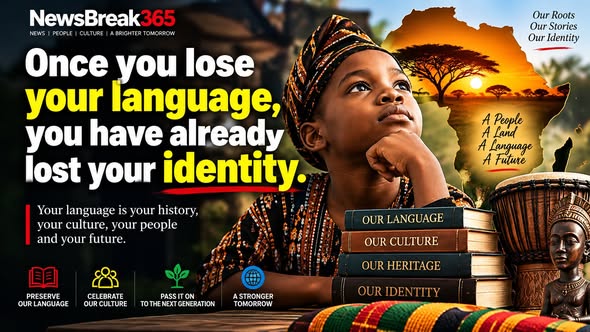
A language is more than words—it is a connection to who we are, where we come from and the generations that came before us.
If your children cannot speak the language you grew up speaking, what part of you will they really know?
It is a question many African parents living at home and in the diaspora should be asking themselves.
Our children may speak English, French, Dutch, German or other international languages fluently. These languages can open doors to education, employment and opportunities.
But while teaching our children the languages of the wider world, are we allowing them to lose the language that connects them to their roots?
Yoruba: More Than a Language
Consider the Yoruba language.
For a Yoruba child, learning words such as “Ẹ káàárọ̀” (good morning), “Ẹ ṣé” (thank you), or “Bàbá” and “Ìyá” for father and mother is more than learning vocabulary.
These words carry relationships, respect and cultural meaning.
Yoruba also has a rich tradition of òwe—proverbs that communicate wisdom and life lessons.
The famous saying “Ọ̀rọ̀ ni kẹ́kẹ́, ìwà ni ẹṣin” reflects the importance of character and conduct in Yoruba thought. Across generations, such expressions have helped elders teach younger people without simply giving them instructions.
When a child can no longer understand the language, they may also lose access to the deeper meaning behind these expressions.
And it is not only Yoruba.
Across Africa, Language Carries Culture
The same story can be found across the continent.
An Igbo parent may use traditional expressions and proverbs to teach a child about family, responsibility and community.
A Hausa-speaking grandparent may pass down stories and wisdom through Hausa.
A Swahili-speaking family may use “Asante” for thank you and “Karibu” to welcome others, passing along not only words but traditions of hospitality and social connection.
Amharic, Wolof, Akan, Zulu, Xhosa, Shona, Lingala, Somali and hundreds of other African languages carry their own histories, expressions, oral traditions and ways of understanding the world.
Africa’s linguistic diversity is one of its great cultural treasures.
The Loss Often Begins at Home
Language loss rarely happens overnight.
It can begin with a simple pattern:
A parent speaks the mother tongue.
The child responds in English or French.
The parent switches languages because it is easier.
The process repeats.
Eventually, the child understands the language but cannot speak it confidently.
Then the next generation may understand even less.
Before long, a language that was once spoken every day becomes something the family remembers rather than something the family lives.
That is how cultural connections can quietly disappear.
Learning English, French or Dutch Is Not the Problem
There is absolutely nothing wrong with learning other languages.
African children should be encouraged to become multilingual.
A Yoruba child can speak Yoruba and English.
An Igbo child can speak Igbo and French.
A Hausa child can speak Hausa and German.
A Congolese child can speak Lingala, French and another language.
The goal should not be to choose between languages. The goal should be to add languages without erasing identity.
One language can open the door to the world.
Another can keep you connected to home.
You need both.
Parents and Grandparents Are the First Teachers
Schools, cultural organizations and governments can help preserve African languages, but the strongest language classroom is often the family home.
Parents can make a difference by:
Speaking their mother tongue regularly at home.
Teaching children greetings and expressions.
Explaining the meaning behind traditional names.
Sharing African proverbs and stories.
Teaching traditional songs and poems.
Encouraging children to communicate with grandparents in the language.
Correcting mistakes patiently rather than making children embarrassed.
Using the language during everyday activities—not only during cultural celebrations.
Creating opportunities for children to meet other speakers of the language.
Most importantly, children should hear adults treating their language as something valuable.
If we constantly describe our own language as backward, difficult or unnecessary, children may eventually believe that it has little value.
What Happens When Grandparents and Grandchildren Can’t Speak?
Perhaps the most painful consequence is the growing distance between generations.
Imagine a grandmother who has spent decades carrying family stories, traditional knowledge and memories—but her grandchildren cannot fully understand her.
Imagine a grandfather who wants to teach his grandchildren the proverb his own father taught him, but there is no shared language through which to pass it on.
The loss is not only linguistic.
It is emotional.
A language can be one of the bridges connecting generations.
When that bridge disappears, rebuilding the connection becomes much harder.
What Will We Leave Behind?
Every generation receives an inheritance.
We inherit names.
We inherit stories.
We inherit music.
We inherit food.
We inherit traditions.
We inherit values.
And we inherit language.
The question is:
Will we pass that inheritance on?
Our children deserve the opportunity to know the world beyond their heritage. But they also deserve the opportunity to know their heritage from the inside—not simply through translations, history books or social media.
Let them hear the language.
Let them speak it imperfectly.
Let them ask questions.
Let them make mistakes.
Let them laugh in it.
Let them tell stories in it.
Let them teach it to their own children.
Because when a language survives in the home, a piece of history survives with it.
A Message to African Parents
Teach your children English.
Teach them French.
Teach them Dutch.
Teach them every language that can help them navigate the modern world.
But teach them yours, too.
If you are Yoruba, let them hear Yoruba.
If you are Igbo, let them hear Igbo.
If you are Hausa, let them hear Hausa.
If you speak Twi, Wolof, Amharic, Swahili, Zulu, Xhosa, Shona, Lingala, Somali or another African language, give your children the gift of hearing and speaking it.
Don’t wait until they are adults and wish they had learned.
Don’t wait until grandparents are gone and the opportunity has disappeared.
Start at home. Start today.
Your Language Is Your Inheritance
Losing a language does not automatically mean losing every part of one’s identity. But losing a language can mean losing an important pathway to one’s culture, history and family memory.
That is why preserving African languages matters.
Speak it.
Teach it.
Preserve it.
Pass it on.
❤️ Your children should know the world—but they should also know where they come from.
The NewsBreak365 Question
If your children cannot speak the language you grew up speaking, what part of your story will they struggle to understand?
Do you speak your mother tongue with your children?
What African language did your parents or grandparents teach you?
And what can we do—as families and communities—to make sure these languages survive for generations to come?
NewsBreak365 — News | People | Culture | A Brighter Tomorrow
FOLLOW US ON:
FACEBOOK
TWITTER
PINTEREST
TIKTOK
YOUTUBE
LINKEDIN
INSTAGRAM








 Lifestyle11 hours ago