Connect with us

News

Army activates three new battalions to boost security in Zamfara

Published

on

The Nigerian Army has operationalised three new Infantry Battalions in Zamfara State as part of efforts to strengthen security operations and improve rapid response across the state.

In a statement by the Acting Assistant Director, Army Public Relations, 1 Brigade Nigerian Army, Gusau, on Tuesday on X, the newly activated units are the 12 Infantry Battalion in Bakura, 23 Infantry Battalion in Kaura Namoda and 28 Infantry Battalion in Anka.

The battalions are expected to expand the Army’s operational coverage and secure their respective Areas of Responsibility (AOR).

Speaking during the activation ceremonies, the General Officer Commanding (GOC) 8 Division Nigerian Army and Commander, Sector 2 Joint Task Force, North West, Operation FANSAN YAMMA, Major General BP Koughna, represented by the Acting Commander, 1 Brigade, Colonel Joseph Umaru, reaffirmed the Army’s commitment to strengthening security operations in the state.

Colonel Umaru said the military would continue to work towards protecting law-abiding citizens, stressing that lasting peace required cooperation among security agencies, traditional institutions and communities.

He called on residents to support security agencies by providing “timely, credible, and actionable intelligence.”

Addressing the newly deployed troops, Umaru charged them to maintain discipline, professionalism and operational vigilance while carrying out their constitutional responsibilities and adhering to established Rules of Engagement.

The traditional rulers in the three locations also welcomed the establishment of the new battalions.

The Emir of Bakura, Alhaji Bello Sani; Emir of Anka, Alhaji Attahiru Muhammad Ahmad; and Emir of Kaura Namoda, Maj. Dr Sanusi Mohammed Ahmed (rtd), commended the Nigerian Army for establishing the additional units.

See also  Sowore regains freedom after four days in Kuje prison

The monarchs described the deployments as a “crucial milestone” towards restoring normalcy and improving safety in communities across Zamfara.

They also assured the Army of the continued support of traditional institutions, particularly through community mobilisation and information sharing.

“We urge residents to provide timely, credible, and actionable intelligence,” Umaru said

The army said the new battalions are expected to enhance its ability to respond rapidly to security threats and strengthen operations across their respective areas of responsibility.

Source: punchng.com

FOLLOW US ON:

FACEBOOK

TWITTER

PINTEREST

TIKTOK

YOUTUBE

LINKEDIN

INSTAGRAM

Continue Reading
Click to comment

Leave a Reply

Your email address will not be published. Required fields are marked *

News

Kebbi warns civil servants against lateness, absenteeism

Published

on

The Kebbi State Government has directed civil servants across the state to strictly observe the official working hours of 8:00 a.m. to 4:00 p.m., Monday to Friday, warning against lateness and absenteeism.

The directive, according to a statement made available to our correspondent on Wednesday, was contained in a circular issued by the Head of the Civil Service, Malami Shekare, dated September 23, 2026, from the Office of the Head of the Civil Service, Cabinet Office, Birnin Kebbi.

Shekare said the directive followed observations that some civil servants had developed the habit of reporting late for work or staying away from their duty posts without official communication or approval.

He said, “The approved official working hours for the State Civil Service are 8:00 a.m. to 4:00 p.m., Monday to Friday, and all civil servants are expected to strictly adhere to them.”

The Head of Service added that the prescribed working hours were provided for under Chapter 13, Section 4, Sub-section 140122 of the Public Service Rules, 2021 Edition.

He directed civil servants to “be punctual at their duty posts and comply strictly with the approved working hours.”

Shekare further warned that any absence or lateness must be officially communicated to and approved by the appropriate authority.

“Any absence from duty or lateness must be officially communicated to, and approved by, the appropriate authority,” he said.

He also directed heads of ministries, departments and agencies to bring the circular to the attention of their staff and ensure strict compliance.

See also  Pay more attention to health, education, TUC tells Diri

The circular was addressed to the Chief of Staff, Government House; Director, Deputy Governor’s Office; Secretary to the State Government; commissioners; permanent secretaries; and chief executives of commissions, boards and parastatals across the state.

Source: punchng.com

FOLLOW US ON:

FACEBOOK

TWITTER

PINTEREST

TIKTOK

YOUTUBE

LINKEDIN

INSTAGRAM

Continue Reading

News

Workers set October strike over petrol price hike

Published

on

Public servants under the Joint National Public Service Negotiating Council have reaffirmed their September 30, 2026, ultimatum to the Federal Government over the rising cost of petrol, the demand for a wage award and the commencement of negotiations for a new national minimum wage.

The JNPSNC, made up of eight public sector unions, issued a three-day warning strike notice to the Federal Government, beginning October 2, should the government fail to slash the price of petrol to N500 per litre, announce a wage award and introduce other measures to cushion the crushing hardship in the country.

Members of the JNPSNC include the Nigerian Civil Service Union; Medical and Health Workers Union; Association of Senior Civil Servants of Nigeria; and National Association of Nigerian Nurses and Midwives.

Others are the Amalgamated Union of Public Corporations, Civil Service Technical and Recreational Employees; Nigeria Union of Public Service, Reportorial, Secretarial, Data Processors and Allied Workers; National Union of Printing, Publishing and Paper Products Workers; and National Union of Agriculture and Allied Employees.

The council said it had mobilised public servants across the country for a three-day warning strike if the Federal Government failed to address the issues raised in its letter to President Bola Tinubu before the deadline.

Recall that the JNPSNC had, on September 21, written to Tinubu, demanding that the price of petrol be slashed to N500, the immediate announcement of a wage award and the beginning of negotiations for not less than N500,000 minimum wage from 2027, among others.

In a statement on Tuesday, September 29, 2926, leaders of the JNPSNC warned that should the issues of fuel pump prices and the wage award not be addressed by September 30, especially during the Independence anniversary speech by the President, public servants nationwide would commence a three-day warning strike beginning October 2, 2026.

See also  Pay more attention to health, education, TUC tells Diri

The statement issued by the National Secretary of the JNPSNC and General Secretary of the Nigeria Civil Service Union, Gbenga Olowoyo, said the September 30 deadline remained sacrosanct, stressing that the concerns of Nigerian workers could no longer be ignored.

According to him, “The three critical issues requiring urgent attention are as follows: reduction of fuel price to N500 per litre. The Federal Government should take urgent steps to bring down the price of Premium Motor Spirit (PMS) to N500 per litre.

“This can be achieved through the provision of an intervention fund to address landing costs and support oil and gas operators.

“It is equally important for the Federal Government to ensure the sale of crude oil to the Dangote Refinery and operators of modular refineries at appropriate terms to facilitate increased domestic refining and help bring down the price of petroleum products.

“The current price of PMS, ranging from N1,450 to N2,000 and, in some locations outside major communities and cities, as high as N2,500 per litre, is unacceptable to Nigerian workers.

“The council maintains that the economic hardship occasioned by the high cost of fuel is placing the survival of Nigerian workers, their dependants and the general populace under severe pressure, making it increasingly difficult for Nigerians to live normal and dignified lives.

“The Federal Government should urgently approve a wage award for Nigerian workers to cushion the effects of the prevailing harsh economic conditions being experienced by workers, their dependants, and vulnerable Nigerians.

“The council believes that urgent action on this demand will further enable public servants to consolidate their loyalty, commitment and productivity within the public service ecosystem.”

See also  Sowore regains freedom after four days in Kuje prison

Minimum wage committee

The workers asked the Federal Government to urgently establish a committee to facilitate negotiations for the new minimum wage.

“The Federal Government should urgently establish a tripartite committee to commence and facilitate negotiations for the new national minimum wage expected to become due in 2027.

“The Nigerian workers’ demand for the immediate constitution of the committee is informed by the need to avoid any administrative or procedural delay that could affect the implementation of the new National Minimum Wage once it is eventually negotiated and passed into law by the National Assembly,” the statement added.

Warning strike

“Consequently, the council states that failure by the Federal Government to take the necessary steps to address these issues on or before 30th September 2026 will leave Nigerian workers with no option but to commence a three-day warning strike, with effect from Friday, 2nd October 2026, to press home their demands.

“It is imperative to state clearly that the Independence Day address of the President of the Federal Republic of Nigeria should adequately address these critical issues.

“Failure to address the concerns raised, according to the Council, will attract the displeasure of Nigerian workers and their dependants, as well as other vulnerable Nigerians who continue to bear the brunt of the prevailing economic hardship,” the statement concluded.

Source: punchng.com

FOLLOW US ON:

FACEBOOK

TWITTER

PINTEREST

TIKTOK

YOUTUBE

LINKEDIN

INSTAGRAM

Continue Reading

News

Senate, Reps extend capital implementation of the 2025 budget to December

Published

on

The Senate and House of Representatives, on Tuesday, approved another extension of the implementation of the capital component of the 2025 Appropriation Act, moving the deadline from September 30 to December 31, 2026.

The latest decision marks another extension of the lifespan of the 2025 capital budget.

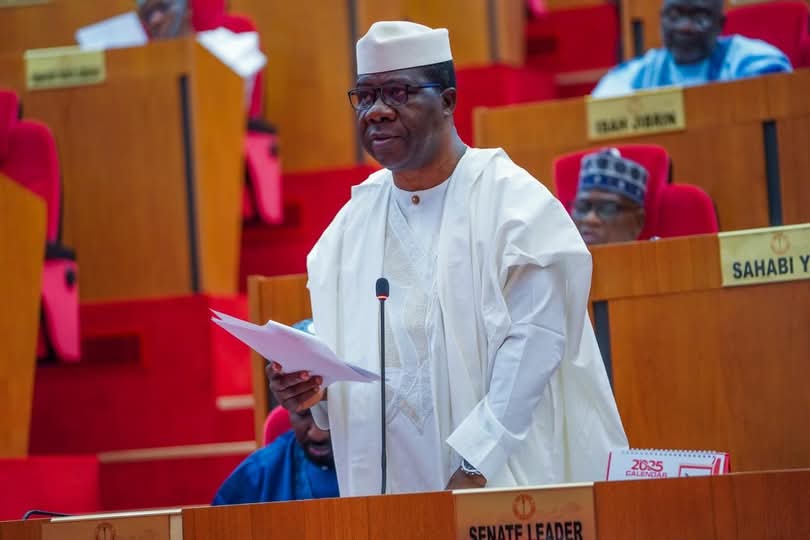
At the Senate, the extension followed the passage of a bill sponsored by the Senate Leader, Opeyemi Bamidele (APC, Ekiti Central), after clause-by-clause consideration by the lawmakers.

The bill seeks to amend the 2025 Appropriation Act and further extend the implementation period of its capital component to enable Ministries, Departments and Agencies to complete ongoing projects and utilise appropriated funds.

Moving the bill, Bamidele said the amendment was necessary because the implementation of capital projects under the 2025 Appropriation Act had not reached optimal levels despite the release of funds to MDAs.

In his presentation, Bamidele said he was forwarding “A Bill for an Act to Amend the Appropriations (Repeal & Enactment) Act 2025 to Extend the Implementation of the Capital Aspect of the Appropriations (Repeal & Enactment) Act 2025 from 30th September, 2026 to 31st December, 2026 and for other Related Matters, 2026 (SB. 1067).

“A Bill for an Act to Amend the Appropriations (Repeal & Enactment) Act 2025 to Extend the Implementation of the Capital Aspect of the Appropriations (Repeal & Enactment) Act 2025 from 30th September, 2026 to 31st December, 2026 (SB. 1067).”

At the House of Representatives, members also extended the implementation of the capital component of the 2025 Appropriation Act for the fourth time, moving the deadline from September 30 to December 31, 2026.

See also  Second body recovered after car plunged into Lagos Lagoon

The extension was approved during Tuesday’s plenary following a motion moved by the House Leader, Julius Ihonvbere.

The latest extension means the implementation period of the 2025 capital budget, originally due to expire on December 31, 2025, has now been carried over for another full year.

The National Assembly had previously extended the implementation period from March 31 to June 30, 2026, and subsequently to September 30, 2026, to allow the government to complete ongoing capital projects and meet outstanding obligations.

The latest extension means that funds appropriated under the capital component of the 2025 budget will remain available for implementation until December 31, 2026, subject to the President’s assent.

The extension also comes against the backdrop of the Federal Government’s earlier pledge to end the practice of overlapping budgets.

While presenting the 2026 Appropriation Bill in December 2025, President Bola Tinubu said the government would move away from multiple overlapping budget cycles and operate within a single revenue cycle.

However, the government had previously justified extensions of the 2025 budget on the need to complete ongoing projects and ensure effective utilisation of appropriated funds.

In April, the Presidency said an earlier extension was intended to enable MDAs to consolidate ongoing works, improve project completion rates and maximise value for public expenditure.

The Senate’s approval of the latest extension came on the first day of its resumed plenary after an extended legislative recess.

The National Assembly had shifted its resumption from September 15 to September 29 to allow for the completion of rehabilitation works in the legislative chambers.

See also  Court orders FG to close case in Dasuki’s decade-old trial

With the passage of the bill, the 2025 capital budget will now remain open for implementation for an additional three months beyond the September 30 deadline.

Source: punchng.com

FOLLOW US ON:

FACEBOOK

TWITTER

PINTEREST

TIKTOK

YOUTUBE

LINKEDIN

INSTAGRAM

Continue Reading

Trending