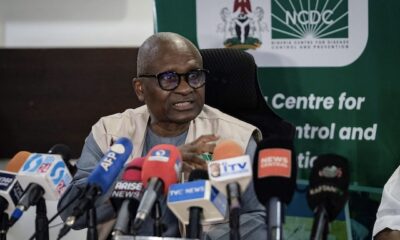
The National Peace Committee said 26 states and the Federal Capital Territory recorded 109 breaches of the National Peace Accord over 10 weeks of monitoring, raising concerns about potential threats to peaceful campaigns and the 2027 general elections.
The centre, in its monitoring report covering the period between August 19 and October 27, obtained by The PUNCH on Tuesday, identified political violence and thuggery, as well as misinformation and disinformation, as the leading violations, accounting for 33 and 29 incidents, respectively.
It identified Kaduna, Edo and Enugu as election flashpoints, citing recurring political violence, armed disruptions and other security concerns, revealing that the Federal Capital Territory also recorded seven incidents, while Kaduna had the highest number, with nine.
The panel called for investigations into reported violations and urged security agencies to provide equal protection for lawful campaign activities. It also asked political parties and candidates to condemn violence, disown armed groups and ensure accountability for threats and intimidation.
The Independent National Electoral Commission has scheduled the presidential and National Assembly elections for January 16, 2027, while the governorship and state Houses of Assembly elections will hold on February 6, 2027.
Campaigns for the presidential and National Assembly elections commenced on August 19, while those for the governorship and State Assembly polls began on September 9.
Against this backdrop, 19 political parties signed the National Peace Accord in Abuja on August 18, pledging to uphold 12 standards aimed at promoting peaceful and issue-based campaigns ahead of the 2027 general elections.
Under the agreement, the parties and their candidates committed to rejecting violence, threats and intimidation.
Other commitments covered issue-based campaigns, the dissemination of truthful political information, responsible use of digital media, inclusive participation, respect for electoral and security institutions, rejection of the partisan misuse of public authority and civil communication among political actors.
According to the report, the 109 recorded breaches represented an average of about 11 incidents weekly, with political violence and thuggery accounting for the largest category.
It identified that “33 incidents of political violence and thuggery, representing 30.3 per cent of the total, while 29 cases of misinformation and disinformation accounted for 26.6 per cent.
“Attacks on political activities and campaign assets accounted for 19 incidents, representing 17.4 per cent, while intimidation and threats recorded 15 cases, or 13.8 per cent.”
The report also documented seven incidents of restrictions on freedom of expression and assembly, four inflammatory statements, one intra-party conflict and one case of voter inducement.
It stated that, “The four leading categories accounted for 88 per cent, representing 96 of the 109 breaches recorded during the monitoring period. And 57 incidents, representing 52 per cent of the total, did not involve physical attacks”.
The Peace Committee warned that threats, false information, restrictions on expression, divisive rhetoric and voter inducement could undermine citizens’ freedom of choice before election day.
On the geographical spread of the incidents, the report identified Kaduna, Edo, Cross River, Kogi and Borno among the states affected, while its breakdown of the highest recorded counts showed Kaduna leading with nine incidents, followed by Edo, Enugu and the FCT with seven each.
It explained that, “The incidents occurred across different campaign environments, including social media platforms, political rallies, meetings, processions, party offices, campaign materials, public speeches, administrative actions and encounters with security agencies.”
Highlighting some of the flashpoints, the NPC report cited the September 8 obstruction of the convoy of former Anambra State governor and Nigeria Democratic Congress presidential candidate, Peter Obi, near Makurdi, Benue State.
In Enugu State, the monitoring documented repeated armed disruptions of NDC and Peoples Democratic Party gatherings and party premises between September and October.
The National Peace Committee also documented several incidents of political violence, including the disruption of PDP consultations by gunmen in Calabar South, Cross River State, on October 2, and the reported shooting of an African Democratic Congress supporter during political engagements in Igueben, Edo State, four days later.
In Oyo State, the NPC said violence during a political procession in Ibadan between October 14 and 17 claimed one life, while an APC ward member was reportedly killed days later. It added that allegations linking a council official to the violence were denied.
The National Peace Committee also recorded 15 incidents of intimidation and threats involving political office-holders and party officials across the country.
It cited cases in Edo, Taraba, the FCT and Ebonyi, including an alleged threat by an APC state chairman to unleash AK-47 fire on those obstructing an electoral target, and a warning by the chairman of Ibi Local Government Area, Taraba State, against civil servants voting for candidates other than his preferred choice.
The National Peace Committee raised concerns over the use of religious and family affiliations to influence political choices, citing an alleged appeal by an APC-affiliated lawmaker in Oyo State urging Muslim voters to reject Christian candidates.
It also reported that a party official in Yobe State advised women to leave their husbands if they disagreed with their preferred political party.
On freedom of expression and assembly, the NPC recorded seven incidents, including the arrest and subsequent charging of men in Borno State for wearing shirts bearing anti-government messages, as well as the police dispersal of a political support-group march in Akwa Ibom State.
The committee warned that unjustified restrictions on lawful expression and assembly could discourage citizens from participating in political campaigns.
On information integrity, the report documented 29 incidents of misinformation and disinformation, identifying fabricated newspaper headlines, recycled campaign footage, false attribution of statements and forged documents as recurring tactics.
It said old campaign videos were recirculated to portray events or endorsements as recent, while fabricated pledges were attributed to former Vice-President Atiku Abubakar on social media.
The report also identified falsified letters purportedly concerning President Bola Tinubu and Peter Obi, as well as newspaper-style front pages carrying fabricated political quotations.
It warned that “The circulation of false political content could distort public debate, damage reputations and deepen mistrust among political groups.”
The monitoring further showed that 30 incidents originated online, with most lacking a specific state of origin and spreading across geographical boundaries.
On political party involvement, the report said the parties identified as alleged perpetrators differed from those targeted in the incidents.
It stated, “The All Progressives Congress was an actor in 24 incidents and a target in 23, while the Nigeria Democratic Congress was identified as an actor in four incidents and a target in 28 cases.
“The African Democratic Congress was named as an actor in two incidents and targeted in 15, while the PDP featured as an actor in four cases and a target in six incidents.
“The Allied People’s Movement was identified as an actor in one incident and targeted in two, while the Accord, Action Alliance and All Progressives Grand Alliance were targeted in an incident.”
Looking ahead to the 2027 elections, the committee identified five major risks requiring urgent attention: “restricted campaign access, armed political mobilisation, coercion by public office-holders, information disorder and declining institutional credibility.
It identified Enugu, Oyo, Edo and Cross River as states requiring attention over recurring armed disruptions, while Edo, Taraba, Ebonyi and the FCT were flagged over intimidation by public office-holders. Benue and Kogi were also identified as states where political convoys and movements face potential risks.”
To address the concerns, the committee recommended a four-stage response involving “Independent verification of reported incidents, protection of lawful political participation, institutional and party responses, and transparent investigations and accountability.”
It urged the National Peace Committee to sustain engagement with political parties and relevant institutions, while calling on parties and candidates to unequivocally condemn violence, disown armed groups and clarify threats made by their officials.
NPC report also urged political parties to discipline erring members where necessary and correct false claims capable of escalating political tensions.
It called on the police and other security agencies to provide equal protection for all lawful political gatherings, investigate the organisers of violent incidents and regularly publish updates on the status of cases.
The committee further urged INEC and relevant legal institutions to refer credible electoral offences under sections 97, 120 and 125 of the Electoral Act for appropriate action.
It stressed the need for public institutions to distinguish between complaints, arrests, charges and final case outcomes in their communications, warning that the credibility of the Peace Accord would depend on consistent political conduct and visible institutional accountability.
Amupitan tasks tribunals
In a related development, INEC Chairman, Prof. Joash Amupitan (SAN), has admonished members of the 2027 Election Petition Tribunals to avoid technicalities that undermine substantive justice, insisting that the truth of the ballot must prevail in resolving electoral disputes.
Amupitan said the political stability of Nigeria after the 2027 general election would depend not only on the conduct of the polls but also on the courage, transparency and fairness with which the judiciary handles election petitions.
The INEC chairman spoke on Monday in Abuja while delivering the opening remarks at a three-day workshop for Justices of the Court of Appeal and members of the 2027 Election Petition Tribunals, organised by the Court of Appeal.
A statement issued on Tuesday by INEC Director of Voter Education and Publicity, Mrs Victoria Etta-Messi, said the workshop was themed, ‘Election Tribunal as a Tool for Political Stability.’
The event featured the swearing-in of tribunal chairmen and members and the unveiling of the Second Edition of the Judicial Electoral Manual, 2026, by the Chief Justice of Nigeria, Justice Kudirat Kekere-Ekun.
Addressing the judicial officers, Amupitan urged them to uphold the law, maintain integrity and ensure that justice was not only done but seen to be done.
“Let your decisions be characterised by deep fidelity to the law, uncompromising integrity and a clear recognition that justice must be seen to be done.
“As you take your oaths, you carry the democratic aspirations of over 200 million Nigerians. The courtroom to which you are deployed is the altar upon which public confidence in constitutional governance is preserved,” he said.
The INEC chairman described election petition tribunals as constitutional mechanisms for managing political disagreements and preventing electoral disputes from degenerating into civil unrest.
He said tribunals must combine procedural speed, evidentiary rigour and impartiality to assure aggrieved parties that their complaints would be determined on merit.
He added that electoral adjudication must be based on credible and legally admissible evidence, particularly as disputes increasingly involve voter accreditation, electronic transmission of results, technological failures and digital records.
On the Bimodal Voter Accreditation System and the INEC Result Viewing Portal, Amupitan cautioned against treating technology as infallible or dismissing electronic evidence simply because it was digitally generated.
He said the commission had issued the Regulations and Guidelines for the Conduct of Elections, 2026, to establish clearer operational standards for assessing allegations of electoral non-compliance.
The chairman also warned that artificial intelligence-generated disinformation, cloned audio recordings and deepfake videos posed emerging challenges to electoral adjudication.
He urged tribunal members to apply Section 84 of the Evidence Act on electronic evidence, stressing the importance of verifying the origin and authenticity of digital materials.
“The digital provenance, forensic chain of custody and reliance on certified data from INEC will be vital in preventing synthetic fabrications from misleading the courts,” he said.
Amupitan also called for consistency in judicial decisions, warning that conflicting judgments on similar electoral disputes could create uncertainty and undermine public confidence.
He commended the Court of Appeal, the National Judicial Institute and legal experts involved in producing the Second Edition of the Judicial Electoral Manual, 2026, describing it as an important guide for judicial officers.
He further stressed that engagements between INEC and the judiciary must respect constitutional boundaries and must not be used to influence judicial decisions or discuss pending cases.
Meanwhile, the President of the Court of Appeal, Justice Monica Dongban-Mensem, disclosed that 375 judicial officers had been nominated to serve on the 2027 Election Petition Tribunals.
She said the nominees comprised 138 returning members with previous tribunal experience and 237 newly nominated members.
Dongban-Mensem urged them to protect judicial independence, resist improper influence and discourage unnecessary adjournments, while ensuring that speedy determination of cases did not undermine fairness.
Electoral threats warning
In a similar development, INEC has warned political leaders and the media against promoting the slogan, ‘Rig and Die,’ saying it could endanger the lives of electoral officials, voters, party agents and observers during the 2027 general election.
The National Commissioner and Chairman of INEC’s Information and Voter Education Committee, Mohammed Haruna, gave the warning on Saturday in Enugu at a forum organised for media practitioners ahead of the 2027 general election, a press statement issued on Tuesday in Abuja by INEC’s Director of Voter Education and Publicity, Mrs Victoria Etta-Messi, disclosed.
Haruna, who was represented by the Enugu State Resident Electoral Commissioner, Dr Chukwuemeka Chukwu, said the slogan was dangerous regardless of the intention of those promoting it.
Speaking on the theme, ‘Ethical and Professional Standards in Election Reporting Ahead of the 2027 General Election,’ he said, “Whatever the intention of its originators, and some insist it targets only those who rig, a slogan that links an electoral offence to death is dangerous.”
He noted that election officials at polling units, rather than influential politicians, were often the most vulnerable to attacks arising from suspicions of electoral malpractice.
“The people most exposed at the polling unit are not powerful politicians but ordinary Nigerians serving as presiding officers, assistant presiding officers, collation officers and other ad hoc staff.
“A charged crowd can easily mistake a delayed result, a technical challenge or a rumour for rigging, and a mistake of that kind can never be undone,” he said.
Haruna stressed that electoral malpractice was a criminal offence punishable under the Electoral Act 2026, adding that suspected cases should be addressed through lawful channels rather than threats or violence.
He identified vigilant election observation, transparent result viewing through the INEC Result Viewing Portal, formal complaints to the commission and security agencies, and litigation as appropriate ways of challenging suspected irregularities.
Citing section 33 of the Constitution, which guarantees the right to life, the commissioner said nobody should be subjected to violence or killed on suspicion of electoral wrongdoing.
“I therefore appeal to political leaders to retire such language, and to you in the media not to amplify it as a headline or hashtag,” he said.
He urged journalists to provide adequate context when reporting the slogan, taking into consideration its legal implications and the safety of election officials.
The INEC commissioner described the media as critical to the credibility of elections, noting that most Nigerians depended on journalists for information about polling arrangements, voter accreditation and result collation. “Public confidence in our elections rests on the credibility of your reporting,” he said.
Haruna urged journalists to verify information before publication, resist the temptation to break unconfirmed stories and clearly distinguish projections and unofficial tallies from officially declared results.
He stressed that only the commission, through its returning officers, had the authority to declare election results.
He also called for conflict-sensitive reporting, equal coverage for candidates and political parties, and prompt correction of inaccurate reports.
Citing the recent off-cycle governorship elections, Haruna identified vote buying as the most troubling feature of the June election in Ekiti State.
He said false claims about ghost and hired voters, alongside artificial intelligence-generated content, circulated on social media during the collation of results in Osun State in August.
He, however, noted that independent observers found the declared results consistent with polling unit tallies.
“Where accurate information travels as fast as falsehood, public trust is protected,” he said.
The commissioner urged media organisations to support INEC’s voter education efforts, particularly on Permanent Voter Card collection and voter participation.
He expressed concern over low voter turnout, noting that only 26.72 per cent of registered voters participated in the 2023 presidential election.
He also called on journalists to investigate and expose vote buying and help debunk disinformation, including deepfakes and fake social media accounts, which he said were offences under the Cybercrimes Act.
Haruna said INEC remained open to media enquiries and urged journalists to verify information about the Commission through its official channels, including its Citizens Contact Centre and verified social media handles. “We would rather you ask us now than speculate later,” he said.
He assured Nigerians that any INEC staff member or ad hoc official found compromising the electoral process would face the full weight of the law.
The commissioner added that the commission was working to ensure that election officials and materials arrived at polling units by about 7:30 am on election day.
Haruna further urged journalists to give greater attention to women, young people and persons with disabilities in their election coverage, noting that their experiences deserved representation beyond statistics.
Earlier, the Enugu State REC, Chukwu, urged journalists to uphold professionalism, accuracy, fairness and objectivity in their reports.
He warned that “A single unverified report can create unnecessary tension, undermine public confidence, discourage voter participation and potentially threaten peaceful coexistence.”
The Chairman of the Nigeria Union of Journalists, Enugu State Council, Obinna Ogbuka, commended INEC for choosing the state to host the forum and called for sustained training of journalists.
The Director of Voter Education and Publicity, Victoria Eta-Messi, represented by the Deputy Director of Information and Publicity, Wilfred Ifogah, said the engagement was designed to strengthen collaboration between INEC and the media.
She said discussions at the forum would cover ethical election reporting, the Electoral Act 2026, INEC’s technological innovations and voting procedures.
ADC alleges bias
The ADC has, however, accused INEC of applying double standards in its handling of inflammatory political statements ahead of the 2027 general elections, questioning the commission’s silence over an alleged threat by the Edo State Chairman of the APC, Jarrett Tenebe, involving AK-47 rifles.
The opposition party’s criticism followed INEC’s condemnation of the slogan, “rig and die”, which has generated controversy in the build-up to the 2027 elections.
INEC National Commissioner, Haruna, in an exclusive chat with The PUNCH on Tuesday, however, denied condemning the group of protesters who recently visited the commission, insisting that he received them on behalf of the electoral body and asked them to submit their complaints and demands in writing.
Haruna, who clarified the commission’s position, said the protesters had promised to return with their demands three days after their meeting.
“I received them on behalf of INEC, and I never condemned them. Indeed, I said they should have brought their complaints and demands in writing. They said they’ll do so when they return in three days,” he said.
This followed a statement issued on Tuesday by the ADC National Publicity Secretary, Mallam Bolaji Abdullahi, wherein the party questioned why INEC had publicly condemned the “rig and die” slogan but had allegedly failed to respond to remarks attributed to Tenebe concerning the use of AK-47 rifles against those unwilling to support President Bola Tinubu.
The party argued that statements involving firearms and threats of violence should attract at least the same level of attention from the electoral commission as provocative political slogans.
It said the commission’s response raised questions about its impartiality and commitment to ensuring a peaceful electoral environment.
“Why has INEC found its voice to condemn ‘rig and die’ but remained conspicuously silent on the threat by an APC chairman to use AK-47 rifles against opposition voters? Is a slogan more dangerous than a gun?” the party asked.
The ADC also demanded to know whether INEC had reported the alleged threat to security agencies for investigation.
“Has INEC referred the matter to security agencies? If not, why not?” it queried.
While acknowledging that the commission was right to condemn inflammatory political language, the opposition party insisted that its interventions must be consistent, irrespective of the political affiliation of those involved.
The party said it rejected electoral violence in all forms and expected INEC to demonstrate the same commitment when statements capable of intimidating opposition supporters were made by members of the ruling party.
It maintained that the commission’s responsibility went beyond condemning provocative remarks to ensuring that Nigerians could participate in elections without intimidation.
“However, INEC cannot demand peaceful elections without demonstrating equal concern for those threatened with violence. Its responsibility is not merely to condemn inflammatory language, but to demand an environment that permits every Nigerian to vote freely,” the statement further read.
The controversy comes as political parties intensify mobilisation and other activities ahead of the 2027 general elections, with concerns over voter intimidation, inflammatory rhetoric and the conduct of political actors attracting attention.
INEC is constitutionally responsible for organising and supervising elections, while security agencies are expected to protect voters, candidates and electoral officials and investigate threats capable of disrupting the process.
Source: punchng.com
FOLLOW US ON:
FACEBOOK
WHATSAPP CHANNEL
TWITTER
PINTEREST
TIKTOK
YOUTUBE
LINKEDIN
INSTAGRAM