Connect with us

Business

Dangote stops petrol sales to fuel importers

Published

on

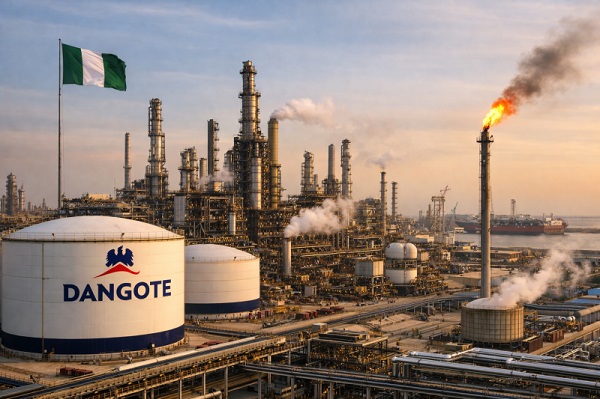
The Dangote Petroleum Refinery has finally stopped the sale of Premium Motor Spirit (petrol) to major marketers importing petroleum products into Nigeria.

An official of the refinery confirmed this to our correspondent, saying the refinery would no longer sell petrol to those blending Dangote fuel with imported grades.

“We are not selling petrol to those who are importing, since they are trying to blend our high-quality products with their ultra-low-quality imported products,” the source said, pleading for anonymity because he was not permitted to speak with the press.

Another source told our correspondent that the refinery now prefers to sell its petrol to members of the Independent Petroleum Marketers Association of Nigeria and others not known for importing. “We are selling to independent marketers and others who are not importing,” he stated.

It was learnt that the development informed why some marketers went to court to get an order that the Nigerian Midstream and Downstream Petroleum Regulatory Authority should continue to grant them import licences.

The marketers feared that they might be left stranded if they could not import fuel at a time when the Dangote refinery had halted petrol sales to them. Dangote had earlier threatened to stop transacting business with fuel importers, whom it accused of blending its Euro-5 petrol grade with imported grades.

It is concerned that such practices could make it difficult to distinguish between products supplied directly by the refinery and products subsequently blended or handled by third parties.

“It is difficult to understand why we would invest heavily in producing high-quality petroleum products for Nigerians, only for those products to be mixed with imported products of uncertain quality and the resulting product to be associated with the refinery,” the refinery said last month.

See also  Corruption goes beyond stealing money – ICPC boss

Reacting, importers and petroleum marketers kicked against the restriction of petrol sales to marketers who import petrol, describing the move as an attempt to block imports. The marketers also challenged the refinery to provide evidence that imported petrol entering the Nigerian market is below the required quality standard.

The marketers, who preferred not to be mentioned, accused Dangote of trying to prevent the importation of petrol. “We know what Dangote is trying to do. He is just trying to block imports,” one of the marketers said. The marketer argued that a company that sells petrol could not dictate whether a consumer should combine its product with fuel purchased from another supplier.

Using the example of motorists buying petrol from different filling stations, the marketer said Dangote could not prevent consumers from combining products sourced from different suppliers.

“For example, when you buy petrol from a TotalEnergies station, and you go down the road, and your petrol is almost finished, you then buy from MRS. Can TotalEnergies say you should not mix its petrol with MRS petrol? No, it can’t. I don’t understand the game that the Dangote refinery is playing,” he stated.

Another marketer also argued that the Federal Government had a responsibility to ensure an adequate petrol supply and protect consumers, insisting that imports remain necessary when domestic production drops.

Speaking, the National Vice Chairman of the IPMAN, Hamed Fashola, stated that the Dangote refinery is selective about who it sells petrol to because not all major marketers import.

“I don’t know how far that is correct; Dangote now sells to only IPMAN. I think somehow the information I have is that Dangote is selective about it, say those that are involved in importing. I think it’s not everybody that is importing,” he said.

See also  UK bans over 100 jobs from foreign recruitment to curb migration

Clarifying IPMAN’s purchasing position amid market competition, Fashola noted that independent marketers operate flexibly to secure the most competitive pricing, sourcing supply indiscriminately from both local refineries and importers.

“We buy our product anywhere we feel it is cheap. Anywhere we see the product, we go for it, both Dangote and the importers. We always go for the best price,” Fashola stated.

Meanwhile, the National Publicity Secretary of the IPMAN, Chinedu Ukadike, expressed the belief that the Dangote refinery is open to doing business with anyone.

Ukadike noted that independent marketers are ready to buy and sell petrol from all suppliers, stressing that they were not currently involved in importing the product.

While saying he would not know if importers truly blend Dangote’s petrol with imported petrol, he concluded that Dangote is in the best position to determine whatever it can do to discourage blending.

“I believe that the Dangote refinery is open for business and that it will continue to sell to marketers. The issue of blending, I cannot say yes or no, because I’m not part of those who are importing. Independent marketers are not importing yet; we are just marketers who buy and sell.

“So, if there is any measure to discourage adulteration of petroleum products by Dangote, I think the refinery and its experts know best. They know the best way to deal with that. But our own is to continue to buy and sell to marketers. If there is a way to discourage adulteration of petroleum products, I won’t stop Dangote from doing so,” Ukadike added.

See also  CBN pumps $1.25bn into fuel import, others

Source: punchng.com

FOLLOW US ON:

FACEBOOK

TWITTER

PINTEREST

TIKTOK

YOUTUBE

LINKEDIN

INSTAGRAM

Continue Reading
Click to comment

Leave a Reply

Your email address will not be published. Required fields are marked *

Business

Nigeria must stop depending on imported finished goods — BUA founder

Published

on

The Founder and Executive Chairman of BUA Group, Abdul Samad Rabiu, has called on Nigeria to reduce its dependence on imported finished goods by expanding domestic manufacturing, processing raw materials locally and strengthening its export capacity.

Rabiu made the call on Monday while delivering a keynote address at the 32nd Nigerian Economic Summit in Abuja, where he argued that Nigeria could not achieve sustainable economic prosperity by remaining predominantly a consumer of foreign products.

“Nigeria must not remain simply a supplier of raw materials or a market for finished goods. We must become a nation that processes, manufactures, and exports,” he said.

The industrialist identified Nigeria’s cement industry as evidence that domestic investment and supportive industrial policies could transform an import-dependent sector into an export-oriented industry.

“Not so long ago, Nigeria was importing almost 80 per cent of the cement that we were consuming. Today, through deliberate policies and major private sector investments, Nigeria has become self-sufficient in cement production and is now an exporter,” he stated.

Rabiu said the transformation resulted from investments in processing locally available limestone, citing BUA’s cement operations in Sokoto and Edo states.

He urged the government and private sector to replicate the experience in agriculture, food processing and other manufacturing industries.

“Nigeria must increasingly grow what it consumes, manufacture what it needs, and export more of what it produces,” he added.

Highlighting BUA’s expansion plans, Rabiu said its two listed subsidiaries, BUA Foods and BUA Cement, have a combined market capitalisation of more than $17bn.

See also  After Elumelu’s rebuke, Delta gov aide offers UBA staff member N500,000, ambassadorial deal

He said BUA Foods was valued at over $10bn, while BUA Cement had a market capitalisation of about $7bn.

He also announced ongoing investments in flour milling, pasta, noodles, edible oils, rice milling and feed mills, with completion expected in 2027.

“These projects are expected to be completed, insha’Allah, by next year, doubling our production capacity,” he said.

Rabiu further highlighted the group’s integrated sugar project in Lafiagi, Kwara State, involving sugarcane cultivation, sugar refining, ethanol production and electricity generation.

On economic reforms, he acknowledged that the removal of petrol subsidy, foreign exchange liberalisation and other government policies had imposed significant costs on households and businesses.

However, he maintained that improvements in foreign exchange availability had reduced manufacturers’ dependence on direct allocations from the Central Bank of Nigeria.

“As an industrialist, I would rather operate in a transparent market where I can plan than in a system where the official rate appears attractive but foreign exchange is unavailable,” he said.

He recalled previously visiting the CBN regularly to seek foreign exchange allocations, describing the current market arrangement as more predictable.

Despite the improvements, Rabiu identified expensive borrowing, inadequate infrastructure and policy uncertainty as major obstacles to industrial expansion.

“You cannot build a strong industrial economy primarily with expensive short-term financing,” he warned.

He explained that manufacturing investments often required between 10 and 20 years to generate their full returns, making affordable long-term capital essential.

Rabiu consequently called for greater mobilisation of pension funds, insurance capital and other institutional investments into productive enterprises.

He also advocated the emergence of 100 additional major Nigerian industrial companies to expand employment, strengthen local supply chains and increase exports.

See also  CBN pumps $1.25bn into fuel import, others

The BUA chairman urged Nigeria to take advantage of the African Continental Free Trade Area through improved transport infrastructure, efficient ports, payment systems and easier cross-border movement.

He proposed a new economic accord anchored on policy stability, productive investment, human capital development, long-term financing and shared prosperity.

“Because the true measure of economic success is not simply whether our economy grows. It is whether that growth changes the lives of Nigerians,” Rabiu said.

The company’s push to expand domestic food production also follows the recent introduction of Bakers Pride Flour by BUA Foods at a trade launch held in Kano, as part of efforts to broaden its product portfolio and serve Nigerian bakers.

The company said the new flour brand was developed for different baking applications, including gurasa, a popular Northern Nigerian flatbread, and conventional bread, with an emphasis on consistent quality and commercial value.

Speaking at the launch, the Managing Director of BUA Foods, Ayodele Abioye, said the product was designed to support bakers’ productivity and business growth, while the General Manager of Brand and Corporate Communications, Adewunmi Desalu, stressed the need to balance product quality with the commercial realities facing bakers.

The General Manager of Sales, Alim Liman, also highlighted the importance of distributors, wholesalers and retailers in ensuring market availability, saying the company would strengthen partnerships across its distribution network to support the new product’s expansion.

Source: punchng.com

FOLLOW US ON:

FACEBOOK

WHATSAPP CHANNEL

TWITTER

PINTEREST

TIKTOK

YOUTUBE

LINKEDIN

INSTAGRAM

Continue Reading

Business

Nigeria misses 10-month revenue target by N20.7tn

Published

on

Nigeria’s statutory revenue allocation fell N20.74tn short of its budget target in the first 10 months of 2026, despite a sharp increase in crude oil prices triggered by the United States-Iran war, raising questions about the extent to which the country has converted the global oil market rally into stronger government revenue.

Figures from the Federation Account income distribution report of the Office of the Accountant-General of the Federation, analysed by The PUNCH, showed that statutory revenue stood at N26.14tn between January and October, against a budget projection of N46.87tn for the period.

The records were presented in documents associated with the Federation Account Allocation Committee’s September meeting, held at the Federal Ministry of Finance headquarters, Abuja, to consider the August 2026 accounts.

The technical sub-committee’s report, dated 14 October, was obtained by The PUNCH on Monday.

The shortfall represented 44.24 per cent of the total budgeted amount.

The figures showed that the government consistently missed its monthly statutory revenue targets, even as receipts improved significantly between May and August, following the escalation of the Middle East conflict and the resulting disruption to global oil supplies.

The war began on 28 February, 2026, when the United States and Israel launched strikes against Iran.

The conflict disrupted shipping through the Strait of Hormuz, a major route for global oil and gas supplies, and sent crude prices sharply higher.

Although the parties reached ceasefire arrangements and attempted negotiations, the agreements subsequently broke down, with hostilities resuming and uncertainty persisting into the second half of the year.

The International Energy Agency and other market observers have identified disruptions to oil shipments through the Strait of Hormuz as a major source of pressure on global energy prices.

Nigeria, as a crude oil producer, was expected to benefit from higher international prices through increased export earnings and government oil receipts.

The nation’s flagship crude oil grade, Bonny Light, rose by about 76.75 per cent from an average of $70.14 per barrel before the United States-Iran war to $123.97 per barrel in a dated price quote for 22 October, 2026, highlighting the potential for increased oil earnings amid the Middle East crisis.

See also  After Elumelu’s rebuke, Delta gov aide offers UBA staff member N500,000, ambassadorial deal

The 22 October quote of $123.97 per barrel was also $59.12, or 91.16 per cent, above the Federal Government’s 2026 budget benchmark of $64.85 per barrel. This means that the price of Nigeria’s flagship crude grade was almost twice the level assumed in the budget, potentially strengthening export earnings from every barrel sold at the higher price.

However, a 24 October report quoted Bonny Light at about $115 per barrel. At that price, the grade would have risen by $44.86, or 63.96 per cent, from the pre-war average of $70.14.

However, the Accountant-General’s figures suggest that the higher prices have not translated into statutory revenue sufficient to meet the monthly budget targets.

The report showed that the monthly budget benchmark remained unchanged at N4.687tn throughout the 10 months, while actual receipts fluctuated considerably.

In January, statutory revenue stood at N1.63tn, leaving a shortfall of N3.06tn, or 65.19 per cent below the monthly target.

Revenue improved to N1.96tn in February, an increase of N325.35bn, or 19.94 per cent, from January. Nevertheless, the February figure was N2.73tn below budget, representing a 58.25 per cent shortfall.

The improvement was reversed in March, when statutory revenue fell to N1.56tn from N1.96tn in February. The decline of N395.14bn represented a 20.19 per cent month-on-month drop.

March recorded the weakest revenue performance of the first quarter, with receipts missing the monthly budget by N3.13tn, or 66.68 per cent.

Revenue recovered in April to N1.70tn, an increase of N137.91bn, or 8.83 per cent, from March. However, the figure remained N2.99tn below the target, representing a 63.74 per cent deficit.

The upward movement gathered pace in May, when statutory revenue rose to N2.38tn from N1.70tn in April. The increase of N678.22bn represented a 39.90 per cent month-on-month improvement.

Despite the rebound, May’s receipts were still N2.31tn below the monthly budget, equivalent to a 49.27 per cent shortfall.

In June, revenue increased further to N2.65tn, up by N273.62bn, or 11.51 per cent, from May. The figure nevertheless fell N2.04tn short of the target, representing a 43.43 per cent deficit.

See also  New tax regime: What’s true, what’s not

The greatest monthly improvement occurred in July, when actual statutory revenue, including a N250bn augmentation, reached N3.95tn.

The July figure represented an increase of N1.30tn, or 48.99 per cent, from June’s N2.65tn. It was, however, still N736.50bn below the monthly budget, a shortfall of 15.71 per cent.

Revenue peaked in August at N4.36tn, the highest monthly figure in the period under review. This represented an increase of N408.09bn, or 10.33 per cent, from July.

August came closest to the monthly budget, missing the N4.69tn target by just N328.41bn, or 7.01 per cent.

However, the momentum weakened sharply in September, when statutory revenue fell to N2.85tn from N4.36tn in August.

The decline of N1.51tn represented a 34.61 per cent month-on-month contraction. September’s receipts were N1.84tn below the budget, equivalent to a 39.19 per cent shortfall.

Revenue recovered modestly in October, rising to N3.10tn from N2.85tn in September. The increase of N246.38bn represented an 8.64 per cent improvement.

Despite the recovery, October’s receipts remained N1.59tn below the monthly target, a deficit of 33.94 per cent.

The October figure was approximately 89.77 per cent higher than January’s N1.63tn, showing that the nominal value of monthly receipts had increased substantially over the 10-month period. Yet, the improvement was not sufficient to close the gap between actual revenue and the budget.

The data also reveal a significant difference between the first six months of the year and the period from July to October.

Between January and June, statutory revenue totalled N11.88tn. From July to October, the figure rose to N14.26tn, including July’s N250bn augmentation.

The four-month total was therefore N2.38tn higher than the receipts recorded in the first six months, despite covering a shorter period.

The stronger performance from July was consistent with the possibility of improved oil receipts during the period of elevated international prices. However, the figures alone do not establish how much of the increase came directly from the oil price rally, as statutory revenue also depends on production volumes, export receipts, exchange rates, collection efficiency and other revenue sources.

See also  UK bans over 100 jobs from foreign recruitment to curb migration

The figures further show that the revenue shortfall remained substantial even after the monthly receipts approached the budget in August. The subsequent decline in September and the incomplete recovery in October widened the gap again.

For the Federal Government and the state and local governments that depend on Federation Account allocations, the performance has implications for budget implementation, capital spending and the financing of public services.

Higher crude oil prices can improve government earnings, but the benefits depend on Nigeria’s ability to produce and export crude, collect the proceeds due to the Federation and translate the additional earnings into distributable revenue.

The report also recorded N39.91bn in shared Electronic Money Transfer Levy proceeds in January, with no further amounts shown under that column from February to October. The levy was listed separately from the statutory revenue figures used in the monthly budget comparison.

Overall, the N20.74tn shortfall indicates that the anticipated oil windfall has not been enough to bring statutory revenue in line with the budget benchmark during the first 10 months of 2026.

The figures do not mean that Nigeria earned no additional revenue from the higher oil prices. Rather, they show that the total statutory revenue recorded in the Federation Account income distribution report remained well below the amount budgeted for the period.

Last week, The Minister of Finance and Coordinating minister of the economy, Taiwo Oyedele, admitted that Nigeria’s budget projections have often been based on unrealistic expectations, resulting in actual revenue falling significantly below targets.

Speaking at Chatham House in London, Oyedele said the country had repeatedly built its budgets on optimistic revenue estimates rather than realistic assessments of its earning capacity.

“We haven’t been doing the budget right. We do projections that are sometimes based on faith and hope. You don’t run a country based on faith,” he said.

Source: punchng.com

FOLLOW US ON:

FACEBOOK

WHATSAPP CHANNEL

TWITTER

PINTEREST

TIKTOK

YOUTUBE

LINKEDIN

INSTAGRAM

Continue Reading

Business

FG, Labour resume talks on wage, fuel price crisis

Published

on

Organised labour will decide its next course of action after a crucial meeting with the Federal Government on Tuesday (today), with the Nigeria Labour Congress and Trade Union Congress demanding concrete proposals on petrol prices, wage negotiations and other unresolved workers’ welfare issues amid the threat of nationwide industrial action.

The talks, which follow an earlier meeting that ended without an agreement, are expected to determine whether the government can address labour’s demands before the unions’ ultimatum expires.

The NLC and TUC are seeking a reduction in petrol prices to 2024 levels, tax relief for workers, immediate wage awards and the commencement of negotiations for a new minimum wage ahead of the government’s proposed June 2027 review.

Meanwhile, the Federal Parastatals and Private Sector Pensioners Association of Nigeria has urged the government to pay eligible retirees three months of outstanding fuel-subsidy palliatives totalling N75,000 and improve access to pensioners’ healthcare benefits.

The Nigeria Labour Congress said it expected the Federal Government to present concrete proposals on workers’ outstanding demands when both sides resume negotiations on Tuesday, following an earlier meeting that ended without agreement on petrol prices, wage negotiations and other unresolved public-sector labour issues.

The NLC Assistant Secretary-General, Chris Onyeka, confirmed to The PUNCH on Monday that the government had invited the union to the meeting. He said labour expected the government to respond to demands already submitted rather than reopen discussions without concrete proposals.

“We expect them to come with answers to our demands, so that the meeting will not be prolonged,” Onyeka said. “We don’t expect them to come and start asking us again, ‘What are your demands?’ The demands have already been tabled before them.”

A source within organised labour also confirmed the development to one of our correspondents on Monday, saying the government had requested more time to prepare for the meeting.

“The government pleaded for more time. So, we will be meeting with them tomorrow (today), and after that we will take our final decision,” the source said.

A Trade Union Congress official, who spoke to one of our correspondents on condition of anonymity, said the outcome of the meeting would determine labour’s next move.

“Whatever action we are going to take will rest on the outcome of tomorrow’s meeting,” the official said.

The Head of Press and Public Relations at the Federal Ministry of Labour, Ann Daniel, also confirmed the meeting, saying, “Yes; there will be a meeting tomorrow (today); if nothing changes.”

The meeting follows the October 22 negotiations, which ended without an agreement. The NLC said the government delegation arrived without the authority needed to negotiate substantively, leaving the talks without concrete commitments.

See also  After Elumelu’s rebuke, Delta gov aide offers UBA staff member N500,000, ambassadorial deal

The government subsequently requested an adjournment to allow relevant ministers and heads of departments and agencies to attend the next session.

In a statement signed by the acting NLC General Secretary, Benson Upah, and the TUC Secretary-General, Nuhu Toro, the unions said the government delegation lacked the mandate to engage meaningfully with their demands.

“Regrettably, the government delegation came unprepared and without the necessary mandates to engage substantively on these issues. No concrete commitments were secured, and the outstanding issues remain unresolved,” the unions stated.

Organised labour said the government requested more time to ensure that the next meeting would be productive.

“The Honourable Minister requested adjournment of the meeting to Tuesday, 27th October 2026, to allow the government to make adequate arrangements for a productive session, including assembling all the relevant ministers and Heads of Departments and Agencies,” the statement read.

The outcome of Tuesday’s meeting could determine the next steps in the dispute. The NLC had directed its affiliates and state councils to prepare for possible nationwide action if the government failed to make meaningful progress.

The union said its relevant organs would decide on further action after assessing the outcome of the discussions.

The dispute goes beyond the timing of negotiations for a new national minimum wage. Labour is also demanding lower petrol prices, tax relief for workers, wage awards and the implementation of outstanding agreements affecting health-sector and other public-sector employees.

The NLC issued a two-week ultimatum on October 8, demanding that the Federal Government reduce petrol prices to the levels prevailing when the current minimum wage was signed into law in 2024, begin negotiations for a new minimum wage before the end of October, and resolve outstanding labour agreements. The ultimatum expired on October 22, the same day talks between the government and organised labour ended without a resolution.

The labour unions subsequently extended the deadline to October 27, warning that they could embark on nationwide action if the negotiations failed.

A major point of disagreement is when negotiations should begin to replace the N70,000 monthly minimum wage introduced in 2024.

The Federal Government maintains that the current wage is due for review on June 1, 2027, arguing that the National Minimum Wage Act, 2019, as amended in 2024, provides for a three-year review cycle.

In a letter dated October 12, the Minister of Labour and Employment, Dr Muhammad Dingyadi, described negotiations for another review barely two years into the implementation of the current wage as premature and potentially disruptive to industrial relations.

The NLC disagrees and wants preparations for a new wage review to begin immediately. In a letter dated October 13, the union’s president, Joe Ajaero, argued that the timetable under the original 2019 legislation remained relevant despite the 2024 amendment.

The union has called for the nomination of representatives and the inauguration of a National Minimum Wage Tripartite Committee comprising the government, organised labour and employers. It argues that starting the administrative process early would allow sufficient time for negotiations and prevent delays in implementing a new wage.

See also  Corruption goes beyond stealing money – ICPC boss

The current minimum wage followed negotiations in 2024 involving the Federal Government, organised labour and the organised private sector. President Bola Tinubu signed the legislation into law on July 29, 2024, raising the statutory minimum wage from N30,000 to N70,000 after prolonged negotiations.

The government has cited the 133 per cent increase as evidence of the adjustment granted to workers. Labour, however, argues that the gain has been eroded by the depreciation of the naira and rising costs of essential goods and services.

Ajaero has maintained that workers’ purchasing power has declined despite the higher minimum wage, leaving many struggling to afford transportation, food, housing, healthcare and education.

Petrol prices remain another major point of contention. Labour argues that higher fuel costs have increased transportation expenses and pushed up the prices of food and other essential goods, further eroding workers’ purchasing power.

The NLC wants petrol prices reduced to the levels prevailing when the N70,000 minimum wage was signed into law in 2024. It is also demanding the implementation of tax relief measures agreed with the government in 2023 and immediate wage awards to cushion workers against rising living costs.

Other unresolved issues include the implementation of the February 5, 2026, terms of settlement involving the Joint Health Sector Unions and the Assembly of Healthcare Professionals. Labour is also seeking action on demands raised by the Joint Public Service Negotiating Council, including issues relating to peculiar allowances, wage awards and hazard allowances.

The Federal Ministry of Labour said it was engaging relevant ministries, departments and agencies to address issues within the government’s remit.

Pensioners demand benefits

The Federal Parastatals and Private Sector Pensioners Association of Nigeria has urged the Federal Government to settle outstanding pension entitlements, including three months of the N25,000 monthly subsidy-removal palliative for eligible beneficiaries, amounting to N75,000.

The demands were contained in a communiqué issued after the association’s National Executive Council meeting in Abuja on October 22, 2026. It was signed by its President-General, Benjamin Maisamari Amako, and General Secretary, Franklin Erinle.

The association also called on the Pension Transitional Arrangement Directorate to clarify the implementation of pension harmonisation, which took effect in January 2026, and make the relevant government circular available to retirees.

See also  Again, Petrol Stations Increase Fuel Prices

It said the exercise should improve monthly benefits for eligible pensioners and urged the authorities to convene a stakeholders’ meeting to address complaints, improve communication and resolve outstanding cases.

FEPPPAN further urged PTAD to ensure that the planned relaunch of its ‘I Am Alive’ verification platform did not disrupt payments to elderly, sick or physically incapacitated pensioners. It called for clear guidelines, adequate assistance and safeguards to prevent eligible beneficiaries from being excluded.

While commending President Bola Tinubu for the timely payment of monthly pensions to retirees under the Defined Benefit Scheme, the association urged him to sustain the practice and ensure uninterrupted payments.

On healthcare, FEPPPAN called on PTAD and the National Health Insurance Authority to simplify enrolment in the Pensioner Health Insurance Scheme by providing assisted registration, accessible enrolment centres and support for retirees unable to travel because of age, illness or disability.

The association expressed concern that administrative and technological barriers could prevent eligible pensioners from registering for and accessing healthcare benefits.

It urged the authorities to identify eligible retirees who had yet to enrol and assist them in completing the process.

“No eligible pensioner should be denied access to the scheme because of difficulties with registration, verification or other administrative procedures,” the association said.

FEPPPAN also called for an effective complaints-resolution mechanism to address enrolment difficulties and other challenges retirees might encounter while seeking healthcare services.

It urged PTAD and other relevant authorities to provide clear, timely and accessible information on pension entitlements, verification procedures, healthcare enrolment, eligibility requirements and channels for resolving complaints.

The association said transparent and responsive pension administration was essential to protecting retirees’ welfare, dignity and financial security amid rising living costs.

It specifically called for assistance for elderly, sick and physically incapacitated pensioners who might struggle with verification, stressing that support mechanisms should prevent unnecessary hardship or disruption to pension payments.

The association underscored the importance of regular pension payments to the welfare and financial security of retired workers, particularly amid prevailing economic challenges.

It urged the President and relevant authorities to ensure that pensioners received their entitlements promptly and without interruption, and called for the “prompt and favourable consideration” of the resolutions contained in the communiqué.

PTAD administers pension liabilities for eligible federal public-sector retirees under the Defined Benefit Scheme. Its ‘I Am Alive’ platform is used to verify beneficiaries’ continued eligibility for pension payments.

Source: punchng.com

FOLLOW US ON:

FACEBOOK

WHATSAPP CHANNEL

TWITTER

PINTEREST

TIKTOK

YOUTUBE

LINKEDIN

INSTAGRAM
Continue Reading

Trending