Connect with us

Lifestyle

They Have the Wealth to Change Your Life, But They Would Rather Watch You Beg: The Cruel Side of Wealth and Poverty

Published

on

When the wealthy have more than enough to help those struggling around them, yet choose to watch them suffer, it raises an uncomfortable question: Is it really about a lack of resources, or the satisfaction of having power over someone else’s hardship?**

### When Your Poverty Becomes Someone Else’s Entertainment

There is a painful reality in society that many people experience but rarely talk about: some people do not necessarily want to see you succeed. They are comfortable watching you struggle, provided your struggles never threaten their position of comfort and superiority.

They have money. They have connections. They have opportunities. They possess the resources that could make a meaningful difference in someone’s life. Yet, instead of extending a genuine helping hand, they choose to watch someone return repeatedly, begging for food, financial assistance, or even the smallest necessities of life.

What makes this situation even more disturbing is that some people appear to enjoy the power they exercise over those who depend on them.

### They Don’t Want You to Become Independent

For some individuals, helping another person is not about compassion. It is about maintaining control.

They would rather give you enough to survive today than help you build a future where you no longer need them.

They want you to remain available whenever they decide to offer assistance. They want to be remembered as the person who feeds you, pays your bills, or rescues you from difficult situations.

But what happens when you finally become financially independent?

See also  50 CHARACTERISTICS OF BAD PARENTS VS. GOOD PARENTS: WHICH CATEGORY DESCRIBES YOUR PARENTING STYLE?

What happens when you no longer need to knock on their doors?

Sometimes, the greatest threat to a person who enjoys controlling others is seeing those people become independent.

### Wealth Without Compassion Is Nothing to Celebrate

Having money does not automatically make someone successful in character.

You can own expensive houses, drive luxury cars, wear designer clothes and have millions in your bank account, yet still lack one of humanity’s most important qualities: compassion.

True greatness is not measured only by what you accumulate but also by the positive difference you make in other people’s lives.

Nobody is suggesting that wealthy people should carry everyone’s financial burden. However, when someone has the genuine ability to help and deliberately chooses humiliation, cruelty and manipulation instead, society has every reason to question such behaviour.

There is a difference between refusing to help someone and deliberately enjoying their suffering.

### Never Allow Your Present Situation to Define Your Future

To anyone currently struggling financially, remember that poverty is a condition, not your identity.

Do not allow temporary hardship to destroy your dignity. Do not allow someone else’s wealth to make you feel inferior. And never believe that the person helping you today has the right to control your entire life.

Accept genuine assistance when necessary, but continue working towards independence.

The person begging for food today may be financially independent tomorrow. Life changes, circumstances change, and positions can be reversed.

Those who once looked down on others may eventually discover that money cannot buy genuine respect.

See also  See the travails of Nigerian parents struggling to raise children abroad

### The Bigger Question: Why Do Some People Enjoy Seeing Others Suffer?

Perhaps the most disturbing part of this issue is not simply the existence of poverty, but the attitude of those who have the means to make a difference and still choose to humiliate vulnerable people.

Wealth should create opportunities, not become a weapon for controlling others.

A society where people celebrate another person’s helplessness is a society that needs to examine its values.

**FINAL QUESTION: If someone is wealthy enough to help lift you out of poverty but prefers to watch you beg for food every day, is that person truly generous, or are they simply enjoying the power your suffering gives them?**

Share your thoughts. This is a conversation society needs to have.

#Newsbreak365 #WealthAndPoverty #Humanity #SocialInequality #FinancialFreedom #WealthAndPower #AfricanSociety

FOLLOW US ON:

FACEBOOK

WHATSAPP CHANNEL

TWITTER

PINTEREST

TIKTOK

YOUTUBE

LINKEDIN

INSTAGRAM

Continue Reading
Click to comment

Leave a Reply

Your email address will not be published. Required fields are marked *

Lifestyle

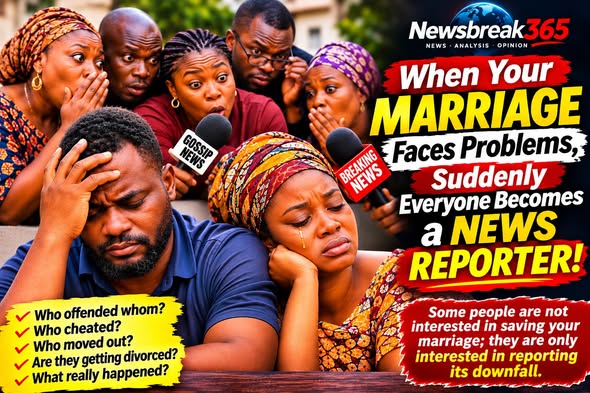
When Your Marriage Faces Problems, Suddenly Everyone Becomes a News Reporter!

Published

on

Some people are not interested in saving your marriage; they are only interested in reporting its downfall.**

There is something deeply disturbing about how some people react when they discover that another person’s marriage is experiencing difficulties. Instead of offering genuine support, understanding, or encouragement, they suddenly transform themselves into investigative journalists.

A marriage that was once private suddenly becomes public entertainment. People who never bothered to ask how your family was doing now want to know everything that is happening behind your bedroom doors.

Who offended whom? Who cheated? Who moved out? Who is responsible? Are they getting divorced? What exactly happened?

Suddenly, everybody has questions, theories, opinions, and breaking news to share.

And the most shocking part? Some of these people are not strangers. They are friends, neighbours, colleagues, relatives, and even people who regularly sit at your dining table.

## When Your Pain Becomes Their Entertainment

Some people are strangely fascinated by other people’s marital struggles. They can spend hours discussing somebody else’s relationship while pretending to be concerned.

They will call one person for information, contact another person for confirmation, and share the latest gossip with a third person.

Before you know it, a private disagreement between husband and wife has become a community discussion.

They don’t know the full story, but they are already passing judgment. They don’t understand what the couple is going through, but they have already appointed themselves as judges.

For some, the bigger the crisis, the more exciting the story becomes.

See also  Lateef Olufemi Okunnu: The Distinguished Nigerian Lawyer and Statesman

**They are not looking for a solution; they are looking for another episode.**

## The People Who Pretend to Care

One of the most dangerous aspects of marital gossip is that it often comes disguised as concern.

“How is your marriage?”

“Is everything okay between you two?”

“I heard something happened. Is it true?”

These questions are not necessarily bad. Genuine concern exists, and sometimes people really want to help.

But there is a difference between someone who wants to help you resolve a problem and someone who wants information to distribute to others.

Not everybody deserves access to your private family matters.

Your marriage is not a reality television programme, and your relationship struggles are not breaking news for public consumption.

## Stop Giving People a Front-Row Seat to Your Marriage

Every marriage experiences challenges. No husband and wife are perfect, and disagreements do not automatically mean that a relationship has failed.

Some couples need communication. Others need counselling, patience, understanding, and time to rebuild trust.

But when outsiders turn private problems into public gossip, they can make an already difficult situation even more painful.

This does not mean couples should remain silent when they need help. Seeking professional counselling, trusted advice, or support when facing abuse or serious problems is important.

However, there is a difference between seeking help and allowing everyone to become involved in your private affairs.

Sometimes, protecting your marriage also means protecting your privacy.

## Final Thoughts: Not Every Reporter Deserves Your Story

The next time you hear that somebody’s marriage is going through a difficult period, ask yourself whether spreading the information will help anyone.

See also  Wole Soyinka’s Nobel Prize Banquet, 1986

If you cannot offer genuine support, perhaps silence is a better contribution.

Today, you may be discussing another person’s marriage. Tomorrow, your own family could become the subject of somebody else’s gossip.

Remember this: **The same people who are eagerly reporting somebody else’s marital crisis today may be waiting for an opportunity to report yours tomorrow.**

Build relationships, offer support, encourage reconciliation where appropriate, and stop turning other people’s pain into entertainment.

—

## THE BIG QUESTION: LET’S DEBATE!

Why do some people become more interested in other people’s marriages when things go wrong?

1. Are they genuinely concerned, or are they secretly enjoying the drama?
2. Should couples keep their marital problems completely private?
3. Are friends and relatives sometimes responsible for making marital problems worse through gossip and unnecessary interference?
4. Would you trust someone who constantly brings you updates about another couple’s marital problems?

**Drop your opinion in the comment section. Let’s have an honest conversation!**

*Newsbreak365 — Bringing important conversations to the public.*

#MarriageAndRelationships #MarriageProblems #RelationshipGossip #AfricanSociety #FamilyMatters #HumanBehaviour #MarriageAdvice #Newsbreak365

FOLLOW US ON:

FACEBOOK

WHATSAPP CHANNEL

TWITTER

PINTEREST

TIKTOK

YOUTUBE

LINKEDIN

INSTAGRAM

Continue Reading

Lifestyle

Bad News Spreads Like Wildfire: Why Are People More Interested in Other People’s Misfortunes Than Their Success?

Published

on

From shocking rumours and public scandals to personal failures and disgrace, negative stories often attract more attention than positive achievements. Why does bad news travel so quickly while good news struggles to receive recognition?**

There is something deeply troubling about human behaviour: bad news seems to have wings, while good news sometimes struggles to walk.

A rumour about someone’s marriage, a scandal involving a public figure, a business failure, a family disagreement or someone’s personal misfortune can spread through an entire community before the people involved even have the opportunity to explain themselves.

One person hears it, another adds a little more drama, and before long, the original story has been transformed into something completely different.

But let someone build a successful business, buy a house, secure a promotion, graduate from university or achieve something extraordinary, and the reaction can be surprisingly different.

The same people who were eager to spread negative stories may suddenly become silent.

**Why is someone’s downfall more entertaining to some people than another person’s breakthrough?**

## The Addiction to Gossip and Other People’s Misfortunes

Gossip has become a powerful social currency. In some communities, knowing the latest scandal makes people feel important. Being the first to reveal someone’s private business can make an individual feel influential.

Unfortunately, not everyone spreading information is interested in establishing the truth.

Some people exaggerate stories, others deliberately twist facts, while some simply repeat whatever they hear without considering the damage their words could cause.

A person’s reputation can be destroyed by a story that has never been properly investigated.

See also  Lateef Olufemi Okunnu: The Distinguished Nigerian Lawyer and Statesman

And when the truth finally emerges, the correction rarely travels as far as the original accusation.

## Why Do People Struggle to Celebrate Other People’s Success?

Success can sometimes expose jealousy, insecurity and unhealthy competition.

When someone rises above their previous circumstances, not everybody will celebrate that progress.

Some may question how the person made their money. Others may dismiss their achievements, search for mistakes in their past or invent reasons why they do not deserve their success.

Instead of asking how they can learn from that person’s journey, they become more interested in finding something negative to say.

This is one of the unfortunate realities of social relationships: not everyone who smiles when you are struggling will be equally happy when you succeed.

## Social Media Has Turned Negativity into Entertainment

Social media has made information travel faster than ever before.

A controversial video, shocking allegation or embarrassing incident can attract thousands of reactions within hours.

Algorithms often amplify content that generates strong engagement, including anger, outrage and controversy.

Meanwhile, stories about kindness, community development, educational achievements and personal victories may receive considerably less attention.

The result is an environment where controversy can become more profitable than constructive conversation.

People are increasingly encouraged to react before thinking, share before verifying and condemn before understanding.

## The Damage Caused by Spreading Bad News

The consequences are not always harmless.

A false rumour can destroy friendships, damage marriages, ruin business relationships and permanently affect someone’s reputation.

Families can become divided. Communities can become suspicious of one another. People can lose opportunities because of accusations that were never proven.

See also  Wole Soyinka’s Nobel Prize Banquet, 1986

And sometimes, those responsible for spreading the information move on to the next scandal without ever considering the damage they have caused.

We must begin to understand that sharing information is not always an innocent activity. Sometimes, it is participation in somebody else’s suffering.

## What Kind of Society Are We Building?

A healthy society should be interested in truth, progress, education, innovation, kindness and achievement.

We should be just as eager to share stories about people creating employment, helping the less privileged, building successful businesses, supporting their communities and overcoming difficult circumstances.

There is nothing wrong with discussing genuine wrongdoing or holding people accountable. However, accountability is different from malicious gossip, character assassination and celebrating another person’s suffering.

We must learn to distinguish between public interest and the desire to entertain ourselves with other people’s problems.

## The Final Question: Why Do We Celebrate Failure More Than Success?

Perhaps the biggest problem is not simply that bad news spreads quickly. It is that too many people have become comfortable participating in the spread of negativity.

Before forwarding a rumour, ask whether it is true.

Before laughing at someone’s downfall, remember that life can change unexpectedly.

Before dismissing someone’s achievement, consider the sacrifices behind it.

And before spreading another person’s disgrace, ask yourself whether you would appreciate the same treatment.

**A society that gives more attention to scandals than achievements, more publicity to rumours than truth, and more applause to failure than progress must seriously examine its values.**

The world does not need more people spreading misery. It needs more people celebrating genuine progress and standing up for the truth.

See also  How I made my first N1m in 1999 – Actress Funke Akindele

—

### LET’S HEAR YOUR VOICE

Why do you think bad news spreads faster than good news?

1. Are people naturally attracted to gossip and controversy?
2. Is jealousy responsible for the reluctance to celebrate other people’s success?
3. Have social media platforms made society more interested in negativity?
4. Or is the problem a reflection of our declining values and moral standards?

**Join the conversation. Your opinion matters.**

*Newsbreak365 — Bringing Society, People and Issues into Focus.*

FOLLOW US ON:

FACEBOOK

WHATSAPP CHANNEL

TWITTER

PINTEREST

TIKTOK

YOUTUBE

LINKEDIN

INSTAGRAM

Continue Reading

Lifestyle

GOSSIP: THE SILENT WEAPON THAT CAN DESTROY A HUMAN LIFE – YOU DON’T NEED A GUN TO KILL SOMEONE

Published

on

Sometimes, the people who destroy your life are not your enemies. They are the ones smiling with you, sharing your secrets and discussing your private affairs behind your back.**

There are many ways to destroy a human being without physically touching them. One of the most dangerous weapons people use every day is gossip.

It is a weapon without bullets, a knife without a blade and an attack that can happen behind closed doors. Yet its consequences can be devastating.

In many families, workplaces, religious organisations and communities, people have turned gossip into a form of entertainment. They gather, whisper, exchange rumours, exaggerate stories and damage the reputations of people who are not even present to defend themselves.

What makes this behaviour particularly disturbing is that some people who participate in it see absolutely nothing wrong with what they are doing.

But have we ever stopped to consider what happens to the person at the centre of those conversations?

## 1. Gossip can destroy someone’s reputation.

A person can spend decades building a respectable name, only for malicious rumours to damage it within days.

One false accusation can make friends suspicious, neighbours judgmental and business associates uncomfortable.

The person spreading the story may move on to another conversation, but the victim may spend years trying to restore a damaged reputation.

## 2. Gossip can destroy marriages and relationships.

Some people deliberately carry stories between couples, friends and family members.

They exaggerate innocent conversations, twist statements and create suspicion where there was once trust.

Before long, husbands and wives begin questioning each other, siblings become enemies and lifelong friendships collapse.

See also  YOUR HUSBAND IS SITTING BESIDE YOU, BUT YOUR PHONE HAS YOUR FULL ATTENTION!

Sometimes, the biggest problem in a relationship is not the two people involved but the outsiders constantly feeding them poisonous information.

## 3. Gossip can expose people’s deepest secrets.

Everyone has private struggles.

Some people are battling financial difficulties, marital problems, personal disappointments or family challenges.

Instead of respecting their privacy, malicious individuals turn these struggles into public entertainment.

Imagine confiding in someone during your darkest moment, only to discover that your private story has become the subject of discussion in an entire community.

That is not friendship. That is betrayal.

## 4. Gossip can destroy careers and business opportunities.

Imagine losing a job, a promotion, a business partnership or an important opportunity because somebody decided to spread an unverified story about you.

In professional environments, rumours can undermine confidence, damage working relationships and make people question someone’s integrity.

Not every accusation is true, but once a damaging story spreads, correcting it can become extremely difficult.

## 5. Gossip can isolate people from their communities.

One of the cruelest consequences of malicious gossip is social isolation.

People who once welcomed someone may suddenly avoid them. Friends may withdraw, neighbours may become hostile, and relatives may begin treating them differently.

The victim may not even understand why everyone has changed towards them.

They are left fighting a battle they never knew existed.

## 6. Gossip can damage someone’s mental and emotional well-being.

Constant humiliation, false accusations and public rejection can cause serious emotional suffering.

Victims may experience anxiety, depression, sleeplessness, shame and loss of confidence.

In extreme cases, relentless harassment and humiliation can contribute to suicidal thoughts or self-harm.

See also  Veteran actor, EyiyemiOlivia Rogbinyin, to host QEDNG summit

This is why we must stop treating malicious gossip as harmless entertainment.

Words have consequences, and those consequences can be life-changing.

## 7. Gossip can turn innocent people into enemies.

Perhaps one of the most dangerous forms of gossip is the deliberate creation of hatred between people who have never had a genuine disagreement.

A person can tell one story to you, another version to your brother and a completely different version to your friend.

Before anyone realises what is happening, people who should be supporting one another are fighting over information that may not even be true.

This is how families become divided, communities lose unity and friendships disappear.

## THE BIGGEST HYPOCRISY: PEOPLE WHO GOSSIP OFTEN HATE BEING GOSSIPED ABOUT!

Here is a question worth asking: Why do people who spend their time discussing other people’s private lives become angry when somebody discusses theirs?

Why do those who spread rumours demand respect for their own privacy?

Why do people who destroy other people’s reputations become offended when their own character is questioned?

The hypocrisy is astonishing.

Some people want everyone to respect their dignity while showing absolutely no respect for the dignity of others.

They want forgiveness when they make mistakes but offer no mercy when someone else becomes the subject of their gossip.

## BEFORE YOU OPEN YOUR MOUTH, THINK ABOUT THE DAMAGE!

Not every conversation about another person is gossip. Sometimes, discussing someone’s behaviour is necessary to protect others, seek advice or address genuine concerns.

But deliberately spreading false information, exposing private matters, exaggerating stories and encouraging hatred is something entirely different.

See also  See the travails of Nigerian parents struggling to raise children abroad

We must learn the difference between speaking the truth responsibly and using someone’s personal life as entertainment.

Parents must teach their children to respect others. Religious leaders must discourage malicious rumours within their congregations. Politicians must stop using misinformation to divide communities. Society must stop celebrating people who destroy others with their tongues.

**You do not need to physically attack someone to make their life miserable. Sometimes, a rumour, a lie or a carefully manipulated story can cause damage that takes years to repair.**

Remember this: The person you are gossiping about today may be someone you need tomorrow.

And the same mouths that are discussing another person’s private life today may become the subject of tomorrow’s conversation.

## THE NEWSBREAK365 QUESTION: LET’S DEBATE!

1. Is gossip simply harmless conversation, or can it become a form of psychological and emotional violence?
2. Have you ever seen a family, marriage or friendship destroyed by gossip?
3. Should people who deliberately spread false rumours be held accountable for the damage they cause?
4. Why do some people enjoy destroying other people’s reputations while protecting their own?

**ONE FINAL MESSAGE:**

Before you spread a rumour, remember that there is a human being behind the name you are discussing.

That person has feelings, family, dreams, dignity and a life worth protecting.

**STOP USING YOUR MOUTH AS A WEAPON. YOU NEVER KNOW HOW MUCH DAMAGE YOUR WORDS CAN CAUSE.**

*Newsbreak365 – Challenging Perspectives, Exposing Truth and Inspiring Conversations.*

FOLLOW US ON:

FACEBOOK

WHATSAPP CHANNEL

TWITTER

PINTEREST

TIKTOK

YOUTUBE

LINKEDIN

INSTAGRAM

Continue Reading

Trending