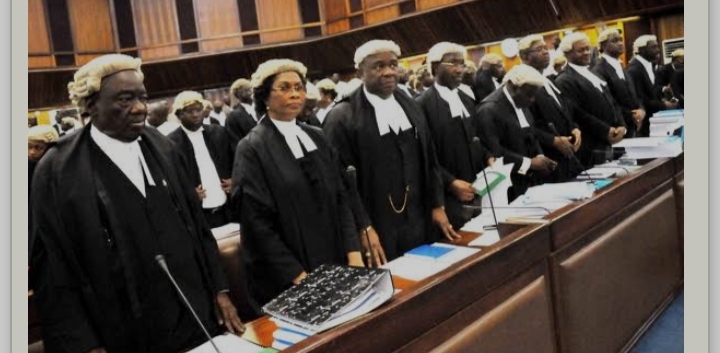
Although Nigeria’s constitution does not recognise witchcraft or the use of charms, long-standing rumours persist about alleged spiritual attacks on lawyers and the judicial system, writes CHIJIOKE IREMEKA
In many parts of the world, men in white wigs face undue pressure from political interests, powerful individuals and aggrieved parties while discharging their professional duties.
However, beyond the visible pressures of the courtroom, physical threats and assaults, some lawyers and judges told Sunday PUNCH that they face unusual spiritual attacks while handling certain sensitive cases.
Although diabolism or charms, popularly referred to as juju, have no place in Nigeria’s law and legal system, an unidentified lawyer, in a viral video clip on X and Instagram, while shedding light on such practices, appealed to litigants to stop directing spiritual attacks at opposing lawyers during court proceedings.
His experience became a widely discussed topic among religious and legal communities, where differing opinions were expressed on the place of juju and charms in Nigeria’s legal system.
The lawyer emphasised that lawyers are professionals carrying out their ethical duties and should not be targeted through spiritual means that could undermine justice.
“If you have a problem with someone and the case is already in court, and you still want to report the matter to your ‘juju’, leave the opponent’s lawyer out of it.
“Stop attacking the lawyers spiritually; attack your opponent only. Lawyers are just doing their job,” he said.
The video sparked widespread discussion online, highlighting the prevalence of beliefs in consulting spiritualists to influence court outcomes in Nigeria.
Following this, many Nigerians expressed support for the lawyer’s stance on social media, calling for an end to the practice of targeting lawyers with spiritual attacks, while others treated it with humour.
However, several lawyers who spoke to Sunday PUNCH recounted harrowing experiences they alleged were ‘spiritual attacks’ in the course of their profession.
A strange experience
A retired judge of the Federal High Court in Imo State, who asked to be identified only by her first name, Joyce, said, “Although juju has no place in Nigeria’s legal system, there are moments, both inside and outside the courtroom, when events unfold that simply defy explanation.”
The Imo State-born jurist said that on a few occasions, she had been subjected to what she described as spiritual attacks and intimidation during court proceedings, but she had always prevailed through her Christian faith.
The 76-year-old recounted several experiences during sensitive cases when she began to experience unusual moments.
The mother of three said that on one occasion, she arrived at court as usual, took her seat, and prepared to begin the day’s proceedings. After handling the first case without difficulty, the second became a problem.
“When the second case was called, I was preparing to listen to the submissions, and that was the last case for the day. I became unusually still and quiet, staring ahead without speaking for a long time.
“For several minutes in the courtroom, I was blank and confused. I did not know where such a feeling came from, but I was unable to proceed with the case, and I had to adjourn it to a later date.
“It was a murder case involving the only male child of his parents. I was lost in thought and struggled to proceed. I knew it wasn’t ordinary; I knew where it was coming from. But the law will always take its course. Litigants try to attack practitioners to derail their minds, but it does not last if you remain strong,” Joyce said.
According to her, such experiences are among the pressures faced by many legal practitioners, but they rarely speak about them because charms and juju have no place in the legal system, and since they cannot be proven, discussing them may appear irrational.
“In Nigeria, where people pray over everything and hold strong beliefs in God and certain ancestral powers, people commit their activities and challenges to prayers, irrespective of the supreme beings they believe in,” she added.
Joyce believed the strange occurrence was linked to spiritual attacks intended to distract or weaken her resolve in delivering a fair judgment.
For her, the experience became a test of faith rather than a moment of defeat. Instead of yielding to external pressures, she became more determined to carry out her judicial responsibilities with integrity and without fear or favour.
‘Spiritual attacks’ under judicial lens
Belief in supernatural intervention is not uncommon in parts of Nigeria, where spirituality and traditional beliefs often intersect with daily life.
Legal analysts often frame such accounts in broader terms. They noted that the real challenge facing judges is the intense pressure associated with high-profile cases, including threats to life, physical attacks, and other forms of intimidation.
They stressed that attempts to influence judicial decisions, whether through bribery, threats, or coercion, have long been recognised as challenges in many judicial systems worldwide.
Nigeria’s justice system, long regarded as the bedrock of law and order, is increasingly entangled in narratives that extend beyond the physical realm.
Across courtrooms and legal corridors, there have been claims of spiritual interference, ritual practices, and unseen forces that have become part of conversations within and outside the system.
From delayed judgments to controversial case outcomes, missing files, and absent witnesses, many insiders attribute irregularities not only to corruption or inefficiency but also to perceived metaphysical influences.
These experiences, often dismissed yet widely believed, reveal a complex intersection of law, culture, and spirituality, raising questions about integrity, accountability, and the unseen pressures shaping the pursuit of justice in Nigeria and across Africa today.
Findings revealed that many legal practitioners believe in spiritual powers but are reluctant to openly discuss them because the subject is highly subjective.
Section 210 of the Criminal Code Act criminalises offences related to witchcraft and charms, stating that anyone involved in such acts is guilty of a misdemeanour and liable to two years’ imprisonment.
It provides that any person who, by his statements or actions, represents himself to be a witch or to have the power of witchcraft; or accuses or threatens to accuse any person of being a witch or of having the power of witchcraft; or makes, sells, uses, assists in making or using, or has in his possession any juju, drug, or charm intended to prevent or delay a person from doing what they have a legal right to do, or to compel them to do what they have a legal right to refrain from doing, commits an offence and is guilty of a misdemeanour.
It further states that a person who claims such items have the power to cause natural phenomena, diseases, or epidemics, or who directs, controls, presides over, is present at, or takes part in the worship or invocation of any juju prohibited by an order of the President or a state governor, is also culpable under the law.
Additionally, anyone who is in possession of or has control over any human remains used or intended to be used in connection with the worship or invocation of any juju; or makes or uses, or assists in making or using, or has in his possession anything whatsoever, the making, use, or possession of which has been prohibited by an order as being or believed to be associated with human sacrifice or any other unlawful practice, is guilty of a misdemeanour and is liable to imprisonment for two years.
‘Legally, ethically unacceptable’
Buttressing this legal provision, a popular Nigerian human rights lawyer, Deji Adeyanju, cited Sections 210–213 of the Criminal Code, which criminalise acts of witchcraft, sorcery, or juju when used to cause harm, fear, or deceive others.
“The idea of clients using ‘juju’ or supernatural means to target a lawyer on the opposing side is both legally and ethically unacceptable. Therefore, any attempt to use such means against a lawyer could constitute a criminal offence.
“However, while the Criminal Code criminalises such acts, the Supreme Court of Nigeria has consistently affirmed that juju, charms, rituals, or other supernatural practices have no objective legal effect or power in legal proceedings,” he said.
Adeyanju emphasised that Nigerian law is secular and evidence-based, arguing that courts decide cases on facts, witness testimony, documents, and applicable statutes, not on spiritual claims, curses, oaths with supernatural backing, or beliefs in the occult.
“The Supreme Court treats defences or claims based purely on witchcraft or juju as subjective and legally untenable. While such beliefs may sometimes be offered to explain motive, they cannot justify or excuse unlawful acts unless they meet strict objective legal tests, which they rarely do,” he added.
From a professional standpoint, he noted that lawyers must be protected from threats, whether physical or otherwise, adding that legal practitioners owe duties to their clients, the court, and the justice system, and any attempt to compromise those duties through extra-judicial means is unacceptable.
According to him, disputes between clients should be resolved strictly through legal channels.
“To clarify, I have never experienced any such attacks from opposing parties. My focus remains on representing clients within the law and maintaining the integrity of the legal profession,” Adeyanju added.
Physical attacks and threats
Beyond alleged spiritual attacks, several legal practitioners recounted experiences of intimidation, harassment, and direct threats from opposing parties during high-stakes cases.
A human rights lawyer, Jude Ofokansi, said he had, on a couple of occasions, been followed by unknown persons and, at other times, received anonymous calls and threats to drop certain cases.
He noted that his experiences highlight the broader risks associated with legal practice, particularly in contentious matters involving powerful interests.
According to him, these encounters can be deeply unsettling and, in some instances, may discourage lawyers from fully pursuing justice for their clients.
“Many people have lost their cases because of these threats and intimidation. However, these accounts point to a troubling environment where legal battles are not only fought on the basis of evidence and law but are also shaped by fear, intimidation, and external pressures.
“I have had a case where the youth of a particular community attacked me and blocked my way after a court case because they felt I should not stand in their way of justice.
“They had a community land dispute, which I obtained an injunction to stop the allocation and plotting of the land meant to be shared among the community members. So, I was hired by the opposing community to defend them, and the first thing I did was to stop the plotting of the land,” Ofokansi said.
Strange occurrences
A Delta-based litigation lawyer with 13 years of courtroom experience, Emeke Omogiafo, was reported to have personally faced spiritual attacks during a land case in 2021.
According to The Pointer of October 26, 2025, Omogiafo said he believed in sound logic and reasoning and never subscribed to spiritual warfare as a lawyer, until he collapsed in the courtroom and woke up in a hospital while making a case submission.
“I had been briefed by a client, whom I will not mention, in a Delta community over a land dispute that had lingered for almost 20 years. It was between two brothers. I knew it was going to be tough legally, but I did not expect it to turn into a battle of life and death,” he recalled.
According to Omogiafo, strange things began happening barely a week after he took the brief. He said the first sign was waking up in the middle of the night, feeling as though someone was sitting on his chest.
He said he would struggle to breathe, as if something was pressing him down, which he initially dismissed as stress, but became alarmed when it continued for days.
“Then, on the first hearing date, my car refused to start. I checked the battery, fuel, and everything was fine. I ended up using my wife’s car to go to court. The following night, my tyres burst in my parking lot. There was no explanation for that, and this pushed me to prayer.
“Meanwhile, I had already been warned that people don’t fight fair in that community once land is involved. I was told they can go to any length. My client even told me that the other side had gone to a native doctor, but I laughed it off until I collapsed in court.
“I collapsed in court, right in the middle of my submission. I felt dizzy, then blank. I lost consciousness and woke up in the hospital. The doctor said my blood pressure was extremely low and could not explain why I collapsed. But a pastor friend who visited me told me I was under spiritual attack. He prayed with me and advised me to fast for seven days,” Omogiafo said.
According to him, he obeyed and fasted, adding that after the spiritual exercise, things changed for the better, and the case eventually ended in his client’s favour.
“I used to mock colleagues who said they fortified themselves spiritually before major cases, but not anymore. Now I know better. Law may be a profession of logic and evidence, but in Nigeria, there are forces logic cannot explain.
“I still don’t visit any herbalist or traditionalist, no. I’m a Christian, and my faith is enough. But I don’t step into court without praying and covering myself with the blood of Jesus. I’ve seen too much to take chances again,” he added.
In another development, a legal practitioner, Chukwuemeke Ogbuobodo, affirmed that spirituality exists, saying if not, there would not be the word ‘spirit.’
He said that although its existence is abstract, some people think it does not exist, adding that on several occasions, he has seen situations where a lawyer slumped during court proceedings, which people often attribute to a rise in blood pressure or cardiac arrest.
“Again, sometimes, a lawyer can attend court to defend his client but end up not knowing what to say or do during the proceedings. People see such a lawyer as a quack who does not know his duty, but in reality, such a lawyer at that moment is under spiritual attack, which may have come from the opponent. Sometimes, lawyers forget to appear in court. All these are not ordinary; they are spiritual attacks,” Ogbuobodo said.
He revealed that sometimes clients on the opposing side can go the extra mile to eliminate a lawyer, thinking that once the lawyer handling a case is gone, the matter will close.
“However, in reality, this is not so, because other lawyers are readily available to carry on the case,” he noted.
Ogbuobodo affirmed that spirituality exists, but said he fears nothing in the process of discharging his legal obligations.
He further stated that spiritual protection is a general concept, in the sense that one prays to one’s God, adding that prayer serves as spiritual protection and is not restricted to Christians or Muslims alone.
Ogbuobodo urged legal practitioners to uphold the pride of the profession, as it remains the last hope of the common man.
Spiritual attacks stall cases
Across Nigeria and Anglophone African countries, allegations of spiritual attacks disrupting legal proceedings are gaining attention, as some lawyers claim unseen forces stall cases, raising concerns about justice, belief systems, and professional accountability within the judiciary.
Last month, a human rights activist and social crusader, Festus Ogun, shared his experience on X (formerly Twitter).
The lawyer said he once became ill shortly after shaking hands with an individual who had filed a case against his client.
“I did a pre-election litigation in 2022. After successfully persuading the court to refuse his motion for joinder, the applicant jokingly approached and shook hands with me. That was how the sickness started. Thank you, Blessed Virgin Mary, for giving me a chance to tell the story,” Ogun wrote,” he wrote on his handle.
‘There’s no spiritual attack in law’
Reacting to what he described as extra-legal harm in litigation, a traditionalist and human rights lawyer, Malcolm Omirhobo, told Sunday PUNCH that the claim is deeply disturbing and professionally inappropriate.
Omirhobo, who said the claim was dangerous to the administration of the justice system in the country, is also the Principal Partner at the Chambers of Chief Malcolm Omirhobo & Co., Lagos.
He said litigation in Nigeria is governed strictly by the rule of law, due process, and ethical standards, adding that the administration of justice must remain rooted in law, evidence, and reason, not fear, superstition, or intimidation.
“Any suggestion that expressly or impliedly indicates that a litigant may lawfully or acceptably resort to extra-legal means, including spiritual or traditional practices intended to harm an opposing party, is wholly inconsistent with Nigerian law and the ethical obligations of legal practitioners.
“Under Nigerian criminal jurisprudence, any act intended to cause harm to another person, whether directly or indirectly, constitutes a punishable offence. The law does not recognise ‘spiritual harm’ as a defence or justification,” Omirhobo said.
He noted that acts of intimidation, threats, conspiracy, or any conduct calculated to harm another person fall within the purview of criminal liability under the Criminal Code Act and other applicable laws.
“Furthermore, the Rules of Professional Conduct for Legal Practitioners (2007) impose a clear duty on lawyers to uphold the rule of law and maintain the highest standards of professional integrity.
“In particular, Rule 1 mandates that a lawyer shall uphold and observe the rule of law and promote and foster the cause of justice. Rule 15(1)(a) prohibits a lawyer from engaging in any conduct that is unlawful or incompatible with the legal practitioner’s duty to the court and the administration of justice.
“A statement that appears to disclaim involvement while failing to unequivocally condemn unlawful conduct may be construed as tacit approval or normalisation of illegality, which is unacceptable within the legal profession,” he noted.
Omirhobo argued that the Supreme Court of Nigeria has consistently emphasised that legal practitioners are ministers in the temple of justice, whose conduct must at all times reflect dignity, responsibility, and fidelity to the law.
He said, “In Legal Practitioners Disciplinary Committee v. Fawehinmi (No. 2) (1985) 2 NWLR (Pt. 7) 300, the Court underscored the central role of lawyers in preserving the integrity of the justice system.
“Therefore, the propagation of narratives suggesting that disputes may be influenced or resolved through extra-judicial or supernatural means poses a serious threat to public confidence in the judiciary, encourages fear-based litigation, and undermines the very foundation of justice in a constitutional democracy.
“It must be stated unequivocally: No litigant has the right to harm, threaten, or intimidate an opposing party by any means whatsoever, physical, psychological, or spiritual, and no lawyer should, directly or indirectly, lend credence to such conduct.”
Omirhobo noted that legal practitioners confronted with clients expressing such intentions have a duty to advise firmly against such conduct, distance themselves clearly and professionally, and, where necessary, withdraw from representation in line with ethical rules.
“The Nigerian Bar Association and relevant disciplinary bodies are urged to reiterate and enforce clear ethical guidelines on this issue to preserve the sanctity of the legal profession,” he added.
Buttressing Omirhobo’s point, the Managing Partner of an Abuja-based firm, Charles I. Ndukwe & Co., Barr Charles Ndukwe, who has been in the legal profession for over 35 years, said he had never witnessed or heard of a lawyer being attacked spiritually while handling a brief.
“I have not had any such experience since I started practising law 35 years ago. I have also never heard of this from colleagues who have been practising for decades. Such a claim is balderdash. If anyone loses a case, they should accept it and seek help if they wish.
“If such spiritual attacks were real, the majority of lawyers would have been destroyed or driven out of the profession long ago, because those with superior powers or charms would have dominated everyone,” he said.
However, he acknowledged that physical attacks do occasionally occur, usually because some individuals are unhappy or angry that a lawyer took up a particular case they believe should not have been accepted.
“They may become malicious or hostile because of that. But that is no reason to entertain claims of spiritual interference. Lawyers are doing their jobs, and anyone who says you shouldn’t take up a case should compensate you, not intimidate you.
“Apart from this, there is nothing like a spiritual attack in law. When you lose a case, accept it, learn from it, and restrategise,” he added.
Diablism has no place in law – NBA President
Strongly condemning allusion to spiritualism attacks on lawyers, a Senior Advocate of Nigeria and President of the Nigerian Bar Association, Afam Osigwe, said ‘juju’ and ‘charms’ have no role in Nigeria’s legal system.
“I have practised law for over 27 years and handled numerous critical and high-profile cases, yet I have never encountered juju or charms in court. They simply have no place in our legal system.
“This is not a topic we should be discussing in the 21st century. As NBA president, I cannot speak on juju because I do not believe in it. I have not seen it, and there is no such thing as spiritual attacks in our courts.”
punch.ng
FOLLOW US ON: