Connect with us

News

Trump appoints hardliner Miller as Chief Of Staff after midterm election defeat

Published

on

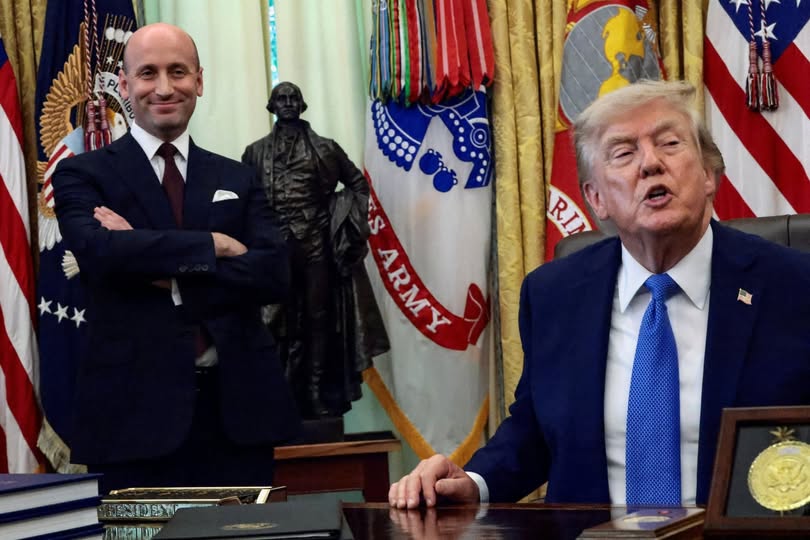
US President Donald Trump has appointed Stephen Miller as White House chief of staff, replacing Susie Wiles following the Republican Party’s heavy losses in this week’s midterm elections. Miller, 41, has been a leading figure behind Trump’s immigration policies, serving as deputy chief of staff for policy and homeland security adviser.

Asked on Friday, November 6, why he had replaced Wiles, Trump told reporters: “I wanted to make a change.” “Sometimes in life you have to make moves,” he added. The appointment followed Trump’s repeated assurances before the elections that there was “zero chance” he would replace Wiles. A White House official told AFP that she resigned on Thursday night.

Announcing the change on Truth Social, Trump described Miller as “one of my most trusted advisors”. He said Wiles would move to his political operation and praised her work at the White House. “I want to thank her for her service as Chief of Staff. She has done a great job!” he wrote.

Miller’s promotion drew strong criticism from Democrats, who secured congressional majorities in the midterms. “Stephen Miller is the architect of the most barbaric, inhumane policies of this administration. Trump couldn’t have made a worse choice,” Chuck Schumer wrote on X.

“Our Democratic majorities will fight him every step of the way.” Miller played a central role in developing the mass deportation programme that became a defining policy of Trump’s second term.

He faced widespread criticism after immigration agents fatally shot two protesters in Minneapolis in January, incidents that triggered mass demonstrations. The administration’s enforcement operations also drew scrutiny over masked agents and confrontations with members of the public. White House communications director Steven Cheung welcomed Miller’s appointment, describing him as a longstanding Trump ally.

See also  Over 100,000 policemen assigned to VIPs — EU report

“He will help the Administration deliver on monumental victories for the rest of this historic second term,” Cheung said. Wiles, 69, was the first woman to serve as White House chief of staff. Trump nicknamed her the “ice maiden” for her efforts to maintain discipline in the West Wing.

For much of the past two years, she had helped limit the staff turnover and internal disputes that characterised Trump’s first administration. She also recently announced that she had received the all-clear following breast cancer. In a statement on X, Wiles confirmed that Friday would be her final day as chief of staff. “Serving President Trump in the White House has been the honor of a lifetime,” she said.

“I’m so proud to have been a part of what we’ve accomplished together from securing our border and cutting taxes to strengthening our economy and putting America First.” Prominent supporters of Trump’s Make America Great Again movement welcomed the appointment. Right-wing commentator Jack Posobiec posted, “It’s Miller Time,” borrowing a well-known American beer slogan.

FOLLOW US ON:

FACEBOOK

WHATSAPP CHANNEL

TWITTER

PINTEREST

TIKTOK

YOUTUBE

LINKEDIN

INSTAGRAM

Continue Reading
Click to comment

Leave a Reply

Your email address will not be published. Required fields are marked *

News

Belgium’s Parliament Passes Law Allowing Police Home Entries to Find Undocumented Migrants

Published

on

Just after 05:00 on Friday, Belgium’s federal parliament passed a bill that allows police and immigration officers, under specific conditions and with prior judicial authorisation, to enter private homes to enforce removal orders, during a parliamentary hearing that started on Thursday evening.

The highly divisive bill has been the subject of debate for over a year, with 53% of Belgians supporting the legislation according to a survey conducted by human rights organisation 11.11.11.

During the bill’s final parliamentary session, which lasted all night, the debate became incredibly heated, with MPs booing each other and trading verbal jabs the entire evening.

‘Solidarity isn’t a crime’

Debate over the bill began when Flemish far-right MP Barbara Pas (Vlaams Belang) requested that all “non-urgent” legislation on the agenda be tabled so parliament could focus on the ramifications of Prime Minister Bart De Wever (N-VA) submitting his resignation to the King earlier this week.

Several other MPs expressed a similar desire, including Francophone socialist Pierre-Yves Dermagne (PS), albeit for different reasons. He questioned why the Francophone progressive-centrist Les Engagés and other majority parties were keen to vote on the legislation a day after protests across Belgium occurred against the legislation.

The organisers of those protests, No ICE in Belgium, told the Brussels Times that their “solidarity isn’t a crime, and respect for fundamental rights is non-negotiable.”

In Brussels, demonstrators formed a human chain around the Palais de Justice, while around 50 other rallies were organised in front of town halls across the country.

“We saw a strong mobilisation across Belgium last night to tell you, ladies and gentlemen of the parliament, to not support this bill authorising home visits we’re discussing today,” Dermagne said. “Seize this political opportunity to ensure that your speeches are consistent with your actions.”

See also  US launches another massive round of strikes on Iran

However, some MPs who support the legislation, like Michel De Maegd (Les Engagés), called these requests hypocritical.

De Maegd added that he believed some MPs only want to discuss legislation when conversations favour them, and when it no longer does, they begin to oppose democratic debates.

“There is a difference between doing politics and petty politics,” De Maegd said. “I want to point out on behalf of my group that we are here voting for a law that further pursues terrorists and who votes against that? … Do not prevent the debate, listen to these arguments and respond with your own arguments.”

After a vote of 84-52 over whether or not the bill should be voted on during Thursday’s debate, it was ultimately left on the parliament’s agenda.

‘A slap in the face’

When the bill was revisited on the floor, Maaike De Vreese (N-VA) began conversations by calling out misconceptions she believed certain MPs and NGOs were pushing. In particular, De Vreese questioned the demonstrations that had taken place the prior evening, asking if the protesters even understood what exactly they were protesting against.

“For whom, for God’s sake, are you taking up with that human chain?” De Vreese asked. “It’s a slap in the face to our police forces and immigration offices that are confronted with reality on a daily basis and carry out these home checks. But much worse, it’s a slap in the face of the victim of these measures.”

In response, Matti Vandemaele (Groen) mocked the legislation by questioning what it will achieve that the current statute doesn’t.

See also  PHOTOS: Nigerian Army confirms multiple b0mb explosions in Maiduguri; intensifies surveillance and patrols to track down remaining su!cide b0mbers

“You say that with home entries, we will finally be able to tackle the pedophiles, rapists and terrorists!” he exclaimed. “But which of those categories can we currently not tackle with the tools we have now? Because that is what you’re saying while everyone else in the hearings has indicated that this is total nonsense.”

Claire Hugon Lecharlier (Ecolo) added to Vandemaele’s point, stating that police officers and other affected parties have asked her to vote ‘no’ on the bill. According to Lecharlier, this alone should be enough of a warning sign for the parliament to rethink the bill.

She added that some of the things she’s heard supporters of the bill share are misguided and could unfairly stigmatise certain groups of people.

“I think you would do well to find out about the profile of perpetrators of sexual violence against minors,” Lechalier said. “It’s the fathers, brothers and cousins. So don’t come and tell me that my daughter and other children are in danger because we are welcoming, when it’s you who apparently has no knowledge of how sexual assaults against children occur.”

In response to the questioning, De Vreese questioned if these conversations would even have to happen if there were stricter rules for removing illegal immigrants already in statute. In particular, she questioned why “illegal” immigrants, some of whom have committed crimes, are allowed to leave the country of their own free will.

“How many chances do these people actually get?” she questioned. “These people shouldn’t even be here in the first place. They just have to leave, and they can cooperate right? But they don’t do that, and they refuse to leave. What’s more, they commit criminal acts on top of that!”

See also  16 escape death in Lagos-Abeokuta Expressway crash

Empty seats and shouting matches

As the debate continued into late Thursday evening, the chamber became increasingly hostile. By 20:00, many MPs had left the chamber, something both Denis Ducarme (Reformis) and Sarah Schlitz (Ecolo) expressed their disdain for. After Schlitz called the nearly vacant room “disgusting,” the debate was interrupted for nearly 20 minutes as the chamber descended into a shouting match.

When the debate recommenced, Khalil Aouasti (PS) questioned Asylum and Migration Minister Anneleen Van Bossuyt (N-VA), the bill’s sponsor, over comments she’s made.

“Do you agree with the idea that the threshold of the home is an obstacle to overcome, or do you agree that it is a freedom to preserve?” he asked.

Van Bossuyt did not have a chance to respond to this or any criticism for another ten hours.

Just after 05:00 on Friday, the bill was ultimately passed with 80 votes in favour, 35 against, and 12 abstentions.

“We can certainly call this a historic moment,” Van Bossuyt said. “After years of political opposition and a great deal of misinformation, it can finally come into force. The law’s aim is to deport rapists, drug offenders and hate preachers from the country. Those people will no longer be able to hide behind closed doors.”

Source: BRUSSELSTIMES



Continue Reading

News

Belgian King rejects PM De Wever’s resignation, new deadline to find way out of budget crisis

Published

on

King Philippe has rejected Prime Minister Bart De Wever’s (N-VA) resignation during a meeting on Friday, giving the Prime Minister’s federal government 10 more days to reach an agreement on next year’s budget.

“Following talks with the five party leaders of the coalition, the King has decided to reject the resignation of the Prime Minister,” the Belgian Royal Palace shared in a statement. “The King has asked him to resume negotiations for a budget.”

De Wever will report back to the King on 16 November.

De Wever handed in his resignation on Monday, after the PM deemed the negotiations around a budget for 2027 within his coalition to have failed. He had set a target of curbing the national deficit by €10 billion back in September.

The talks have stalled after Vooruit (Flemish social democrats), CD&V (Flemish Christian democrats) and Les Engagés (Francophone centrists) reportedly asked for increased taxes on the “strongest financial shoulders,” something MR (Francophone liberals) and N-VA (Flemish nationalists) strongly oppose.

The Belgian deficit sits at 5.2% of GDP, the highest in the eurozone, with the debt rising to over 110% of GDP this year. Across the eurozone, only France (116%), Italy (137%) and Greece (146%) have a higher relative debt than Belgium.

As things stand now, Belgium will be hit by a so-called “snowball of compounding interest” in 2029, as the country will have to borrow money to pay interest on its debt.

Last weekend, an ultimate effort to find an agreement failed, as parties within the government failed to agree on where to make adjustments. A provisional monthly budget will have to be used at the start of next year, as parliament will no longer have enough time to put a budget agreement into law.

See also  FAAN steps up airport surveillance for Ebola, urges calm, vigilance

De Wever called the use of provisional budgets a “horrible failure” in Parliament on Thursday.

Source: BRUSSELSTIMES

FOLLOW US ON:

FACEBOOK

WHATSAPP CHANNEL

TWITTER

PINTEREST

TIKTOK

YOUTUBE

LINKEDIN

INSTAGRAM

Continue Reading

News

Israel opposition brands Netanyahu ‘toxic’ after Democrats seize US Congress

Published

on

Israeli opposition leaders have intensified their criticism of Prime Minister Benjamin Netanyahu, accusing him of damaging Israel’s relationship with the United States after Democrats won control of both chambers of Congress in the US midterm elections.

The Democratic victory on Tuesday, November 3, is seen as a major setback for US President Donald Trump and could complicate Washington’s traditionally strong support for Israel, particularly amid growing opposition to the US-Israeli war with Iran and Israel’s military campaign in Gaza.

Former Israeli Prime Minister Yair Lapid said the election results showed why Netanyahu could no longer remain in office, warning that his continued leadership threatened Israel’s security, democracy and international standing.

“It endangers our security, it jeopardizes our democracy, and it will ruin our standing on the global stage,” Lapid wrote on social media.

Lapid also accused Netanyahu of abandoning Israel’s longstanding bipartisan approach to Washington by openly aligning himself with Republicans. He recalled Netanyahu’s controversial 2015 address to the US Congress, in which he opposed then-President Barack Obama’s proposed nuclear agreement with Iran.

Meanwhile, opposition politician Yair Golan described Netanyahu as increasingly unpopular across the American political establishment, saying the election exposed “just how toxic Netanyahu has become” among Democrats and Republicans.

Golan warned that retaining Netanyahu and his far-right government could push Israel towards international sanctions, diplomatic isolation and a confrontation with the United States.

Another opposition figure, Gadi Eisenkot, pledged to restore Israel’s bipartisan relationship with Washington if he succeeded in forming the next government.

See also  16 escape death in Lagos-Abeokuta Expressway crash

The criticism comes as Netanyahu faces political difficulties at home following Israel’s October 27 election, in which his bloc secured 53 seats in the 120-member Knesset, falling short of the 61 needed for a majority. The opposition bloc secured 48 seats, while Arab-led parties won 19, leaving the country facing difficult coalition negotiations.

The Democratic takeover of Congress could also have significant consequences for Israel’s military and diplomatic relationship with Washington, as some Democratic lawmakers have increasingly questioned continued military assistance to the country.

Trump, who openly backed Netanyahu during Israel’s election campaign, also pledged to end the annual US military aid to Israel, worth about $3.8bn, arguing that doing so would remove an issue Democrats had used against his administration.

Despite the criticism, the American Israel Public Affairs Committee (AIPAC) congratulated pro-Israel candidates who won their elections, saying 234 candidates it supported had secured victories.

Netanyahu had not immediately responded to the opposition’s latest criticism.

Al Jazeera

Source: tribuneonlineng.com

FOLLOW US ON:

FACEBOOK

WHATSAPP CHANNEL

TWITTER

PINTEREST

TIKTOK

YOUTUBE

LINKEDIN

INSTAGRAM

Continue Reading

Trending