Connect with us

Lifestyle

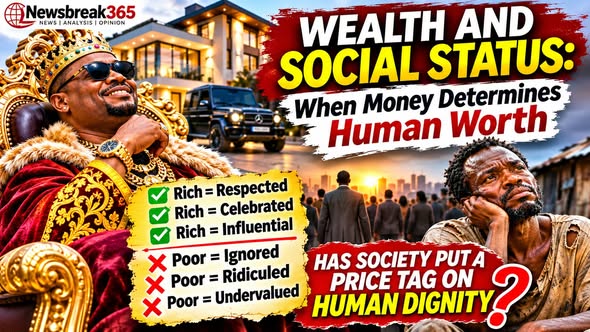
WEALTH AND SOCIAL STATUS: WHEN MONEY DETERMINES HUMAN WORTH – HAS SOCIETY PUT A PRICE TAG ON HUMAN DIGNITY?

Published

on

In a society where money speaks louder than character, a wealthy fool can receive more admiration than an educated, hardworking and morally upright poor person. Is this the new definition of human worth?**

There was a time when people were respected for their wisdom, integrity, courage, generosity and contributions to society. Today, however, it appears that society has developed a dangerous measuring scale: the size of someone’s bank account.

A luxury car can attract more respect than years of hard work. An expensive mansion can command more admiration than a lifetime of honesty. Designer clothes can make someone appear important, even when their character is questionable.

Welcome to a society where wealth is increasingly becoming a substitute for character.

## When money becomes the foundation of respect

Consider what happens when someone becomes wealthy.

People who previously ignored them suddenly want to become friends. Those who never answered their phone calls now rush to pick up. Invitations begin to arrive, doors open, and opinions that were once dismissed suddenly become important.

But what happens when the same person loses their wealth?

The expensive car disappears. The luxurious lifestyle comes to an end. The influential friends become unavailable, and the admiration gradually fades.

Suddenly, the same society that celebrated them begins to treat them differently.

Does this mean the respect was never genuine in the first place?

Perhaps what people admired was not the individual but the financial benefits they believed they could receive.

## The humiliation of poverty

One of the most painful realities of modern society is how easily poverty can become a reason to humiliate another human being.

A poor person may be intelligent, hardworking, educated, generous and honest, yet struggle to receive the recognition they deserve.

See also  Dr. E. Latunde Odeku: The Pioneer of Neurosurgery in Nigeria and a Trailblazer in African Medicine

A struggling father may sacrifice everything to educate his children but receive less admiration than someone displaying unexplained wealth.

A hardworking teacher may spend decades shaping future generations but struggle financially, while individuals who acquire wealth through questionable means are celebrated as role models.

A successful businessperson may be praised without anyone questioning how the wealth was acquired.

This raises an uncomfortable question: **Have we reached a point where how much you have matters more than how you got it?**

## When questionable wealth becomes an achievement

Perhaps one of the most disturbing developments is the growing tendency to celebrate wealth without examining its source.

In some communities, financial success appears to have become the ultimate qualification for social recognition.

Nobody wants to ask difficult questions. Nobody wants to examine the source of the money. Nobody wants to discuss integrity.

As long as someone can afford expensive cars, build impressive houses, organise extravagant celebrations and distribute money publicly, they are treated like important personalities.

Meanwhile, those who choose honest but less financially rewarding paths are sometimes mocked for not being ambitious enough.

What kind of values are we passing to the younger generation when questionable wealth attracts more applause than honest labour?

If a young person grows up believing that money is the only language society understands, what incentive do they have to value patience, education, discipline and integrity?

## The hypocrisy of social status

Society often claims to value good character, but its behaviour sometimes tells a different story.

We say we respect honesty, yet we admire people whose wealth has never been questioned.

We preach humility, yet we compete to associate with the wealthy.

See also  “Your Hands Are Full of Innocent Blood”

We condemn corruption, yet celebrate individuals whose lifestyles raise serious questions.

We claim that every human being deserves dignity, yet we sometimes treat people according to their financial circumstances.

This contradiction deserves serious reflection.

There is nothing wrong with becoming wealthy. Financial success can create opportunities, support families, provide security and improve communities.

The problem begins when wealth becomes a weapon for superiority and a condition for treating others with basic respect.

**Money should improve the quality of human life, not determine the quality of human dignity.**

## What happens when the next generation inherits these values?

Children are watching.

They observe who receives attention, who gets invited to important gatherings, who is celebrated on social media and who is treated as insignificant.

If they repeatedly see wealth receiving admiration regardless of character, they may eventually conclude that becoming rich is more important than becoming responsible.

They may begin to measure success through expensive possessions rather than meaningful achievements.

They may believe that respect must be purchased, friendships must be financially beneficial, and human relationships should be judged by social status.

That is a dangerous foundation for any society.

A society that teaches its children to worship wealth without teaching them to respect humanity risks producing generations that know the price of everything but understand the value of very little.

## A question we must all answer

Imagine two people standing before you.

One is extremely wealthy but dishonest, arrogant and disrespectful to others.

The other is financially struggling but honest, hardworking, compassionate and committed to helping people.

Who deserves your respect?

If your answer depends entirely on who has more money, perhaps the problem is no longer just the society we live in. Perhaps the problem is the values we have personally accepted.

See also  NOT EVERY MOTHER WHO SAYS “AFTER ALL I HAVE DONE FOR YOU” IS SPEAKING OUT OF LOVE. SOMETIMES, IT IS EMOTIONAL BLACKMAIL!

We must learn to distinguish between admiration for financial achievement and respect for human character.

A person can be poor without being worthless. A person can be wealthy without being admirable.

And a person’s financial circumstances should never determine whether they deserve dignity.

**The greatest tragedy is not that some people are poor while others are rich. It is that we have created a society where some people believe they are worth more simply because they have more money.**

—

### THE NEWSBREAK365 DEBATE

Let’s confront this uncomfortable reality:

1. Has money become more important than integrity, education and good character in our society?
2. Why do some people receive greater respect simply because they own expensive cars, houses and businesses?
3. Would your friends, relatives and associates treat you the same way if you suddenly lost all your wealth?
4. Should society celebrate wealthy individuals without questioning the source of their money?
5. Are we raising a generation that values becoming rich more than becoming responsible?

**THE BIG QUESTION:**

If a wealthy person and a poor person walk into the same room, why does society often pay more attention to the person with money?

Is this human nature, social hypocrisy or a complete collapse of our moral values?

**Let’s have an honest conversation. Your opinion matters.**

*Newsbreak365 – Challenging society, questioning values and provoking conversations that matter.*

#Newsbreak365 #WealthAndSocialStatus #HumanWorth #MoneyAndPower #SocialHypocrisy #AfricanSociety #MoralValues #SocialJustice #TheValueOfHumanity

FOLLOW US ON:

FACEBOOK

WHATSAPP CHANNEL

TWITTER

PINTEREST

TIKTOK

YOUTUBE

LINKEDIN

INSTAGRAM

Continue Reading
Click to comment

Leave a Reply

Your email address will not be published. Required fields are marked *

Lifestyle

BLACKMAIL: THE CRUEL WEAPON PEOPLE USE TO DESTROY OTHER PEOPLE’S LIVES – BEFORE YOU THREATEN SOMEONE, THINK ABOUT THE DAMAGE YOU COULD CAUSE!

Published

on

Some people don’t need weapons to destroy another person’s life. All they need is a secret, a private photograph, a personal conversation or information they know someone desperately wants to keep confidential.**

Blackmail is one of the ugliest forms of manipulation. It is an act of intimidation that turns someone’s private life into a weapon for personal gain, revenge, financial benefit or control.

What makes it even more disturbing is that some people who engage in blackmail see nothing wrong with their actions. They threaten, intimidate, demand money and deliberately create fear in the lives of others, without considering the emotional and psychological consequences of what they are doing.

But here is a question worth asking: **Have you ever stopped to imagine what happens to the person you are blackmailing after you send that threatening message?**

## The Secret You Are Using Against Someone Could Become Their Greatest Nightmare

Imagine waking up every morning afraid to check your phone because someone is threatening to expose your private information.

Imagine receiving messages from someone demanding money, threatening to destroy your marriage, embarrass you publicly or expose something you shared in confidence.

Imagine living every day with the fear that your family, children, spouse, colleagues or friends might suddenly discover something you never intended to make public.

That is the psychological burden blackmail can create.

While the blackmailer may be enjoying the power they believe they have over another person, the victim could be experiencing sleepless nights, anxiety, humiliation, emotional distress and fear.

**You may see it as an opportunity to make money or settle a personal score, but someone else may be fighting to keep their life from falling apart.**

See also  Dr. E. Latunde Odeku: The Pioneer of Neurosurgery in Nigeria and a Trailblazer in African Medicine

## 1. Blackmail Can Destroy Marriages and Families

Some blackmailers deliberately target people’s marriages and relationships.

They threaten to expose private conversations, photographs, past relationships or personal mistakes to spouses and family members.

They understand that certain revelations could create serious conflict, embarrassment and emotional pain.

But what gives anyone the right to deliberately interfere with another person’s marriage or use private information to threaten an entire family?

A mistake someone made in the past does not give another person unlimited permission to terrorise them.

## 2. Blackmail Can Destroy Careers and Reputations

Some people spend years building their careers, businesses and public reputations.

One threatening individual can attempt to put everything at risk by using confidential information as leverage.

Imagine someone losing professional opportunities, business relationships or public trust because another person decided to use private information as a weapon.

The damage may take years to repair, even after the threats stop.

## 3. Blackmail Can Cause Serious Psychological and Emotional Damage

This is perhaps one of the most overlooked consequences of blackmail.

Not everyone responds to threats in the same way.

Some victims become withdrawn. Others experience extreme anxiety, depression, shame and emotional exhaustion.

Some become afraid of social interactions because they constantly worry about being exposed or humiliated.

We must never underestimate the psychological consequences of deliberately making another human being live in fear.

## 4. Blackmail Is Not Always About Money

Some people engage in blackmail because they want revenge.

Others want to control someone, punish a former partner, settle personal disputes or force someone to do things against their will.

See also  Life in This World Is Temporary and Full of Vanity

Some use private photographs, intimate conversations, financial information and personal secrets to intimidate their victims.

Whether the motivation is money, revenge, jealousy or personal satisfaction, the underlying behaviour remains dangerous.

## 5. Having Someone’s Secret Does Not Make You Powerful

This is a lesson many people need to understand.

Knowing someone’s secret does not make you superior to them.

Having access to someone’s private photographs does not give you ownership of their life.

Possessing confidential information does not give you the right to threaten, intimidate or financially exploit another person.

**The fact that someone trusted you with something private should be a reason to respect their confidence, not an opportunity to exploit their vulnerability.**

## THE BIGGER QUESTION: WHAT KIND OF HUMAN BEING TAKES PLEASURE IN ANOTHER PERSON’S FEAR?

We live in a society where some people are willing to destroy friendships, relationships and families simply because they possess information that can be used against someone.

People who once shared laughter, secrets and personal experiences can suddenly become enemies when trust breaks down.

And sometimes, the person threatening you is someone you once trusted with your deepest secrets.

That is what makes blackmail particularly painful: the weapon is often placed in someone’s hands by the very trust they were given.

## FINAL WARNING: THINK BEFORE YOU DESTROY SOMEONE’S PEACE!

Before you threaten someone, demand money, expose private information or use another person’s vulnerability for revenge, ask yourself one question:

**If someone did the same thing to you, your spouse, your children, your parents or someone you deeply love, how would you feel?**

See also  “Your Hands Are Full of Innocent Blood”

Would you still consider it entertainment?

Would you still call it business?

Would you still laugh while another person struggles with fear and humiliation?

There is a difference between exposing genuine wrongdoing in the public interest and exploiting someone’s private life to threaten or control them.

Blackmail is not courage. It is not intelligence. It is not power.

It is an abuse of trust that can leave consequences long after the threats have stopped.

And remember: the internet never forgets easily, but neither should society forget the damage caused by those who deliberately use another person’s vulnerability as a weapon.

—

## LET’S DEBATE!

1. Should someone who blackmails another person receive severe legal punishment?
2. If someone shares private information with you in confidence, do you have any moral right to use it against them?
3. Should victims expose their blackmailers publicly, or should they report them to the authorities?
4. Can you ever forgive a friend, former partner or family member who uses your secrets to blackmail you?

**What is your opinion? Is blackmail one of the most cruel forms of betrayal in human relationships?**

Join the conversation and share this article. Someone needs to understand that another person’s private life is not a weapon for personal profit.

**Newsbreak365 – Bringing Issues That Matter to Light.**

FOLLOW US ON:

FACEBOOK

WHATSAPP CHANNEL

TWITTER

PINTEREST

TIKTOK

YOUTUBE

LINKEDIN

INSTAGRAM

Continue Reading

Lifestyle

BEFORE YOU DO EVIL TO SOMEONE, THINK TWICE! WHEN KARMA CATCHES UP WITH YOU, DON’T BLAME THE DEVIL, YOUR ENEMIES OR YOUR VILLAGE PEOPLE!

Published

on

Some people are busy destroying other people’s lives, yet they expect their own lives to be filled with blessings, peace and happiness. What kind of hypocrisy is that?**

There is something deeply disturbing about people who deliberately hurt others but become professional victims the moment life stops going according to their expectations.

They betray people who trust them. They exploit those who genuinely care about them. They manipulate relationships, destroy reputations, frustrate people’s progress and sometimes go out of their way to make others miserable.

Yet, when their own lives begin to experience difficulties, suddenly, the devil is responsible. Their enemies are responsible. Somebody in their village is responsible. Even innocent people who have nothing to do with their problems become suspects.

But have you ever considered that some of the problems you are experiencing might be connected to the way you have treated other people?

## YOU CANNOT PLANT WICKEDNESS AND EXPECT TO HARVEST HAPPINESS!

One of the greatest problems in human society is the refusal to take responsibility for personal actions.

People want blessings without accountability. They want divine favour without basic human decency. They want everyone to treat them with kindness while they treat others with cruelty.

They want forgiveness when they make mistakes but refuse to forgive others when they are offended.

They want people to understand their struggles but show no compassion when somebody else is suffering.

Some even use religion as a hiding place, attending religious gatherings, shouting amen, making spiritual declarations and publicly presenting themselves as righteous while privately engaging in deception, exploitation and wickedness.

See also  Video - Sunday Igboho Arrival | Massive Welcome for Yoruba Nation Activist

**What exactly are you asking God to bless when you deliberately make life miserable for other people?**

You cannot continuously destroy people’s peace and expect everybody to celebrate your happiness.

## NOT EVERY MISFORTUNE IS THE WORK OF YOUR ENEMIES!

This is a difficult truth that many people do not want to hear.

Not every setback is caused by witchcraft. Not every disappointment is a spiritual attack. Not every financial difficulty is the result of somebody trying to destroy your destiny.

Sometimes, your dishonesty destroys your relationships.

Sometimes, your arrogance drives good people away.

Sometimes, your greed makes you lose valuable opportunities.

Sometimes, your betrayal destroys the trust that people once had in you.

And sometimes, your own decisions create consequences that no amount of blaming other people can erase.

Unfortunately, instead of examining their behaviour, some people would rather organise spiritual investigations against imaginary enemies.

They will accuse their village people, blame their family members, attack their neighbours and suspect everybody except themselves.

**How convenient it is to blame an invisible enemy for damage caused by your own visible actions!**

## STOP CONFUSING THE FEAR OF GOD WITH THE FEAR OF CONSEQUENCES!

Being religious does not automatically make someone a good human being.

Wearing religious clothing, quoting scriptures, attending church or mosque and making public declarations of holiness do not erase the responsibility to treat people fairly.

You cannot use God’s name to intimidate people, manipulate their emotions, exploit their generosity and escape accountability.

Your relationship with God should not become an excuse for treating fellow human beings badly.

If your religion makes you feel superior to others but does not teach you compassion, honesty, humility and responsibility, perhaps you need to examine what you are practising.

See also  Beko Ransome-Kuti: Human Rights Activist and Physician

## KARMA IS NOT A LICENCE TO CELEBRATE OTHER PEOPLE’S SUFFERING

Whether you understand karma as a spiritual principle, a moral lesson or simply the consequences of human behaviour, one thing remains clear: actions matter.

A person who repeatedly lies may eventually lose credibility.

Someone who constantly betrays trust may eventually find themselves without genuine friends.

A person who takes advantage of everybody may eventually discover that nobody wants to help them.

These are not necessarily supernatural punishments. They are sometimes the natural consequences of repeated behaviour.

Life does not always deliver consequences immediately, and good people sometimes suffer despite doing nothing wrong. That is why we should not assume that every hardship is deserved.

But nobody should mistake a temporary escape from accountability for permanent immunity.

## BEFORE YOU HURT SOMEONE, ASK YOURSELF THESE QUESTIONS

– Would you be happy if somebody treated your children the same way you are treating another person’s children?
– Would you accept the same betrayal you are planning against someone who trusts you?
– Would you consider it fair if somebody deliberately destroyed your happiness?
– If your actions became public tomorrow, would you be proud to defend them?
– If the people you hurt never had the opportunity to fight back, would that make your behaviour acceptable?

Think about these questions before you destroy somebody’s confidence, exploit their kindness or deliberately make their lives miserable.

You may be able to manipulate people into believing your version of events, but that does not automatically make your actions right.

## FINAL WORD: STOP BLAMING THE DEVIL FOR WHAT YOUR CHARACTER HAS CREATED!

See also  Dr. E. Latunde Odeku: The Pioneer of Neurosurgery in Nigeria and a Trailblazer in African Medicine

Life is not a competition to see who can hurt the most people without getting caught.

You do not become powerful by destroying others. You do not become successful by exploiting people’s weaknesses. And you do not become righteous simply because you know how to speak religious language.

Learn to apologise. Learn to take responsibility. Learn to respect other people’s feelings. Learn to treat people with dignity, even when you have the power to mistreat them.

**Before you deliberately destroy someone’s happiness, remember that you are also a human being whose life is not guaranteed to remain perfect forever.**

And when your own decisions eventually bring difficult consequences, have the courage to examine yourself before accusing the devil, your enemies or your village people.

**YOU CANNOT SPEND YOUR LIFE CREATING OTHER PEOPLE’S TEARS AND THEN EXPECT THE WORLD TO OWE YOU A LIFETIME OF SMILES!**

Sometimes, the first enemy you need to confront is not outside your house. It is the behaviour you refuse to change.

—

### WHAT DO YOU THINK?

Why do some people deliberately hurt, betray and exploit others, yet immediately blame the devil, enemies, witches and village people whenever they experience difficulties?

Is society becoming too comfortable with avoiding personal responsibility?

**Drop your opinion in the comment section. Let’s have an honest conversation.**

*NewsBreak365 — Challenging perceptions, questioning society and exposing uncomfortable truths.*

FOLLOW US ON:

FACEBOOK

WHATSAPP CHANNEL

TWITTER

PINTEREST

TIKTOK

YOUTUBE

LINKEDIN

INSTAGRAM
Continue Reading

Lifestyle

You Work Like an Elephant, But You Eat Like an Ant: The Painful Reality of Hard Work Without Reward

Published

on

Hard work is supposed to bring financial freedom, dignity and a better life. But what happens when you give your employer your strength, your sweat and your best years, yet struggle to afford the basic necessities of life?**

There is something deeply disturbing about a society where people can work tirelessly for decades and still remain financially trapped.

You wake up when others are sleeping. You leave home before sunrise, spend hours working under pressure, obey instructions, meet targets and return home physically exhausted. You sacrifice family time, personal happiness and even your health because you believe that hard work will eventually pay off.

But when payday arrives, reality delivers another painful lesson.

After paying rent, electricity, transportation, food, children’s school fees and other bills, what remains?

Almost nothing!

You work like an elephant, but you eat like an ant.

## The Modern Worker: Rich in Labour, Poor in Reward

One of the greatest contradictions of modern society is that some of the people who work the hardest are among those who struggle the most financially.

The warehouse worker lifting heavy goods, the construction worker carrying materials, the cleaner maintaining public spaces, the security guard working overnight and the factory employee standing for hours all contribute to keeping society functioning.

Yet, many of them struggle to enjoy the comfort their labour helps create.

Their employers may celebrate productivity records, increased profits and business expansion, but how often do those celebrations translate into better wages and improved living conditions for ordinary workers?

See also  “Your Hands Are Full of Innocent Blood”

A worker can spend 40 hours or more every week generating value for a business and still struggle to provide a comfortable life for their family.

Is this really what economic progress is supposed to look like?

## Your Employer Gets Your Best Years, But What Do You Get?

Think about it.

You spend your youth working. You sacrifice your energy chasing financial stability. You postpone your dreams because you have responsibilities.

Years turn into decades.

Your body becomes weaker, your energy decreases, and your responsibilities may even increase. But the financial freedom you were promised remains a distant dream.

Meanwhile, the business continues operating, customers keep buying, and profits may continue growing.

Who is benefiting most from this arrangement?

Of course, not every employer exploits workers, and not every business can afford unlimited wage increases. Businesses have costs and financial responsibilities too.

However, that should never become an excuse to ignore the dignity, welfare and fair compensation of the people whose labour keeps those businesses alive.

## The Dangerous Culture of Celebrating Suffering

Perhaps one of the biggest problems is how society has turned suffering into a badge of honour.

People are constantly told:

– Work harder.
– Wake up earlier.
– Stop complaining.
– Be grateful you have a job.
– Sacrifice today for a better tomorrow.

But nobody seems interested in asking whether the reward is worth the sacrifice.

Why should someone spend their entire life working without having enough money to enjoy the basic pleasures of life?

Why should a person feel guilty for wanting a decent salary, financial security, holidays and time with family?

See also  Video - Sunday Igboho Arrival | Massive Welcome for Yoruba Nation Activist

Being hardworking should not mean accepting a lifetime of financial struggle.

**A job should provide a living, not simply consume a life.**

## Hard Work Alone Is Not Enough

We must also confront another uncomfortable truth: working hard does not automatically make someone wealthy.

Financial progress depends on several factors, including wages, opportunities, education, financial decisions, economic conditions and access to resources.

This is why people must think beyond simply exchanging their time and physical energy for money.

Developing new skills, building additional income streams, saving, investing wisely and creating opportunities can help people improve their financial circumstances.

But society must also create an environment where honest work is properly valued and workers can afford a dignified standard of living.

The responsibility should not fall entirely on the individual worker.

## The Question Society Must Answer

Imagine a world where the people who build houses can afford decent homes, the people who produce food can afford nutritious meals, and the people who keep businesses running can enjoy the benefits of their labour.

That should not be an outrageous expectation.

Nobody is saying that every worker must become a millionaire. But people who dedicate their lives to honest work should not have to spend every month fighting to survive.

Hard work deserves respect. Hard work deserves dignity. And hard work deserves fair compensation.

**You cannot keep telling people to work harder when the real problem is that their hard work is not translating into a better life.**

Perhaps it is time we stopped glorifying endless labour and started demanding a fairer relationship between productivity, wages and human dignity.

See also  PHOTOS: Chief Nike Davies-Okundaye and the Legacy of Nike Art Centre

Because at the end of the day, life should be about more than waking up, working, paying bills, sleeping and repeating the same struggle until retirement.

**You were born to live, not merely to work.**

—

## THE BIG QUESTION: LET’S DEBATE!

If someone works eight to ten hours every day, sacrifices their health and spends most of their life serving an employer, but still struggles to pay rent, buy food and support their family, should we call that person hardworking or should we question the economic system that rewards their labour so poorly?

Is hard work still the pathway to financial freedom, or has society turned hard work into another form of modern-day survival?

**Drop your opinion in the comment section. This conversation needs to happen!**

*Newsbreak365 — Bringing Society’s Uncomfortable Truths to Light.*

FOLLOW US ON:

FACEBOOK

WHATSAPP CHANNEL

TWITTER

PINTEREST

TIKTOK

YOUTUBE

LINKEDIN

INSTAGRAM

Continue Reading

Trending