Connect with us

Education

NDLEA, HEPPWAS warn students against drug abuse

Published

on

A non-governmental organisation, Health Promotion for People With Addiction and Suicide, has partnered the National Drug Law Enforcement Agency, Rotary Club of Yenagoa City Centre and Damaris Hotel and Suites to sensitise students on the harmful effects of drug abuse.

Over 100 senior secondary school students of the Government Secondary School, Obogoro on Tuesday benefited from the sensitisation programme with the theme, ‘Sensitisation On Substance Uses And Its Impacts On Youths’ Brain.’

The President and Chief Executive Officer of HEPPWAS, Prof Izebeloko Jack Ibe, a professor of Mental Health and Psychiatric Nursing at the Niger Delta University spoke on the harmful effects of drugs on the human brain.

Ibe, who hails from Obogoro community in the Yenagoa Local Government Area of Bayelsa State, said she shared the same background with the students and enjoined them to strive for the top.

The Prof added, “Don’t let circumstances make you a stumbling block to others. You can be what you want to be, you can strive for the top.”

She, however, warned that while some organs of the body can regenerate, the brain does not regenerate, and “when we take substance in this brain that cannot expand, they excite the brain cells which cannot regenerate, and they damage the brain.”

According to her, some of the social ills among children such as stubbornness and lack of respect for elders are traceable to substance abuse and cautioned the students against engaging in it

Mr. Godwin Erepa, NDLEA Assistant State Commander, Drug Demand Reduction Unit, enumerated some harmful drugs including ice, fentanyl, cannabis and local gin (ogogoro).

See also  OAU has fulfilled founding fathers’ vision, says TETFund boss

Erepa said such substance abuse leads to crime and criminality, adding that many cases of domestic violence are caused by substance abuse.

Another native of Obogoro community, Dr. Pawei Igodo, warned the students to shun drugs and focus on their studies and also highlighted the harmful effects of drugs on the human brain.

HEPPWAS Executive Secretary, Mr. Ben Ibe, said, “An estimated 14.3 million Nigerians are using drugs and could be responsible for the growing cases of insecurity in the country.”

Earlier, the owner of Damaris Hotel and Suites, Dr. Boma Spero-Jack, an Obogoro indigene who is serving as security adviser to Bayelsa State Governor, Senator Douye Diri, urged the students to listen to the various speakers.

The Principal of Government Secondary School, Obogoro, Mrs. Dick Agbeyen, expressed appreciation to the organisers of the sensitisation programme and said it will be beneficial if government would incorporate teachings on drug abuse in the school curriculum.

A student of the school, Awake Dufaye Daniel, said the programme was helpful as he has learned about the effects of drug abuse and misuse on the brain.

Continue Reading
Click to comment

Leave a Reply

Your email address will not be published. Required fields are marked *

Education

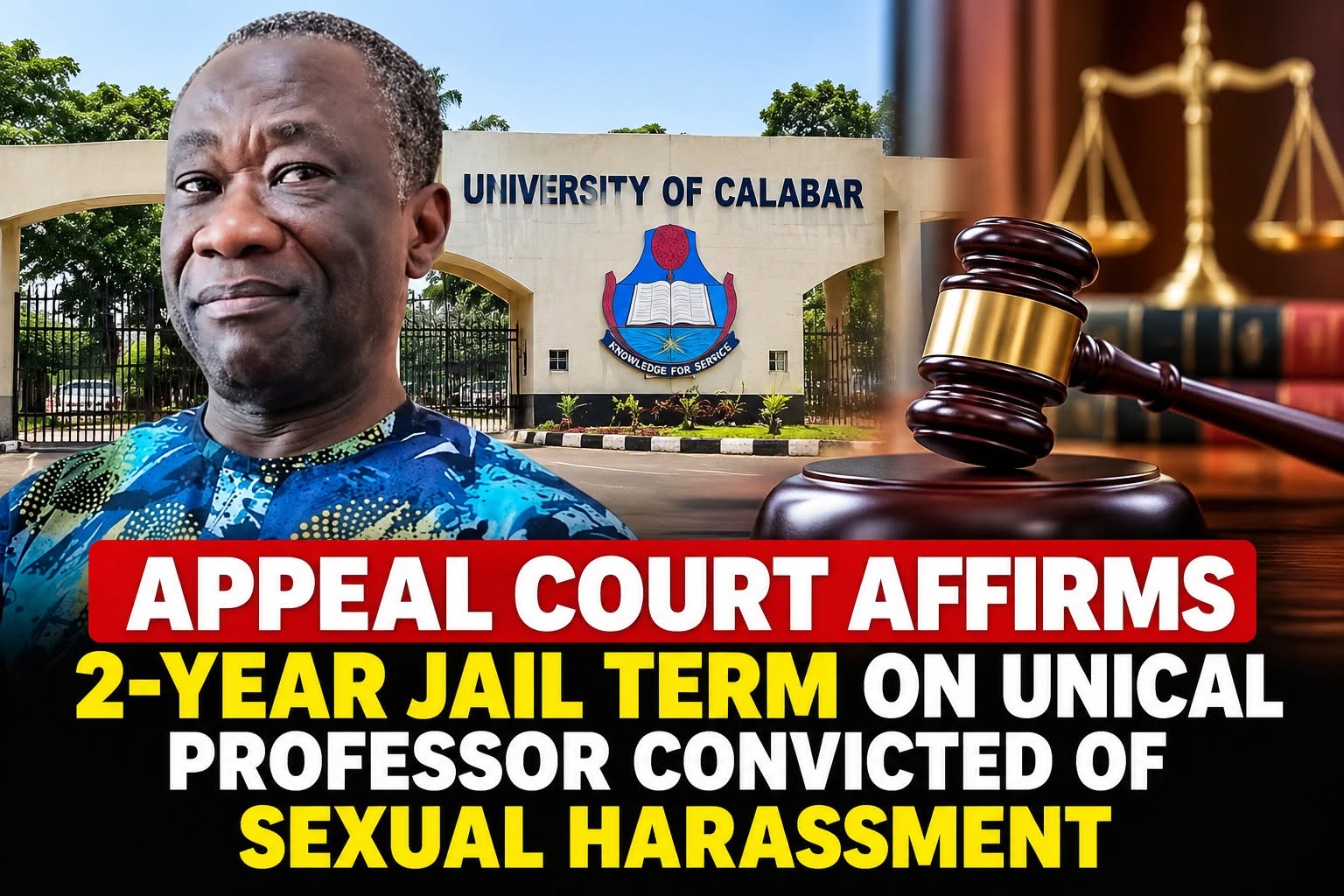
Appeal Court affirms 2-year jail term on UNICAL Professor convicted of s£xual harassment

Published

on

The Court of Appeal has affirmed two-year-jail sentence on Prof. Cyril Osim Ndifon, former Dean of the Faculty of Law, University of Calabar, for soliciting p0rnographic, indecent and obscene photographs from a female student.

J. Okor Odey, Head, Media and Public Communications, Independent Corrupt Practices and Other Related Offences Commission, ICPC revealed this in a statement on Friday, September 25.

According to the statement, the Abuja Division of Court of Appeal, in its judgment delivered in Appeal No. CA/ABJ/CR/1798/2025, upheld the judgment of the Federal High Court, Abuja, which convicted Prof Ndifon on one count charge and sentenced him to two years’ imprisonment without an option of fine.

The conviction arose from evidence put before the trial court that Professor Ndifon, while serving as Dean of the Faculty of Law, University of Calabar, solicited p0rnographic, indecent and obscene photographs from a female student through electronic communication.

The offence in Count One was prosecuted under Section 24 of the Cybercrime (Prohibition, Prevention, etc.) Act, 2015.

Following a protracted trial, the Federal High Court, presided over by Justice James Omotosho, found the prosecution’s evidence sufficient to establish the offence against the former Dean beyond reasonable doubt.

The trial court subsequently convicted Professor Ndifon on November 17, 2025, and sentenced him to two years’ imprisonment on Count One and five years on Count Two, without the option of a fine.

The sentences were ordered to run concurrently.

Professor Ndifon, dissatisfied with the judgment, appealed to the Court of Appeal, challenging his conviction and sentence.

See also  FG bans admission and transfer into SS3 nationwide from 2026/27 session

The appellate court, having considered the grounds of appeal, affirmed the conviction and sentence in respect of Count One.

ICPC, in the statement noted that the affirmation by the Court of Appeal means that the conviction of Professor Ndifon on the cybercrime-related offence contained in Count One has now been sustained by the appellate court.

The case originated from allegations concerning the conduct of Prof. Ndifon towards female students while he was Dean of the Faculty of Law, University of Calabar.

During the trial, the ICPC presented evidence relating to communications between the appellant and a female student, including electronic communications which formed part of the evidence relied upon by the prosecution.

The prosecution’s case was that Professor Ndifon, by virtue of his position as Dean and the authority attached to that office, was in a position to exercise significant influence over students of the Faculty.

The allegation in count one specifically concerned the solicitation of p0rnographic, indecent and obscene photographs from a student.

In its consideration of the evidence, the Federal High Court examined the testimony of prosecution witnesses as well as the electronic evidence tendered before it. The court ultimately held that the ingredients of the offence charged under the Cybercrime Act had been established beyond reasonable doubt.

The Court of Appeal has now affirmed that finding in respect of Count One, thereby sustaining the conviction and the two-year custodial sentence imposed on Professor Ndifon for the offence

With respect to Count Two, which concerned the allegation of conferment of an undue advantage contrary to Section 19 of the Corrupt Practices and Other Related Offences Act, 2000, the Court of Appeal took a different position on jurisdiction.

See also  ASUU warns of fresh strike over 2025 agreement delay, others

The appellate court held that the Federal High Court lacked jurisdiction to entertain the offence under the ICPC Act and consequently ordered the Respondent to commence prosecution of Professor Ndifon on the count before the High Court of Cross River State.

But Odey said the ICPC is currently taking steps to challenge this aspect of the judgment before the appropriate superior court.

According to him, the Commission considers the jurisdictional question arising from Count Two to be a matter requiring further judicial determination.

“The Commission wishes to emphasise that the appellate court’s decision on Count Two does not affect its affirmation of the conviction on Count One. The conviction for soliciting pornographic, indecent and obscene photographs from a student remains affirmed by the Court of Appeal.

“The Commission reiterates its commitment to the prosecution of corruption, abuse of office and other related offences, particularly where public or institutional authority is allegedly used to exploit persons under the authority or influence of an accused person.

“The ICPC also reaffirms its commitment to conducting its investigations and prosecutions strictly within the provisions of the law and in accordance with due process.

“The Commission respects the decisions of the courts and will continue to utilise the available legal avenues where it considers further judicial clarification necessary.

“The Commission will provide further updates on the matter as the legal process progresses,” Odey said.

FOLLOW US ON:

FACEBOOK

TWITTER

PINTEREST

TIKTOK

YOUTUBE

LINKEDIN

INSTAGRAM

Continue Reading

Education

NECO records 58.67% pass rate in English, Maths

Published

on

A total of 804,948 candidates, representing 58.67 per cent of those who sat for the 2026 Senior School Certificate Examination conducted by the National Examinations Council, obtained five credits and above, including English Language and Mathematics.

The Registrar of NECO, Prof Dantani Wushishi, disclosed this on Thursday during the release of the 2026 internal examination results.

Wushishi said 1,378,048 candidates registered for the examination, comprising 682,352 male and 695,696 female candidates.

He said 1,371,992 candidates sat for the examination, comprising 678,903 males and 693,089 females.

According to him, 1,162,118 candidates, representing 84.70 per cent, obtained five credits and above irrespective of English Language and Mathematics.

Wushishi said 1,334 candidates with special needs also sat for the examination.

He disclosed that 1,406 candidates were involved in examination malpractice in 2026, compared with 3,878 in 2025, representing a 64.74 per cent decrease.

The registrar said the 2026 examination represented an improvement over the 2025 exercise.

Wushishi, while responding to questions from journalists, also distanced NECO from so-called miracle centres, saying the examination body had no dealings with such centres.

“NECO is not aware of miracle centres because we don’t have any business with them,” he said.

He added that NECO had only one school and could not be associated with miracle centres.

“We register centres and have criteria for which we register these centres. We don’t know miracle centres because we have only one school and we cannot be associated with miracle centres.

“If there are miracle centres, it is the state governments that established these miracle centres or they are privately owned, but NECO does not believe in miracle centres,” he said.

See also  FG, Germany chamber of commerce partner to train, export graduates

Meanwhile, at an event preceding the release of the 2026 examination results, Wushishi honoured staff of the examination body at the 2025 Annual Staff Productivity Awards.

He said the awards were designed to reward workers and pupils for their hard work, dedication and performance.

The registrar stressed that banditry, kidnapping and sit-at-home orders could not stop NECO examinations.

Highlighting the council’s achievements, he cited the successful and transparent conduct of its internal examinations, prompt release of results, rancour-free promotion exercises and development of ICT software.

Wushishi said the annual awards recognised workers in zones, states and headquarters, as well as pupils who excelled in its examinations during the year.

He disclosed that 55 former workers received certificates of service for their retirement in 2025.

He noted that the awards were grouped into categories, including certificates for retirees, recognition for hardworking and dedicated staff, and prizes for the best state coordinator, best driver and top-performing pupils.

The Director-General of Student Affairs, Niger State Government, Bello Sheriff, who spoke on behalf of the state government, congratulated the recipients and charged the council to sustain its tempo of success.

Among the awardees were Akai Kuyet, who emerged best female in the SSCE category, and Felix Emenike, who emerged best male.

Others were Ezeudu Akachukwu, who emerged best male, and Ubochi Nancy, who emerged best female in the National Gifted Examination category.

Source: punchng.com

FOLLOW US ON:

FACEBOOK

TWITTER

PINTEREST

TIKTOK

YOUTUBE

LINKEDIN

INSTAGRAM

Continue Reading

Education

Ignore fake conference advertisement, Army College tells Nigerians

Published

on

The Nigerian Army College of Logistics and Management (NACOLM), Ojo, Lagos, has warned Nigerians to disregard an online advertisement promoting a purported “Highstone Global University USA International Research Conference” allegedly scheduled to hold at the college.

The college, in a statement dated September 22, 2026, said the advertisement was false and fraudulent, stressing that it had no connection with the purported programme.

NACOLM’s Public Relations Officer, Major Innocent Audu, said, “The College has no affiliation, partnership, endorsement or involvement whatsoever with the said programme, and no such conference has been authorised to take place at the College.”

The college urged members of the public not to make payments or disclose personal information in connection with the purported conference.

“Members of the public are therefore advised to disregard the advertisement and refrain from making any payments or providing personal information in connection with the purported programme,” Audu said.

According to the statement, NACOLM remains committed to protecting the integrity of its name, facilities and official engagements.

It added that any authorised programme or event involving the college would be communicated through its recognised official channels and those of the Nigerian Army.

The college also urged the public to exercise caution and report any suspicious solicitation linked to the purported event to the appropriate authorities.

Source: punchng.com

FOLLOW US ON:

FACEBOOK

TWITTER

PINTEREST

TIKTOK

YOUTUBE

LINKEDIN

INSTAGRAM

See also  FG, Germany chamber of commerce partner to train, export graduates
Continue Reading

Trending