Connect with us

Lifestyle

Tinubu’s New Year message (Full Text)

Published

on

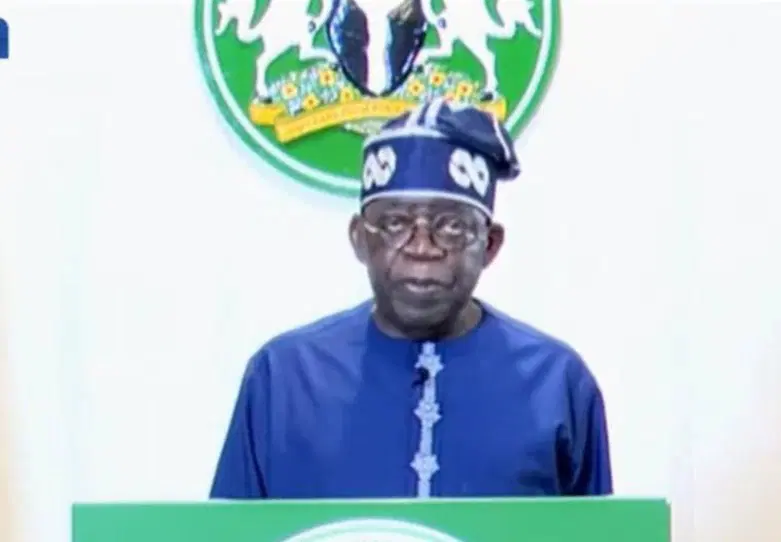
President Bola Tinubu says 2026 marks the beginning of a more robust phase of economic growth.

The President stated this on Thursday in his New Year’s message to Nigerians,

Fellow Compatriots,

I welcome you all to 2026, with gratitude to God and confidence in our collective resolve that this new year will be a more prosperous one for our nation, our citizens, and all who call Nigeria home.

During 2025, we sustained the momentum on our major reforms. We had a fiscal reset and also recorded steady economic progress.

Despite persistent global economic headwinds, we recorded tangible and measurable gains, particularly in the economy.

These achievements reaffirm our belief that the difficult but necessary reforms we embarked upon are moving us in the right direction with more concrete results on the horizon for the ordinary Nigerian.

As we enter 2026, our focus is on consolidating these gains and continuing to build a resilient, sustainable, inclusive, and growth-oriented economy.

We closed 2025 on a strong note. Despite the policies to fight inflation, Nigeria recorded a robust GDP growth each quarter, with annualised growth expected to exceed 4 per cent for the year.

We maintained trade surpluses and achieved greater exchange rate stability. Inflation declined steadily and reached below 15 per cent, in line with our target.

In 2026, we are determined to reduce inflation further and ensure that the benefits of reform reach every Nigerian household.

In 2025, the Nigerian Stock Exchange outperformed its peers, posting a robust 48.12 per cent gain and consolidating its bullish run that began in the second half of 2023.

See also  Petrol, diesel vessels arrive Nigeria amid price surge

Supported by sound monetary policy management, our foreign reserves stood at $45.4 billion as of December 29, 2025, providing a substantial buffer against external shocks for the Naira. We expect this position to strengthen further in the new year.

Foreign direct investment is also responding positively. In the third quarter of 2025, FDI rose to $720 million, up from $90 million in the preceding quarter, reflecting renewed investor confidence in Nigeria’s economic direction, which global credit rating agencies, including Moody’s, Fitch, and Standard & Poor’s, have consistently affirmed and applauded.

A few days ago, I presented the 2026 Appropriation Bill to the National Assembly.

In that address, I emphasised that our administration has implemented critical reforms that are laying a solid foundation for long-term stability and prosperity.

With patience, fiscal discipline, and unity of purpose, Nigeria will emerge in 2026 stronger and better positioned for sustained growth.

As inflation and interest rates moderate, we expect increased fiscal space for productive investment in infrastructure and human capital development.

We are also confronting the challenge of multiple taxation across all tiers of government. I commend states that have aligned with the national tax harmonisation agenda by adopting harmonised tax laws to reduce the excessive burden of taxes, levies, and fees on our people and on basic consumption.

The new year marks a critical phase in implementing our tax reforms, designed to build a fair, competitive, and robust fiscal foundation for Nigeria.

By harmonising our tax system, we aim to raise revenue sustainably, address fiscal distortions and strengthen our capacity to finance infrastructure and social investments that will deliver shared prosperity.

See also  Nelson Mandela and Nigeria’s Anti-Apartheid Role

My fellow Nigerians, the path of reform is never easy, but it is necessary. We remain mindful that economic progress must be accompanied by security and peace.

Our nation continues to confront security threats from criminal and terrorist elements determined to disrupt our way of life.

In collaboration with international partners, including the United States, decisive actions were taken against terrorist targets in parts of the Northwest on December 24.

Our Armed Forces have since sustained operations against terror networks and criminal strongholds across the Northwest and Northeast.

In 2026, our security and intelligence agencies will deepen cooperation with regional and global partners to eliminate all threats to national security.

We remain committed to protecting lives, property, and the territorial integrity of our country.

I continue to believe that a decentralised policing system with appropriate safeguards, complemented by properly regulated forest guards, all anchored on accountability, is critical to effectively addressing terrorism, banditry, and related security challenges.

The new year marks the beginning of a more robust phase of economic growth, with tangible improvements in the lives of our people.

We will accelerate the implementation of the Renewed Hope Ward Development Programme, aiming to bring at least 10 million Nigerians into productive economic activity by empowering at least 1,000 people in each of the 8,809 wards across the country.

Through agriculture, trade, food processing, and mining, we will stimulate local economies and expand grassroots opportunities.

We will also continue to invest in modernising Nigeria’s infrastructure – roads, power, ports, railways, airports, pipelines, healthcare, education, and agriculture to strengthen food security and improve quality of life.

See also  The Historic Palace of Aare Latoosa in Ibadan: A Living Monument to Yoruba Martial Heritage

All ongoing projects will continue without interruption.

To achieve our objectives in 2026, we must all play our part.

Nation-building is a shared responsibility. We must stand together in unity and purpose, uphold patriotism, and serve our country with honour and integrity in our respective roles.

Let us resolve to be better citizens, better neighbours, and better stewards of our nation.

Fellow Nigerians, I wish you all a peaceful, productive, and prosperous New Year.

May God continue to bless and protect our beloved country, keep our troops safe and destroy the enemies bent on disrupting our national peace, security and stability.

Happy New Year to you all.

Bola Ahmed Tinubu, GCFR

President, Commander-in-Chief of the Armed Forces,

Federal Republic of Nigeria

FOLLOW US ON:

FACEBOOK

TWITTER

PINTEREST

TIKTOK

YOUTUBE

LINKEDIN

TUMBLR

INSTAGRAM

Continue Reading
Click to comment

Leave a Reply

Your email address will not be published. Required fields are marked *

Lifestyle

Women Who Love and Listen to Their Pastors More Than Their Husbands Should Be the Pastor’s Second Wife

Published

on

This statement may sound funny, provocative, or even offensive, but it raises an important question about priorities in marriage and religion.

A pastor is a spiritual leader, but he is not supposed to replace a woman’s husband. If a married woman consistently values her pastor’s opinions above her husband’s, obeys her pastor while dismissing her husband, or shows greater loyalty and admiration toward her pastor than toward her spouse, then something may be seriously wrong with the balance in that marriage.

Marriage requires communication, mutual respect, trust, and understanding. A pastor can provide spiritual guidance, but that guidance should not become a reason for a husband and wife to lose respect for each other.

At the same time, husbands should not expect their wives to obey them blindly. Both husband and wife should seek God’s wisdom, communicate openly, and make decisions with love and respect.

So perhaps the real question is not whether such a woman should become the pastor’s “second wife,” but why has the pastor become more important in her marriage than her own husband?

Put God first. Respect your spouse. And never allow a spiritual leader to become a substitute for your marriage partner.

FOLLOW US ON:

FACEBOOK

TWITTER

PINTEREST

TIKTOK

YOUTUBE

LINKEDIN

INSTAGRAM

See also  The Historic Palace of Aare Latoosa in Ibadan: A Living Monument to Yoruba Martial Heritage
Continue Reading

Lifestyle

Why is it only in Africa that we hear so much about “generational curses”?

Published

on

This is a question worth asking—not to insult African traditions or dismiss anyone’s beliefs, but to encourage honest reflection.

Across Africa, it is common to hear people explain repeated family problems as a “generational curse.” When poverty, broken relationships, addiction, failure, sickness, family conflict or misfortune appears to repeat from one generation to another, some people immediately conclude that an ancestor, spiritual force or past wrongdoing is responsible.

But is every repeated family problem truly a curse?

If a child grows up in poverty, has limited access to quality education, receives little financial support and then struggles as an adult, is that necessarily a spiritual curse—or could it be the result of circumstances that have been passed from one generation to another?

If children grow up watching violence, substance abuse, unhealthy relationships or constant conflict, they may unknowingly repeat those patterns. That does not necessarily mean they are cursed. Sometimes behaviour is inherited through environment, not through supernatural forces.

And Africa is certainly not the only place where people believe in supernatural explanations for suffering or misfortune. Different societies around the world have their own concepts of inherited wrongdoing, family misfortune, ancestral consequences, fate and spiritual punishment.

So perhaps the more important question is not:

“Who cursed my family?”

But:

“What pattern has been passed down to me, and what can I do to stop passing it to the next generation?”

We should be careful not to use the idea of a curse to discourage people from taking action. A family facing poverty may need education, opportunity and financial planning. A family experiencing repeated conflict may need healthier communication. A person struggling with addiction may need professional support and a strong recovery environment. Communities facing injustice may need better institutions, accountability and opportunity.

See also  FG to borrow N800bn via February bonds

Faith and spirituality are deeply meaningful to many people, and everyone has the right to hold their beliefs. But faith should not prevent us from examining the practical causes of our problems.

We cannot change the past, but we can change what we pass forward.

Instead of teaching our children that they are victims of an unavoidable family curse, let us also teach them knowledge, discipline, emotional strength, financial responsibility, education, healthy relationships and the courage to break destructive patterns.

Maybe the greatest “curse” is not something mysterious placed upon a family.

Maybe sometimes it is simply a problem that nobody stopped long enough to understand and change.

And the greatest inheritance we can give the next generation is not fear of a curse—but the knowledge and courage to build a better future.

FOLLOW US ON:

FACEBOOK

TWITTER

PINTEREST

TIKTOK

YOUTUBE

LINKEDIN

INSTAGRAM

Continue Reading

Lifestyle

You are very proud to speak big English, but yet you cannot speak your own language?

Published

on

There is nothing wrong with speaking English fluently. In fact, being able to communicate confidently in different languages is a valuable skill. But we should ask ourselves a deeper question: while learning to speak the language of another culture, are we slowly losing the language that connects us to our own roots?

Your mother tongue is more than just words. It carries the stories of your ancestors, the wisdom of your grandparents, the jokes that only your people understand, the traditional greetings, the names, the songs, the history and the identity of your community.

Imagine being able to speak perfect English, but struggling to have a simple conversation with your own grandmother because you do not understand the language she grew up speaking. Imagine your children knowing foreign languages but being unable to understand the language of their own heritage.

That should make us pause.

Speaking English does not make you more intelligent, and speaking your indigenous language does not make you less educated. One is a communication skill; the other can be a connection to your heritage. We should not have to choose between being educated and preserving our identity.

Learn English. Speak it confidently. Learn French, Dutch, Spanish or any other language that opens doors for you.

But don’t let the pursuit of foreign languages close the door to your own.

Teach your children your language. Speak it at home. Ask your parents and grandparents to teach you the words you never learned. If you have forgotten it, it is never too late to start again.

See also  Nigeria’s Independence in Print: The Daily Times, October 1, 1960

Because when a language disappears from a family, something precious disappears with it.

Be proud of your education. Be proud of your ability to speak English. But also be proud of where you come from.

Your language is not something to be ashamed of. It is a part of your story. Preserve it before the next generation only knows it as something their ancestors once spoke.

FOLLOW US ON:

FACEBOOK

TWITTER

PINTEREST

TIKTOK

YOUTUBE

LINKEDIN

INSTAGRAM

Continue Reading

Trending