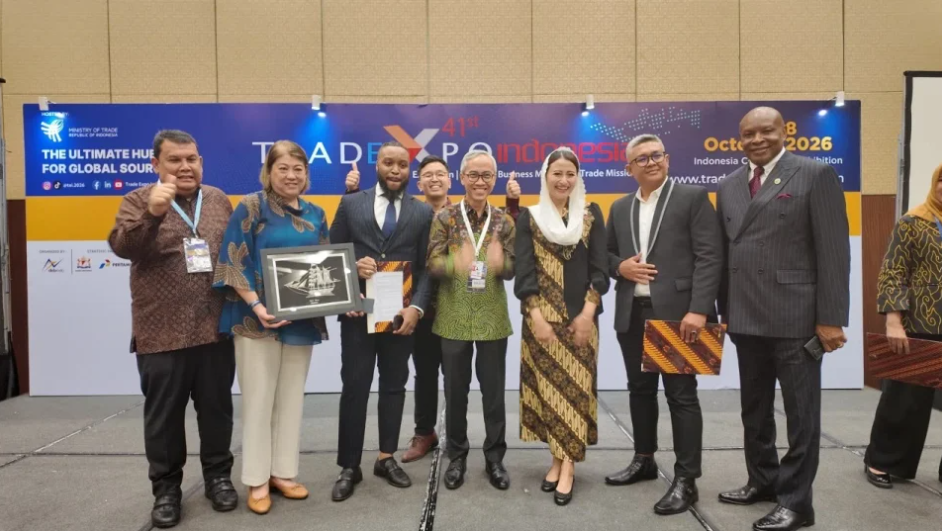
Nigerian and Indonesian companies have signed business agreements worth a combined $10m to strengthen trade and economic cooperation between the two countries.
The Indonesian Ambassador to Nigeria, Bambang Suharto, disclosed this on Thursday during a memorandum of understanding signing ceremony involving Nigerian investors and their Indonesian counterparts at the 2026 Trade Expo Indonesia.
The agreements were among a broader collection of business commitments at the expo, where 55 memoranda of understanding involving Indonesian companies and international business partners were signed.
The participating countries included Nigeria, Australia, Canada, Chile, Germany, Hungary, Malaysia, Mexico, the Netherlands, Romania, South Africa, South Korea, Thailand, the United Arab Emirates and Vietnam.
The event had present ambassadors, diplomatic representatives, international buyers and business partners.
The occasion was highly praised as one of the significant moments of the 2026 Trade Expo Indonesia which kickstarted and was declared opened on Wednesday.
Suharto speaking to Journalists described the agreements involving Nigerian and Indonesian companies as a historic development, expressing optimism that the partnerships would expand bilateral business relations and deliver economic benefits to both countries.
“Today we are witnessing a very historical moment for this year. We have two companies who are having signing ceremony, the MOU, a business contract with their counterpart in Indonesia. So, the amount reached in total 10 million USD or 5 million USD each,” the ambassador said.
He explained that the agreements covered the dental equipment and pharmaceutical sectors, describing them as important areas with significant implications for public welfare.
The ambassador urged Indonesian businesses to look beyond commercial trading and explore investment opportunities in Nigeria, noting that some Indonesian companies already operating in the country had demonstrated the benefits of long-term business engagement.
“I mentioned that there are now some Indonesian companies operating in Nigeria. So, they are a good example. For so many years, they have been doing business in Nigeria, creating job opportunities for the locals and also absorb the local resources that can be produced in their factory and bring, of course, for the benefit of Nigeria as well,” he said.
Suharto encouraged Nigerian companies to invest in Indonesia, highlighting the countries’ large populations, available human resources and investment potential.
“We have 280 million people and Nigeria has 230 million people. In both countries, we have a demographic bonus. So, we have also attractive manpower, which is good for investment,” he said.
He added that Indonesia remained open to Nigerian businesses seeking opportunities in its market.
One of the Nigerian investors who signed an agreement, Ralph-Michael Simon-Michael of Irad Investment Limited, said his company had partnered with Indonesian firm PT Winn Appliance to introduce domestic gas appliances into the Nigerian market.
Simon-Michael, whose company is headquartered in Port Harcourt, Rivers State, said the partnership was aimed at making the products accessible to ordinary Nigerians through established distribution channels.
“So, we’re based in Port Harcourt, our headquarters. So, we’re an oil and gas servicing company. We’ve come to Indonesia to partner with a company called Win Appliances. So, we’re going to be bringing gas, domestic appliances into Nigeria,” he said.
He explained that the products would be targeted at everyday consumers and distributed nationwide through established retail outlets and cash-and-carry distributors.
“The appliances that we’re bringing are for domestic use, for the everyday consumer. So, the everyday man can essentially afford these appliances that we’re bringing in,” he said.
Simon-Michael named Shoprite, Next cash-and-carry distributors among other outlets, through which he said the products would be distributed across Nigeria.
He said the company’s long-term plan was to establish a factory in Indonesia, and expand its operations into other African countries.
The investment agreements also formed part of broader efforts to deepen trade relations between Nigeria and Indonesia, according to Sheye Oyetade, Executive Director of Invest Nigeria, who said the Nigerian delegation was working to translate existing cooperation agreements into practical business opportunities.
Oyetade said the delegation’s participation was linked to the memorandum of understanding between Invest Nigeria and the Developing Eight (D-8) countries, a grouping of countries that includes Nigeria and Indonesia.
“We actually came to service our Memorandum of Understanding with D8 to make sure that trade is actually seamless between Nigeria and Indonesia,” he said.
He added that economic reforms in Nigeria had created opportunities for cross-border trade and investment, while the country’s growing population offered businesses access to a large consumer market.
“The signing of the MOU is key, simply because, whether you like it or not, Africa is becoming the major darling of the world in terms of the market,” Oyetade said.
He projected that Nigeria’s population would rise to about 400 million by 2050, arguing that the expansion would increase its importance as a destination for investment and consumer goods.
“So, where the people are, there the market is. So, that’s exactly what we are doing here today,” he said.
The agreements are expected to strengthen commercial links between businesses in both countries, with participants expressing hope that the partnerships would encourage further investment, job creation and the exchange of products and expertise.
Source: punchng.com
FOLLOW US ON:
FACEBOOK
WHATSAPP CHANNEL
TWITTER
PINTEREST
TIKTOK
YOUTUBE
LINKEDIN
INSTAGRAM