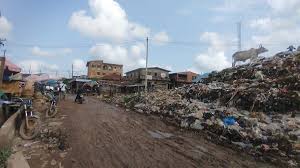
The first thing that hits visitors to the Oja Agbe Market in Ifo, Ogun State, is the suffocating stench from a towering dumpsite that looms over traders, buyers and residents. As residents and traders raise fears of food contamination, recurrent disease outbreaks and deadly accidents linked to the refuse-filled road, the market has become a symbol of a community trapped between neglect and survival, UTHMAN SALAMI writes
It was a rain-soaked Saturday, May 29, 2026, when this reporter visited the popular farmers’ market in Oja Oba along Sholu-Kajola Road in the Ifo Local Government Area of Ogun State.
As heavy rains lashed the already waterlogged and muddy ground, scores of motorcycles lined up at the entrance of the road leading to the market and the communities, beckoning passengers despite the downpour. Clad in full nylon raincoats, the commercial riders braved the elements, determined to weather the storm.
Before this reporter stepped onto the slippery entrance, the stench hanging in the air was already overpowering, strong enough to churn the stomach and leave one gasping for breath.
While struggling through the suffocating odour, a towering mountain of refuse, the source of the foul smell, stood brazenly by the roadside like an unwelcome gatekeeper.
Even more startling was the sight of a watermelon seller directly opposite it inside a bustling market where traders and buyers went about their businesses under the shadow of the dumpsite and its nauseating fumes.
Behind the market sat another massive dumpsite, though smaller than the one at the entrance.
Just a few metres to the right stood an abattoir where cows are slaughtered, and raw beef is sold daily.
The market, popularly known as Oja Agbe, stretches across a vast expanse of land. Most of the stalls are makeshift structures fashioned from planks and covered with roofing sheets that connect one section of the market to another.
True to its name, the market serves as a major hub for fresh farm produce, including watermelon, garri, fruits, vegetables, wheat flour and other staple foods.
In a desperate bid to keep the stench at bay, some traders wore nose masks while others cupped their palms over their noses as swarms of flies danced through the air.
This reporter also saw sellers at the market constantly swatting away the persistent insects with pieces of cloth to protect their goods.
Separating the market from the towering dumpsite is a narrow, heavily damaged road riddled with deep potholes, turning every journey into a risky undertaking and making accidents a near-daily occurrence.
During the visit, this reporter witnessed a heated confrontation between a truck driver and several commercial motorcyclists after both became trapped on the narrow stretch, each insisting on the right of way as traffic ground to a standstill.
“They are the ones saying they do not want Ebola and other diseases in the state, but what we have here, if left unattended, is a disaster waiting to happen,” said a garri seller in the market, who identified herself simply as Mrs Akinola.

Appealing to the government, she warned, “This can trigger a cholera outbreak, especially through the contaminated water and the flies. We are begging the government to intervene before it is too late.”
Describing the daily ordeal faced by traders, Akinola said, “This is Oja Oba in Ifo along Sholu Road. There is no well-being here. Whenever we spread our garri for sale, flies descend on it from every direction.
“Once customers see that, many of them turn back and never return. The nose masks we once relied on can no longer keep out the stench.”
She further lamented that the hardship extends beyond the market itself.
“When it is time to return home after trading, another struggle begins because of the terrible condition of the road. This market is trapped between dumpsites at both the front and the back.
“There is hardly a day without an accident on this road because of its condition. The government tells us to be patient and keep hope alive, but there is no peace of mind here. We live with worry every day. There is simply no peace of mind for us.”
A pepper seller, Adeola Afolabi, recalled how the hazardous condition of the road nearly led to tragedy.
“This morning, Saturday, a pregnant woman fell off a motorcycle into that stagnant floodwater because of the terrible state of the road caused by the dumpsite,” she said.
“It was commercial motorcyclists nearby who rushed to rescue her. This dumpsite has become a serious burden on everyone. We are begging the government to help us before people start falling sick and contracting diseases.
“Schoolchildren and pregnant women regularly fall off motorcycles at this spot, especially when leaves and debris cover the road,” Afolabi added.
Lamenting the worsening environmental conditions, she added, “The smell is overwhelming. We used to rely on nose masks, but once it rains, they become useless against the stench. We do not want a disease outbreak here because if this situation continues, that is exactly what may happen.
“This is a market where fresh farm produce is sold every day. As you can see, having a dumpsite of this nature beside a food market poses a danger to people’s health.”
A corn and wheat seller, Suliat Amosun, said traders and residents continue to pay the price for the neglected road and the growing refuse heap.
“We spend hours on the road because of its terrible condition, but the dumpsite remains the market’s biggest problem,” she said.
“There is a lot we can achieve here, but this dumpsite is driving customers away. We used to wear nose masks, but once the rains come, they can no longer shield us from the foul smell. It is hurting our business.”
According to her, sales have dropped significantly as customers increasingly avoid the market.
“We do not sell the way we used to. Many people tell us they can no longer buy from this market because of the smell and the sight of the dumpsite. We want the government to come to our aid because this market is where we earn our daily bread.”
A member of the Butchers Association, Abudulkazeem Ogbonlawe, who spoke on behalf of butchers in the market, said the dumpsite had become a major threat to their livelihood.
“We have been searching for someone who can help us get rid of this dumpsite,” he said.
“If not for the trust and goodwill we have built with the community over the years, people would have stopped buying meat from us altogether.
“What is keeping us going is simply God’s grace because the dumpsite is chasing customers away. Many people get to the entrance, see the mountain of refuse, and immediately turn back. They tell us they cannot buy food from such a dirty and foul-smelling environment.”

He expressed concerns over the health implications of the refuse dump.
“Any fly that lands on that dumpsite, where all kinds of germs thrive, can easily make its way into the market. People who care about cleanliness often refuse to buy from here because of that fear.”
Appealing for intervention, Ogbonlawe said, “We will be grateful if this refuse dump can be relocated. Whoever helps us achieve that will earn the appreciation of the entire community and all the butchers here. If it is a politician, we will not forget such a gesture.
“This abattoir existed long before the dumpsite was moved here. The refuse dump used to be on the other side of Oja Agbe Market.
“The land where it now stands was once used for vegetable farming. It was only when the government carried out work on the market that the dumpsite was relocated to its present location.
“There is only so much the community can do about the road. What we need now is for the government to help us move this dumpsite to a more suitable location.”
I lost my two-month pregnancy on the road – Female resident
For Olayinka Adegboyega, the consequences of the road’s condition are deeply personal.
“When we moved here in 2022, I was pregnant and on my way to the market to buy a few things,” she recalled. “I was about two to three months pregnant at the time. I lost the pregnancy while riding on a motorcycle because of the stress and condition of the road.”
She said the miscarriage was a painful experience she had never encountered before.
“I had never suffered a miscarriage before moving to this community. That was my third pregnancy, and I already had two children. It was a very painful experience for me.”
Since then, she said, she had become extremely cautious whenever she was pregnant.
“After that incident, whenever I become pregnant, I prefer to stay indoors and only go out when necessary, such as for medical scans. This road is very bad. During the rainy season, it becomes even worse. Getting to the market is difficult, and even travelling by motorcycle is dangerous.”
Sharing her ordeal, Mrs Omotola Omolola, a resident and business owner in one of the communities, said years of navigating the road had left her with painful memories and a growing sense of frustration.
“I supply granite and sharp sand, but anytime my trailer is coming into this community, there is always one incident or another,” she said.
“If vehicles are not getting stuck, they are involved in accidents. I have witnessed countless unpleasant experiences on this road. Some long-time residents have even moved away because they could no longer cope with the hardship.”
According to her, the dumpsite at the entrance to the market has compounded the challenges faced by residents and commuters.
“If you check the entrance by the market, you will see a huge dumpsite. That is one of our biggest problems,” she said.
“For pregnant women facing medical emergencies, the situation can be tragic. Some have lost their pregnancies, while others have died because of the terrible state of the road leading into and out of these communities.
“It is painful because Kajola Rail Terminal is very close to us, yet there is no accessible route through this area.”
Omolola recalled the case of a pregnant woman in her neighbourhood whose death, she said, could have been prevented if the road had been motorable.
“There was a woman in our area in 2024 known as Alhaja. She went into labour, but getting her to Ifo, where there are hospitals, became a major challenge because of the road. She died on the way to the hospital,” she recounted.
“She was well known in the community and was a very kind and generous woman. If we had better access out of this community, she would have survived. That incident was so devastating that her family eventually left the area.
“There are many other cases that may never be reported to community leaders. What is happening here is becoming a scourge on the lives of residents. We urgently need help.”
A driver and resident of Lerin Community, Okeyode Adewale, who said he witnessed one of the tragic incidents linked to the road, recounted how a pregnant woman lost her life while being rushed to the hospital.
“I was with Mr Omotosho Johnson on the day it happened,” he said. “We saw a man struggling with his vehicle on the road. When I got closer, I realised he was with a heavily pregnant woman who was already in labour. Because of the terrible state of the road, he could not drive through.”
According to him, he immediately stepped in to help.
“I took over the wheel and managed to navigate the road as best as I could. But by the time we got to the hospital, the woman was declared dead on arrival.”
Adewale believes the outcome could have been different if the road had been in better condition.
“If this road had been motorable, that woman would probably still be alive today. We would have been able to drive faster and get her medical attention on time. But because of the condition of the road, especially around the dumpsite area, we were severely constrained.”
He added that the woman’s husband, whom he identified as Adewale Hamzat, was not around when the incident occurred.
“I think they were from Kwara State. The tragedy affected the family so much that the man eventually left the community. The dumpsite and the road have brought a lot of suffering to people living here.”
Also speaking, Muftau Okunola described the dumpsite as a major obstacle to movement and emergency response, particularly during the rainy season.
“The dumpsite is one of the biggest problems on this road, especially when it rains,” he said. “The situation has become almost unbearable. If the road were motorable, it would be easier and quicker for people to access Kajola Train Station.”
He noted that residents also face difficulties reaching the nearby Osinbajo Terminal and other essential services.
“Osinbajo Terminal is on the other side of the community, but getting there during an emergency is a major challenge. Even commercial motorcyclists often refuse to ply the route because of the road conditions. Sometimes people are forced to trek from the market to their homes after being stranded.”
A community leader and vice chairman of one of the affected CDCs, Shina Dosumu, said he had developed the habit of taking his wife out of the community whenever her pregnancy reached a certain stage.
Dosumu said, “Whenever my wife is pregnant, once the pregnancy reaches five months, I would take her to Lagos because, God forbid, there is an emergency, considering the news we have heard from other people. She would have been in Lagos for five months before her delivery.”
He noted that the dumpsite affects several villages and communities in the area.
“It affects more than six villages directly under my area, including Sholu, Kajola, Rerin, Baamu, Ebiti and Ilari, apart from many other communities deeper inside the area,” he said.
“This dumpsite has existed for more than 20 years. The market also has an abattoir, and during the rainy season, the smell becomes almost unbearable.
“It creates serious problems during emergencies because vehicles can hardly pass through the road when it rains. Sometimes residents have to abandon their vehicles because the filth covers everything.
“I stopped buying meat and food items from that market because of the smell around the dumpsite. The CDAs and CDCs have tried several times to clear the road, but the problem is beyond what we can handle financially.”
Dumpsite risks
According to the 2025 World Health Organisation report, effective solid waste management is critical to protecting public health.
The report noted that waste collection and proper disposal systems were historically introduced to maintain cleanliness and prevent disease outbreaks.
The WHO explained that outbreaks of cholera and typhoid in rapidly expanding cities during the 19th century prompted the establishment of formal waste collection systems and regulations.
“These early public health efforts laid the foundation for modern waste management systems, emerging in response to uncollected waste and later expanding to address environmental risks from inadequate disposal,” the report stated.
The organisation further warned that poor waste management could have serious consequences for both the environment and human health.
“Mismanagement of waste can result in widespread contamination of the environment, affecting soil, water and air, and accumulating in food chains,” the report noted.
It added that the accumulation of waste encourages the spread of disease-causing pathogens and vectors such as mosquitoes and rodents.
“Accumulation of waste facilitates the spread of pathogens and disease vectors such as mosquitoes and rodents and increases the risk of outbreaks, particularly in densely populated or impoverished areas,” the WHO stated.
Environmentalist warns
Echoing the WHO’s concerns, the President and Chief Executive Officer of the Statewide Waste and Environmental Education Foundation, Phillips Obuesi, urged the government to intervene urgently, warning that the situation could trigger a disease outbreak.
Obuesi argued that siting a dumpsite close to a market poses significant environmental and public health risks.
“If there was a market and the government came and sited a dumpsite near the market, it would be a very wrong step because there would be contamination,” he said.
According to him, residents should petition the relevant authorities to relocate either the dumpsite or the market.
“One has to make way because it is practically impossible for people not to get contaminated food items if there is a dumpsite by the market. Environmentally speaking, it is not proper. In terms of sanitation, it is not proper,” he added.
Obuesi maintained that, from an environmental standpoint, dumpsites should not be located near markets.
“Speaking environmentally, it is absolutely wrong for dumpsites to be sited close to a market. If a dumpsite is sited close to a market by the government, it behoves the people around that locality to call the attention of the government to relocate the market,” he said.
Ogun reacts
The Ogun State Commissioner for Environment, Ola Oresanya, confirmed in a telephone interview with this reporter that the government was aware of the condition of the market and had plans to clear the dumpsite.
According to him, the waste heap is part of a backlog that accumulated over several years of neglect.
“Every backlog of waste like that is an accumulation of years of abandonment. We have some of them in different parts of the state, including Sagamu, Ifo and other locations,” he said.
Oresanya explained that the current administration had undertaken efforts to clear such sites across the state since assuming office in 2019.
“We identified about 56 of those sites when we came in 2019, and we’ve been able to eradicate most of them. We are left with about three major backlog sites now, and the one at Oja Agbe is one of the critical ones that we plan to address,” he said.
He assured residents that the government was not unaware of the situation and was already working towards resolving it.
“I can assure you that we are not ignorant of what is there and that we are planning to clear it,” Oresanya added.
From declining patronage and fears of food contamination to reports of accidents, pregnancy losses and delayed access to emergency healthcare, the community and market’s predicament paints a troubling picture of neglect.
Although the Ogun State Government promises intervention, residents say time is running out, insisting that unless urgent action is taken to clear the dumpsite and rehabilitate the road, a preventable health or humanitarian crisis may only be a matter of time.
punch.ng
FOLLOW US ON: