Connect with us

Business

Trump earned over $1bn from crypto ventures in 2025 — Report

Published

on

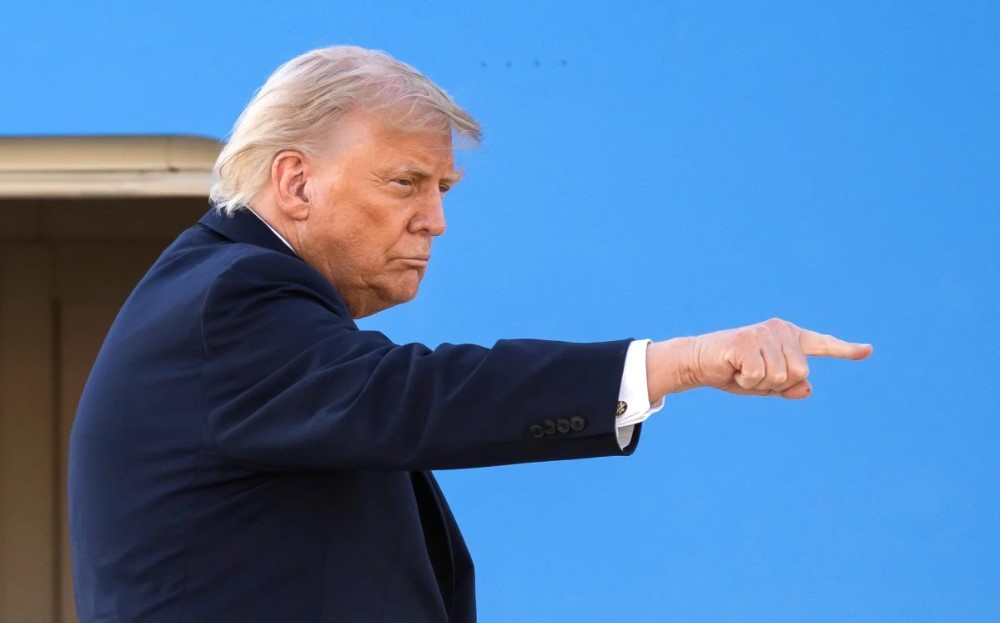
US President Donald Trump recorded around $1.2 billion in income from his cryptocurrency activities in 2025, according to documents released on Tuesday by the US Office of Government Ethics.

A 1978 law requires the president and vice president of the United States to declare their income as well as their assets.

According to the documents, which are more than 900 pages long, Trump received nearly $`550 million from his ties to the startup World Liberty Financial.

The Trump family lent its support and its name to this cryptocurrency platform, launched in September 2024.

World Liberty Financial issued its own cryptocurrency, WLFI, whose initial sale brought in `$550 million.

Trump and his three sons also obtained, via an intermediary company, DT Marks Defi, an additional 22.5 billion WLFI, currently worth around $`1.3 billion.

In April 2025, WLF also marketed its stablecoin — a digital currency whose value is pegged to a traditional currency, in this case the dollar.

Trump’s income disclosure also mentions $635 million in royalties received under a licensing agreement related to the $TRUMP cryptocurrency, launched just hours before his inauguration in January 2025.

The president’s activities in the cryptocurrency sector are the main reason for the near tripling of his personal fortune, which rose from `$2.3 billion to $6.5 billion between 2024 and 2026, according to Forbes.

The former real estate developer is regularly accused of conflicts of interest, in particular for having invested in the crypto-currency industry while as president taking several measures to deregulate the sector, causing asset prices to soar.

See also  Govt eyes N1.49tn electricity export revenue

Beyond the income derived from WLF and its cryptocurrency, Trump has also earned several million dollars from shares in various publicly listed companies active in cryptocurrencies, such as the Coinbase exchange platform.

The president’s assets are held in a trust managed by his son, Donald Trump Jr. But its bylaws stipulate that the entity can be dissolved at any time, which means the billionaire could regain control of it as soon as his second term ends.

AFP

punch.ng

FOLLOW US ON:

FACEBOOK

TWITTER

PINTEREST

TIKTOK

YOUTUBE

LINKEDIN

Continue Reading
Click to comment

Leave a Reply

Your email address will not be published. Required fields are marked *

Business

668,000 meters deployed, installed on customers’ premises – FG  

Published

on

The Federal Government has said roughly 60 per cent of active electricity customers in Nigeria have now been metered as it continues efforts to reduce the country’s electricity metering gap and end arbitrary estimated billing.

The disclosure was contained in a statement issued on Thursday by Stanley Nkwocha, Senior Special Assistant to the President on Media and Communications, Office of the Vice President, following the second meeting of the National Council on Privatisation for 2026, chaired by Vice President Kashim Shettima at the Presidential Villa, Abuja.

According to the statement, the metering exercise is being carried out under Phase 1 of the $500m World Bank-financed Distribution Sector Recovery Programme, alongside initiatives such as the Presidential Metering Initiative.

The Director-General of the Bureau of Public Enterprises, Ayodeji Ariyo Gbeleyi, said 668,000 meters had so far been installed out of the 1,033,000 meters delivered under the programme.

“On various issues, we provided updates on meter deployment under Phase 1 of the World Bank-financed Distribution Sector Recovery Programme. We have implemented 60 percent of the meters that have been delivered in the country out of 1,033,000. So far, we have deployed and installed 668,000 meters on customers’ premises,” he said.

The government said the metering initiative was aimed at closing the electricity metering gap and eliminating arbitrary estimated billing for registered customers across the country.

The BPE boss also disclosed that about 17 states had established State Electricity Regulatory Commissions since April 2024, following the transition provided for under the Electricity Act.

See also  Govt eyes N1.49tn electricity export revenue

He said Akwa Ibom State became one of the latest states to establish its own electricity regulatory commission in July, but noted that some aspects of the implementation of the law still required adjustment.

“Some fine-tuning is required here and there in the implementation of that Act,” Gbeleyi said.

He added that the council had directed key stakeholders, including the Attorney-General of the Federation, Minister of Power, Special Adviser to the President on Power, NERC and BPE, to engage on proposed amendments to the law.

“Council has directed that stakeholders, led by the Attorney General of the Federation, the Honourable Minister of Power, the Special Adviser on Power, the Office of the Special Adviser to the President on Oil and Gas, the Nigerian Electricity Regulatory Commission, the BPE and all other critical stakeholders, should engage constructively so as to streamline and harmonise the Federal Government’s position in terms of the required amendments to fine-tune the Electricity Act,” he said.

Also speaking, the Minister of Power, Joseph Olasunkanmi Tegbe, said the government was working to ensure Nigerians derived greater value from electricity and other critical sectors of the economy.

“We are working concertedly and in a very collaborative manner to ensure that we give value, either in electricity or in telecoms—whichever area—to make sure that Nigerians benefit from this government,” Tegbe said.

The meeting was attended by the Minister of Finance and Coordinating Minister of the Economy, the Minister of Power, the Attorney-General of the Federation’s representative, the Minister of Industry, Trade and Investment and private members of the council.

See also  Aiyedatiwa signs new Ondo electricity power sector law

Source: punchng.com

FOLLOW US ON:

FACEBOOK

TWITTER

PINTEREST

TIKTOK

YOUTUBE

LINKEDIN

INSTAGRAM

Continue Reading

Business

TCN refutes Kaduna Electric’s claim on Jos power supply

Published

on

The Transmission Company of Nigeria has refuted claims by Kaduna Electric that a fault on the 330kV Jos transmission line contributed to reduced power supply across its franchise area.

In a statement on Thursday signed by the management of TCN, the company said all 330kV transmission lines connected to Jos were operational and transmitting bulk electricity.

TCN described Kaduna Electric’s claim as “false and a deliberate misrepresentation of facts,” saying there had been no disruption of bulk power transmission on any 330kV line supplying Jos since the restoration of the Jos–Lafia 330kV Line 2 circuit breaker.

The company explained that the circuit breaker was opened on August 23 for voltage control as part of a routine operation to maintain grid stability.

“For the avoidance of doubt, all 330kV transmission lines connected to Jos are in service and transmitting bulk power,” the statement said.

“TCN recorded a lone incident on 23rd August 2026 at 03:30hrs, when the Jos–Lafia 330kV Line 2 circuit breaker was opened for voltage control. This was a routine operational action to maintain grid stability.”

According to the transmission company, the line was restored at 11:59 pm on August 24 and had remained in service since then.

“There has been no outage or disruption of bulk electricity transmission on any 330kV line supplying Jos attributable to TCN since that restoration,” it added.

The development followed an announcement by Kaduna Electric on Wednesday attributing reduced power supply across its franchise area to lower load allocation.

The electricity distribution company had said the reduction was mainly due to an outage of one generating unit at the Shiroro Generating Station and a fault on the 330kV Jos transmission line.

See also  Venezuela must buy only made in America products with money made from oil deal, Trump says

Kaduna Electric said the fault had resulted in Shiroro supplying Jos and its surrounding areas instead.

The company also said that, based on the National Control Centre Daily Load Allocation for August 25, it received 104 megawatts, comprising 54MW from the Mando 330kV Transmission Station and 50MW from the Birnin-Kebbi axis.

It said it was working with TCN on the equitable distribution of available power and monitoring efforts to restore supply.

However, TCN urged Kaduna Electric and other stakeholders to verify information with the transmission company before making public statements on transmission-related issues.

“We urge Kaduna Electric and other stakeholders to verify facts with TCN before issuing statements that misinform the public and create unnecessary anxiety,” it said.

TCN also advised electricity customers in Jos and its environs to disregard what it described as the misleading information, assuring that it remained committed to ensuring stable and reliable bulk power transmission to distribution companies nationwide.

Source: punchng.com

FOLLOW US ON:

FACEBOOK

TWITTER

PINTEREST

TIKTOK

YOUTUBE

LINKEDIN

INSTAGRAM

Continue Reading

Business

Dangote raises petrol to N1,200/l despite crude price decline

Published

on

Dangote Petroleum Refinery and Petrochemicals FZE has increased the gantry price of Premium Motor Spirit (petrol) from N1,185 to N1,200 per litre, effective August 26, 2026.

In an official communication to customers issued on Tuesday, the refinery’s Group Commercial Operations announced revised depot prices for gantry and coastal deliveries.

The email, titled ‘PMS Price Change Communication (N1,185 per Litre To N1,200 Per Litre)’, asked customers to take note of the revised DPRP PMS gantry and coastal price, which is effective 26th August 2026.

According to the table contained in the notice, the coastal price rose from N1,562,265 per metric tonne to N1,582,380, while the gantry price increased from N1,185 to N1,200 per litre.

The refinery further directed customers to return all Authorisation to Collect documents for repricing, adding that a new volume contract would be issued for immediate loading resumption.

“You are advised to return all ATCs for repricing, and a new volume contract will be issued for immediate loading resumption. Should you require any further clarification, please do not hesitate to contact us,” the notice said.

The latest adjustment represents a N15 per litre increase in the gantry price and comes barely days after the refinery raised the price from N1,165 to N1,185 per litre. The previous increase took effect from midnight on August 21, 2026, according to industry trackers.

However, the latest hike comes against a backdrop of falling international crude oil prices. Data from oilprice.com on Tuesday showed West Texas Intermediate crude trading at $82.13 per barrel, down $2.88 or 3.39 per cent, while Brent crude stood at $88.37 per barrel, declining by $3.80 or 4.12 per cent. Murban crude also fell to $92.71 per barrel, shedding $8.73 or 8.61 per cent.

See also  Venezuela must buy only made in America products with money made from oil deal, Trump says

Our correspondent gathered that marketers and depot operators who received the circular might have begun returning existing ATCs for repricing in line with the refinery’s directive.

The N15 increase could result in higher pump prices as oil marketers factor in transportation, landing and other downstream costs. Petrol is expected to return to an average of N1,250 per litre.

The Dangote Group has yet to respond to messages from our correspondent.

The price increase comes at a time of renewed volatility in the international oil market amid the ongoing US-Iran conflict. Reuters reported that oil prices fell as investors viewed the latest US sanctions against Iran as less threatening to global oil supplies than a military escalation. However, analysts warned that the decline could be an overreaction, noting that prices could rise sharply if Iran retaliates militarily.

Reuters also reported that supply disruption risks remained, with only two commodity vessels transiting the Strait of Hormuz on Monday, the lowest daily tally since early May. The waterway handled about one-fifth of global oil consumption before the conflict began, leaving the market vulnerable to further disruptions.

Source: punchng.com

FOLLOW US ON:

FACEBOOK

TWITTER

PINTEREST

TIKTOK

YOUTUBE

LINKEDIN

INSTAGRAM

Continue Reading

Trending