Connect with us

Lifestyle

Don’t Build Your Happiness on Someone Else’s Pain: A Lesson About Life, Love and Humanity

Published

on

True happiness should never depend on another person’s suffering. Discover why kindness, empathy, and integrity matter, and join the debate about forgiveness and consequences.

What kind of happiness can you truly enjoy when it comes at the expense of another person’s tears?

In a world where some people celebrate another person’s failure, take pleasure in heartbreak, or feel powerful by making others suffer, one important question deserves attention: Can happiness built on someone else’s pain ever be genuine happiness?

From romantic relationships and family disputes to friendships, workplaces, and everyday human interactions, people sometimes hurt others deliberately and move on as if nothing happened. The person who caused the pain may continue smiling, while the person who was hurt struggles to recover emotionally.

But success should not require cruelty, and happiness should never depend on another person’s suffering.

When Someone Else’s Pain Becomes Your Pleasure

Some people believe they have won when they make a rival fail, destroy a relationship, damage another person’s reputation, or watch someone who once trusted them suffer.

In relationships, betrayal can leave deep emotional wounds. In workplaces, jealousy and sabotage can undermine another person’s progress. Even among friends and family members, competition and resentment can turn ordinary disagreements into painful experiences.

The problem is not simply that people disagree or that relationships sometimes end. It is when someone deliberately seeks to humiliate, exploit, or emotionally destroy another person.

There is a difference between protecting your own happiness and deliberately destroying someone else’s.

You can walk away from a relationship without revenge. You can pursue success without sabotaging another person. And you can establish boundaries without treating others as if their feelings do not matter.

See also  A laugh offering for President Tinubu

Do Bad People Always Face the Consequences?

This is where the debate becomes complicated.

Many people believe that those who deliberately hurt others will eventually face the consequences of their actions. Sometimes, harmful behaviour damages relationships, destroys trust, or leads to serious personal and professional consequences.

However, life does not always provide immediate or visible justice. Some people appear to move forward without apologising, accepting responsibility, or showing remorse.

That reality can be painful for those who have been mistreated.

It is important, therefore, not to build your recovery around waiting for another person to suffer. Their future is beyond your control, but your decisions, boundaries, and healing are still yours to pursue.

Should You Forgive Someone Who Hurt You?

Forgiveness is a personal decision. For some people, it offers a path towards emotional freedom. For others, healing begins with distance, accountability, and refusing to allow the same person to cause further harm.

Forgiving someone does not necessarily mean trusting them again, forgetting what happened, or allowing them back into your life.

You can choose peace without accepting repeated mistreatment. You can move forward without revenge. And you can demand accountability without becoming cruel yourself.

Sometimes, moving on is not about pretending the pain never happened; it is about refusing to let that pain control the rest of your life.

The Question Everyone Should Consider

Imagine that someone deliberately breaks your heart, destroys an opportunity you worked hard for, or causes you serious emotional pain. That person then moves on, appears happy, and never apologises.

See also  Nigercem: Nigeria’s First Indigenous Cement Company (PHOTOS)

Would you forgive them and move forward, or would you feel that they should experience the same pain they caused you?

There is no single response that captures every situation. Some people will argue that forgiveness brings peace, while others will insist that accountability must come before reconciliation.

The important distinction is between seeking fair consequences and deliberately trying to make another person suffer.

Final Thoughts

Life is too short to measure your happiness by another person’s downfall. Treating people with dignity does not make you weak, and refusing revenge does not mean accepting injustice.

You may not control how others treat you, but you can decide whether their actions will determine the kind of person you become.

Never build your happiness on someone else’s pain. Build it on integrity, self-respect, compassion, and the ability to succeed without deliberately destroying another person’s peace.

NEWSBREAK365 ASKS: JOIN THE DEBATE

If someone deliberately destroys your happiness, breaks your heart, or ruins your life and then moves on happily without regret, should you forgive them and move on, or should they face the same pain they caused you?

Share your honest opinion in the comments. We want to hear different perspectives.

Follow Newsbreak365 for thought-provoking discussions about relationships, society, humanity, and everyday life.

#Newsbreak365 #LifeLessons #Relationships #Forgiveness #Humanity #SocialDebate

FOLLOW US ON:

FACEBOOK

TWITTER

PINTEREST

TIKTOK

YOUTUBE

LINKEDIN

INSTAGRAM

Continue Reading
Click to comment

Leave a Reply

Your email address will not be published. Required fields are marked *

Lifestyle

DIFFERENT WAYS TO MURDER SOMEONE: YOU DON’T ALWAYS NEED A WEAPON TO DESTROY A HUMAN LIFE

Published

on

Some people carry guns. Others carry words, power, hatred, bitterness and cruelty. The damage they cause may not leave visible wounds, but the scars can last a lifetime.**

When we hear the word *murder*, we immediately think of guns, knives, poison and other forms of physical violence. But there is another disturbing reality that society often overlooks: the devastating damage human beings inflict on one another through emotional abuse, psychological manipulation, humiliation, exploitation and deliberate cruelty.

Not every act of destruction involves physical violence.

Think about the person who wakes up every morning feeling worthless because someone constantly reminds them that they are failures.

Think about the child whose confidence is destroyed by parents who use insults, rejection and humiliation as methods of upbringing.

Think about the husband or wife who lives in constant emotional distress because of manipulation, intimidation, betrayal and psychological abuse.

Think about employees who are bullied, exploited and humiliated by employers who believe that having money or authority gives them the right to treat others without dignity.

And what about people who deliberately spread lies, destroy reputations, betray trust and turn someone’s peaceful existence into a nightmare?

These behaviours are not legally equivalent to murder, but their psychological and emotional consequences can be devastating.

## 1. Emotional Abuse

Constant insults, rejection, humiliation and belittling can gradually destroy someone’s confidence and sense of self-worth.

## 2. Psychological Manipulation

Some people deliberately manipulate others, making them question their own judgment, memories and reality.

## 3. Betrayal and Broken Trust

See also  Nigercem: Nigeria’s First Indigenous Cement Company (PHOTOS)

Betrayal by someone you deeply trust can leave emotional wounds that take years to heal.

## 4. Humiliation and Public Shame

Some individuals enjoy embarrassing others, especially those who cannot defend themselves or fight back.

## 5. Exploitation and Oppression

Using wealth, authority, employment or social status to take advantage of vulnerable people is a serious form of human cruelty.

## 6. Intimidation and Fear

Making another person live in constant fear through threats, bullying and intimidation is unacceptable.

## 7. Deliberate Cruelty

Some people know exactly how much pain their actions cause, yet continue because they enjoy having power over another person’s suffering.

## 8. Social Isolation and Rejection

Deliberately isolating someone, turning people against them or depriving them of meaningful support can have serious consequences.

## THE QUESTION SOCIETY MUST ANSWER

Why do we condemn physical violence but sometimes celebrate people who destroy others emotionally?

Why do some parents believe that providing food and shelter gives them unlimited permission to humiliate their children?

Why do some employers believe that paying salaries gives them the right to abuse workers?

Why do some wealthy individuals believe that poverty makes other human beings less deserving of respect?

Why do people wait until someone breaks down before recognising that their suffering was real?

Human beings need more than food, money, shelter and material possessions. We need compassion, dignity, understanding, emotional security and respect.

**You may never pick up a weapon against another person, but your words, decisions and behaviour can still cause enormous suffering.**

See also  PHOTOS: Shaykh Uthman dan Fodio (1754 –1817)

Let us stop normalising cruelty. Let us stop celebrating intimidation. Let us stop making excuses for emotional abuse.

A person’s life should not become a prison because someone else wants to exercise power over them.

**NEWSBREAK365 FINAL THOUGHT:**

Before you destroy someone’s confidence, exploit their vulnerability, humiliate them or make their life unbearable, remember one thing: the person you are hurting is a human being with feelings, dreams, fears and dignity.

**QUESTION FOR READERS:**

Do you agree that emotional and psychological abuse deserve much more attention in society, or do people only take suffering seriously when physical violence occurs?

Share your thoughts. Your opinion matters.

FOLLOW US ON:

FACEBOOK

WHATSAPP CHANNEL

TWITTER

PINTEREST

TIKTOK

YOUTUBE

LINKEDIN

INSTAGRAM

Continue Reading

Lifestyle

THEY DON’T WANT TO WORK; THEY WANT SHORTCUTS TO WEALTH!

Published

on

The dangerous obsession with quick money is making hard work look unattractive.**

There is a growing mentality in society where people want to enjoy the rewards of success without accepting the responsibilities, sacrifices and discipline required to achieve it.

Everybody wants to be rich. Everybody wants luxury cars, expensive houses, designer clothes, financial freedom and the admiration that comes with wealth. But how many people are genuinely prepared to work, learn, sacrifice and build something meaningful?

Some people are no longer interested in developing skills, establishing businesses, creating opportunities or earning an honest living. They are obsessed with finding the fastest possible route to money, regardless of the consequences.

The obsession with quick money has encouraged some people to embrace fraudulent schemes, deception, manipulation, exploitation and other dishonest practices.

**But here is a question society must confront: When did hard work become something to be ashamed of, while unexplained wealth became something to celebrate?**

There is nothing wrong with wanting to become wealthy. There is nothing wrong with dreaming of a comfortable life. However, the desire for wealth should never become an excuse to abandon integrity, responsibility and common sense.

We must stop glorifying people simply because they display expensive possessions. A luxury car does not automatically represent success. Expensive clothing does not prove intelligence. And having money does not necessarily mean someone has built a meaningful life.

Real success requires more than appearances. It requires discipline, patience, knowledge, consistency, creativity and the willingness to create value.

We should teach the younger generation that there is dignity in honest labour. Whether someone works in a factory, drives a bus, builds houses, runs a small business or works in an office, honest work deserves respect.

See also  Nigercem: Nigeria’s First Indigenous Cement Company (PHOTOS)

**The problem is not wanting money. The problem is wanting money without wanting to do anything worthwhile to earn it.**

A society that celebrates wealth without questioning how it is acquired risks raising generations that value appearances over character and shortcuts over hard work.

It is time to change that mentality.

**Work hard. Build skills. Create value. Earn honestly. Stop chasing the appearance of wealth and start building something that lasts.**

—

THE BIG QUESTION

Why are so many people attracted to quick money but unwilling to embrace the discipline and patience required to build genuine wealth?

Has society made honest hard work look unattractive?

Share your thoughts. Let’s have an honest conversation.

**Newsbreak365.com — Trusted News, Real Stories.**

#Newsbreak365 #QuickMoney #HardWork #WealthCreation #AfricanSociety #FinancialIntegrity #HonestLiving #SocialCommentary #SuccessMindset

FOLLOW US ON:

FACEBOOK

WHATSAPP CHANNEL

TWITTER

PINTEREST

TIKTOK

YOUTUBE

LINKEDIN

INSTAGRAM

Continue Reading

Lifestyle

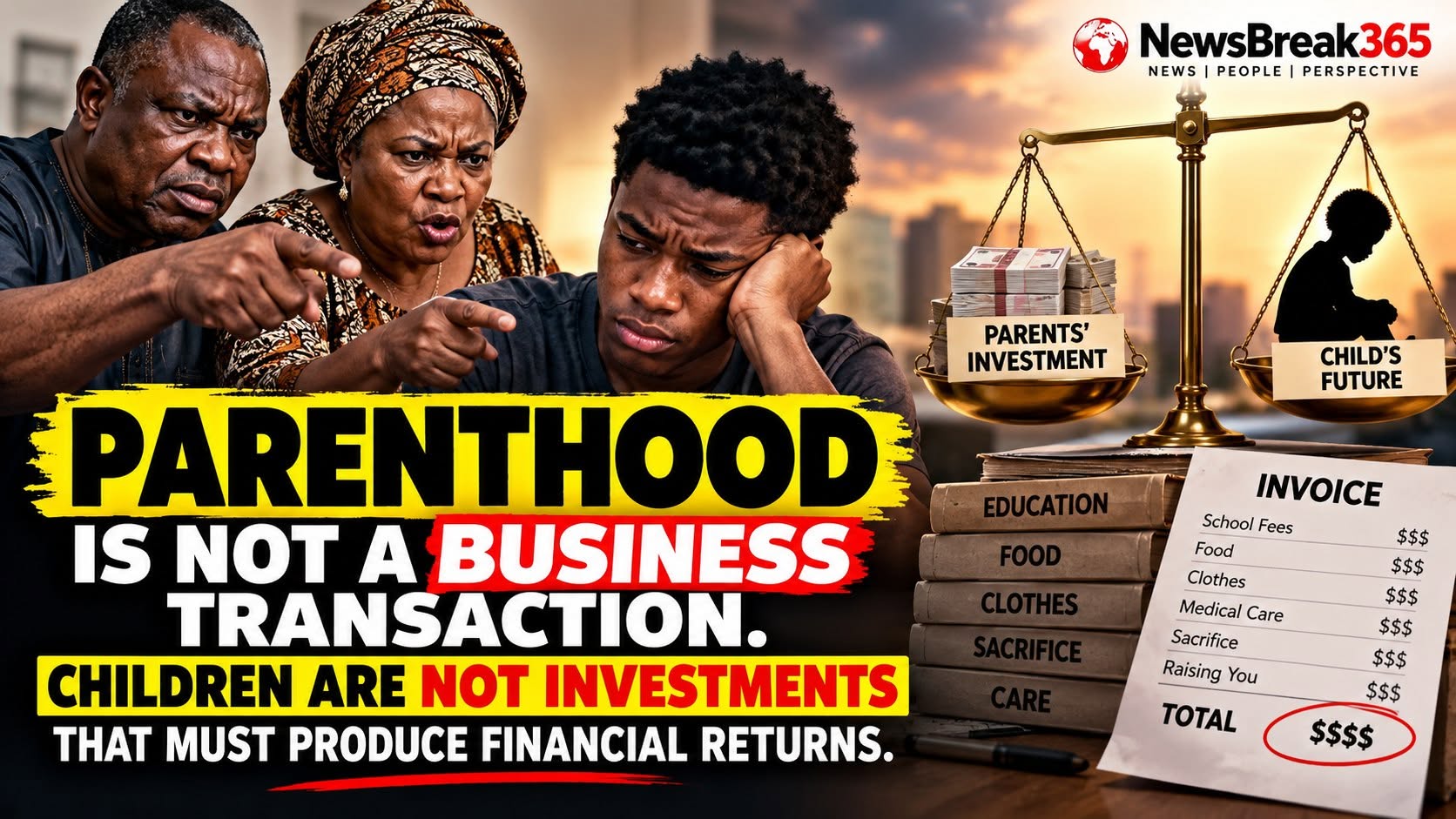
PARENTHOOD IS NOT A BUSINESS TRANSACTION. CHILDREN ARE NOT INVESTMENTS THAT MUST PRODUCE FINANCIAL RETURNS

Published

on

One of the biggest misconceptions in society is the belief that because parents gave birth to children, fed them, clothed them, educated them and sacrificed for them, those children automatically owe them a financial repayment for the rest of their lives.

**But who signed that agreement?**

Did the child ask to be born? Did the child negotiate the conditions of birth? Did the child sit down with the parents and promise to become their retirement plan?

No!

Parenthood is a responsibility voluntarily undertaken by adults. Children do not choose to enter this world. Therefore, raising them should not be treated as a financial investment with guaranteed returns.

Some parents raise children with love, only to turn around years later and demand repayment as if they had given out a bank loan.

Every sacrifice becomes a debt. Every school fee becomes an invoice. Every meal becomes evidence of an obligation. Every parental responsibility is eventually presented as a reason why the child must surrender their financial freedom.

**THIS IS NOT LOVE. THIS IS FINANCIAL ENTITLEMENT!**

Of course, children should appreciate their parents. They should show kindness, gratitude, compassion and support whenever they are able to do so.

But appreciation is not the same as lifelong financial slavery.

There is a difference between voluntarily supporting your parents and being emotionally blackmailed into funding their lifestyle.

Parents must also understand that their children have their own lives to build, their own families to support, their own dreams to pursue and their own financial responsibilities.

See also  Secret of Uma Ukpai’s ministry revealed by his son

**GIVING BIRTH DOES NOT GIVE YOU OWNERSHIP OVER ANOTHER HUMAN BEING’S FUTURE!**

If your primary reason for having children is to secure your old age, provide lifelong financial support or guarantee wealth for yourself, perhaps you need to reconsider your understanding of parenthood.

Raise children to become independent, responsible and compassionate human beings, not financial assets waiting to mature.

Love your children without presenting them with an invoice for their existence.

**A CHILD IS A HUMAN BEING, NOT A RETIREMENT PLAN. PARENTHOOD IS A RESPONSIBILITY, NOT A BUSINESS INVESTMENT!**

**LET’S DEBATE:**

Should children be financially obligated to repay their parents for the cost of raising them, or should supporting parents be a voluntary act of love and appreciation?

Drop your opinion in the comments.

#Parenthood #Parenting #ChildrenAreNotInvestments #FinancialEntitlement #FamilyValues #ParentalResponsibility #SocialDebate #Newsbreak365

FOLLOW US ON:

FACEBOOK

WHATSAPP CHANNEL

TWITTER

PINTEREST

TIKTOK

YOUTUBE

LINKEDIN

INSTAGRAM

Continue Reading

Trending