Connect with us

Lifestyle

Bullying Is Never Acceptable

Published

on

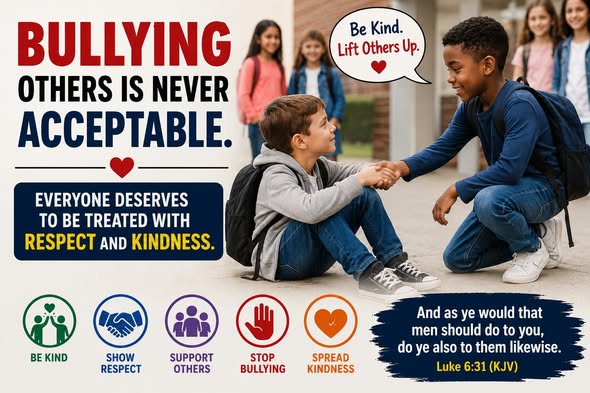
Bullying others is never acceptable. Every person deserves to be treated with respect, kindness, dignity, and compassion. Words and actions can deeply hurt others, so we should choose to encourage rather than humiliate, support rather than intimidate, and show kindness rather than cruelty.

The Bible teaches us:

“And as ye would that men should do to you, do ye also to them likewise.”
— Luke 6:31 (KJV)

This is the Golden Rule: treat others the way you would want to be treated.

“Be kindly affectioned one to another with brotherly love; in honour preferring one another.”
— Romans 12:10 (KJV)

We are called to show genuine care and respect for one another.

“Let no corrupt communication proceed out of your mouth, but that which is good to the use of edifying…”
— Ephesians 4:29 (KJV)

Our words should build people up, not tear them down.

“And be ye kind one to another, tenderhearted, forgiving one another…”
— Ephesians 4:32 (KJV)

Bullying is not strength. Kindness is strength. You never know what someone else may be going through, so choose your words carefully, stand against bullying, and treat everyone with the respect and kindness they deserve.

FOLLOW US ON:

FACEBOOK

TWITTER

PINTEREST

TIKTOK

YOUTUBE

LINKEDIN

INSTAGRAM

See also  Bayelsa raises the alarm over rising cases of hypertension
Continue Reading
Click to comment

Leave a Reply

Your email address will not be published. Required fields are marked *

Lifestyle

Pride Before Everything Can Lead to a Fall

Published

on

Pride can quietly take control of a person’s life. When pride becomes more important than humility, wisdom, correction, and respect for others, it can eventually lead to failure and destruction.

The Bible gives us a clear warning:

“Pride goeth before destruction, and an haughty spirit before a fall.”
— Proverbs 16:18 (KJV)

Pride can make a person believe they are always right, refuse correction, look down on others, and ignore wise counsel. But true strength is not found in arrogance; it is found in humility, wisdom, and self-control.

“Before destruction the heart of man is haughty, and before honour is humility.”
— Proverbs 18:12 (KJV)

We should never allow success, wealth, position, intelligence, beauty, or influence to make us feel superior to others.

“Let nothing be done through strife or vainglory; but in lowliness of mind let each esteem other better than themselves.”
— Philippians 2:3 (KJV)

Being humble does not mean thinking you are worthless. It means recognizing that you are not above others and remaining willing to learn, listen, and accept correction.

“For all that is in the world, the lust of the flesh, and the lust of the eyes, and the pride of life, is not of the Father, but is of the world.”
— 1 John 2:16 (KJV)

Never let pride come before everything else. A person may stand tall today, but pride can make them blind to the very things that could bring them down tomorrow.

Choose humility over arrogance, wisdom over stubbornness, and kindness over superiority.

See also  Onyeka Onwenu (1952–2024): The Elegant Stallion of Nigerian Arts and Advocacy

Remember: Pride may lift you up in your own eyes, but humility prepares you for lasting honour.

FOLLOW US ON:

FACEBOOK

TWITTER

PINTEREST

TIKTOK

YOUTUBE

LINKEDIN

INSTAGRAM

Continue Reading

Lifestyle

Some People Know Very Little, Yet They Behave as Though They Know Everything

Published

on

There is a difference between having confidence and having wisdom.

Some people have very little knowledge or experience about a subject, yet they speak with absolute certainty. They interrupt those with more experience, reject correction, and behave as though there is nothing left for them to learn.

The problem is not that someone is inexperienced. Everyone starts somewhere. The real problem is refusing to learn while believing you already know everything.

The Bible has a lot to say about this kind of attitude.

1. A wise person knows that there is more to learn

“The fear of the LORD is the beginning of knowledge: but fools despise wisdom and instruction.”
— Proverbs 1:7 (KJV)

A person who wants to become wise must be willing to receive instruction. Nobody becomes knowledgeable by pretending to know everything.

2. Listen before you speak

Some people are quick to give opinions but slow to listen. They speak confidently even when they have not taken the time to understand the subject.

The Bible says:

“Wherefore, my beloved brethren, let every man be swift to hear, slow to speak, slow to wrath.”
— James 1:19 (KJV)

Listening is not a sign of weakness. It is one of the ways we learn.

3. Thinking you know everything can lead to mistakes

A person who believes they cannot be wrong will rarely examine their own thinking.

“Seest thou a man wise in his own conceit? there is more hope of a fool than of him.”
— Proverbs 26:12 (KJV)

Being “wise in your own conceit” means having an exaggerated opinion of your own wisdom.

See also  Onyeka Onwenu (1952–2024): The Elegant Stallion of Nigerian Arts and Advocacy

Confidence without knowledge can be dangerous because it may cause someone to make decisions without understanding the consequences.

4. Don’t reject correction

One of the clearest signs of wisdom is the ability to accept correction.

“The ear that heareth the reproof of life abideth among the wise.”
— Proverbs 15:31 (KJV)

If someone corrects you and you discover that they are right, there is no shame in changing your position.

Admitting that you don’t know something is not ignorance. Refusing to learn is.

5. Experience matters

A person who has spent years studying, working, practicing, or dealing with a particular subject has accumulated experience that cannot be acquired simply by having an opinion.

The Bible says:

“Wisdom is with the aged, and understanding in length of days.”
— Job 12:12 (KJV)

This does not mean that older people are automatically right about everything. It means experience can provide valuable wisdom.

We should therefore learn from people who have knowledge and experience rather than assuming that our limited understanding is complete.

6. Don’t confuse confidence with wisdom

Someone can speak loudly, argue strongly and appear extremely confident while still being completely mistaken.

True wisdom is different.

A wise person can say:

“I don’t know.”
“Let me learn.”
“I may be wrong.”
“Show me the evidence.”

That kind of humility creates room for growth.

“Before honour is humility.”
— Proverbs 15:33 (KJV)

Final Thought

You don’t have to know everything to be respected.

In fact, one of the most intelligent things a person can say is:

See also  Bayelsa raises the alarm over rising cases of hypertension

“I don’t know, but I’m willing to learn.”

Never be ashamed of being a beginner. Everyone who is an expert today was once a novice.

The danger begins when a person knows very little but refuses to learn because they believe they already know everything.

“Pride goeth before destruction, and an haughty spirit before a fall.”
— Proverbs 16:18 (KJV)

Be confident, but remain teachable. Speak when you have something valuable to contribute, listen when you have something to learn, and never let pride convince you that there is nothing more for you to understand.

FOLLOW US ON:

FACEBOOK

TWITTER

PINTEREST

TIKTOK

YOUTUBE

LINKEDIN

INSTAGRAM

Continue Reading

Lifestyle

Some People Are Always Wrong, Yet They Believe They Are Right About Everything

Published

on

One of the most difficult things for a person to recognize is their own mistake. Some people can be clearly wrong, yet they will argue endlessly because they are convinced that they are right. They may refuse correction, reject advice, and blame everyone else rather than examine their own actions.

The Bible warns us about this kind of attitude.

“The way of a fool is right in his own eyes: but he that hearkeneth unto counsel is wise.”
— Proverbs 12:15 (KJV)

A person who thinks they are always right can easily become blind to their own weaknesses. Being confident is not the same as being correct. Sometimes wisdom means having enough humility to say, “I was wrong.”

1. Being convinced does not make you correct

A person can sincerely believe something and still be mistaken. Your confidence does not automatically make your opinion the truth.

The Bible says:

“There is a way which seemeth right unto a man, but the end thereof are the ways of death.”
— Proverbs 14:12 (KJV)

This is why we should examine our decisions instead of assuming that everything we think must be right.

2. Learn to accept correction

Nobody knows everything. Even intelligent and experienced people can make mistakes.

The Bible teaches:

“Reprove not a scorner, lest he hate thee: rebuke a wise man, and he will love thee.”
— Proverbs 9:8 (KJV)

A wise person does not necessarily enjoy correction, but they understand that correction can help them become better.

3. Pride can prevent people from seeing their mistakes

See also  The Loved Child and the Hated Child by Parents

Sometimes the problem is not a lack of information but pride. A proud person may consider admitting a mistake a sign of weakness, when in reality it can be a sign of maturity.

“Only by pride cometh contention: but with the well advised is wisdom.”
— Proverbs 13:10 (KJV)

When pride controls a person, even a simple disagreement can become a major conflict.

4. Listen before you answer

Some people are already preparing their response before the other person has finished speaking. They are more interested in winning an argument than understanding the truth.

The Bible says:

“He that answereth a matter before he heareth it, it is folly and shame unto him.”
— Proverbs 18:13 (KJV)

Listening does not mean that you agree with everything you hear. It means you are willing to understand before making a judgment.

5. Examine yourself first

It is easy to see other people’s faults while ignoring our own.

Jesus taught:

“And why beholdest thou the mote that is in thy brother’s eye, but considerest not the beam that is in thine own eye?”
— Matthew 7:3 (KJV)

Before constantly pointing fingers at others, we should ask ourselves: “Could I also be wrong?”

That single question can prevent many unnecessary arguments.

6. Wisdom requires humility

A truly wise person understands that there is always something more to learn. They are willing to listen, reconsider their position, apologize when necessary, and change when they discover that they were wrong.

“When pride cometh, then cometh shame: but with the lowly is wisdom.”
— Proverbs 11:2 (KJV)

Humility does not mean thinking you are worthless. It means recognizing that you are not infallible.

See also  Onyeka Onwenu (1952–2024): The Elegant Stallion of Nigerian Arts and Advocacy

Final Thought

Some people would rather defend a mistake than admit they made one. They would rather blame others than examine themselves. They would rather win an argument than discover the truth.

But being wrong is not the greatest problem. Refusing to accept that you are wrong is.

A mature person should be able to say:

“I may be wrong. Let me listen. Let me learn. Let me examine myself.”

The goal of life should not be to prove that you are always right. The goal should be to become wiser, more humble, and closer to the truth.

“Let another man praise thee, and not thine own mouth; a stranger, and not thine own lips.”
— Proverbs 27:2 (KJV)

Sometimes the wisest words you can say are: “I was wrong.”

FOLLOW US ON:

FACEBOOK

TWITTER

PINTEREST

TIKTOK

YOUTUBE

LINKEDIN

INSTAGRAM

Continue Reading

Trending