Connect with us

Lifestyle

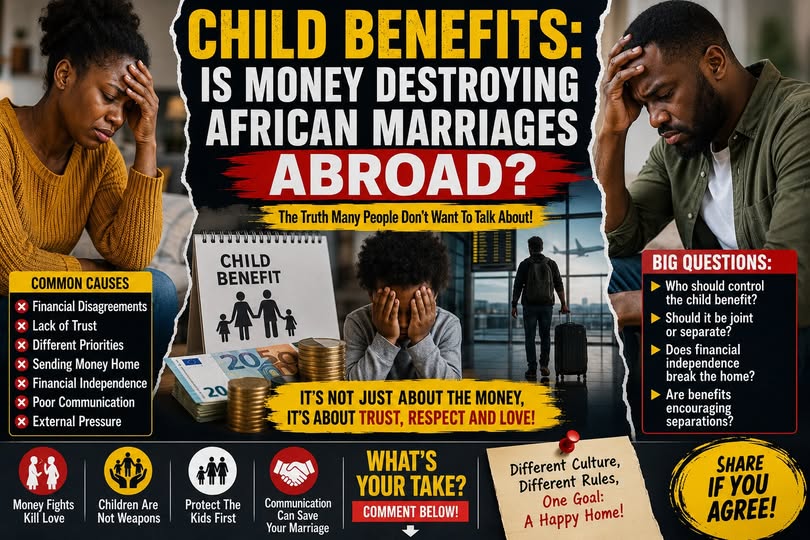
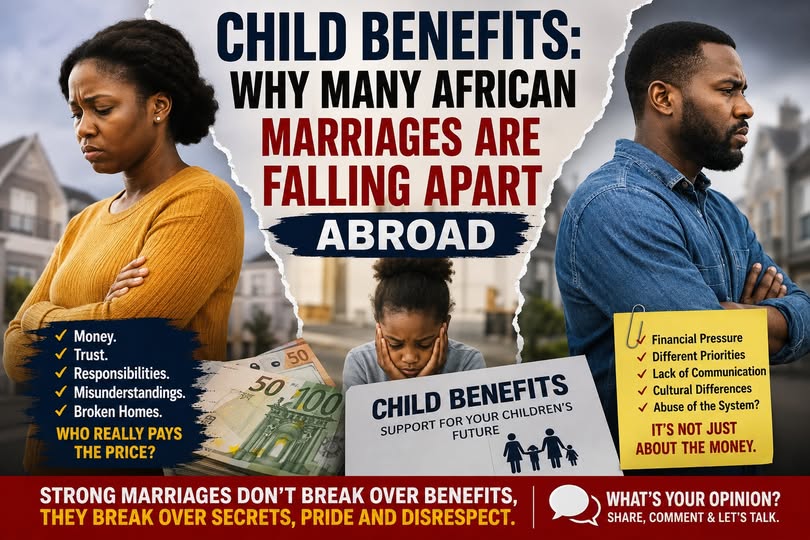
Child Benefits: Why Many African Marriages Are Falling Apart Abroad

Published

on

For many African families who move abroad, the dream is simple: find better opportunities, build a stable home, educate the children, support relatives back home, and create a better future for the next generation.

But behind the beautiful pictures of life abroad, some families are experiencing a painful reality that is rarely discussed openly.

Some marriages that survived poverty, long-distance relationships, family pressure, and difficult living conditions back home are struggling after migration.

In some cases, money and social benefits intended to support children have unexpectedly become part of the conflict.

This is not to say that child benefits cause divorce. They do not. Child benefits are designed to help families meet the costs of raising children. The deeper problems often involve mistrust, financial disagreements, unequal responsibilities, cultural differences, relationship breakdown, and misunderstandings about the welfare system.

However, when money enters an already troubled relationship, it can expose problems that were previously hidden.

When the dream of a better life becomes a family battle

For many African couples, moving abroad represents a major sacrifice.

One partner may travel first, secure accommodation, find employment, obtain legal residence, and eventually bring the spouse and children.

The family may arrive expecting life to become easier.

Instead, they discover rent, energy bills, childcare expenses, transportation costs, taxes, insurance, school-related expenses, and other financial responsibilities.

Then there may be child-related payments or allowances available to families.

And this is where disagreements can begin.

Questions that might never have been asked back home suddenly become extremely important:

Who receives the money?

Who controls it?

Should it go into the family account?

Should it be spent directly on the children?

Should one parent be allowed to save it?

Should some of it be sent to relatives in Africa?

What happens if the couple separates?

These questions may appear simple, but they can become explosive inside a troubled marriage.

“The money is for the children” — but who controls it?

One of the biggest sources of conflict can be the question of financial control.

A parent may believe that child-related benefits should be managed by the person who takes care of the children every day.

The other parent may argue that because they work and pay most household expenses, the money should be part of the family’s overall budget.

Neither position automatically makes someone a bad parent.

The problem begins when the issue becomes a battle for control rather than a discussion about the children’s needs.

A couple can start fighting over relatively small amounts of money until the disagreement becomes symbolic.

It may no longer be about the benefit itself.

It becomes:

“You don’t trust me.”

“You don’t respect me.”

“You are hiding money from me.”

“You only care about yourself.”

“You don’t contribute enough.”

“You are using the children against me.”

Once conversations reach this stage, the marriage may already have deeper problems.

Financial independence can change a relationship

Migration can dramatically change the economic relationship between husband and wife.

In some African marriages, one spouse may traditionally have been the main financial provider.

After moving abroad, however, the other spouse may become financially independent through employment, government-supported childcare arrangements, benefits, education, or other opportunities.

This can be positive.

Financial independence can empower people and reduce unhealthy dependence.

But it can also create tension where couples have never discussed how their roles should change.

A husband may feel that his authority is being challenged.

A wife may feel that she no longer needs to tolerate behavior she tolerated when she was financially dependent.

The disagreement may then become bigger than money.

It may become a disagreement about power, respect, freedom and control.

Some couples arrive abroad with unresolved problems

Another uncomfortable truth is that migration does not automatically fix a broken relationship.

Sometimes couples believe that moving abroad will solve everything.

They think:

“Once we get to Europe, things will become better.”

But a new country cannot automatically repair communication problems, infidelity, domestic conflict, resentment, jealousy, or emotional disconnection.

See also  Prince Bola Ajibola: Nigerian Jurist and International Statesman

In fact, migration can make those problems more visible.

A couple who barely communicated in Nigeria, Ghana, Cameroon, Kenya, Uganda, Sierra Leone, Liberia or elsewhere may communicate even less effectively when faced with the pressures of life abroad.

The environment has changed.

The problems have not.

The pressure of sending money home

For many African migrants, supporting relatives back home remains an important responsibility.

Parents may need help.

Siblings may request financial assistance.

Extended family members may expect regular contributions.

There may be school fees, medical bills, house projects, funerals, weddings and other family obligations.

But the spouse living abroad may see things differently.

One partner may say:

“My family needs help.”

The other may respond:

“Our children need help too.”

This can become a major source of marital conflict.

Imagine a family struggling to pay rent while one spouse is sending money abroad every month.

The other spouse may feel betrayed.

The spouse sending the money may feel that their partner does not understand their responsibility toward their parents and siblings.

Again, the child benefit may become part of the argument.

One person may say:

“You received money for the children and sent part of it home.”

The other may respond:

“I am the one taking care of the children every day.”

What started as a financial disagreement can quickly become a marital crisis.

Children can become the centre of the conflict

Perhaps the most painful part is when children become involved in their parents’ financial battles.

Children should not be forced to choose between their parents.

They should not hear:

“Your mother took your money.”

or

“Your father doesn’t care about you.”

They should not become messengers between parents.

They should not be used as weapons during separation.

A child-related payment exists to support the welfare of the child. It should never become a tool for humiliating, threatening or manipulating the other parent.

When parents fight over money in front of children, the emotional consequences can last much longer than the financial disagreement.

“My wife changed after coming to Europe”

This is a statement sometimes heard in African communities abroad.

A husband may complain:

“She was different when we were in Africa.”

But what does “changed” actually mean?

Perhaps she became more independent.

Perhaps she found employment.

Perhaps she learned about her legal rights.

Perhaps she developed new friendships.

Perhaps she became more confident.

Perhaps she simply stopped accepting certain things she previously tolerated.

The same can happen to men.

A woman may say:

“My husband changed after coming abroad.”

Perhaps he became more financially independent.

Perhaps he developed a new social circle.

Perhaps he began spending more time outside the home.

Perhaps he became exposed to a different lifestyle.

Migration can change people.

The challenge for couples is learning how to grow together instead of growing apart.

Welfare systems are not necessarily the enemy

It is important to make one thing clear:

Social welfare systems are not designed to destroy African marriages.

Child benefits and family support programmes exist in many countries because raising children is expensive.

They can help families pay for necessities and reduce financial pressure.

The problem is not necessarily the existence of these programmes.

The problem can be how couples understand and manage money within their relationship.

If a marriage is healthy, transparent and cooperative, financial assistance can become an opportunity to strengthen the family.

If a marriage is already full of mistrust and resentment, even a relatively small payment can become another battlefield.

What happens when couples separate?

When a marriage breaks down, financial arrangements can become even more complicated.

The couple may disagree about where the children should live.

They may disagree about who provides daily care.

They may disagree about expenses.

They may disagree about child-related payments.

They may accuse each other of withholding money.

They may involve relatives.

They may involve lawyers or social services.

And eventually, what began as a private family disagreement can become a formal dispute.

See also  My father’s death turned me to Lagos hawker – Gov. Umo Eno inspiring story

This is why couples should understand the laws and benefit rules of the country where they live rather than relying on information from friends, WhatsApp groups, or community gossip.

Rules differ from one country to another.

What applies in Belgium may not apply in Germany.

What applies in Germany may not apply in the United Kingdom.

What applies in France may not apply in the Netherlands.

People should obtain accurate information from the relevant authorities.

The danger of comparing African marriages with Western marriages

Another mistake is assuming that every African marriage abroad must follow exactly the same cultural expectations that existed back home.

Migration creates a new environment.

A spouse may encounter ideas about marriage, parenting, gender roles, privacy, personal finances and individual rights that differ significantly from what they grew up with.

That does not mean African culture is wrong.

It also does not mean everything in Western culture is automatically better.

It means couples need to have honest conversations about which values they want their household to follow.

A marriage cannot survive permanently on assumptions.

Couples must communicate.

When one spouse becomes dependent on benefits

There can also be situations where one spouse becomes heavily dependent on government support while the other works long hours.

This can create resentment.

The working spouse may feel:

“I am carrying the whole family.”

The spouse staying at home may respond:

“I am looking after the children and managing the household.”

Both contributions may be real.

The problem arises when neither person appreciates the contribution of the other.

Raising children is work.

Paid employment is work.

Household management is work.

A successful marriage requires both partners to recognize that family responsibilities cannot always be measured simply by who brings home a salary.

Transparency can prevent many financial conflicts

One of the simplest ways couples can reduce financial arguments is through transparency.

Partners should know:

What income is coming into the household
What major expenses exist
What debts need to be paid
What money is being saved
What money is being sent to relatives
What the children’s needs are
What government support the family receives
What the family’s financial goals are

This does not mean every couple must have exactly the same bank account arrangements.

Different families can organize their finances differently.

But secrecy is dangerous.

When one spouse discovers that the other has been hiding money, opening secret accounts, sending large amounts abroad or making major financial decisions without consultation, trust can collapse.

African men and women must have difficult conversations

Before marriage, couples should talk about money.

After marriage, they should continue talking about money.

After migration, they should talk about money again.

And after having children, they should revisit the conversation.

Questions should include:

How will we manage our household income?

How much should we save?

How much can we send to relatives?

Who pays which bills?

How will we manage child-related support?

What happens if one person loses their job?

What are our long-term goals?

How will we handle disagreements?

These conversations may not be romantic.

But they can save marriages.

Don’t let social media define your marriage

Social media has also created another problem.

People see photographs of other African families abroad showing beautiful houses, expensive cars, holidays and happy marriages.

They may think:

“Everybody is doing better than us.”

But social media rarely shows the arguments behind closed doors.

It does not show unpaid bills.

It does not show loneliness.

It does not show immigration stress.

It does not show marital counseling.

It does not show separation.

It does not show parents crying because they cannot see their children.

Do not compare your real marriage to somebody else’s edited online life.

When money becomes more important than the marriage

A marriage becomes vulnerable when money becomes the measure of love.

A husband may believe:

“If I pay all the bills, my wife must obey me.”

A wife may believe:

See also  KWAM 1 - The Arikuyeri 1 of Abuja

“Because I receive money for the children, I don’t need to explain anything to my husband.”

Both attitudes can create problems.

Marriage requires more than financial contributions.

It requires communication, respect, responsibility, trust, forgiveness and cooperation.

Money can support a family.

Money cannot create love.

And money cannot repair a relationship that both partners have stopped investing in.

The real question is not “Who gets the child benefit?”

The deeper question is:

“How can we make sure our children are properly cared for while maintaining a healthy relationship between their parents?”

That should be the focus.

Instead of asking:

“Who owns the money?”

Couples should ask:

“What do our children need?”

Instead of:

“How much can I keep?”

Ask:

“How can we build a stable future for this family?”

Instead of:

“Your money versus my money,”

ask:

“What financial system works fairly for everyone in this household?”

What African couples abroad can do

If you are an African couple living abroad, consider these practical steps:

1. Have regular financial meetings

Sit down together and review household income, expenses, savings and children’s needs.

2. Keep financial records

Know what comes into the household and what goes out.

3. Agree on support for relatives

Helping family members is admirable, but it should not destroy your own household.

4. Keep children out of adult conflicts

Never make children responsible for resolving parental disagreements.

5. Learn the local rules

Do not rely entirely on community rumors about benefits, taxes, residence or family law.

6. Seek help early

Marriage counseling, family mediation or professional advice can sometimes prevent a disagreement from becoming a separation.

7. Respect each other’s contributions

A salary is not the only contribution to a family.

8. Avoid secret financial decisions

Financial secrecy can destroy trust.

9. Build shared goals

Saving for a home, educating children, starting a business or preparing for retirement can give couples a common purpose.

10. Remember why you migrated

The purpose of migration should not become simply earning money.

For many families, the ultimate goal was to build a better life together.

The uncomfortable truth

Sometimes the child benefit is not the real problem.

The real problem is the marriage.

The money simply reveals what was already there.

If there is trust, communication and mutual respect, financial support can help a family survive difficult times.

If there is jealousy, secrecy, resentment, manipulation and poor communication, almost anything can become a source of conflict.

Today it may be child benefits.

Tomorrow it may be a bank account.

Next week it may be rent.

Then it may be a car.

Eventually, the couple may realize that they are no longer fighting about money.

They are fighting about the relationship itself.

Before the marriage falls apart

African families abroad should not wait until divorce papers arrive before taking their relationship seriously.

Talk.

Listen.

Budget together.

Respect one another.

Protect the children.

Understand the law.

Seek help when necessary.

And remember that independence should not mean isolation, while family responsibility should not mean control.

The goal should not be to determine which spouse “wins.”

The goal should be to build a family where the children are protected, both parents are respected, and financial assistance is used responsibly for the family’s welfare.

Child benefits can help families.

But no government payment can replace communication, trust and responsibility inside a marriage.

And if a marriage collapses because of money, the money was probably only part of the story.

The bigger question is: what happened to the trust between the two people who once decided to build a life together?

What do you think?

Do child benefits and financial independence make some African marriages abroad more difficult, or are these simply symptoms of deeper marital problems?

Should couples combine child-related benefits with household income, or should the parent caring directly for the children control the money?

Share your opinion respectfully in the comments.

FOLLOW US ON:

FACEBOOK

TWITTER

PINTEREST

TIKTOK

YOUTUBE

LINKEDIN

INSTAGRAM

Continue Reading
Click to comment

Leave a Reply

Your email address will not be published. Required fields are marked *

Lifestyle

SOME AFRICAN MARRIAGES SURVIVED POVERTY IN AFRICA — BUT ARE NOW COLLAPSING OVER MONEY ABROAD?

Published

on

This is a conversation many people don’t want to have.

A couple struggles together in Africa.

They endure poverty.

They survive long-distance relationships.

They make sacrifices.

They dream about Europe.

Then one spouse finally travels abroad.

Years later, the family is reunited.

Better income.

Better opportunities.

Child benefits.

Financial independence.

And suddenly…

💥 THE MARRIAGE STARTS FALLING APART.

So what happened?

Did Europe destroy the marriage?

Did financial independence change the relationship?

Did child-related benefits create financial competition between husband and wife?

Or was the marriage already broken — and money simply exposed the cracks?

🔥 LET’S TALK.


💰 “THE CHILDREN’S MONEY IS MINE TO CONTROL.”

This is where some couples begin fighting.

One spouse says:

“I am the one taking care of the children every day. Why shouldn’t I manage the money?”

The other says:

“I work hard to pay the rent, electricity, food and other bills. Why should you control everything?”

Then the argument becomes bigger.

WHO OWNS THE MONEY?

WHO SHOULD MANAGE IT?

SHOULD IT BE SHARED?

SHOULD IT GO INTO A JOINT ACCOUNT?

SHOULD IT ONLY BE SPENT DIRECTLY ON THE CHILDREN?

And suddenly, a family benefit becomes a marital battlefield.


🇳🇬 “BUT MY FAMILY BACK HOME NEEDS HELP!”

This is another major issue for many African families abroad.

Your mother needs money.

Your father needs money.

Your brother needs school fees.

Your sister needs help.

A relative needs medical treatment.

Someone is building a house.

Someone is getting married.

Someone has lost a loved one.

The requests continue.

But your spouse says:

“We have children here. We have rent to pay. We have bills. Why are you sending so much money back home?”

You respond:

“That is my family. I cannot abandon them because I moved abroad.”

🔥 BOOM! ANOTHER FIGHT.

See also  Pastor Adeboye predicts his own death

And the question becomes:

Should your immediate family abroad always come before your extended family back home?

Or does marriage require you to continue supporting your parents and siblings?


💔 THEN FINANCIAL INDEPENDENCE ENTERS THE MARRIAGE

Some African couples grew up with traditional expectations.

The man provides.

The woman depends on the man.

The husband makes major financial decisions.

But abroad, the situation can change.

The wife gets a job.

She earns her own money.

She opens her own account.

She learns her rights.

She becomes financially independent.

And suddenly, the relationship has changed.

Some husbands may struggle with that change.

Some wives may feel liberated by it.

And some couples may simply fail to adjust to their new reality.

But here’s the uncomfortable question:

Should financial independence strengthen a marriage — or can it make some couples feel they no longer need each other?


⚠️ MEN ARE NOT THE ONLY ONES WHO CHANGE

Let’s be fair.

Men can change too.

A man may arrive abroad alone.

He gets a job.

He starts earning good money.

He makes new friends.

He develops a different lifestyle.

He may begin spending more time outside the home.

He may become less interested in the traditional family structure.

His wife may then ask:

“Why did you change after coming abroad?”

So this isn’t simply a men-versus-women issue.

It is a relationship issue.


👀 AND THEN SOCIAL MEDIA MAKES EVERYTHING WORSE

You see another African family abroad posting:

🏠 Beautiful house.

🚘 Expensive car.

✈️ Holiday abroad.

💍 Happy marriage.

👨‍👩‍👧‍👦 Beautiful family pictures.

You start thinking:

“Why isn’t my family like that?”

But social media doesn’t show the arguments.

It doesn’t show the bank-account problems.

It doesn’t show the marital counseling.

It doesn’t show the nights when husband and wife sleep in separate rooms.

See also  KWAM 1 - The Arikuyeri 1 of Abuja

It doesn’t show the divorce papers.

Never compare your private reality with somebody else’s public performance.


🚨 AND HERE IS THE PART PEOPLE DON’T WANT TO HEAR

Child benefits may not be the real problem.

The real problem may be:

SECRECY.

MISTRUST.

INFIDELITY.

CONTROL.

POOR COMMUNICATION.

FINANCIAL DISAGREEMENTS.

DIFFERENT EXPECTATIONS.

PRESSURE FROM RELATIVES.

LOSS OF RESPECT.

The benefit may simply become the thing that exposes everything.

A healthy couple can argue about money and still find a solution.

An unhealthy relationship can turn €100 into a war.


👶 AND WHO SUFFERS?

The children.

While parents fight about money, children are watching.

They hear:

“Your mother is taking advantage of me.”

Or:

“Your father doesn’t care about this family.”

The child becomes confused.

The child starts taking sides.

The child becomes the messenger.

Eventually, the marriage may end.

But the emotional consequences can remain with the children for years.

Children should never be made to pay the emotional price for their parents’ financial disagreements.


🔥 HERE’S THE QUESTION THAT WILL START THE DEBATE:

IF A WOMAN RECEIVES CHILD BENEFITS ABROAD, SHOULD HER HUSBAND HAVE A RIGHT TO KNOW EXACTLY HOW THE MONEY IS BEING SPENT?

YES or NO?

And another one:

IF THE HUSBAND PAYS MOST OF THE HOUSEHOLD BILLS, SHOULD THE CHILD BENEFIT BE PART OF THE FAMILY BUDGET?

YES or NO?

And another:

SHOULD A MARRIED COUPLE BE ALLOWED TO KEEP THEIR FINANCES COMPLETELY SEPARATE?

YES or NO?

And finally:

ARE SOME AFRICAN MARRIAGES ABROAD COLLAPSING BECAUSE PEOPLE BECOME TOO FINANCIALLY INDEPENDENT — OR IS THAT JUST AN EXCUSE FOR CONTROLLING PARTNERS?

🔥 THIS IS WHERE THE REAL ARGUMENT BEGINS.

There are people on both sides of this debate.

Some will say:

“Women become too independent abroad.”

See also  Real Warri Pikin, Delta groups resolve dispute over planned show

Others will say:

“Men want financial control.”

Some will say:

“Benefits encourage family separation.”

Others will say:

“Stop blaming benefits for broken marriages.”

Some will say:

“African couples need to preserve traditional values.”

Others will say:

“Marriage must evolve when people move to a different country.”

Perhaps the truth is somewhere in the middle.


❤️ THE BIGGER QUESTION

Instead of asking:

“WHO GETS THE MONEY?”

Maybe couples should ask:

“HOW DO WE BUILD A FAMILY THAT BOTH OF US CAN BE PROUD OF?”

Because money can pay the rent.

Money can buy food.

Money can pay school expenses.

Money can support children.

But money cannot create trust.

Money cannot create respect.

Money cannot create communication.

And money cannot save a marriage where both partners have stopped caring about each other.


🔥 WHAT DO YOU THINK?

Has living abroad made some African marriages stronger — or weaker?

Do child benefits create unnecessary financial conflicts between couples?

Should husband and wife have complete financial transparency?

Should money received for children always be jointly managed?

Is financial independence helping African women — or creating new problems in some marriages?

Are African men struggling to adapt to changing gender roles abroad?

Are some women using financial independence to leave relationships they no longer want?

Or are these arguments simply excuses for marriages that were already failing?

👇 COMMENT BELOW.

👇 TAG SOMEONE WHO HAS AN OPINION ON THIS.

👇 SHARE THIS POST AND LET’S HEAR WHAT AFRICANS ABROAD REALLY THINK.

NO INSULTS. NO PERSONAL ATTACKS. JUST A REAL CONVERSATION.

🔥 THE MONEY MAY BE CALLED “CHILD BENEFIT” — BUT THE ARGUMENT AROUND IT CAN AFFECT THE WHOLE FAMILY.

FOLLOW US ON:

FACEBOOK

TWITTER

PINTEREST

TIKTOK

YOUTUBE

LINKEDIN

INSTAGRAM

Continue Reading

Lifestyle

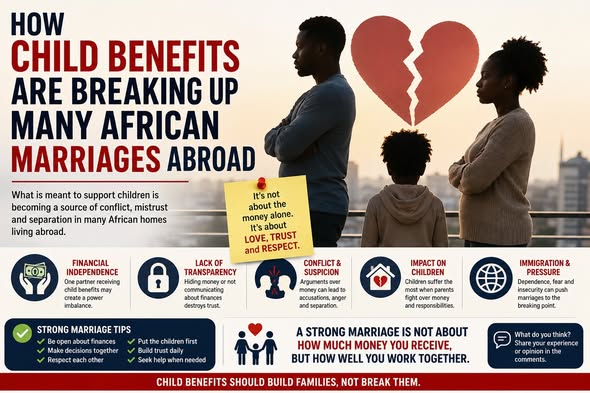
HOW CHILD BENEFITS ARE BREAKING UP MANY AFRICAN MARRIAGES ABROAD

Published

on

For many African families who relocate abroad, the dream is simple: build a better life, raise the children in a safe environment, work hard, support one another and enjoy the opportunities that come with living in a developed country.

But for some couples, that dream can become complicated when child benefits, social welfare payments and financial independence enter the marriage.

Money has always been capable of exposing problems that already existed in a relationship. In some African marriages abroad, disagreements over child benefits have reportedly become a source of serious conflict, mistrust, separation and, in some cases, divorce.

But is the problem really the child benefit—or is it the way couples handle money, responsibility and independence?

WHEN MONEY CHANGES THE BALANCE OF POWER

In many traditional African families, couples are accustomed to sharing financial responsibilities according to cultural expectations. The husband may be seen as the primary provider, while the wife manages the home and children.

After moving abroad, however, the financial structure can change.

A wife may receive child-related benefits directly into her personal bank account. She may also have her own salary, housing support or other forms of assistance, depending on the country and her circumstances.

Suddenly, she may have a level of financial independence that she did not have before.

For some couples, this is a positive development.

For others, it can create tension.

A husband may begin asking:

“Where is the money going?”

A wife may respond:

“It is meant to support the children, and I am the one taking care of them.”

The disagreement can become bigger than the money itself.

It can become a battle over control, trust, responsibility and respect.

THE DANGER OF HIDING MONEY FROM YOUR SPOUSE

See also  Prince Bola Ajibola: Nigerian Jurist and International Statesman

One of the biggest problems in some relationships is a lack of financial transparency.

A couple may live under the same roof while keeping separate financial lives.

One partner may not know exactly how much the other earns or receives. Bills may not be discussed openly. Savings may be hidden. Benefits may be treated as personal money rather than money connected to the family’s needs.

When trust disappears, even a relatively small financial disagreement can become a major marital crisis.

And once accusations begin—“You are hiding money,” “You are controlling me,” “You don’t care about the children,” or “You only married me for papers”—the marriage can quickly become toxic.

CHILD BENEFITS SHOULD NOT BECOME A WEAPON

Child-related benefits are generally intended to help families meet the costs associated with raising children. They should not become a weapon that one spouse uses to punish or control the other.

The same principle applies to the husband.

A husband should not demand complete control over money simply because he is the husband.

And a wife should not assume that receiving a benefit gives her the right to exclude her husband from every financial discussion concerning the children.

Marriage is a partnership, not a financial battlefield.

BUT LET’S ALSO BE HONEST ABOUT ABUSE

There is another side of this conversation that must not be ignored.

Some people may use money to control their spouse.

A husband may take all the household income and leave his wife without access to money.

A wife may also deliberately hide money or manipulate financial assistance.

In situations involving financial abuse, coercive control or domestic violence, the answer is not simply to tell the couple to “share the money.”

The safety and wellbeing of the person being abused must come first.

See also  ‘You Leave Problem For Nigeria Go Greet ‘Big Men’ In UK’ – Charly Boy Knocks Tinubu

Therefore, we should be careful not to blame every marriage breakdown on child benefits.

Sometimes benefits are merely the trigger that exposes deeper problems that were already present.

THE IMMIGRATION PRESSURE

For some African couples living abroad, immigration status can add another layer of pressure.

A spouse may feel financially dependent on the other person. Another may feel that the relationship has become unequal because one partner controls documents, money, housing or access to information.

This can create fear and resentment.

When financial independence finally becomes available, a person who has felt trapped may decide that they no longer want to remain in an unhappy relationship.

That does not necessarily mean that the benefit “destroyed” the marriage.

It may simply mean that the person finally had enough independence to make a decision they previously felt unable to make.

CHILDREN SHOULD NOT BECOME THE VICTIMS

Whatever happens between husband and wife, the children should not be used as tools in the conflict.

Children should not be told:

“Your father doesn’t give us money.”

Or:

“Your mother is taking all the money meant for you.”

Parents should avoid turning children against one another.

The money may come and go, but the emotional consequences of parental conflict can remain with a child for many years.

AFRICAN COUPLES ABROAD NEED FINANCIAL CONVERSATIONS

Before relocating, couples should discuss how they intend to manage money.

Who pays the rent?

Who pays for food?

Who pays school expenses?

Who saves for emergencies?

How will child-related benefits be used?

How much money should each spouse keep personally?

What happens if one spouse loses a job?

How will major purchases be decided?

See also  PHOTOS: Chief Alimotu Pelewura – Champion of Market Women

These conversations may feel uncomfortable, but they can prevent serious problems later.

Love without communication can become frustration.

Money without transparency can become suspicion.

Independence without responsibility can become conflict.

And marriage without trust can become a prison for both people.

SO, ARE CHILD BENEFITS REALLY BREAKING AFRICAN MARRIAGES?

Perhaps the better question is:

Are child benefits breaking marriages—or are they exposing weaknesses that were already inside those marriages?

A strong marriage should be able to survive financial changes.

If a couple genuinely loves and respects each other, receiving additional financial support for their children should become an opportunity to improve the family’s situation—not a reason to destroy the family.

But when there is already jealousy, control, dishonesty, resentment, lack of communication or domestic abuse, money can become the spark that sets everything on fire.

Living abroad can change many things.

It can change people’s income.

It can change their independence.

It can change their expectations.

It can change their relationships with family and society.

But one thing should remain unchanged:

Respect for one another and responsibility toward the children.

Before blaming child benefits for a broken marriage, couples should ask themselves a deeper question:

“What was already broken between us before the money became the problem?”

💬 WHAT DO YOU THINK?

Do you believe child benefits and financial independence are contributing to the breakdown of some African marriages abroad?

Or do you believe that bad communication, mistrust, domestic abuse, financial irresponsibility and lack of respect are the real causes?

Share your experience or opinion in the comments.

FOLLOW US ON:

FACEBOOK

TWITTER

PINTEREST

TIKTOK

YOUTUBE

LINKEDIN

INSTAGRAM
Continue Reading

Lifestyle

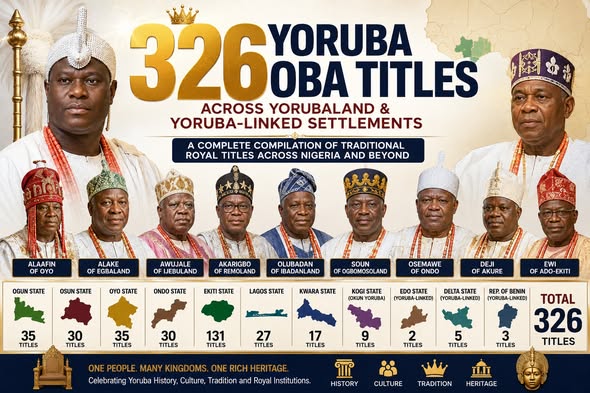
326 YORUBA OBA TITLES ACROSS YORUBALAND AND YORUBA-LINKED SETTLEMENTS

Published

on

A Compilation of Traditional Royal Titles Across Nigeria and Yoruba-Linked Communities

The Yoruba people have one of Africa’s most diverse and historically rich traditional institutions. Across Yorubaland and Yoruba-linked communities, traditional rulers bear different titles reflecting the history, traditions, kingdoms, towns and royal institutions of their respective communities.

From the Ooni of Ife, Alaafin of Oyo, Alake of Egbaland, Awujale of Ijebuland, Akarigbo of Remoland, Olubadan of Ibadanland, Soun of Ogbomosoland, Osemawe of Ondo, Deji of Akure, Olowo of Owo, Ewi of Ado-Ekiti and many others, each title has its own historical and cultural significance.

Below is a compilation of Yoruba Oba titles across Yorubaland and Yoruba-linked settlements in Nigeria and neighbouring areas.


📍 OGUN STATE

  1. ABEOKUTA — Alake of Egbaland
  2. SAGAMU — Akarigbo of Remoland
  3. SANGO-OTA — Olota of Ota
  4. IGBESA — Onigbesi of Igbesa
  5. IPERU-REMO — Oba of Iperu
  6. IKORODU — Ayangburen of Ikorodu
  7. ISHARA-REMO — Onishara of Ishara
  8. IJEBU-ODE — Awujale of Ijebuland
  9. IJEBU-IGBO — Orimolusi of Ijebu-Igbo
  10. ITELE-IJEBU — Onitele of Itele
  11. ODOGBOLU — Osile of Oodogbolu
  12. OGERE-REMO — Oba of Ogere
  13. IROLU-REMO — Oba of Irolu
  14. IPARA-REMO — Olofin of Ipara
  15. ILISAN-REMO — Onishan of Ilisan
  16. IKENNE — Oniwere of Ikenne
  17. OMU — Oloomu of Omu
  18. ILARO — Olu of Ilaro
  19. OKEHO — Onjo of Okeho
  20. ADO-ODO — Alado of Ado-Odo
  21. ITORI — Olu of Itori
  22. AYETORO — Olu of Aiyetoro
  23. MAGBON — Onimagbon of Magbon
  24. OFFIN — Onioffin of Offin
  25. EMUREN — Ologere of Emuren
  26. IBONWON — Oba of Ibonwon
  27. IPOJI — Oba of Ipoji
  28. IWOYE-KETU — Oloomu of Iwoye-Ketu
  29. IMEKO — Onimeko of Imeko
  30. IRANIKIN — Oniranikin of Iranikin
  31. ODE-REMO — Oba of Ode-Remo
  32. AKAKA-REMO — Oba of Akaka-Remo
  33. ILARA-REMO — Oba of Ilara-Remo
  34. OFADA — Oba of Ofada
  35. OWODE-REMO — Oba of Owode-Remo

📍 OSUN STATE

  1. ILE-IFE — Ooni of Ife
  2. OSOGBO — Ataoja of Osogbo
  3. ILESA — Owa Obokun of Ijesaland
  4. MODAKEKE — Ogunsua of Modakeke
  5. IWO — Oluwo of Iwo
  6. IKIRE — Akire of Ikire
  7. IKIRUN — Akinrun of Ikirun
  8. EDE — Timi of Ede
  9. ILA-ORANGUN — Orangun of Ila
  10. EJIGBO — Ogiyan of Ejigbo
  11. ESA-OKE — Owamiran of Esa-Oke
  12. IREE — Aree of Iree
  13. ILOBU — Olobu of Ilobu
  14. GBONGAN — Akinrun of Gbongan
  15. IRESI — Alana of Iresi
  16. ERIN-OSUN — Elerin of Erin-Osun
  17. KUTA — Alakuta of Kuta
  18. IPETU-IJESA — Olipetu of Ipetu-Ijesa
  19. ORILE-OWU — Olowu of Orile-Owu
  20. AWO — Oloawo of Awo
  21. ODE-OMU — Olomu of Omu
  22. IPETUMODU — Ooni of Ipetumodu
  23. IFE-ODAN — Ooni of Ife-Odan
  24. OKUKU — Akosin of Okuku
  25. OKE-ILA — Orangun of Oke-Ila
  26. IKONIFIN — Oba of Ikonifin
  27. IGBODI — Oba of Igbodi
  28. ILA-ORANGUN — Orangun of Ila
  29. IGBAYO — Oba of Igbayo
  30. OKE-IMO — Oba of Oke-Imo

📍 OYO STATE

  1. OYO — Alaafin of Oyo
  2. IBADAN — Olubadan of Ibadanland
  3. OGBOMOSO — Soun of Ogbomosoland
  4. ISEYIN — Aseyin of Iseyin
  5. SHAKI — Okere of Shaki
  6. ERUWA — Eleruwa of Eruwa
  7. IGBOHO — Onigboho of Igboho
  8. IGBETI — Onibeti of Igbeti
  9. ADO-AWAYE — Onjo of Ado-Awaye
  10. IGBO-ORA — Eleruwa of Igbo-Ora
  11. OKEHO — Onjo of Okeho
  12. IJIO — Onijio of Ijio
  13. IGBO-IFA — Onigbo-Ifa of Igbo-Ifa
  14. IRAYE — Oniraye of Iraye
  15. ORILE-IGBON — Olugbon of Orile-Igbon
  16. IJERU — Onpetu of Ijeru
  17. ILORA — Akinbio of Ilora
  18. FIDITI — Onifiditi of Fiditi
  19. AAWE — Alaawe of Aawe
  20. TAPA — Elempe of Tapa
  21. OJONGBOUDU — Oloodu of Ojongbodu
  22. AGUO — Alaguo of Aguo
  23. AJAGBA — Alajagba of Ajagba
  24. ISOKUN — Ona Isokun of Isokun
  25. GUDUGBU — Onigudugbu of Gudugbu
  26. AKEETAN — Alakeetan of Akeetan
  27. ISEKE — Elepe of Iseke
  28. IDODE — Onidode of Idode
  29. APAARA — Alapaara of Apaara
  30. OTEFON — Olotefon of Otefon
  31. IMELEKE — Onimeleke of Imeleke
  32. OKE-OGUN — Various traditional rulers
  33. TESHIE — Traditional ruler of Teshie
  34. FASOLA — Traditional ruler of Fasola
  35. KISHI — Iba of Kishi

📍 ONDO STATE

  1. AKURE — Deji of Akure
  2. OWO — Olowo of Owo
  3. ONDO — Osemawe of Ondo
  4. OKE-IGBO — Oniro of Oke-Igbo
  5. ODE-UGBO — Olugbo of Ugbo
  6. ODE-MAHIN — Olumahin of Mahin
  7. IKARE-AKOKO — Owa of Ikare
  8. OKA-AKOKO — Olubaka of Oka
  9. IRELE — Olofun of Irele
  10. OKITIPUPA — Traditional ruler of Ikale
  11. ILARA-MOKIN — Alara of Ilara-Mokin
  12. IGBARA-OKE — Olowa of Igbara-Oke
  13. IDANRE — Owa of Idanre
  14. ILE-OLUJI — Jegun of Ile-Oluji
  15. ODE-AYE — Onikeye of Aye
  16. ODE-ERINJE — Onierinje of Erinje
  17. ARAROMI-OBU — Olobu of Araromi-Obu
  18. IGBADO — Asafunrin of Igbado
  19. IGUNSIN — Alara of Igunsin
  20. ATOSIN — Awosunye of Atosin
  21. OBA — Oloba of Oba
  22. SUPARE — Olusupare of Supare
  23. AKUNGBA — Alale of Akungba
  24. IKUN — Onikun of Ikun
  25. IGBOKODA — Ayangburen of Igbokoda
  26. ILU-TITUN — Majuwa of Ilutitun
  27. IGBODIGO — Obagberume of Igbodigo
  28. MAHIN — Olumahin of Mahin
  29. AYE — Onikeye of Aye
  30. ILAJE — Various traditional rulers

📍 EKITI STATE

  1. ADO-EKITI — Ewi of Ado
  2. IGEDE-EKITI — Onigede of Igede
  3. IJERO-EKITI — Ajero of Ijero
  4. IKERE-EKITI — Ogoga of Ikere
  5. IKOLE-EKITI — Elekole of Ikole
  6. ISE-EKITI — Arinjale of Ise
  7. EFON-ALAAYE — Alaaye of Efon-Alaaye
  8. OTUN-EKITI — Oore of Otun
  9. ILAWE-EKITI — Alawe of Ilawe
  10. IGBARA-ODO — Arajaka of Igbara-Odo
  11. ARAMOKO-EKITI — Alara of Aramoko
  12. IDO-EKITI — Olojudo of Ido
  13. ISAN-EKITI — Onisan of Isan
  14. OYE-EKITI — Oloye of Oye
  15. OGOTUN-EKITI — Ologotun of Ogotun
  16. ITAJI-EKITI — Onitaji of Itaji
  17. OKEMESI-EKITI — Owa-Ooye of Okemesi
  18. AIYEDE-EKITI — Attah of Aiyede
  19. EMURE-EKITI — Elemure of Emure
  20. OMUO-EKITI — Olomuo of Omuo
  21. OSI-EKITI — Olosi of Osi
  22. IDO-ILE-EKITI — Olojudo of Ido-Ile
  23. IYIN-EKITI — Oluyin of Iyin
  24. ARE-EKITI — Alare of Are
  25. IYE-EKITI — Oniye of Iye
  26. ODE-EKITI — Olode of Ode
  27. IKORO-EKITI — Olukoro of Ikoro
  28. ISINBODE-EKITI — Onisin of Isinbode
  29. OTUNJA-EKITI — Olootunja of Otunja
  30. OKE-AYEDUN-EKITI — Alaaye of Oke-Ayedun
  31. ERINMOPE-EKITI — Obaleo of Erinmope
  32. EDA-ONIYO-EKITI — Eleda of Eda-Oniyo
  33. IGOGO-EKITI — Onigogo of Igogo
  34. ILASA-EKITI — Alasa of Ilasa
  35. ILORO-EKITI — Oluloro of Iloro
  36. IPOTI-EKITI — Olupoti of Ipoti
  37. IMESI-EKITI — Onimesi of Imesi
  38. OSAN-EKITI — Olosan of Osan
  39. USIN-EKITI — Olusin of Usin
  40. AISEGBA-EKITI — Apalufin of Aisegba
  41. EWU-EKITI — Elewu of Ewu
  42. ODO-ORO-EKITI — Onise of Odo-Oro
  43. AWO-EKITI — Alawo of Awo
  44. AYEGUNLE-EKITI — Alayegunle of Ayegunle
  45. AYETORO-EKITI — Alayetoro of Ayetoro
  46. ERIO-EKITI — Elerio of Erio
  47. ERINJIYAN-EKITI — Olohan of Erinjiyan
  48. IFAKI-EKITI — Olufaki of Ifaki
  49. IGBEMO-EKITI — Onigbemo of Igbemo
  50. IJURIN-EKITI — Ojurin of Ijurin
  51. ILUPEJU-EKITI — Apeju of Ilupeju
  52. ISABA-EKITI — Asaba of Isaba
  53. IROPORA-EKITI — Oniropora of Iropora
  54. ITAPA-EKITI — Owatapa of Itapa
  55. IWOROKO-EKITI — Alaworoko of Iworoko
  56. ODO-AYEDUN-EKITI — Owa of Odo-Ayedun
  57. ODO-OWA-EKITI — Olowa of Odo-Owa
  58. EGBE-EKITI — Owa-Egbe of Egbe
  59. IJAN-EKITI — Onijan of Ijan
  60. ORUN-EKITI — Olowuro of Orun
  61. IPOLE-ILORO-EKITI — Olupole of Ipole-Iloro
  62. IKUN-AMURE-EKITI — Onikun of Ikun-Amure
  63. AGBAADO-EKITI — Owa-Oroo of Agbado
  64. ARA-EKITI — Alara of Ara
  65. ILOGBO-EKITI — Owalogbo of Ilogbo
  66. ILUDUN-EKITI — Owa of Iludun
  67. IPAO-EKITI — Obanla of Ipao
  68. ORIN-ODO-EKITI — Olorin of Orin-Odo
  69. ITAPAJI-EKITI — Olu of Itapaji
  70. AFAO-EKITI — Alafao of Afao
  71. EYIO-EKITI — Eleyio of Eyio
  72. ESURE-EKITI — Elesure of Esure
  73. IPERE-EKITI — Onipere of Ipere
  74. AAYE-OJA-EKITI — Alaaye of Aaye-Oja
  75. OLOJE-EKITI — Obaloja of Oloje
  76. IMOJO-EKITI — Olumojo of Imojo
  77. ESUN-EKITI — Elesun of Esun
  78. IKOGOSI-EKITI — Oloja of Ikogosi
  79. IKOSUN-EKITI — Obanikosu of Ikosun
  80. ILAFON-EKITI — Alafon of Ilafon
  81. AAYE-EKITI — Alaaye of Aaye
  82. ARAROMI-OKE-EKITI — Oloja of Araromi-Oke
  83. ASIN-EKITI — Alasin of Asin
  84. AYEGBAJU-EKITI — Owa of Ayegbaju
  85. IGBOLE-EKITI — Olugbole of Igbole
  86. IJESAMODU-EKITI — Onijesa of Ijesamodu
  87. IJELU-EKITI — Elejelu of Ijelu
  88. IKOYI-EKITI — Onikoyi of Ikoyi
  89. IKUN-OBA-EKITI — Onikun of Ikun-Oba
  90. ILU-OMOBA-EKITI — Ajagun of Ilu-Omoba
  91. IROKO-EKITI — Oluroye of Iroko
  92. OMU-EKITI — Owajumu of Omu
  93. OSIN-EKITI — Olosin of Osin
  94. KOTA-EKITI — Elekota of Kota
  95. OMUO-OKE-EKITI — Olomuo-Oke of Omuo-Oke
  96. ILEMESO-EKITI — Obadu of Ilemeso
  97. IFISIN-EKITI — Onifisin of Ifisin
  98. ARAROMI-EKITI — Alararomi of Araromi
  99. ARAROMI-OBO-EKITI — Odolofin of Araromi-Obo
  100. AYEBODE-EKITI — Owa of Ayebode
  101. EDA-ILE-EKITI — Eleda-Ile of Eda-Ile
  102. EPE-EKITI — Elepe of Epe
  103. OKE-ORO-EKITI — Owa of Oke-Oro
  104. IGBONA-EKITI — Obaloke of Igbona
  105. IKUNRI-EKITI — Eleri of Ikunri
  106. ILAMO-EKITI — Alamo of Ilamo
  107. ILOGUN-EKITI — Obalogun of Ilogun
  108. ILUKUNO-EKITI — Eesalokun of Ilukuno
  109. IRARE-EKITI — Onirare of Irare
  110. IRELE-EKITI — Onirele of Irele
  111. IRO-EKITI — Oniro of Iro
  112. ISA-OYE-EKITI — Obasaoye of Isa-Oye
  113. IYEMERO-EKITI — Olu of Iyemero
  114. ODO-ORA-EKITI — Obalemo of Odo-Ora
  115. OKE-AKO-EKITI — Owa of Oke-Ako
  116. OKE-IJEBU-EKITI — Oloojebu of Oke-Ijebu
  117. OKE-ORA-EKITI — Olora of Oke-Ora
  118. ORIN-EKITI — Olorin of Orin
  119. TEMIDIRE-EKITI — Onikun of Temidire
  120. IRA-EKITI — Eisa of Ira
  121. EJIYAN-EKITI — Obalaye of Ejiyan
  122. IJARO-EKITI — Onijaro of Ijaro
  123. ARAROMI-UGBESHI-EKITI — Owa Eleshi of Araromi-Ugbeshi
  124. ILOMU-EKITI — Olomu of Ilomu
  125. IJOWA-EKITI — Alajowa of Ijowa
  126. ISAYA-EKITI — Asaya of Isaya
  127. AHAN-AYEGUNLE-EKITI — Alahan of Ahan-Ayegunle
  128. OWATEDO-EKITI — Oloja-Owa of Owatedo
  129. AYETEJU-EKITI — Owa-Ateju of Ayeteju
  130. ODO-OJA-EKITI — Olukere of Odo-Oja
  131. AHUN-EKITI — Alahun of Ahun
See also  Pastor Adeboye predicts his own death

The Ekiti State Government’s published traditional-ruler records confirm many of these titles, including Ewi, Ajero, Alaaye, Ogoga, Elekole, Oore, Alawe, Arinjale, Owa-Ooye, Onisan, Onitaji, Olojudo and others.


📍 LAGOS STATE

  1. LAGOS/EKO — Oba of Lagos
  2. IRU — Oniru of Iruland
  3. IKATE — Elegushi of Ikate
  4. IKOYI — Onikoyi of Ikoyi
  5. IBA — Oniba of Iba
  6. IGBEJU-LEKKI — Onibeju of Ibeju
  7. LEKKI — Onilekki of Lekki
  8. EPE — Olu of Epe
  9. ORIMEDU — Onimedu of Orimedu
  10. POKA — Alade Uraka of Poka
  11. OKE-ODO-IWEREKUN — Onitedo of Oke-Odo-Iwerekun
  12. IKOTUN — Onikotun of Ikotun
  13. IKOSI — Onikosi of Ikosi
  14. IBESHE — Olubeshe of Ibeshe
  15. ODO-AVANDELU — Alayandelu of Odo-Avandelu
  16. AJAH — Ojomu of Ajah
  17. IJORA — Ojora of Ijora
  18. EJIGBO — Elejigbo of Ejigbo
  19. ISOLO — Osolo of Isolo
  20. IGANDO — Onigando of Igando
  21. IJEGUN — Onijegun of Ijegun
  22. ITIRE — Onitire of Itire
  23. ELEKO — Eleko of Eleko
  24. AKESAN — Onikesan of Akesan
  25. IKEJA — Onikeja of Ikeja
  26. OGBA — Onigba of Ogba
  27. OSHODI — Traditional ruler of Oshodi

📍 KWARA STATE

  1. ILORIN — Emir of Ilorin
  2. OFFA — Olofa of Offa
  3. AJASE-IPO — Olupo of Ajase-Ipo
  4. ESIE — Olori-Esie of Esie
  5. OMU-ARAN — Olomu of Omu-Aran
  6. IWOYE-AYEDUN — Onigede of Iwoye-Ayedun
  7. IRAA — Oniraa of Iraa
  8. SHARE — Olupako of Share
  9. IGBAJA — Elese of Igbaja
  10. ORA — Olora of Ora
  11. IKOSIN — Olukosin of Ikosin
  12. IJAGBO — Onijagbo of Ijagbo
  13. ERIN-ILE — Elerin of Erin-Ile
  14. ISANLU-ISIN — Olusin of Isanlu-Isin
  15. IJARA-ISIN — Olusin of Ijara-Isin
  16. ILUPEJU — Onilupeju of Ilupeju
  17. OKE-OPIN — Oloke of Oke-Opin
  18. MASUDO — Onimosudo of Masudo

📍 KOGI STATE — OKUN YORUBA

  1. KABBA — Obaro of Kabba
  2. IFE-OLUKOTUN — Ajalorun of Ife-Olukotun
  3. EKINRIN-ADDE — Oba of Ekinrin-Adde
  4. OGIDI — Oba of Ogidi
  5. IYARA — Oba of Iyara
  6. IYAH-GBEDDE — Oba of Iyah-Gbedde
  7. ISANLU — Oba of Isanlu
  8. IYAMOYE — Oba of Iyamoye
  9. ODO-ERE — Oba of Odo-Ere

📍 EDO STATE — YORUBA-LINKED SETTLEMENTS

  1. USEN — Elawure of Usen
  2. EGBETA — Oba of Egbeta

📍 DELTA STATE — YORUBA-LINKED SETTLEMENTS

  1. WARRI — Olu of Warri
  2. UGBORODO — Traditional ruler of Ugborodo
  3. OGIDIGBEN — Traditional ruler of Ogidigben
  4. INORIN — Traditional ruler of Inorin
  5. UREJU — Traditional ruler of Ureju
  6. OMADINO — Traditional ruler of Omadino

📍 REPUBLIC OF BENIN

  1. KETU — Ahosu of Ketu
  2. DASSA-ZOUME / IGBO-IDAASHA — King of Igbo-Idaasha
  3. SHABE / ILE-SHABE — King of Shabe

👑 THE RICHNESS OF YORUBA ROYAL TRADITION

One of the remarkable features of Yoruba traditional society is that there is no single title used by every Yoruba monarch. Different kingdoms, towns and communities have developed their own royal titles over centuries.

See also  Chief Bola Ige on Awolowo's integrity and desire to work with Igbo & the betrayal by Igbo leaders

For example, the Ooni is associated with Ile-Ife, the Alaafin with Oyo, the Alake with Egbaland, the Awujale with Ijebuland, the Akarigbo with Remoland, the Olubadan with Ibadanland, the Olowo with Owo, the Osemawe with Ondo, the Deji with Akure and the Ewi with Ado-Ekiti.

These titles are more than names. They are connected to the history, political organization, migration traditions, royal families, ancestral institutions and cultural identity of individual Yoruba communities.

⚠️ EDITORIAL NOTE

This compilation is intended as a reference list of Yoruba and Yoruba-linked royal titles. Traditional institutions can change over time, and spellings, titles, classifications and the status of particular communities may differ between official government records, palace records, historical sources and local usage.

There are also repeated names or titles in the original compilation, and some communities listed as Yoruba-linked settlements have complex historical and ethnic relationships that deserve further research. Therefore, readers and traditional institutions are encouraged to provide corrections, additions or clarifications where necessary.

For example, official Ekiti State records provide a government-maintained classification of traditional rulers and show that several titles in this compilation have established official recognition.

This list should therefore be regarded as a living compilation rather than a final ranking of Yoruba monarchs.

🗣️ WHAT DO YOU THINK?

Which Yoruba Oba title is the oldest?

Which Yoruba traditional ruler has the most historically influential kingdom?

Which Oba title did we miss?

Drop your answer in the comments and share this list with others interested in Yoruba history, culture and traditional institutions.

FOLLOW US ON:

FACEBOOK

TWITTER

PINTEREST

TIKTOK

YOUTUBE

LINKEDIN

INSTAGRAM

Continue Reading

Trending