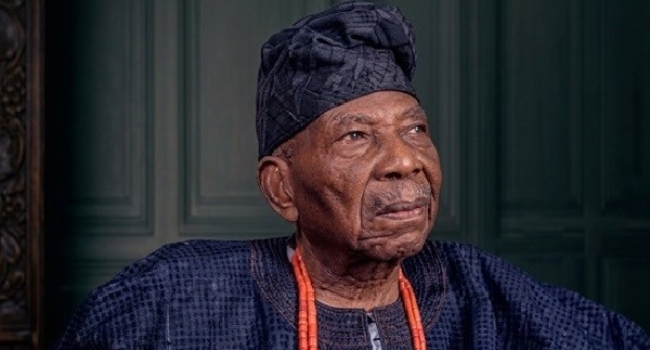
Pa Reuben Fasoranti, the educationist who devoted much of his life to advancing the political ideals of Chief Obafemi Awolowo and who led Afenifere through one of the most consequential internal crises in its history, died on Tuesday, October 20, 2026. He was 100.
Born under colonial rule, Fasoranti lived through Nigeria’s independence, successive military dictatorships and nearly three decades of uninterrupted civilian rule. He followed Awolowo from the Action Group to the Unity Party of Nigeria, served in an administration committed to Awolowo’s social welfare philosophy and joined the pro-democracy struggle after the annulment of the June 12, 1993 presidential election plunged the country into another political crisis.
His death, announced by Ondo State Governor Lucky Aiyedatiwa, closes a remarkable chapter in the history of Yoruba politics. His life was defined by the convergence of education, political conviction, public service and family devotion. For decades, he remained a prominent custodian of Awolowo’s political inheritance, even as the movement he helped sustain became increasingly divided over how best to preserve it.
‘Village boy’ who became schoolmaster
Fasoranti was born on May 11, 1926, in Uso, then a small community in the Owo area of present-day Ondo State. In an interview in 2020, he described himself simply as a “village boy”.
His grandfather had left Akure after failing to secure a traditional chieftaincy title and settled in Uso on his way to Owo. His father later moved to Ayede-Ogbese.
Fasoranti spent his first three years in a village school before being sent to Owo for a better education. He proceeded to Ondo Boys’ High School, Yaba Higher College in Lagos and University College, Ibadan, where he studied English and Geography.
His student years also revealed a lighter side to his character. At Ibadan, he joined a dancing club where students practised classical dances, including the tango. He continued dancing during holidays at home, an interest that offered a glimpse of the life beyond the classroom and political platform.
After completing his education, Fasoranti spent about six months in Lagos searching for a job, only to find that he was considered too young for the positions he sought. He returned to teaching, a profession that gradually became both his vocation and his lifelong commitment.
He later obtained a postgraduate qualification in education at the University of Hull in Britain and a master’s degree in education administration and school management from Macquarie University in Australia.
Back in Nigeria, he taught at several schools, including Oyemekun Grammar School in Akure. In 1957, he became the founding principal of Anglican Grammar School, Iju-Itaogbolu, where he spent 14 years building the institution. The school opened with just 30 pupils. In its early days, Fasoranti lived in an abandoned house in the bush between the two communities as he worked to establish it.
He subsequently worked in Iwo, Oyo and Ado Ekiti before retiring from public education. He also founded private schools, including Omolere Nursery and Primary School and Akure High School, which he co-founded with his wife.
Education was a shared calling in the Fasoranti household. His wife had won a government scholarship to study abroad and later returned to Nigeria to work as an education officer. Their respective postings kept them apart for years, but Fasoranti recalled making visits to see her until he persuaded her to leave government service and establish Omolere, which she founded and managed.
His investment in education was not merely professional. It was a conviction that would later find expression in his politics, particularly his support for Awolowo’s social welfare programme.
Awolowo’s disciple
Fasoranti’s political awakening began while he was teaching at Iju-Itaogbolu. Awolowo’s campaign visits brought him into direct contact with the ideas and movement that would shape his public life.
“He would come there to campaign, and I attended all those rallies,” Fasoranti told Vanguard in 2011. “As a young man I was fascinated and I decided to be a disciple of Awolowo and joined the Action Group.”
That decision proved enduring. Fasoranti later joined the Unity Party of Nigeria, formed by Awolowo and his followers ahead of the 1979 elections. His home in Akure became a meeting place for Awolowo and his associates, including Michael Ajasin, who would later become Ondo State governor.
When the UPN won the governorship election in Ondo State in 1979, Ajasin appointed Fasoranti commissioner for finance. He became part of an administration seeking to translate Awolowo’s social welfare philosophy into public policy through free education, accessible healthcare, employment opportunities and rural development.
For Fasoranti, the commitment carried a personal cost. The government took over some privately owned schools under its free education policy, including Akure High School, which he owned. He accepted the takeover without compensation, despite serving in the administration responsible for the decision.
The episode illustrated the extent to which he was prepared to subordinate personal interests to the programme he had embraced. He regarded the expansion of public education as part of a broader social obligation, one that should not be confined to the circumstances of individual school owners.
His family’s involvement in education continued. After his wife’s death, he established St Frances’ Academy in Igoba, Akure, in her memory.
Fasoranti remained commissioner until the military coup of December 1983 brought the Second Republic to an end. The overthrow of the UPN government removed Awolowo’s followers from office, but it did not extinguish their political engagement. For Fasoranti and other members of the Afenifere tradition, the struggle increasingly shifted from implementing their programme in government to defending democratic rule against military domination.
The annulment of the June 12, 1993 presidential election, widely believed to have been won by Moshood Abiola, brought that struggle into sharper focus. Fasoranti joined Yoruba leaders and activists opposing military rule and became associated with the National Democratic Coalition, formed in 1994 to press for the restoration of democracy.
The campaign exposed its participants to detention, harassment and threats. Accounts of Fasoranti’s life also recount an assassination attempt during the regime of General Sani Abacha. In later years, he continued to describe democracy as a work in progress, reminding Nigerians that the return to civilian rule had come at considerable cost to those who resisted military dictatorship.
His commitment to public service was recognised by political leaders across generations. In a tribute on Tuesday morning, Lagos State Governor Babajide Sanwo-Olu described the late centenarian as a respected statesman whose contributions to education, leadership and public service had left an enduring mark. He also commended Fasoranti’s commitment to community development and what he characterised as his courageous and uncompromising leadership.
Long widowhood
Fasoranti’s public life was accompanied by profound personal losses. His wife died in 1991, ending a marriage that had endured years of separation occasioned by their respective careers in education. He never remarried.
Asked in 2022 why he had remained single for more than three decades, he offered a simple explanation, “Simply because it wouldn’t be the same again.”
He described himself and his wife as close friends who had never experienced a major problem in their marriage. He also said he did not want another marriage to create difficulties for his children.
“I can’t see any other woman like her. I decided not to get married again,” he said.
His children, other relatives and work, he explained, helped him cope with her absence. The decision to remain unmarried was, in his telling, an expression of enduring attachment to a partnership that had shaped both his personal life and his work in education.
Another devastating loss came in July 2019, when his daughter, Funke Olakunrin, was shot dead by gunmen on the Ore road in Ondo State while travelling towards Lagos. She was 58.
Her killing drew widespread national attention and renewed demands for justice and greater public security. Three men were sentenced to death for the murder in 2022.
For a man who had spent decades witnessing political violence and campaigning for a safer, more accountable country, the loss was deeply personal. It also brought the national debate over insecurity into his own family’s experience, even as the legal process continued.
Fasoranti’s public interventions continued to emphasise justice and the responsibilities of government. Yet behind the statements of a veteran political leader was a father whose family had suffered an irreparable loss.
Afenifere’s divided inheritance
The restoration of civilian rule in 1999 did not resolve the questions that had long divided Awolowo’s political followers. Afenifere emerged as a prominent platform for demands for restructuring, regional autonomy and social justice, but its relationship with political parties remained contentious.
At the heart of the disagreement was a fundamental question: should Afenifere remain above party politics, preserving its identity as an ideological movement, or align itself with a political platform capable of implementing its programme?
After the death of Pa Abraham Adesanya in 2008, Fasoranti became one of Afenifere’s principal leaders. He inherited an organisation whose authority rested not simply on electoral strength but on its claim to represent a distinct political tradition.
He frequently returned to the principles that had drawn him to Awolowo, summarising them as “freedom for all, life in abundance, education for all, employment for people, development of the rural areas to prevent rural-urban drift, health for everybody”.
In March 2021, citing his age, Fasoranti stepped aside from the day-to-day leadership of the organisation. Adebanjo became acting leader, with Oba Oladipo Olaitan as deputy. Fasoranti remained an influential elder, but the distinction between his position as the movement’s acknowledged senior figure and the authority exercised by its acting leadership would soon become a source of bitter disagreement.
The dispute came into sharp focus ahead of the 2023 general election. Adebanjo and his supporters backed Peter Obi, the Labour Party candidate, arguing that fairness and national cohesion required the presidency to move to the South-East.
Fasoranti, however, received Bola Tinubu, the All Progressives Congress candidate, at his Akure residence on October 30, 2022, when Tinubu presented his manifesto. Fasoranti subsequently endorsed him, triggering a dispute over who had the authority to speak for Afenifere.
“I’m still the leader of Afenifere. Afenifere has not endorsed Obi, we are endorsing ‘Jagaban’ (Bola Tinubu) for the Presidency,” he told The PUNCH. “Adebanjo took a stand and I took a stand. I didn’t call him and he didn’t call me. We never spoke about the visit.”
Adebanjo maintained his support for Obi and challenged the suggestion that Fasoranti’s endorsement represented the organisation’s collective position under his acting leadership. He also warned that the visit risked deepening existing divisions.
The disagreement was about more than the two presidential candidates. It exposed competing interpretations of Afenifere’s political identity and the authority to determine its direction.
Fasoranti’s supporters argued that he remained the substantive leader and that Tinubu’s candidacy advanced Yoruba political interests. Adebanjo’s camp maintained that backing Obi reflected a commitment to national equity that should not be displaced by the ambition of a prominent Yoruba politician.
One side emphasised Yoruba representation and the right of a people to support a candidate from their region; the other stressed national inclusion and the need for Afenifere to remain guided by principles that transcended individual political ambitions.
With its leading figures supporting opposing candidates, the organisation struggled to reconcile its tradition of consultation with the competing positions of its senior members. The result was a dispute that weakened its ability to project a united voice on the issues it had championed for decades.
In August 2023, Fasoranti offered his own assessment of the crisis at a meeting in Akure. He lamented what he called “a noticeable drift away from our core values of consultation, brotherliness and camaraderie”. He said the organisation’s collegial system had been severely threatened and described its condition as “a sorry state”.
The remarks amounted to a striking acknowledgment of the depth of the crisis by a man who had spent much of his life defending Afenifere’s political tradition.
Subsequent attempts at reconciliation failed to resolve the divisions. Changes to the leadership structure followed in 2024, but rival camps continued to contest who had the authority to speak for the organisation.
Adebanjo died in February 2025, aged 96. In his tribute, Fasoranti described him as a comrade-in-arms and an associate of 70 years, as well as an unrelenting ideologue and disciple of Awolowo.
The tribute was a reminder that the men’s political disagreements had unfolded against a much longer history of shared commitments, personal relationships and collective struggles. Their differences over the direction of Afenifere did not erase the decades they had spent within the same ideological tradition.
On September 29, 2026, a caucus of the organisation met at Fasoranti’s residence and endorsed Tinubu for a second term in 2027. The group said it believed the president was committed to restructuring, deepening democracy, promoting prosperity and addressing insecurity.
The endorsement was consistent with Fasoranti’s position during the 2023 election cycle. It did not, however, settle the deeper disagreements over Afenifere’s leadership, political alliances and ideological direction.
By the end of his life, Fasoranti had become one of the most recognisable custodians of Awolowo’s political inheritance. He outlived his mentor by nearly four decades, carrying the memory of an earlier political era into a country transformed by military rule, democratic transitions and shifting party alliances.
Weight of political inheritance
Fasoranti’s life cannot be reduced to his position in Afenifere or his allegiance to Awolowo. His story began in the classroom, where he helped establish schools and spent years shaping the education of young Nigerians. It extended into government, where he served in an administration that sought to make social welfare a central responsibility of the state. It continued through the pro-democracy struggle, when he joined others in resisting military rule, and into old age, when his name remained inseparable from debates about the future of Yoruba politics.
His life also reflected the tensions inherent in preserving a political legacy across generations. The principles that united Awolowo’s followers — social justice, education, public welfare and regional autonomy — did not always produce agreement on political strategy. In Afenifere, the differences over party affiliation, presidential candidates and leadership authority became increasingly difficult to reconcile.
Fasoranti was both a guardian of that inheritance and a participant in its disputes. His endorsement of Tinubu, opposed by Adebanjo’s camp, revealed how differently members of the same political tradition could interpret its obligations to Yoruba interests and the wider Nigerian federation.
Yet his century-long life also testified to the endurance of political conviction. From the colonial era through independence, military dictatorship and the return to civilian rule, he remained engaged in the arguments over how Nigeria should be governed and what government owed its citizens.
At 100, Fasoranti leaves behind a legacy rooted in education, public service, democratic activism and an unwavering identification with Awolowo’s ideals. The disagreements that marked his final years in Afenifere will remain part of that history, as will his efforts to preserve the movement’s place in Yoruba political life.
His passing closes the life of a schoolmaster who became a political leader, an Awolowo disciple who outlived his mentor and an elder whose influence endured long after he relinquished the organisation’s daily leadership.
For those who shared his political convictions, the task now is to determine how much of the tradition he spent a lifetime defending can survive beyond him — and whether the values of consultation, social justice and collective purpose he championed can help bridge the divisions that troubled Afenifere in his final years.
Source: punchng.com
FOLLOW US ON:
FACEBOOK
WHATSAPP CHANNEL
TWITTER
PINTEREST
TIKTOK
YOUTUBE
LINKEDIN
INSTAGRAM