Connect with us

Crime

Retired Generals back calls for state of emergency on Terrorism

Published

on

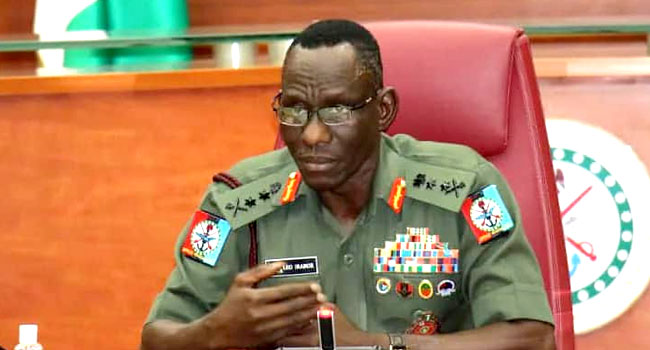
Some retired senior military officers have backed the call by a former Chief of Defence Staff, General Lucky Irabor (retd), for the declaration of a state of emergency to effectively address the Boko Haram insurgency.

In his new book, ‘Scars: Nigeria’s Journey and the Boko Haram Conundrum,’ Irabor argued that the absence of political will had hindered Nigeria’s response to the insurgency, stressing that an emergency proclamation backed by the National Assembly would mobilise all elements of national power towards ending the war.

Irabor, who served as the CDS under the Buhari administration, wrote, “The government had not yet mustered the political will and instruments to declare a war against Boko Haram. With an emergency proclamation, backed by the National Assembly, there will be greater and more focused attention by the government to galvanise all the elements of national power towards the war.

“It should be noted that strategy deals with the aggregate of the elements of national power. These include economic, political, social, diplomatic, information, and military.

‘’The political authority stands at the apex. The success at the tactical and operational levels will never translate to victory if there is failure at the strategic level. Tactical operations alone rarely bring about the desired outcome in political situations.”

Despite being degraded by the military following the killing of many of its top commanders and the arrest of hundreds of its foot soldiers, Boko Haram’s attacks in the North have intensified recently, causing widespread destruction and displacement.

Last week, the group seized the border town of Kirawa in Borno State, forcing thousands to flee to neighbouring Cameroon.

The attack led to the destruction of a military barracks, dozens of homes, and the palace of the district head. Over 5,000 people reportedly fled to Cameroon due to the recent attacks.

Boko Haram fighters also stormed an army base in Borno State, killing four soldiers and setting military equipment on fire. A coordinated attack on security formations in Banki was repelled by joint security forces, with one police constable sustaining minor injuries.

Governor Babagana Zulum has called for increased military presence in border communities, citing the need for adequate security.

More than 2.2 million people remain internally displaced in Nigeria.

The group’s ability to launch coordinated attacks has stretched security forces thin.

The humanitarian impact of the attacks continues to worsen, with many communities left without access to necessities.

Commenting on Irabor’s proposal, Brigadier General Peter Aro (retd.) described it as apt and borne out of deep operational and strategic experience.

He said a properly declared and legislatively backed state of emergency would give coherence and urgency to the fight against insurgency.

Aro noted, “General Lucky Irabor’s position is both apt and deeply informed by experience. Having served at the operational, strategic, and geo-strategic levels, he speaks with the authority of someone who truly knows his terrain.

“But it must be a genuine state of emergency — not the kind where governors and local government chairmen still operate as if it were business as usual. When politics steps aside and security takes full command, coordination improves, resources flow faster, and the chain of authority becomes clear. Such an approach, free from political interference, would give the military and other agencies the freedom to act with precision and integrity.”

See also  Court grants Malami, son N200m bail in terrorism financing case

Also supporting Irabor’s position, retired Major General Dayo Olukoju said while a state of emergency was necessary, it should be complemented by a broader, multilateral approach that addresses the root causes of terrorism.

Olukoju argued,  “I agree with him. But like I do say, a multilateral approach should be added to it. I was in Maiduguri when we captured one of them, and the terrorist was unrepentant. We have the elite, traditional, spiritual, and military leaders — all of them have roles to play.

“The root causes are there — have we been able to look into them? Those causes include issues of freedom, identity, among others. If these things are not looked into, I hope we don’t have a resurgence. I am not saying the state of emergency can’t work — it’s perfect — but we can go further to do what I have earlier said.”

Col. Saka Folusho (retd.) also said there was nothing wrong in declaring a state of emergency on insecurity.

He, however, warned that alone would not solve Nigeria’s security problems unless the authorities tackle the illicit trade in arms and ammunition sustaining the violence.

“The issue at hand — which is the state of emergency — yes, it’s okay. There’s nothing wrong, but there are some things we have not been addressing. For you to decide to sell ammunition, it means there is a lot of interest you are getting from the other side you are selling to. If somebody decides to sell what is supposed to be used to defend himself, that’s like the person wants to commit suicide,” Folusho said.

He urged that commanders be given clear responsibility and that soldiers be properly equipped and not underpaid. “When you are paying somebody N50,000, you are not giving them all the equipment to operate.”

He also noted that the recent moves by the Nigerian Army to boost local production and capabilities are welcome, but called for more sustained effort.

Lending its voice, the Northern Elders Forum reiterated its demand for a state of emergency on insecurity in the northern part of the country.

The spokesperson for the forum, Prof. Abubakar Jiddere, in an interview with one of our correspondents, said, “In one of our press releases, we called for this. For the second time, we called for it twice.  So, it is important for now that the government should declare a state of emergency on security.

“That does not mean suspending any government or doing any other thing.  But rather by massively deploying security agencies. The police, the military, and all the armed, all armed policemen and then take very serious action.

See also  Robbers shoot Lagos hairstylist to death

“Areas that are prone to serious crisis, like Zamfara, Katsina, Niger, Kwara, Benue and in fact, Borno, where Boko Haram has been operating.

“So, until the Federal Government takes serious action and deploys massive security personnel, this issue will continue to be. It’s a matter of national emergency. National emergency requires declaration of a state of emergency on insecurity in Nigeria, which will require deployment of heavy police forces.”

The Federal Government could not be reached for comment on Irabor’s proposal. The Minister of Information, Mohammed Idris, promised to respond, but he had yet to do so as of the time of filing this report.

The Borno state Commissioner for Information and Internal Security, Prof. Usman Tar, said Irabor is entitled to his opinion on the declaration of a state of emergency on insecurity.

‘’He is entitled to his opinion; if you want further clarification, ask him. We have nothing to say about that,” Tar said

Meanwhile, the House of Representatives member representing Demsa, Numan and Lamurde federal constituency, Adamawa State, Kwamoti Laori, has said that only state policing can address insecurity in Nigeria.

Speaking to The PUNCH in Yola, the Peoples Democratic Party federal lawmaker said that state police stand out as the best solution to the country’s insecurity, pointing out that it was experimented with in the 60s and proved effective.

“In the 60s, we had state police in my area, Numan, called Friday police because they were working only on market days to assist the federal police to control crime on market days.

“When people with criminal intentions see the Friday police, they are afraid because the Friday police know them by name, their houses, so if they do anything, they can be traced and arrested. So, there was fear of committing a crime,” he said.

On how to manage the state police without politicians abusing the initiative, he said the law establishing state police should empower communities to nominate people the recruits.

“The reason is that they know the criminals in their communities, so they will not nominate such youth; everyone recruited will not be posted to another community, it will be his area where he knows everyone.”

In a related development, the African Democratic Congress, ADC, has criticised President Bola Tinubu over what it described as his administration’s insensitivity to the worsening insecurity across the country.

In a statement issued on Sunday via X by the party’s National Publicity Secretary, Bolaji Abdullahi, the ADC accused the President of neglecting his constitutional responsibility as Commander-in-Chief of the Armed Forces while insecurity continues to escalate nationwide.

The party condemned Tinubu’s frequent attendance at social and political events amid rising attacks and killings, describing it as “unacceptable and irresponsible.”

Abdullahi said nine local government areas in Kwara State, once known for peace, were recently attacked by armed bandits, with residents allegedly forced to provide food, drinks, money, and other items as ransom.

See also  Drug trafficking in Africa jumps sixfold in two years – AFRICOM

He added that a similar attack occurred in Kogi State, where travellers were killed and several others, including women and children, were abducted.

The ADC noted that over 180 schools in northern Nigeria had been shut due to insecurity, adding that incidents of abductions, killings, and forced displacement were increasing in states such as Plateau, Zamfara, Benue, Niger, Kaduna, and Kwara.

The party faulted the Federal Government’s repeated assurances of “progress” in tackling insecurity, saying the claims were contradicted by the daily killings of innocent Nigerians.

It also criticised the President for failing to visit communities affected by violence, particularly in Plateau State, where hundreds were killed earlier in the year, accusing him of showing “cruel indifference” to the plight of citizens.

“The President’s claim of progress in the fight against insecurity is a tragic denial of reality,” Abdullahi said, arguing that Tinubu’s actions have further divided the country.

‘’The ADC urged the Federal Government to acknowledge the scale of the security crisis, engage directly with affected communities, improve coordination of military and police deployments, and provide transparent public reporting on security operations and spending.

“Nigeria is under attack. This administration must stop pretending otherwise. The time for symbolic gestures is over; what the country needs now is responsible leadership, operational urgency, and measurable results,” the statement concluded.

However, the All Progressives Congress countered the ADC, stating that Nigeria is steadily progressing from a period of insecurity to greater national security, insisting that recent arrests of high-profile kidnappers and gang leaders underscored the government’s unwavering commitment to protecting citizens and stabilising the country.

APC Director of Publicity, Bala Ibrahim, said the ADC is confused, ‘’having failed to gain acceptance among the populace.’’

Ibrahim, in an interview with The PUNCH, stated, “We are not expecting anything different from them. You see, the simple fact is that they have not been able to gain acceptance from the public. They will continue to attack whatever the APC is doing. But Nigerians know better. Nigerians know that the country is moving from insecurity to greater security.

“Yes, there are challenges here and there, but the speed with which these challenges are being confronted is a signal that the APC takes security seriously. Don’t forget, only recently, the APC government announced the arrest of the most high-profile kidnappers and gangsters that have been terrorising the entire West African region.

 “These people have been captured, they are in custody, and their confessions are helping the security operatives to nip these things in the bud. So, whatever the ADC is saying, it is out of desperation because they have not succeeded in gaining the acceptance of Nigerians.”

punch.ng

FOLLOW US ON:

FACEBOOK

TWITTER

PINTEREST

TIKTOK

YOUTUBE

LINKEDIN

TUMBLR

INSTAGRAM

Continue Reading
Click to comment

Leave a Reply

Your email address will not be published. Required fields are marked *

Crime

NAF airstrike kills nine ISWAP fighters, commander in Borno

Published

on

The Nigerian Air Force has said its airstrike in the Sambisa Forest area of Borno State killed nine Islamic State West Africa Province fighters, including a key commander responsible for facilitating the movement and protection of senior members of the group.

The NAF said the operation was conducted on Saturday, August 8, 2026, following credible intelligence on the activities and movement of suspected terrorists within the forest.

The Director of Public Relations and Information, NAF Headquarters, Air Commodore Ehimen Ejodame, disclosed this in a statement issued on Sunday.

According to him, a Remotely Piloted Aircraft was deployed to conduct persistent Intelligence, Surveillance and Reconnaissance operations, leading to the identification and tracking of a group of terrorists moving towards a suspected hideout.

He said following positive identification and confirmation of the target, the aircraft carried out a precision strike on the location.

“The successful operation, conducted on Saturday, 8 August 2026, followed credible intelligence on the activities and movement of suspected terrorists within the Sambisa Forest area. Acting on the intelligence, the NAF deployed a Remotely Piloted Aircraft to conduct persistent Intelligence, Surveillance and Reconnaissance, enabling the identification and tracking of a group of terrorists as they moved towards a suspected hideout.

“Following positive identification and confirmation of the target, the NAF aircraft conducted a precision engagement on the location. Subsequent battle damage assessment indicated significant effects on the targeted compound, with several terrorists neutralised,” Ejodame said.

He added that further intelligence received after the strike confirmed that nine ISWAP fighters were killed, while several others were wounded.

See also  NDLEA recorded 77,792 arrests, seized 14,847kg drugs in five years – Marwa

Among those reportedly killed was Abu Khalid Al Muhajir, whom the NAF described as a prominent ISWAP commander responsible for providing special security escorts for the movement of senior members of the terrorist group.

The statement said his reported knowledge of routes, terrain and tactical movements linking major terrorist enclaves within the Sambisa Forest and surrounding areas made his death a significant operational setback for ISWAP.

The NAF further said intelligence indicated that some of the terrorists affected by the strike were linked to elements suspected to have participated in the recent ambush of Nigerian troops along the Bita-Yamtage axis in Gwoza Local Government Area of the state.

It said the latest operation demonstrated the effectiveness of intelligence-led air operations, particularly the integration of persistent surveillance with precision strike capabilities.

According to the NAF, the operation is expected to disrupt ISWAP’s leadership protection arrangements, movement of high-value personnel and coordination of activities across its enclaves.

The service said it would continue to conduct intelligence-driven and precision air operations in coordination with surface forces to degrade terrorist capabilities, restrict their freedom of movement and improve security for communities in the North-East.

Source: punchng.com

FOLLOW US ON:

FACEBOOK

TWITTER

PINTEREST

TIKTOK

YOUTUBE

LINKEDIN

INSTAGRAM

Continue Reading

Crime

Lagos man beaten to death over missing phone

Published

on

A young man identified simply as Azeez has been beaten to death by suspected cultists following a dispute over a missing phone at Oko-Oba in the Agege area of Lagos State.

A police source told PUNCH Metro on Sunday that the incident occurred on Monday, August 3.

According to the source, Azeez was involved in an argument with some of his colleagues over a missing phone after they attended a party.

The source said the argument later degenerated into an assault on Azeez by some of the suspected cultists, said to be his friends.

“We got a report that he passed away as a result of an assault on him by some suspected cultists said to be his friends. The argument was as a result of a missing phone,” the source said.

The source added that Azeez later succumbed to injuries sustained during the assault.

Meanwhile, an anti-cultism advocacy platform, Naija Confra, in a post on Saturday, gave further details of the incident, saying it began on Sunday night, August 2, during a birthday celebration.

According to the platform, a fight broke out at the event, during which one Abela allegedly took a phone and handed it to Azeez.

The platform said trouble started after the owner of the phone began searching for it.

It alleged that when the owner and his friends confronted Azeez after the phone was found in his possession, he told them that Abela had given him the phone to keep.

“Abela, who was sitting there, denied Azeez, even when people saw him. Azeez would never accuse Abela, an NBM leader who is also a boss to him, if it was not true,” the platform claimed.

See also  See 175 Beneficiaries of Tinubu’s Pardons (Full List)

Naija Confra further alleged that the owner of the phone and his friends, unable to confront Abela, attacked Azeez before leaving the party.

The platform added that Azeez later confronted Abela over his alleged denial of giving him the phone, leading to another argument and subsequent assault.

It alleged that Azeez was taken to another location by suspected members of the Neo-Black Movement, where the attack was carried out on him.

The state Police Public Relations Officer, Abimbola Adebisi, could not be reached for comments as calls made to her telephone lines were not responded to.

A text message sent to her had yet to be replied to as of the time this report was filed.

Source: punchng.com

FOLLOW US ON:

FACEBOOK

TWITTER

PINTEREST

TIKTOK

YOUTUBE

LINKEDIN

INSTAGRAM

Continue Reading

Crime

Speak out against terrorism, banditry, Tinubu urges clerics

Published

on

President Bola Tinubu has urged religious and spiritual leaders to consistently speak out against terrorism, kidnapping, banditry and the misuse of religion to justify violence.

Tinubu made the call on Sunday in Kano, in a goodwill message delivered on his behalf by the Secretary to the Government of the Federation, George Akume, at the Grand Maulud of Sheikh Ahmad Al-Tijani.

A statement by Akume’s media aide, Yomi Odunuga, said the President recognised the crucial role religious leaders could play in confronting violence, extremism and the misuse of faith to justify destructive acts.

He urged religious institutions and networks to strengthen advocacy for peace education, religious literacy, scholarship and the moral development of young people.

Tinubu said religious leaders should also use their influence to promote justice, responsibility, compassion and the peaceful resolution of grievances.

The statement read, “Your voices must be raised consistently against the murder of innocent people, against terrorism, kidnapping, banditry and the misuse of religion to justify cruelty.

“Your institutions and networks must become stronger in the advocacy for peace education, religious literacy, scholarship and the formation of upright young men and women.

“You must also remind political leaders of justice, responsibility and compassion, while reminding citizens that legitimate grievances must never become permission for lawlessness or violence.

“Above all, our spiritual fathers must continue to teach that no genuine service to Allah is advanced by destroying the innocent human life that Allah has made sacred.”

The President said the gathering was taking place at a time when societies around the world were facing conflicts, uncertainty, climate and food shocks, violent extremism, terrorism, transnational crimes and the manipulation of identity and religion.

See also  Drug trafficking in Africa jumps sixfold in two years – AFRICOM

Citing a United Nations High Commissioner for Refugees report, Tinubu said 117.8 million people were forcibly displaced worldwide at the end of 2025.

He said the scale of the challenges confronting the world has made spiritual leaders increasingly important.

According to him, spiritual leaders “guard the frontiers of conscience” through their ability to heal wounds, resolve grievances and address deep-seated hatred and bitterness.

Tinubu said the Tijjaniyya community, with its extensive spiritual networks across West Africa, North Africa and other parts of the world, could deploy its influence towards reconciliation, countering violent extremism, youth guidance and humanitarian support.

He said the Federal Government recognised the roles of religious and traditional leaders in promoting tolerance, countering misinformation and identity-based divisions, strengthening grassroots peacebuilding and fostering peaceful coexistence.

The President also reaffirmed Nigeria’s commitment to regional cooperation, counter-terrorism, maritime security, economic integration and dialogue.

He said Nigeria’s strategic position at the intersection of West Africa, the Sahel, the Lake Chad Basin, the Gulf of Guinea and the wider Atlantic world made the country’s peace and stability important to the region.

“Our position means that peace in Nigeria has consequences far beyond Nigeria. It also means that religious communities with deep transnational connections, such as the Tijjaniyya, can be valuable partners in building an architecture of social peace that complements the work of governments and regional institutions,” he said.

Tinubu said such partnerships should promote the ethical values of truthfulness, compassion, justice, restraint, service and respect for the sanctity of human life.

He also assured that his administration would continue to uphold freedom of worship while strengthening collaboration with religious and traditional institutions to promote peace, mutual respect and national cohesion.

See also  See 175 Beneficiaries of Tinubu’s Pardons (Full List)

The President welcomed the World Khalifa of the Tijjaniyya Order, scholars, spiritual leaders and other guests who travelled from Algeria, Morocco, Senegal, Egypt and other countries for the Maulud.

He described Nigeria as a country where the Tijjaniyya tradition had established deep roots in scholarship, remembrance, service, moral instruction and peaceful community life.

Tinubu also paid tribute to the late Sheikh Dahiru Usman Bauchi, whose foundation played a significant role in organising the Maulud.

He described the late Islamic scholar, who died in November 2025, as “a teacher, a father and a voice of moderation and reason, and as an advocate of peace and piety.”

The President said preserving Sheikh Dahiru’s legacy of Qur’anic scholarship, moral instruction, devotion to Allah, respect for learning, peaceful coexistence and concern for society would be the most enduring tribute to him.

He commended the Supreme Council of the Tijjaniyya, the Sheikh Dahiru Usman Bauchi Foundation, the Kano State Government, scholars, traditional rulers, security and emergency services, organisers and volunteers for their contributions to the event.

Tinubu added, “Nigeria is honoured by your presence, and we pray that you return to your homes safely, carrying with you the affection and hospitality of the Nigerian people. May Almighty Allah accept the prayers and acts of devotion offered at this Maulud.”

The call came against the backdrop of renewed debate over the role of religious leaders in Nigeria’s political and governance affairs.

On July 28, the Catholic Bishops’ Conference of Nigeria, led by Archbishop Matthew Ndagoso, met with Tinubu and raised concerns over the country’s security and economic challenges.

See also  NUPENG suspends strike

Speaking after the meeting, former Catholic Archbishop of Abuja, John Cardinal Onaiyekan, said some people around the President were presenting a “rosy picture” of the situation in the country.

He also warned that the government appeared determined to win future elections “by all means.”

The remarks triggered public debate over the role of religious leaders in governance and politics, with some members of the Presidency and the Federal Government accusing the cleric of partisanship.

Source: punchng.com

FOLLOW US ON:

FACEBOOK

TWITTER

PINTEREST

TIKTOK

YOUTUBE

LINKEDIN

INSTAGRAM

Continue Reading

Trending