Connect with us

Business

Tinubu approves 15% import duty on petrol, diesel

Published

on

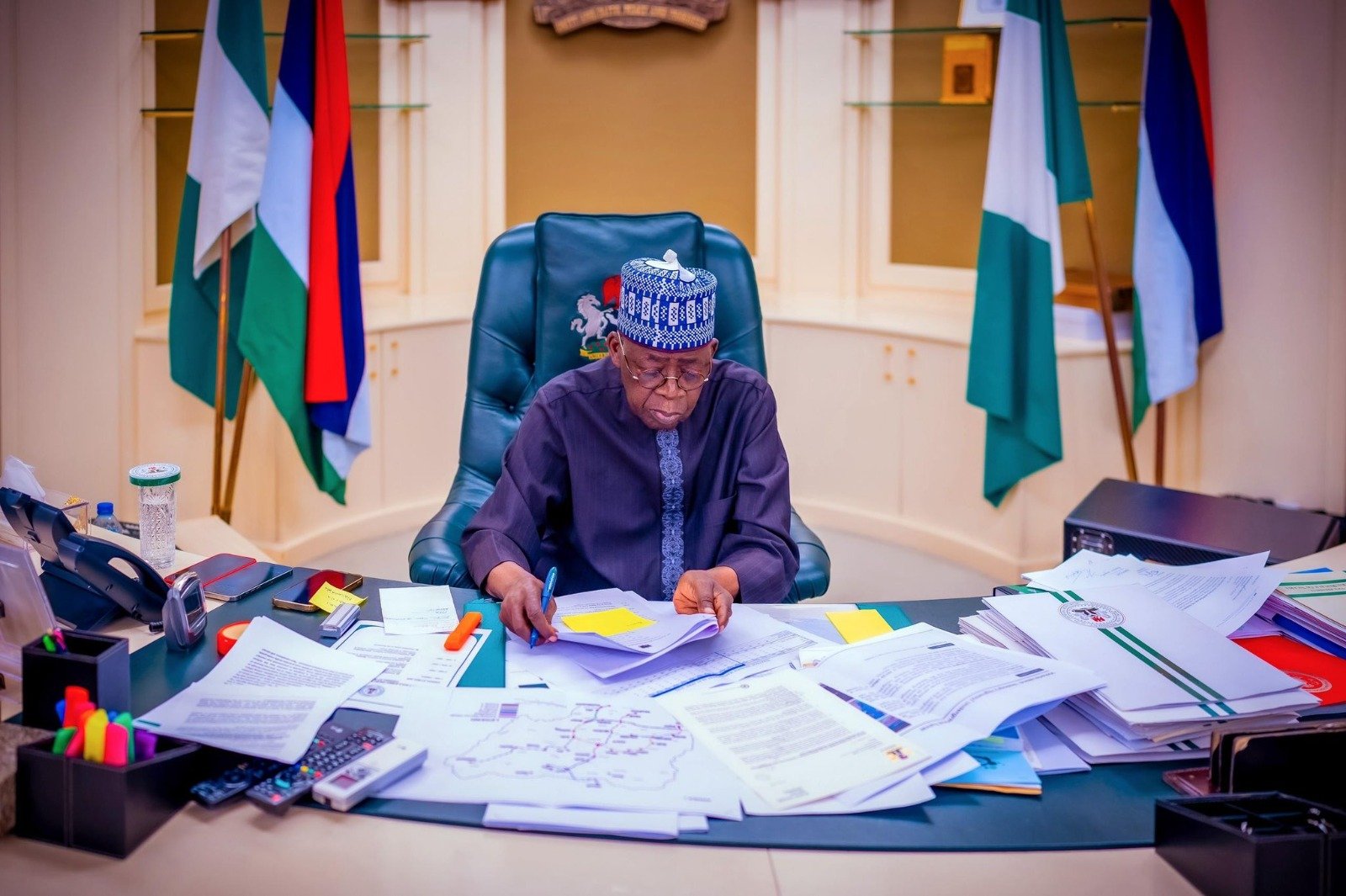
President Bola Tinubu has approved the introduction of a 15 per cent ad-valorem import duty on petrol and diesel imports into Nigeria.

The initiative is aimed at protecting local refineries and stabilising the downstream market, but it is likely to raise pump prices.

In a letter dated October 21, 2025, reported publicly on October 30, 2025, and addressed to the Federal Inland Revenue Service and the Nigerian Midstream and Downstream Petroleum Regulatory Authority, Tinubu directed immediate implementation of the tariff as part of what the government described as a “market-responsive import tariff framework.”

The letter, signed by his Private Secretary, Damilotun Aderemi, and obtained by our correspondent on Wednesday, conveyed the President’s approval following a proposal by the Executive Chairman of the FIRS, Zacch Adedeji.

The proposal sought the application of a 15 per cent duty on the cost, insurance and freight value of imported petrol and diesel to align import costs with domestic market realities.

Adedeji, in his memo to the President, explained that the measure was part of ongoing reforms to boost local refining, ensure price stability, and strengthen the naira-based oil economy in line with the administration’s Renewed Hope Agenda for energy security and fiscal sustainability.

“The core objective of this initiative is to operationalise crude transactions in local currency, strengthen local refining capacity, and ensure a stable, affordable supply of petroleum products across Nigeria,” Adedeji stated.

The FIRS boss also warned that the current misalignment between locally refined products and import parity pricing has created instability in the market.

See also  Govs budget N525bn for security as killings spread

“While domestic refining of petrol has begun to increase and diesel sufficiency has been achieved, price instability persists, partly due to the misalignment between local refiners and marketers,” he wrote.

He noted that import parity pricing- the benchmark for determining pump prices, often falls below cost recovery levels for local producers, particularly during foreign exchange and freight fluctuations, putting pressure on emerging domestic refineries.

Adedeji added that the government’s responsibility was now “twofold, to protect consumers and domestic producers from unfair pricing practices and collusion, while ensuring a level playing field for refiners to recover costs and attract investments.”

He argued that the new tariff framework would discourage duty-free fuel imports from undercutting domestic producers and foster a fair and competitive downstream environment.

According to projections contained in the letter, the 15 per cent import duty could increase the landing cost of petrol by an estimated N99.72 per litre.

“At current CIF levels, this represents an increment of approximately 99.72 per litre, which nudges imported landed costs toward local cost-recovery without choking supply or inflating consumer prices beyond sustainable thresholds. Even with this adjustment, estimated Lagos pump prices would remain in the range of N964.72 per litre ($0.62), still significantly below regional averages such as Senegal ($1.76 per litre), Cote d’Ivoire ($1.52 per litre), and Ghana ($1.37 per litre).”

The policy comes as Nigeria intensifies efforts to reduce dependence on imported petroleum products and ramp up domestic refining.

The 650,000 barrels-per-day Dangote Refinery in Lagos has commenced diesel and aviation fuel production, while modular refineries in Edo, Rivers and Imo states have started small-scale petrol refining.

See also  PHOTOS & VIDEO: Remi Tinubu Donates ₦2 Billion To Boost Akwete Fabric Production In Abia

However, despite these gains, petrol imports still account for up to 67 per cent of national demand.

punch.ng

FOLLOW US ON:

FACEBOOK

TWITTER

PINTEREST

TIKTOK

YOUTUBE

LINKEDIN

TUMBLR

INSTAGRAM

Continue Reading
Click to comment

Leave a Reply

Your email address will not be published. Required fields are marked *

Business

Return of subsidy could lead to ₦2,000/Litre Petrol, ₦3,000/$ exchange rate, FG warns

Published

on

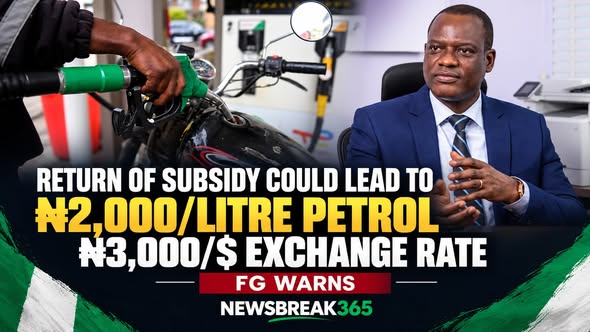
The Federal Government has strongly defended its decision to eliminate fuel subsidies, warning that reinstating the policy would trigger severe economic instability, driving petrol prices above ₦2,000 per litre and pushing the exchange rate toward ₦3,000 per US dollar.

Speaking at a press briefing in Abuja on Thursday, October 8, addressing fuel pricing and growing public calls for subsidy reinstatement, the Minister of Finance and Coordinating Minister of the Economy, Taiwo Oyedele, cautioned that returning to subsidies would destabilize fiscal progress.

“Return subsidy, and the sequence is familiar. Weaker revenues invite a sovereign credit downgrade. As the rating agencies themselves have already signalled, and you can read all their reports, that would put at risk the upgrade we have recently earned, including our first from S&P in 14 years,” Oyedele stated.

“Borrowing becomes costlier, capital leaves, reserves fall, naira weakens. The progress on inflation, which has allowed the central bank to begin lowering interest rates, will be put at risk. Our estimate is that the exchange rate could approach ₦3,000 per dollar within months. And the so-called subsidised petrol will cost at least ₦2,000 per litre. This is well above what Nigerians pay today.”

Oyedele emphasized that a reinstated subsidy would ultimately be funded through inflationary fiscal measures, delayed public earnings, or increased taxation.

“However, it is described, a subsidy must be financed through salaries and pensions not paid on time, through higher taxes, or through the printing of money, like we saw before this current administration. Over 30 trillion naira was printed. That’s inflation we’re dealing with. It wasn’t even just about the reform. Each of these has done great harm before,” Oyedele added. “Short-term relief, but with long-term fragility, is the most expensive money a government can spend.”

See also  Pure Water producers announce increment in price of bag

Addressing critics demanding a return to subsidized pricing over three years after President Bola Tinubu announced the end of the regime, the minister challenged proponents to provide viable, mathematically sound alternatives.

“We remain open to ideas, but any credible proposer should answer three questions. Number one, what will it cost? Number two, how will it be funded sustainably? Number three, what pump price will it deliver? We will engage in good faith with any proposer that shows its arithmetic,” Oyedele declared.

FOLLOW US ON:

FACEBOOK

TWITTER

PINTEREST

TIKTOK

YOUTUBE

LINKEDIN

INSTAGRAM

Continue Reading

Business

TUC reveals how FG can raise workers’ salaries without new minimum wage, read details

Published

on

The Trade Union Congress of Nigeria (TUC) has told the Federal Government that it does not need to wait for the next review of the national minimum wage before improving the salaries of its workers.

TUC President, Comrade Festus Osifo, said the government could independently increase the salaries of federal workers or raise the pay of the least-paid employees without waiting for a new Minimum Wage Act.

Osifo made the position known Wednesday evening while speaking at a press briefing in Abuja after the National Administrative Council (NAC) meeting of the labour centre.

According to him, the minimum wage should be regarded as a statutory wage floor and not a ceiling that prevents government or employers from paying workers substantially above the prescribed minimum.

He said, “Government does not even need to wait for a new Minimum Wage Act to be signed before government will take care of its workers.

“Government can wake up today and say, ‘Okay, I want to pay the least-paid worker in the Federal Government payroll N200,000,’ for example. They could say, ‘Let the least-paid worker be N400,000,’ for example, and graduate it upwards.

“Is that only the minimum wage for government to do that? No. That is not really the function of a minimum wage.”

Osifo argued that employers in several sectors already pay considerably above the statutory minimum, noting that the salaries of university graduates employed by banks, food and beverage companies and oil and gas firms are generally determined by the value of the jobs rather than the national minimum wage.

See also  Petrol May Hit ₦900/Litre This Week As OPEC+ Makes Fresh Plan On Production Hike

“If you are a university graduate and you are to be employed in a bank, are they going to start you from the minimum wage? The answer is no. The pay you will earn is much above minimum wage,” he said.

He added that the same principle applied to major companies in the food and beverage sector.

“If you are a university graduate and you are to be employed in the food and beverage industry, if you are to be employed by Nestlé, if you are to be employed by Cadbury, they are not going to look at minimum wage,” he said.

The TUC president also cited the oil and gas sector, where he said companies such as Shell, Chevron and TotalEnergies would ordinarily negotiate remuneration based on the nature and value of the jobs rather than the statutory wage floor.

“They are going to be talking about living wage,” he said.

Osifo therefore urged the Federal Government to take immediate steps to improve workers’ incomes rather than leaving employees to wait for the next statutory minimum wage review.

He said TUC had already engaged government officials on the issue, including the Minister of Finance and the Secretary to the Government of the Federation, as part of efforts to push for measures that would improve workers’ welfare.

“For us, you don’t really need a new minimum wage to take care of your employees in several sectors. That is not how it is done,” he said.

The labour leader also maintained that allowances could be reviewed independently of the minimum wage, stressing that workers should not be left to bear the full weight of economic reforms until 2027.

See also  Dark horses in Kwara governorship race ahead of 2027

He said, “Allowances don’t need a minimum wage conversation, and even salaries, government on its own can actually push the salaries of workers up, even without minimum wage conversation.”

The current national minimum wage of N70,000 was signed into law in 2024 for a three-year period. Osifo said organised labour was already preparing for the next review, but stressed that government had options for improving workers’ welfare before then.

He further cited Ghana as an example of a country where government does not necessarily wait for a new minimum wage before taking measures to improve workers’ pay.

“Government can decide to pay whatever it takes to take care of its employees. Employers can decide to do way above what is there at the minimum threshold,” he said.

Source: tribuneonlineng.com

Follow Politics

FOLLOW US ON:

FACEBOOK

TWITTER

PINTEREST

TIKTOK

YOUTUBE

LINKEDIN

INSTAGRAM

Continue Reading

Business

Customs explains why shortlisted candidates await training invitations

Published

on

The Nigeria Customs Service has said candidates whose names appeared on its published recruitment list are not automatically guaranteed appointment, explaining that final screening is still ongoing before successful applicants are admitted for training.

The clarification followed complaints by some candidates who claimed they successfully completed the Computer-Based Test, physical examinations and initial screening, accepted their appointments through the official recruitment portal and saw their names published as successful candidates, but had yet to receive invitations for training scheduled to commence on Friday.

The affected candidates, according to a report by SaharaReporters, include more than 500 applicants who said they had been left uncertain about their status after invitations to the training reportedly stopped on Monday.

Some of the candidates claimed they had resigned from their previous jobs and incurred other expenses after believing that their appointments had been secured.

However, the Customs spokesman and Deputy Comptroller of Customs, Abdullahi Maiwada, told The PUNCH exclusively on Wednesday that the publication of a candidate’s name did not amount to a final appointment into the service.

Maiwada said candidates must pass the physical screening and other requirements before they can be admitted into the training college and eventually commissioned as officers.

“I will start my response first with a question. Did anyone who complained to you inform you that they have been issued an appointment letter? So that means the process is still ongoing. Secondly, the essence of screening is to have a physical examination of successful candidates.

“Let me explain so that you would have proper context. The essence of screening is either for candidates to be screened in or screened out, and they are just simple issues. It is either you have not met the criteria to be offered an appointment letter into Customs or to be ushered into training college. If anyone fails this, they will be dropped,” he said.

See also  FG, states, LGs share N1.969trn in December 2025 revenue

The spokesman said age, academic credentials, medical fitness and drug use were among the requirements that could determine whether a candidate progressed to the next stage.

He explained, “Those criteria are simple. Age is very important. If your age is above the threshold, you will be disqualified. If there are inconsistencies in your credentials, you will be disqualified. If there are forgeries detected, you will be disqualified.

“If we see you with drugs, any element of drugs except tobacco and beer, you will be disqualified. If you have medical issues that wouldn’t warrant you to undergo that rigour, you would also be disqualified.”

Maiwada stressed that even admission into the training college would not make a candidate a Customs officer, saying applicants must successfully complete the training and satisfy academic, physical and character requirements before commissioning.

He said, “The fact that your name came out and you are invited for screening doesn’t qualify you to be a Customs officer. Even with that, you are going for training. And you will go for the training. It is when you pass the requirements that you will be commissioned as an officer. Anything before that, you are still not an officer.

“Someone can go to the Nigerian Defence Academy and still fail. It is not everyone who comes out who passes or is a flying lieutenant. And even if you find yourself in training college, you are still not a Customs officer. Until the day you pass out successfully and you are able to withstand all the rigours.

See also  See presidency response to opposition faulting Tinubu's ambassadorial nominations

“Academic exercises will be done, and you must come out well in character and learning. Exams will be conducted.”

The spokesman said the service could not justify spending public resources to train candidates who had already failed basic eligibility requirements. He said drug screening was particularly important because the Customs Service conducts annual drug tests for serving officers, regardless of rank.

“If someone is into drugs and he is disqualified, do we have to waste our resources taking him to training college before disqualifying him? No! These are criteria that are so simple. You have forgery and the like, and you want to be allowed into the system.

“If you see what we saw with medical records, you will be scared for this country. The rate at which boys are into drugs, you will be scared. Is this the future? The service runs drug tests for every officer every year, no matter your ranking. So if we can do that to persons in the system, what do you think we would do to persons outside it?” Maiwada said.

The ongoing controversy is linked to the Nigeria Customs Service’s 2024/2025 recruitment exercise, which began with an advertisement published on December 27, 2024.

The Service declared 3,927 vacancies across the Superintendent, Inspectorate and Customs Assistant cadres and received 573,680 applications.

After several stages of screening and verification, 3,852 candidates were selected, representing only 0.67 per cent of the applicants, or about one successful candidate for every 148 applicants.

The successful candidates comprised 1,275 Superintendents, 367 Inspectors and 2,210 Customs Assistants. The Service later conducted medical documentation and physical screening before inviting candidates who passed the subsequent stage for basic training scheduled to begin on October 9, 2026, at the Customs Training College.

See also  Strike: Court decides today as FCT workers demand Wike’s removal

Maiwada’s explanation means that candidates whose names appeared in the published list may still be subject to further verification before they receive final appointment letters, proceed through training and are eventually commissioned as Customs officers.

Source: punchng.com

FOLLOW US ON:

FACEBOOK

TWITTER

PINTEREST

TIKTOK

YOUTUBE

LINKEDIN

INSTAGRAM

Continue Reading

Trending