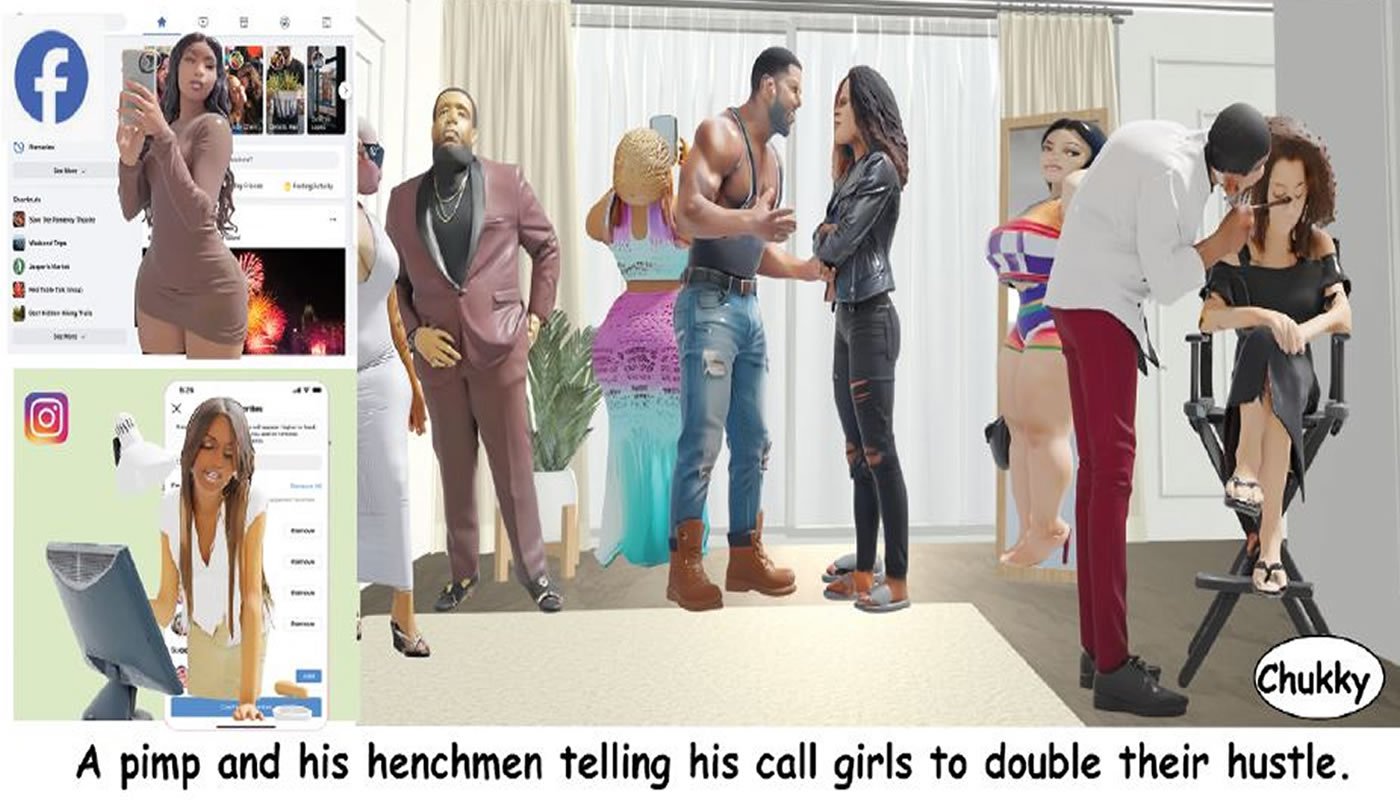
Beneath Nigeria’s digital landscape lies a shadowy and expanding underworld, a network of tech-savvy middlemen and pimps preying on young boys and girls through technology-driven sex crimes. This report exposes how these predators exploit the anonymity of the internet to lure, manipulate, and monetise their victims’ vulnerability. Operating behind screens and encrypted chats, they weave a web of deceit and exploitation, staying one step ahead of security agencies in Nigeria’s fast-evolving digital maze. CHIJIOKE IREMEKA writes
At 37, Bemita never set out to become a pimp, a middlewoman who recruits, manages, and profits from those who sell sex.
What began as a harmless favour to help a childhood friend find female company gradually morphed into a lucrative trade, one that feeds on human vulnerability and digital anonymity.
For the past six years, she has operated as a quiet connector, bridging the worlds of buyers and sellers in both online and offline networks.
“It all started as a favour”
The shadowy business began innocently, Bemita told our correspondent. According to her, she had a childhood friend named Amadi, charming, ambitious, and newly drawn into local politics.
They shared a long, easy history, the kind that made trust seem natural. So, when he occasionally teased her about her beautiful friends, she thought nothing of it.
“Whenever Amadi saw me with my friends, he would say, ‘That your friend is fine o,’” she recalled, her tone carrying a wistful mix of nostalgia and regret. “Then he would ask me to connect them.”
At first, it seemed harmless, just a friend helping another. She introduced them, and somehow, the connections always clicked. Soon, Amadi began to request that she bring girls for parties or private hangouts with his political associates.
“I didn’t know he was collecting money from them,” Bemita said. “I was just doing it as a favour. Sometimes, he would give me small cash for transport or appreciation.”
What she didn’t realise then was that these little acts of goodwill were slowly pulling her into a darker world, one where favours turned into transactions, and innocence blurred into exploitation.
Turning point
According to Bemita, her “eyes opened” in 2015 after a heartbreak pushed her deep into the exciting nightlife of Lekki and Victoria Island, Lagos.
“I started clubbing to get over my relationship,” she recalled, her voice soft but steady. “That’s when I noticed some girls always came in style, top-class clothes, designer bags, expensive drinks, yet they never paid for anything. They always arrived with confidence and left with different men.”
Curiosity soon turned to fascination. One of the girls eventually introduced her to what she called the ‘just bring the right guys and I’ll sort you’ hustle.
“That was how I entered the game,” Bemita said, her tone carrying neither pride nor remorse, just a calm acceptance of a life that had chosen her as much as she had chosen it.
At first, she was merely a link, connecting friends for fun, unaware that her so-called favours were lining other people’s pockets. But it didn’t take long before an older, more experienced woman in the trade took her under her wing and taught her how to monetise what she once did for free.
“I started connecting girls to rich men, politicians, businessmen, even celebrities,” she confessed. “I got paid between N10,000 and N50,000 per connection, sometimes earning from both sides: buyers and sellers. I didn’t see it as wrong. To me, it was just demand and supply. Everyone involved was an adult.”
Targeting desperation
Over time, Bemita perfected her craft, understanding where to look, what to say, and how to sense vulnerability.
“As a pimp, I target ladies desperate for money, especially those struggling to fund school projects or pay rent,” she revealed. “Whenever I see girls on Instagram saying they want a ‘sugar daddy,’ I know they are potential recruits.”
The desperation she preyed upon was often disguised as confidence. “Some only want to do one or two runs, that’s what we call transactional sex, just to pay school fees or hospital bills for their parents,” she explained. “I get messages daily from girls asking if I can connect them to rich men looking for ‘fresh babes.’ Eventually, I created a WhatsApp platform, which I won’t disclose, to manage them.”
Bemita told Saturday PUNCH that whenever she received an “order” for girls, she would scan through her online platform to find the perfect match.
“I always tried to confirm the client’s preference, whether it was a man seeking a lady or, in some cases, a married woman looking for a young boy,” she revealed. “WhatsApp changed everything. I began managing their online profiles, posting seductive photos on Instagram, crafting escort bios, and carefully screening potential clients.”
With practised ease, she described how she built a system around the trade.
“I made sure they didn’t charge too little, and I took between 20 and 30 per cent as commission. I told myself I was only helping them. If I didn’t, someone else would, at least I was protecting them,” she said unapologetically.
“The price depends on the client’s pocket and how attractive the girl is. A beautiful, curvy woman with good features can charge between N200,000 per hour and N400,000 to N500,000 per night. On weekends, it could go as high as N800,000.
“My commission ranged between N70,000 and N150,000 per job. Ladies with Brazilian Butt Lifts charged more. Looks, career, and class determined the price. For the male escorts, their physique and skill in bed determined their worth,” she explained.
At her peak, Benita managed 12 girls, some in Lagos, others in Port Harcourt, and one in Dubai. She maintained tight control over their bookings and fees.
“I didn’t force them, but I controlled the jobs they took. If anyone tried to leave, I would remind them that I had their pictures, chats, even nudes. It was power, but it was also a trap, for me and for them.”
Club Hypeman Turned Digital Pimp
In a twist of fate, Moshood (only first name used due to anonymity) never imagined his name would one day echo within Nigeria’s digital underworld. Yet, over the past eight years, he has quietly climbed the ranks to become one of the most influential figures in the country’s tech-driven sex trade, operating not from dimly lit street corners but from the deceptive comfort of a smartphone screen.
A former club hypeman, the 35-year-old stumbled into the world of pimping almost by accident.
In 2014, he was known for organising high-end nightlife events across Ikeja and Maryland, Lagos, his booming voice electrifying crowds as he hyped them into a frenzy.
His vast network of celebrities, politicians, and wealthy businessmen made him a trusted plug, not just for VIP access and exclusive parties, but eventually, for something darker.
“It started with one request,” he recalled. “Some rich guys asked if I could get two ‘clean girls’ for a weekend retreat. I said, “Why not? I knew a few girls who needed quick cash. I connected them and got paid.”
That seemingly harmless request opened the floodgates. “They must have talked among themselves about the adventure because more people started reaching out. Within months, I wasn’t just hyping parties; I was managing girls, negotiating fees, screening clients, and taking a cut from every booking. Soon, the girls I sent out began coming back for more jobs,” he said.
By 2017, Moshood had moved his operations fully online. He created multiple closed Telegram and WhatsApp groups, coded with emojis and acronyms to conceal their true purpose. Everything became digitised.
“You couldn’t speak to me unless you were trusted,” he said. “I didn’t want to blow my cover, except for clients I met physically. As things grew, I started creating escort bios, short profiles that included services, photos, and agreed rates. I handled pricing, scheduling, and even dress codes.”
Today, his network reportedly includes about 18 individuals, both male and female, ranging from university students to unemployed single mothers, operating across major Nigerian cities and as far as Ghana and Dubai.
He classifies the escorts into “tiers” based on appearance, social class, skin tone, body enhancements such as BBL, and even spoken English proficiency.
The higher the perceived class, the higher the service fee, and the bigger his commission.
“My top-tier girls make up to N500,000 a night, depending on the client,” he boasted. “I also have effeminate boys and gym instructors for clients with different tastes. I provide security by vetting clients, arranging safe locations, and covering transport. None of my people has ever gone missing because I’m fully involved.”
Growing menace
Across Nigeria’s expanding digital landscape, pimping has evolved into a thriving, tech-enabled trade, cloaked in anonymity and powered by encrypted apps. It forms part of a shadowy digital economy where sex work and exploitation intersect, with players operating under the radar while raking in millions.
Pimping, defined by the Cambridge Dictionary as “providing someone to a customer as a prostitute,” is a criminal offence.
According to Greg Hill & Associates, a Los Angeles-based criminal defence firm, pimping and “pandering” often overlap, with pimping referring to profiting from prostitution, while pandering involves persuading or directing someone to engage in it. Both are felonies under California Penal Code sections 261(h) and 266(i).
In Nigeria, however, pimping falls under the broader scope of human trafficking, criminalised by the Trafficking in Persons (Prohibition), Enforcement and Administration Act, 2015.
The law provides a framework for prosecuting those who facilitate or profit from the sexual exploitation of others.
Depending on the region, pimping can also be prosecuted under the Criminal Code Act (Sections 223–225) in Southern Nigeria, covering offences such as keeping a brothel, procuring persons for prostitution, and pawning women or girls for immoral purposes, or under the Penal Code and Sharia Law in the North.
Findings by Saturday PUNCH revealed that across social media platforms, encrypted messaging apps, and dating sites such as RunsConnect and InMessage, the trade has evolved into a coded digital enterprise.
Photos are traded like commodities, deals sealed with a click, and the real power lies with unseen handlers who orchestrate the transactions.
According to digital and social media experts, traditional pimping was once a street operation, where a man or woman physically controlled sex workers and negotiated directly with clients. But technology has changed the game.
“Today, pimps don’t have to be physically present,” explained a digital expert and computer engineer, Victor Ndukwe. “From behind a smartphone or laptop, they manage social media profiles, arrange meetings, negotiate prices, and receive payments, all while staying in the shadows.”
He added that one common method involves creating or managing multiple Instagram or X (formerly Twitter) accounts that showcase curated images of young women, often with their consent, but sometimes without it.
Interested clients are often directed to handlers via encrypted apps such as WhatsApp, Telegram, or Signal.
These digital brokers coordinate every detail, from negotiation to payment, take their commission, and swiftly move on to the next deal.
“In many cases, these digital pimps operate from cities like Lagos, Abuja, and Port Harcourt, yet control a network of sex workers scattered across multiple states, and even across borders,” a source who spoke under anonymity to avoid being targeted by the syndicates revealed.
“Some target university students desperate for quick cash, while others prey on underage girls from poor neighbourhoods, luring them with promises of modelling jobs or hospitality gigs that later turn out to be sex work.”
With law enforcement agencies now clamping down on Instagram and WhatsApp sex-for-hire accounts, many operators have migrated to more secure and anonymous platforms like Telegram and Signal.
Rhoda’s story mirrors this shift. She didn’t start as a pimp; far from it. But over time, what began as casual matchmaking on campus turned into something darker.
“Back in school, we didn’t see it as anything bad or a big deal to arrange girls for guys who came visiting for fun,” she confessed. “I’d get a call that some big boys were coming to town and wanted to hang out with babes. So I’d tell my friends who were interested. It wasn’t serious to us; we already had boyfriends on campus, and it’s not like we weren’t having sex anyway.”
To Rhoda and her friends, such hangouts were part of campus life. “When the guys came, we’d go out, eat, drink, and have fun. Sometimes we ended up in hotels, other times at clubs. We enjoyed ourselves; it was something we looked forward to after exams,” she recalled.
Over time, organising girls became second nature. “If you wanted 20 girls right now, I could get them,” she said matter-of-factly. “It might have been harder then because morals still mattered. But now, if you have money and want 100 girls, I can assemble them in no time. Just say the word.”
She sighed before adding, “These days, it’s even worse. If you skip certain girls, they get angry for being left out. That’s how bad things have become.”
To Rhoda, pimping was once harmless. “Back then, it wasn’t even about money; we did it for fun. Some people even met their future partners that way. But today, things are different. Pimps exploit young girls and get rich off them because of hardship and unemployment,” she admitted, her smile turning rueful. “Maybe I’m one of them.”
Crafty exploitation
For 28-year-old Felicia, the digital sex trade was no adventure; it was a carefully laid trap. Manipulated and emotionally exploited by a man who posed as a loving boyfriend, her story exposes what experts call the “lover boy” technique, a psychological weapon traffickers use to recruit and control victims.
According to the United Nations’ International Organisation for Migration, the “lover boy” method involves traffickers feigning love to gain trust. Once emotional dependence is established, victims are coerced into sex work or other criminal acts. IOM notes that these traffickers maintain control through “coercive manipulation, a mix of affection, violence, and threats against the victim or their family.”
It is a “complex and often invisible” form of control that thrives on emotional entrapment.
Felicia’s ordeal is a chilling example. “My guy, my pimp, started off acting like a caring boyfriend,” she recounted quietly.
“He gave me gifts, attention, and affection I never got from home. Coming from a broken family, I believed he truly loved me.”
Her voice faltered. “Then he started asking me to sleep with rich men for money. He said it was for our good, for our future. When I refused, he guilt-tripped me. He made me feel like I was letting him down. Eventually, I gave in because I thought we had something real.”
What began as emotional manipulation soon became psychological imprisonment. “He started isolating me from my friends and family. He didn’t want anyone to open my eyes to what was happening. I later realised he had complete control over me,” she said softly.
Felicia’s story is far from unique. Like countless others caught in Nigeria’s growing digital sex trade, her journey from affection to exploitation exposes the hidden cruelty behind the screens, where love is leverage and pleasure carries a price.
Politics and prostitution
During the 2019 general elections, another young woman, Bukky (not real name), found herself among 13 girls recruited to “serve” certain politicians in Egbeda, Lagos.
“We were 13 in total, recruited from different schools across Lagos and Ogun states,” she told Saturday PUNCH. “We were paid N70,000 for the weekend, from Friday to Sunday, to stay with politicians who came for the elections.”
Bukky recalled that a recruiter, acting as a middleman, took them to a hotel where the politicians were lodged. “We were given room tags and told to meet our assigned clients. Some of us met nice men, but others had terrible experiences. No one forced us; it was an agreement, but the pay was too small for two nights’ work,” she said.
According to her, the real profit went to the pimp. “He was paid directly by the clients, then gave each of us N70,000. We never knew the actual amount he received. Some girls got tips, but most didn’t,” she added.
Bukky eventually walked away from the trade after hearing about girls who had gone missing under mysterious circumstances. “I stopped because of fear, people disappearing, ritual stories, and other horrible things. The trauma of what I heard made me quit,” she said, her voice trailing off.
Why digital pimping thrives
A Registered Psychologist, Dr Candy Okoye, said that tackling digital pimping requires more than legislation, stressing that it demands a coordinated, multi-layered approach that strengthens surveillance, enhances digital monitoring, and increases public awareness.
“Beyond enacting laws, Nigeria must prioritise digital literacy, awareness campaigns for young people, safe reporting channels for victims, and rehabilitation programmes that provide alternative income opportunities,” he explained.
Okoye emphasised the need for a cultural shift, adding, “We must move from blaming victims to exposing and prosecuting those who profit from exploitation. Until these digital middlemen are unmasked and held accountable, Nigeria’s online sex trade will continue to thrive, hidden behind hashtags and encrypted chats, leaving countless lives destroyed in silence.”
Prevention as priority
The Women Trafficking and Child Labour Eradication Foundation highlighted the importance of sustained public awareness campaigns to curb human trafficking and online exploitation.
The organisation, a long-time leader in Nigeria’s fight against human trafficking and child labour, in a statement obtained from its website, stressed that prevention remains the most effective solution.
“WOTCLEF believes in the adage that says ‘prevention is better than cure.’ We focus on public enlightenment and sensitisation campaigns against trafficking in persons, child labour and abuse, and the spread of HIV/AIDS,” it stated.
Law enforcement gaps
Despite the growing menace of technology-driven sex crimes, Nigeria’s legal and enforcement systems remain ill-equipped to confront the sophistication of digital pimping.
While the Cybercrimes (Prohibition, Prevention, etc.) Act of 2015 and the Trafficking in Persons (Prohibition) Enforcement and Administration Act provide legal frameworks for prosecuting offenders, only a handful of cases ever make it to court, and even fewer result in convictions.
The real challenge
When Saturday PUNCH reached out to the National Agency for the Prohibition of Trafficking in Persons for comment and to ascertain steps taken to address the rising trend, the agency acknowledged receiving two email enquiries but failed to provide a substantive response.
“This is to acknowledge receipt of your email and to inform you that action is being taken in this regard,” read the agency’s brief reply.
The emails, sent on Thursday, October 9, 2025, at 6:36 p.m., were acknowledged. A follow-up sent on Friday at 1:50 p.m. was also acknowledged but went unanswered. On Tuesday, when NAPTIP’s media representative was contacted by phone, she requested that the emails be resent, yet no response had been received as of press time.
However, a senior NAPTIP official, speaking on condition of anonymity, admitted that digital pimping remains among the hardest crimes to trace.
“These people use fake phone numbers, foreign VPNs, and untraceable money transfers,” the official said.
“Victims are often too scared or ashamed to report, especially in a society that blames them. Tracking these cases is extremely difficult.”
The source noted that weak enforcement has emboldened traffickers.
“Some pimps now operate full-fledged escort agencies registered as legitimate businesses. They are getting smarter and bolder every day,” the official further revealed
According to the official, Nigeria’s deep-rooted stigma against sex work gives digital pimps an advantage, as it discourages victims from reporting abuse and allows traffickers to operate with impunity.
“Because sex workers are criminalised and ridiculed, victims of online sexual exploitation rarely seek help. Many fear being arrested, shamed, or even disowned by their families. This silence gives abusers free rein to operate without consequence.”
“There’s no sympathy for the girl,” the source lamented. “Everyone forgets there’s someone behind her, a man or woman taking the cut, setting the terms, and reaping the profits.”
Meanwhile, NAPTIP Director-General Prof Fatima Waziri-Azi, in a statement on the agency’s website, cautioned Nigerians, especially young people, against indiscriminate sharing of intimate content and personal information online amid rising cases of online sexual exploitation and sextortion across the country.
It was noted that the warning was given during the inauguration of NAPTIP’s Cybersecurity Response Team at the agency’s headquarters in Abuja.
“The advent of technology has brought unprecedented opportunities for communication and access to information. However, it has also opened new pathways for criminals to exploit people, particularly vulnerable women and children.
“We are witnessing an alarming rise in child sexual abuse materials on the internet, child pornography, sextortion, and revenge porn. These are all forms of sexual exploitation. This is why, as an agency, we must take proactive and collaborative steps to tackle online threats head-on,” she stated.
Police mum
When contacted on the observed enforcement gaps, the Force Public Relations Officer, CSP Benjamin Hundeyin, did not respond to WhatsApp messages sent by Saturday PUNCH, despite follow-up reminders.
punch.ng
FOLLOW US ON: