Connect with us

Politics

INEC Official Faints In Anambra Community

Published

on

An Independent National Electoral Commission (INEC) presiding officer fainted during the Anambra Governorship election yesterday.

The incident occurred at polling unit 005 in Enugwu-Ukwu in Njikoka local government area.

The presiding officer, Miss Blessing Egoigwe, fainted at the heat of complaints by thick crowd and confusion as a result of malfunctioning of BVAS.She was rushed to undisclosed hospital for medical attention.

More than 470 voters were denied the right to cast their votes at Enugwu-Ukwu Community ward 2 polling unit 005 in Njikoka local government area.

The malfunctioning of the BVAS and difficulty of the machine to recognise cards of newly registered voters caused the uproar.

Miss Blessing Okoye, 18 year old and first time voter, said she was denied the opportunity due to lack of functional BVAS that failed to capture her fingerprint.

Okoye said she was pained over the challenge and felt demoralised in the process and appealed to the electoral body to improve the system.

“My hope to vote to a candidate of my choice was dashed by INEC today.

Mrs Ifeoma Iloeze,a 55 year voter said she was unable to vote after waiting since morning till this evening 6: 29 p.m due to the BVAS failed to capture my face.

Iloeze said the experience was painful and advised that alternative way of voting should be in place in the next election as it was sad to be denied the right to vote.

INEC technician was alerted on the situation in the area and he visited the polling unit, but little improvement was made.

See also  Gov Peter Mbah Reveals Why He Dumped PDP For APC

Names of some dead voters were said to have been seen on the list of registered voters posted.

FOLLOW US ON:

FACEBOOK

TWITTER

PINTEREST

TIKTOK

YOUTUBE

LINKEDIN

TUMBLR

INSTAGRAM

Continue Reading
Click to comment

Leave a Reply

Your email address will not be published. Required fields are marked *

Politics

You’re enemies of democracy, PDP slams defecting Rivers lawmakers

Published

on

The Peoples Democratic Party(PDP) has condemned the defection of 17 Rivers State lawmakers to the All Progressives Congress, describing their action as reckless and an act of betrayal carried out at a critical moment for the state’s democracy.

PDP National Publicity Secretary, Ini Ememobong, in an interview with Saturday PUNCH, said the lawmakers had portrayed themselves as “enemies of democracy by abandoning the platform through which they were elected.”

He accused them of undermining the mandate of Rivers people and destabilising the legislature for partisan gain.

Seventeen members of the Rivers State House of Assembly, led by the Speaker, Martin Amaewhule, dumped the PDP for APC on Friday during a plenary, attributing the move to what he described as a “division” within the PDP.

He said, “Distinguished colleagues, APC is my new party. I will do all that is needed to be done towards ensuring that the party card of the APC is issued to me in no time. But as I speak today, I am a member of the APC. I am happy to be a member of APC so that we can join forces with Mr President. Mr President is doing so much for this country.

“As of today, even the national headquarters of the PDP is not functioning as a result of this division. There are two factions, and the constitution is clear that when there is a division in any political party, when the party is divided, members including Assembly members who no longer have hope can leave the party without any consequences.

See also  Why I will never criticize Goodluck Jonathan – Omokri

“That is why I had to make this clear, that the foundation for this defection is the constitution of the Federal Republic of Nigeria.”

However, Ememobong said there was nothing surprising about the development, noting that they simply moved from APC back to APC.

He stated, “This is a case of re-defection; they had previously defected then later denied it. The members of the Rivers State House of Assembly will go down in history as enemies of democracy and those who made a mockery of the legislature.

“So, the easiest way to describe their action is a defection from APC to APC.”

At the Friday plenary, the House expressed concern over Fubara’s delay in submitting the list of commissioners’ nominees for screening, with the Speaker calling it a breach of the constitution. The House adjourned plenary to the 26th of January, 2026.

A statement later issued by the media aide to the Speaker, Martins Wachukwu, said the House has reaffirmed its resolution to adopt the auditorium of the legislative quarters as its hallowed chamber.

The statement was titled, “Rivers Assembly Reaffirms Resolution on the Adoption of Assembly Quarters Auditorium as Chamber,” with a sub-title, “As 17 Members of the House Defect to the APC.”

“At its 39th Legislative Sitting of the 3rd Session of the Tenth Assembly, the Rivers State House of Assembly, on Friday, through a Motion, reaffirmed its earlier resolution made on the 14th of December, 2023, which adopted the auditorium at the State House of Assembly quarters as its hallowed Chamber to conduct legislative businesses,” it stated.

See also  More Governors will join APC, says Yilwatda

Moving the motion for the reaffirmation, Deputy Majority Leader of the House, Linda Somiari-Stewart, averred that section 101 of the Constitution of the Federal Republic of Nigeria empowers the House to regulate its own procedures, including where to hold its sittings for the good governance of the state.

He prayed the House to resolve, among others, the reaffirmation of the current hallowed Chamber situated at the Assembly quarters as the legitimate and lawful Chamber for the conduct of legislative businesses for the life of the Tenth Assembly of the State.

According to the statement, members commented in support of the motion and urged the House to mandate the Clerk to continue to provide all administrative support to the House in the current hallowed Chamber.

Speaking on the motion, Amaewhule stated that what makes an Assembly is the people and not the building, calling on all relevant security agencies to continue to provide security for the Assembly quarters to enable the House perform its constitutional duties.

The statement added, “Still on Friday, 17 members of the House who were elected into the House under the umbrella of the Peoples’ Democratic Party, defected to the APC.

“The reason given for the defection, as individually affirmed, was predicated on the division in the party at the national level, which has made the future of the party hazy and nebulous.”

“Those who defected to the All Progressives Congress include the Speaker, Rt. Hon. Martin Chike Amaewhule; the Deputy Speaker, Rt. Hon. Dumle Maol; the Majority Leader, Hon. Major Jack; the Deputy Majority Leader, Hon. Linda Somiari-Stewart; the Chief Whip, Hon. Frankline Nwabuchi; and the Deputy Whip, Hon. Ofiks Kabang. Others are Hon. Peter Abbey, Hon. Smart Adoki, Hon. Igwe Aforji, Hon. Arnold Davids, Hon. Enemi George, Hon. Tekenari Granville, Hon. Christian Nwankwo, Hon. Gerald Oforji, Hon. Azeru Opara, Hon. Lolo Opuende, and Hon. Solomon Wami.”

Continue Reading

Politics

Defected Rivers lawmakers free to leave PDP, says Wike

Published

on

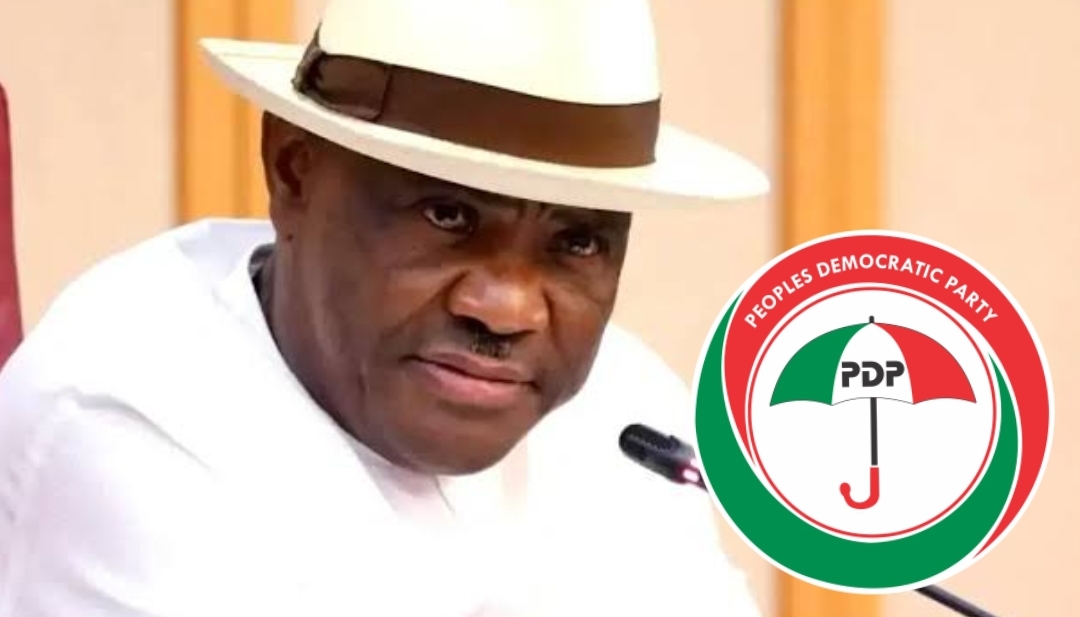
The Minister of the Federal Capital Territory, Nyesom Wike, has said the 16 defected members of the Rivers State House of Assembly are free to leave the Peoples Democratic Party, adding that his camp would continue to work with the remaining lawmakers still loyal to the party.

Wike stated this on Friday while addressing journalists after inspecting the ongoing construction of an interchange bridge connecting Maitama, Gishiri, Jahi, and Gwarimpa in Abuja.

PUNCH Online reports that 16 lawmakers, including Speaker Martins Amaewhule, announced their defection from the PDP to the ruling All Progressives Congress during a plenary session of the Rivers State House of Assembly on Friday.

Citing divisions in the PDP as the reason for the defection, Amaewhule said he was now a member of the APC and would “join hands with Mr President,” noting that the President “means well for the country.”

Reacting, Wike described the development as “unfortunate,” adding that the party’s internal crisis contributed to the lawmakers’ exit.

“Well, it’s unfortunate. I have always said that everybody has the right to make a choice. The party is fully factionalised. And the requirement of the Constitution is that when a party is factionalised, they are allowed to leave the party.

“You will see that it’s not everybody who has left. I believe 16 or 17 of them have left out of 27. We still have a good number, about 10, and we will continue to work together. They never told me, but they have a right,” he said.

The former Rivers State Governor also stated that he remained in the PDP, urging the party to put its house in order.

See also  Leaked memo: Obidient Movement petitions Obi over ADC marginalisation

“I’m still in the PDP. So those who have remained, we’ll continue to work together. And I have said to the party, put your house in order. Because at the end of the day, if you don’t put your house in order, it’s the party that will lose.

“And we still ask the party to work together to see how the remaining members will be a relevant opposition. But they chose not to. So for me, those who have left are free. But those who remain in the party, we will continue to work together,” he added.

punch.ng

FOLLOW US ON:

FACEBOOK

TWITTER

PINTEREST

TIKTOK

YOUTUBE

LINKEDIN

TUMBLR

INSTAGRAM

Continue Reading

Politics

Malami’s 2027 gov bid reshapes Kebbi political landscape

Published

on

The entry of former Attorney General of the Federation and Minister of Justice, Abubakar Malami (SAN), into the 2027 Kebbi State governorship race, under the African Democratic Congress, has reshaped the political landscape in the North-West state, writes ANIMASAHUN SALMAN

Former Attorney General of the Federation and Minister of Justice, Abubakar Malami (SAN), has formally joined the 2027 governorship contest in Kebbi State, a move that immediately altered political calculations in the North-West state and triggered reactions from government officials, political analysts, and supporters.

Malami, who declared his ambition during an interview on DCL Hausa monitored in Birnin Kebbi, said he would be contesting on the platform of the African Democratic Congress, setting the stage for what many observers now describe as a potentially fierce and unpredictable race.

However, just a week later, the Economic and Financial Crimes Commission reportedly invited him as part of an ongoing investigation into the alleged $490m Abacha loot. The move introduced a major stumbling block to his political ambitions, fuelling speculation about whether the legal scrutiny could slow down his campaign or affect voter perception.

Not deterred, Malami wrote on his X handle: “This is to confirm that I have been invited by the EFCC. As a law-abiding and patriotic citizen, I hereby reaffirm my commitment to honour the invitation. I understand the spirit of accountability and transparency in public service – the principles that I both advocate and champion. Rooted in public service and in the spirit of transparency and accountability, I am committed to sharing with the Nigerian public the developments as they unfold.”

After honouring the EFCC invitation, the former minister wrote: “In line with my undertaking to keep Nigerians updated on my invitation by EFCC, I give glory to Allah for his divine intervention. The engagement was successful, and I was eventually released while on an appointment for further engagement as the truth relating to the fabricated allegations against me continues to unfold.”

Announcing his decision to contest the governorship, the former minister said his decision was driven by worsening insecurity, the collapse of agriculture, and what he called “policy failure” affecting thousands of households across Kebbi.

According to him, the state is in desperate need of “rebuilding,” and he believes he possesses the experience and network required to redirect its development.

“I have agreed to contest, and there is no retreat. God willing, we are going to win. When the time comes, you will see that the people of Kebbi are with us,” Malami declared.

His statement signals the beginning of a long political journey that could reshape the balance of power in a state long dominated by the ruling All Progressives Congress.

Malami’s choice of the ADC immediately attracted attention across the state. As one of the most influential figures in the APC during the late President Muhammadu Buhari administration, his defection to a new party signalled a deep political rift.

See also  Peter Obi won’t be voted even if he swears in shrine, only Jonathan can defeat Tinubu – Adeyanju

Political analysts say this could fragment the ruling party’s support base, especially in Gwandu Emirate, where Malami’s influence has long been visible.

According to some political commentators, the former minister’s declaration could introduce a three-way contest between the APC, with incumbent Governor Nasir Idris seeking to maintain party dominance; the PDP, which has struggled to regain momentum in the state; and Malami’s ADC, which may draw support from disaffected voters, youth groups, and political blocs dissatisfied with the current administration.

The development also revives long-standing political rivalries dating back to the 2015 and 2019 election cycles, where Malami was instrumental in mobilising federal support for APC candidates.

His decision to break away is therefore seen by many as both a political rebuke of the present government and a calculated attempt to realign political power around his own camp.

Idris

In announcing his candidacy, Malami focused heavily on the state’s security situation, especially persistent banditry in Zuru Emirate, Danko/Wasagu, Fakai, and parts of Yauri, areas that once formed the backbone of Kebbi’s food production.

He lamented that rice mills that operated for two decades had shut down, blaming state and federal authorities for “negligence.”

“Banditry has pushed thousands away from their farmlands. Rice mills that operated for 20 years have closed because of bad policies favouring foreign companies,” he said.

Kebbi’s agricultural decline is already well documented. The state, once celebrated for its partnership with Lagos in the Lake Rice programme, has experienced reduced yields in rice, wheat, millet, and onions due to insecurity and migration from rural communities.

By focusing on these issues, Malami is attempting to position himself as the candidate with both national and local exposure to reverse the trends.

The Kebbi State Government, however, reacted sharply to Malami’s declaration, insisting that his ambition poses no threat to Governor Nasir Idris or the ruling party.

The Chief Press Secretary to the Governor, Ahmed Idris, said the declaration was neither new nor surprising and insisted that only voters would determine who leads the state.

“The floor is open for everyone to contest. Only the people of Kebbi will decide their governor. We have no reason to panic,” he said.

The governor’s Special Adviser on Communication and Strategy, Abdullah Idris Zuru, described the former minister’s announcement as “a product of desperation.”

In a detailed reaction, Zuru challenged Malami to present his track record for public scrutiny.

“Nobody is moved. Nobody sees him as a threat. Let him go back to the grassroots and tell the people what he has done. People now understand their rights. They will not be deceived by empty rhetoric,” he said.

Zuru argued that modern voters no longer follow politicians blindly and that candidates must demonstrate past contributions to local development before seeking the state’s highest office.

“If you want to be governor, show the people your antecedents. Were you a commissioner, a chairman, a philanthropist? What have you done to improve the well-being of Kebbi people?” he said.

See also  PDP NEC members set high bar for incoming chairman ahead of convention

Malami’s supporters, however, insist the government’s reaction reflects insecurity rather than confidence.

A political associate of the former AGF, Dr Abdurrahman Ibrahim, said the declaration was not an act of desperation but a response to widespread calls across the state.

“People from all corners of Kebbi are calling him to contest. He has a track record. He has brought development. Politics is a game of numbers, and Malami has the numbers,” he said.

He said Malami’s decision to leave the APC was mainly due to what they described as “failed campaign promises” by the current administration.

According to him, the former minister initially supported the governor with the belief that he would deliver on his agenda.

“He believed the governor would prioritise the needs of the people. But after the election, the promises changed. People are suffering. Development has stalled. That is why Malami decided to challenge the status quo,” he said.

On government claims that Malami lacks grassroots presence, Dr Ibrahim insisted the opposite was the case.

“If you go to Kebbi, the people will tell you who is mass-oriented. Malami is strategic, highly educated, and capable of driving development. That is why the people want him.”

He described Malami as a realistic candidate with broad acceptance and the capacity to finance and manage a full-scale campaign under the ADC platform.

One of the striking elements of Malami’s declaration is his choice of platform. The ADC has little electoral history in Kebbi State and has never won a governorship election there.

Though Malami’s entry into the governorship race is seen by many as an act that would strengthen the party, the former AGF still faces major challenges, including absence of traditional party structures in rural communities, lack of grassroots mobilisers in key local government areas, limited presence in previous election cycles, strong APC machinery across the state, and historical loyalty to major parties.

The 2027 election cycle may, however, differ from past cycles due to the impact of insecurity, economic hardship, and rising political consciousness.

Early on Monday, the Government Girls Comprehensive Secondary School in Maga town, Danko Wasagu Local Government Area, was attacked by bandits, where the vice principal was killed and 25 girls abducted.

The current trend of insecurity in the state may give Malami a campaign wave to ride on.

Malami’s financial strength, national influence, and personal political network could also compensate for the ADC’s structural weaknesses.

A lecturer at a federal institution in the state, Dr Musa Bello, said Malami’s entry into a smaller party creates a complex race.

“He is banking on personality, not party structure. If he successfully draws major APC blocs, especially in Gwandu and Argungu, then ADC becomes a strong contender. But the burden of building a statewide structure is enormous,” he said.

See also  Why I will never criticize Goodluck Jonathan – Omokri

Political insiders confirm that Malami played a crucial role in supporting Governor Nasir Idris during the last election. At the time, the former AGF was one of the major forces behind the governor’s emergence.

Their fallout, therefore, marks one of the most significant political breakaways in Kebbi’s recent history.

Sources say the rift widened over policy direction, political appointments, and alleged failure to meet key governance expectations. However, the government insists it owes no explanation.

Malami’s supporters maintain that the governor abandoned core campaign promises, especially regarding security, agriculture, education, and civil service welfare.

This disagreement has now transformed into a full electoral confrontation, with residents expressing their opinions on the candidates.

In Zuru, farmers and traders welcome the former minister’s stance on insecurity, saying any candidate willing to address banditry deserves attention.

In Argungu, some residents recall federal assistance and appointments linked to Malami’s influence while in office.

In Birnin Kebbi, some civil servants express scepticism, saying they prefer candidates with extensive local administrative experience.

A rice miller in Bunza, who simply gave his name as Mohammed, said, “We need someone who understands our struggles. If Malami can bring peace and reopen farms, we will support him.”

However, a trader in Jega, who did not want his name published, offered a different view: “We hear big rhetoric from Abuja. We want someone who has been with us here, not someone who only comes during elections.”

These mixed sentiments reflect a state where voters are increasingly demanding accountability while remaining open to new political alternatives.

With Malami’s entry, the 2027 governorship race in Kebbi is no longer a two-horse contest. The election will now revolve around four key issues: security of lives and farmlands, agricultural revival and economic recovery, performance record of the incumbent administration, and credibility and grassroots acceptance of candidates.

Though the APC still maintains structural dominance, internal cracks and public criticism may weaken its voter base. The ADC is emerging as a new force, buoyed by Malami’s entry. The PDP, though quieter, hopes to benefit from vote splitting between the two major blocs, especially now that the state holds the position of national chairman of the PDP, Tanimu Turaki (SAN).

Malami’s entry has transformed what was expected to be a straightforward governorship succession into a turbulent contest, and in the months ahead, alliances, defections, and political negotiations are expected to further shape the race.

With the development, Kebbi’s 2027 race is now open, competitive, and unpredictable.

Some political watchers of the event in the state, however, suggest that how Malami navigates the legal entanglement with the EFCC probing will be critical in determining whether his political momentum can be sustained.

punch.ng

FOLLOW US ON:

FACEBOOK

TWITTER

PINTEREST

TIKTOK

YOUTUBE

LINKEDIN

TUMBLR

INSTAGRAM

Continue Reading

Trending