Connect with us

Politics

Amaechi reveals how Tinubu can be defeated in 2027

Published

on

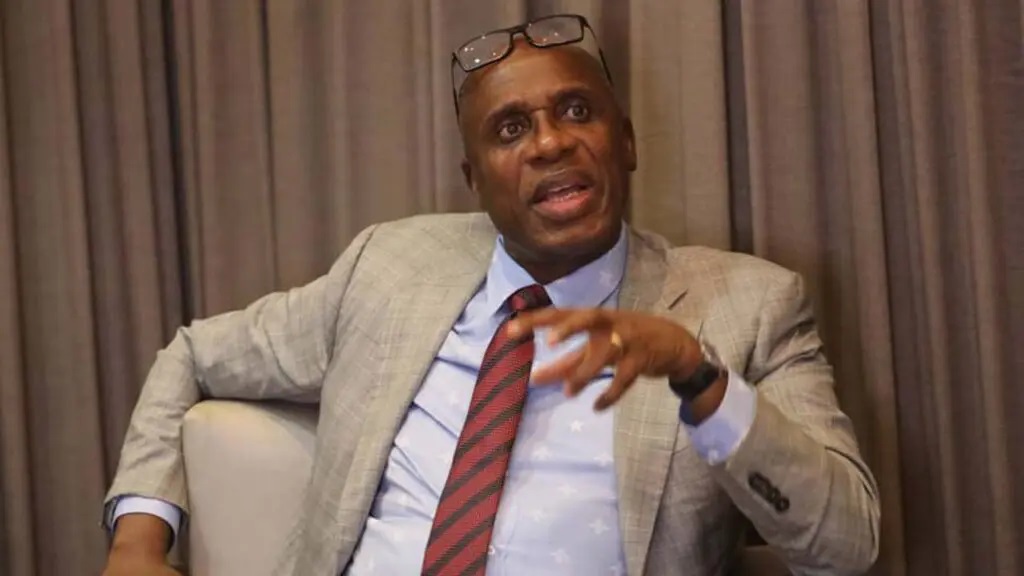
A former governor of Rivers State and chieftain of the opposition coalition, African Democratic Congress, Rotimi Amaechi, has urged Nigerians to prepare to vote massively in 2027 to ensure that President Bola Tinubu is defeated.

According to Amaechi, who in August declared his interest to contest for President in 2027, the fact that Tinubu was defeated in Lagos State in 2023 showed that he is not invincible.

Amaechi, alongside a former governor of Bayelsa State, Seriake Dickson, spoke at the fifth anniversary lecture of First Daily newspaper held in Abuja on Monday.

The theme of the event was ‘2027: How can we make our votes count?’

In his goodwill message, Amaechi cautioned that voter apathy and complacency allow electoral malpractice to thrive, saying Nigerians must participate in the next elections to prevent President Tinubu from getting second term.

He said, “The first solution to electoral reform is not the government. The people are the problem. The more you say they have written the results, the more you have voter apathy. Voter apathy will make President Bola Tinubu return to Villa.”

Amaechi urged citizens to take control of the process, saying, “Tell the people the power is in your hands. Come out. If Tinubu is that invincible, how was he defeated in Lagos?

It can be repeated but first and foremost you must agree that the man there is not invincible. The problem is the opposition.”

He added that it is unrealistic to expect a government in power to undertake an electoral reform.

“The problem with election in Nigeria is that there is no incumbent government that can achieve electoral reform. None. We already tried it and failed,” he said.

See also  Police, INEC move against early 2027 election campaigns

Amaechi alleged that vested interests within the political class often frustrate reform efforts.

The former Minister of Transportation also blamed opposition parties for not developing viable strategies, noting that internal division and lack of focus weaken their ability to challenge the ruling elite.

“I tell the opposition parties that you’re the problem. The opposition party is not discussing how to save Nigeria. Nobody is saying oh things are bad, how do we change the candidate,” he said.

Earlier, Dickson, who chaired the event, condemned what he described as the subversion of the people’s sovereignty through rigged elections, calling it “the worst coup” against democracy.

“We have a long way to go as far as protecting the sovereignty that our constitution says belongs to the people because the only time Nigerians express that sovereignty that the constitution rightly says is theirs is during elections.

“Rigging of elections is the worst coup you can plan,” the ex-governor explained.

Speaking further, the senator representing Bayelsa West condemned the manipulation of election results by politicians and government officials.

He said, “A worst form of violation of the sovereignty of the people is when politicians, governments, security agencies and the electoral umpire itself colludes and then cook election results that have no reference whatsoever to the people.

“In other words, the people don’t even vote but votes are written and ascribed to them and then people say go to court now.

“As far as I’m concerned, anyone who has planned that, anyone who has carried that out, those are the real coup plotters because that is a coup against democracy, against the country, in the sovereignty of the people.”

See also  Residents protest as bandits abduct seven in fresh Kaduna attack

The former Bayelsa governor said he witnessed electoral manipulation during his time in office.

“I was governor in an opposition and fought a lot of battles to keep my state in opposition and I saw all of this. What the average Nigerian politician who calls election planning, my dear friends and fellow Nigerians, if we’re honest, it’s conspiracy to commit crimes,” he said.

He urged the National Assembly to strengthen electoral laws to prevent result falsification and preserve the people’s will.

The Director of the Abuja School of Social and Political Thought, Dr. Sam Amadi , delivered a criticism of the nation’s electoral system during his keynote address, condemning what he described as a growing entanglement between election management and political power.

Amadi argued that the current situation had produced a political environment in which “everyone who has something to do with the management of electoral election is connected to the President.”

He lamented that the long-standing practice of appointing neutral and independent election officials has effectively been abandoned.

“Our elections are always rigged in one form or another,” he said, pointing to systemic drivers, such as high campaign costs, the enormous rewards of office and a political economy that turns elections into “warfare”.

That combination, he said, deepens civic cynicism and depresses turnout, even when citizens see the stakes are national survival.

“Free and fair election is the only way a divided, poor society can have peaceful transition,” the director said.

The speaker ended with a practical call to action, urging focused civic pressure on institutions and actors who can change outcomes.

He singled out INEC for reform.

“INEC must be opened to scrutiny,” he said, blaming both political parties and complicit lawyers and judges for enabling rigging.

See also  Atiku, Obi absent as opposition begins single-candidate talks ahead of 2027

The publisher of First Daily, Daniel Markson, in his welcome remarks, lamented Nigeria’s negative global reputation, stating, “There is a leadership issue in this country. I know there are leaders here. I am not particularly pointing fingers at any of you, but let’s tell ourselves the honest truth: we have failed. We have failed.

“I am 55 years old. I can’t remember any time Nigeria worked for me, as sad as it is. Yes, I can’t remember any time Nigeria worked for me and I doubt whether I would live to see that day when Nigeria will work for me.”

Markson attributed the country’s leadership crisis to flawed elections.

He announced that First Daily would embark on a nationwide voter sensitization campaign next year.

Nigeria’s struggle to achieve credible elections has been a recurring challenge since the return to civilian rule in 1999.

Despite a series of reforms, including the introduction of the Smart Card Reader in 2015 and the Bimodal Voter Accreditation System in 2023, allegations of vote-buying, intimidation, and result manipulation have persisted.

The 2023 general elections, which brought President Bola Tinubu to power, were marred by technical glitches, logistical failures, and accusations of bias against the Independent National Electoral Commission.

These controversies have eroded public trust, with many Nigerians questioning whether their votes truly count—an issue that continues to define political discourse ahead of the 2027 polls.

The event brought together political figures, diplomats, and media executives who discussed the future of Nigeria’s democracy and the urgent need to restore integrity to the nation’s electoral system.


Continue Reading
Click to comment

Leave a Reply

Your email address will not be published. Required fields are marked *

Politics

Peter Obi says he won 2023 election but has ‘no evidence’ to prove claim, read details

Published

on

Presidential candidate of the Nigeria Democratic Congress (NDC), Peter Obi, has acknowledged that he has no evidence to substantiate his claim that he won the 2023 presidential election, while insisting that he remains convinced that he was the actual winner.

Obi made the remarks in a recent interview with BBC Africa while discussing his position on the disputed 2023 election and his plans to contest the 2027 presidential election.

Asked directly whether he had evidence to support his claim of victory in the 2023 election, Obi said, “There’s no evidence. Everything is not based on evidence.”

He nevertheless maintained that he won the election, adding, “I won the election and that’s where I will end. I don’t like going back to the past. I won the election (2023). Well, there’s no evidence but I won the election.”

Obi contested the February 25, 2023 presidential election under the Labour Party and was placed third in the results announced by the Independent National Electoral Commission (INEC).

The electoral commission declared Bola Tinubu of the All Progressives Congress (APC) the winner with 8,794,726 votes, while Peoples Democratic Party (PDP) candidate Atiku Abubakar came second with 6,984,520 votes. Obi recorded 6,101,533 votes.

Following the declaration, Obi and the Labour Party challenged the outcome at the Presidential Election Petitions Court, alleging electoral irregularities and non-compliance with electoral laws.

The five-member tribunal dismissed the petition on September 6, 2023, and upheld Tinubu’s victory.

Obi later took the case to the Supreme Court, but a seven-member panel of the apex court dismissed his appeal on October 26, 2023, ruling that it lacked merit and affirming the lower court’s decision.

See also  Sanwo-Olu congratulates Hamzat on winning Lagos APC gov ticket

Despite the court decisions, Obi has continued to reject the 2023 election outcome as a true reflection of the votes cast by Nigerians.

Source: tribuneonlineng.com

Follow Politics

FOLLOW US ON:

FACEBOOK

TWITTER

PINTEREST

TIKTOK

YOUTUBE

LINKEDIN

INSTAGRAM

Continue Reading

Politics

Presidency reveals key factor that gives Tinubu edge over opposition ahead of the 2027 elections, read details

Published

on

The Presidency has said the growing number of governors backing President Bola Tinubu gives him a stronger political structure and an advantage over opposition candidates ahead of the 2027 presidential election.

The Special Adviser to the President on Policy Communication, Daniel Bwala, said this on Channels Television’s Politics Today, arguing that the political landscape had changed considerably since the 2023 election.

Bwala said the support of governors was significant because they control political structures in their respective states and could translate their backing for Tinubu into grassroots mobilisation ahead of the election.

“Since then, President Bola Tinubu has got how many governors on his side? The governors are the Chief Executive Officers of their respective states. They coordinate the structures of the state. These people say, ‘We are putting our goodwill, our resources, our structure, and our support to the President,’” he said.

He said the President’s political position had also been strengthened by people who had benefited from his administration’s policies, including beneficiaries of the Nigerian Education Loan Fund (NELFUND), agricultural programmes, manufacturing incentives, CrediCorp and infrastructure projects.

Bwala said the developments constituted “facts, verifiable data” which, in his view, showed that Tinubu had made progress since assuming office in 2023.

He also dismissed suggestions that the administration’s confidence ahead of 2027 was based solely on divisions within the opposition, saying its record in office would form an important part of its campaign.

His comments came amid renewed debate over Tinubu’s popularity and the ability of the opposition to challenge his bid for a second term.

See also  Defection: Kwankwaso, Yusuf disagree over alleged coercion of Kano officials

Bwala dismissed an assessment by The Economist that Nigerians may re-elect Tinubu despite disapproval of his administration, arguing that claims about the President’s popularity should be backed by representative opinion surveys.

“When you make a claim that Nigerians don’t like him, without saying, also, that there are a lot of people… one million families that the children have benefited from NELFUND, you think they hate him?” he asked.

He similarly cited beneficiaries of agricultural interventions, support for manufacturers and CrediCorp, arguing that such groups should be considered when assessing public sentiment towards the administration.

On concerns over rising poverty and hunger, Bwala acknowledged that more Nigerians had fallen into poverty but attributed the hardship partly to the economic reforms undertaken by the Tinubu administration.

“More people went down to poverty, I acknowledge, I’m not doubting it. But there’s a but to it. Since when the reform started to today, we have made marked progress,” he said.

According to him, the reforms were necessary to address longstanding economic problems, despite the short-term discomfort experienced by Nigerians.

Bwala also defended Tinubu’s statement that Nigeria had moved from the “doldrums” towards prosperity, saying the President was not suggesting that Nigerians would suddenly begin experiencing prosperity from October 1.

He cited NELFUND beneficiaries, subsidised healthcare, infrastructure projects and support for small and medium-sized businesses as examples of what he described as prosperity already reaching Nigerians.

“One million families whose children have benefited from the NELFUND programme, what they are benefiting is called prosperity,” he said.

“If you go to an environment or a place where there have been no roads or any form of infrastructure, and we have established infrastructure there, what has come to them is prosperity.”

See also  Residents protest as bandits abduct seven in fresh Kaduna attack

Bwala further claimed that the opposition had lost several influential political figures who played key roles in their 2023 campaigns.

He said former Vice President Atiku Abubakar no longer had the support of governors who worked for his 2023 campaign, while Peter Obi had also lost some critical political allies.

“In terms of the other candidates who say he will not win, Atiku Abubakar lost close to 25 per cent of key people that you know around him. All the governors that worked for him that time are no longer with him,” Bwala said.

“Peter Obi lost 55 per cent of the critical people that carried his campaign; they’ve all disappeared. And some of them went to Atiku, some of them went wherever they could go to.”

He consequently expressed confidence in Tinubu’s prospects in the 2027 contest, saying the political support around the President was considerably different from what existed before the 2023 election.

Source: tribuneonlineng.com

Follow Politics

FOLLOW US ON:

FACEBOOK

TWITTER

PINTEREST

TIKTOK

YOUTUBE

LINKEDIN

INSTAGRAM

Continue Reading

Politics

David Mark reveals ADC won’t accept rigging in 2027, read details

Published

on

The National Chairman of the African Democratic Congress, David Mark, has warned that the party will comply with electoral rules but will resist any attempt to manipulate the 2027 general elections or rig it out of the contest.

Mark issued the warning on Wednesday in Abuja when he received the governing council of the Savannah Centre for Diplomacy, Democracy and Development, led by former Chief Justice of Nigeria, Justice Olukayode Ariwoola (retd.), at the ADC national headquarters.

Mark said the ADC was prepared to abide by the rules governing the elections and the party’s own code of conduct, but would not accept electoral manipulation.

“We hold ourselves to the highest standards of good conduct as a political party. We will play by the rules. But we will not accept rigging or allow ourselves to be rigged out.

“We are committed to playing politics in a manner that promotes public confidence in democracy,” he said.

He added that the party would comply with INEC’s guidelines as well as the provisions of its Orange Book, which sets out the party’s code of conduct and governance principles.

The former Senate President had previously warned against the use of state institutions to manipulate the 2027 elections, saying the credibility of the polls must be protected.

The Council of the Wise, as the governing council is known, was at the party secretariat as part of its ongoing engagement with political parties and other stakeholders ahead of the 2027 elections.

Speaking during the visit, Ariwoola said the centre was seeking the commitment of political parties and their candidates to peaceful, free, fair and credible elections.

See also  ‘We drank our urine to survive’ - Read about the horror in NSCDC cell of death

He also urged the ADC leadership to ensure that its candidates and supporters complied with the rules of the Independent National Electoral Commission and avoided conduct capable of triggering political violence.

The latest warning came as the Savannah Centre intensifies consultations with political actors and other stakeholders ahead of the elections.

The Council of the Wise, chaired by Ariwoola, was reconstituted in June with a mandate to promote peaceful, free and credible elections and engage key institutions and political actors.

The council’s recent engagements have included meetings with presidential candidates and other political stakeholders, with repeated calls for adherence to electoral rules, issue-based campaigns and the prevention of violence and hate speech.

Ariwoola’s delegation to the ADC included members of the Council of the Wise, among them Professors Abdullahi Shehu and Azeez Dankano, Executive Director of the Centre, Amb Sani Bala, Mr Tunji Lardner and Amb Godswill Ighali.

The centre had earlier said the Council of the Wise would engage President Bola Tinubu, INEC leadership, political parties, security agencies, traditional and religious leaders, civil society groups and other stakeholders ahead of the elections.

Source: punchng.com

FOLLOW US ON:

FACEBOOK

TWITTER

PINTEREST

TIKTOK

YOUTUBE

LINKEDIN

INSTAGRAM

Continue Reading

Trending