Connect with us

Education

First lady distributes 10,000 sanitary pad packs to Anambra schoolgirls

Published

on

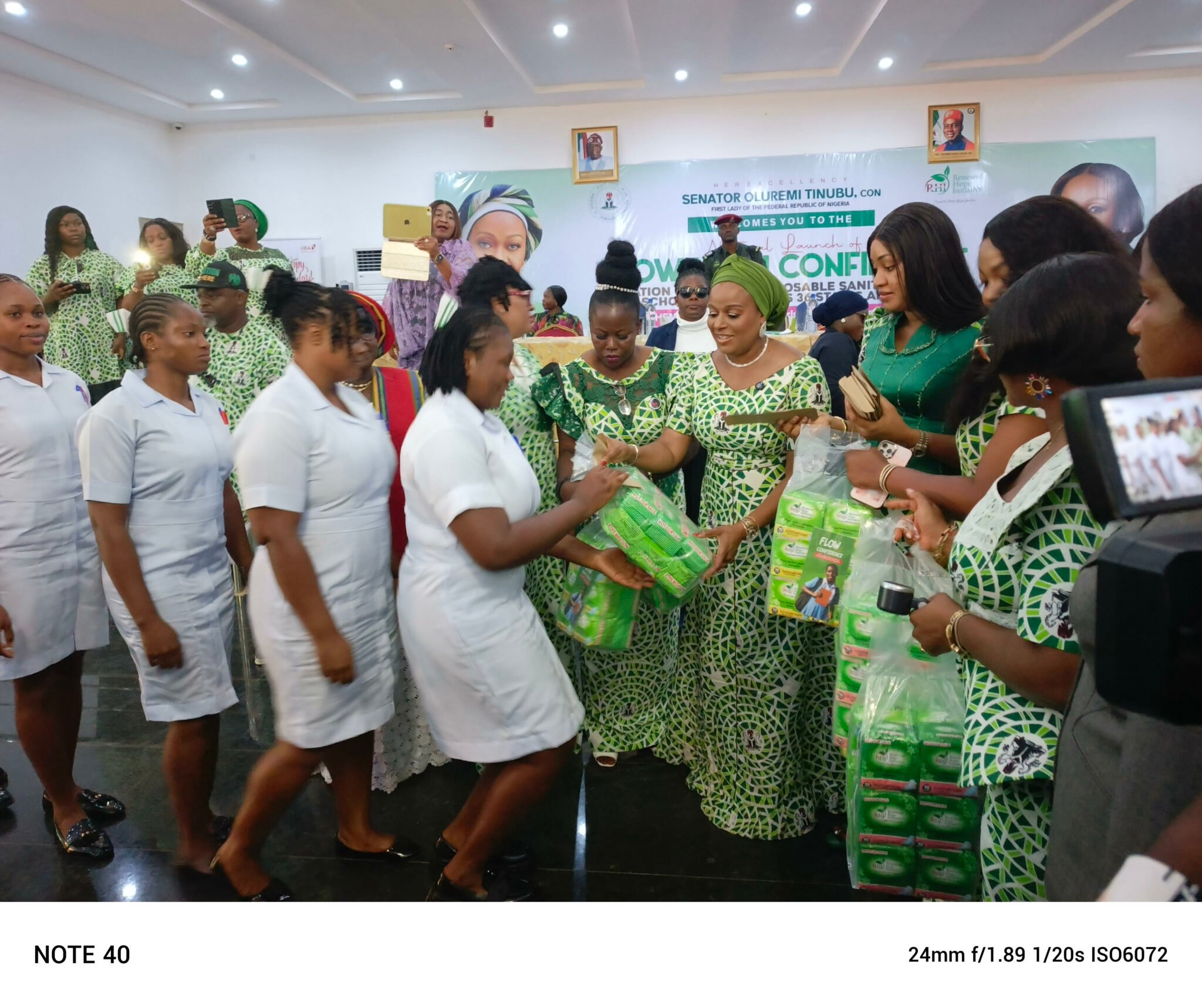
Nigeria’s First Lady, Senator Oluremi Tinubu, has unveiled a national menstrual health project under her Renewed Hope Initiative, tagged “Flow with Confidence,” with the distribution of 10,000 sanitary pad packs to teenage girls from selected schools across Anambra State.

The initiative, which was first launched in October 2025, includes the distribution of 370,000 sanitary pad packs across the 36 states of the federation, including the Federal Capital Territory, with each state expected to receive an allocation of 10,000 packs.

The programme is aimed at empowering schoolgirls, promoting menstrual hygiene, and restoring their dignity during their menstrual cycle through a one-year supply of sanitary pads.

At the Anambra State flag-off ceremony held on Wednesday at the Banquet Hall of the Light House in Awka, Tinubu was represented by the state’s First Lady, Dr Nonye Soludo, who also serves as the state Coordinator of the Renewed Hope Initiative.

Soludo, who is also the founder of the Healthy Living with Nonye Soludo initiative, while reading the First Lady’s speech, disclosed that Anambra received an allocation of 10,000 sanitary pads to be distributed equitably across the state, particularly in rural communities where many girls struggle to access such products.

She described the programme as a timely intervention to address the challenges faced by adolescent girls, especially the stigma, ridicule, and loss of self-confidence that often accompany menstruation in schools.

According to her, the project seeks to prevent girls from missing school due to their periods and to promote dignity and confidence by ensuring they have access to menstrual hygiene products.

See also  Rep urges Atiku, Obi to step down for Tinubu ahead of 2027

She said, “The programme is a timely intervention to address the challenges faced by adolescent girls, especially the stigma, ridicule, and loss of self-confidence that often accompany menstruation in schools.

“It is wrong for girls to miss school during their periods because they cannot afford sanitary pads or fear stained clothes. Through this initiative, young girls will not only receive sanitary pads but also gain the confidence to embrace their education without disruption.

“This gesture is about health, dignity, and self-esteem. We urge beneficiaries not to sell the pads but to use them properly. The project is designed to safeguard your health and prevent infections linked to unhygienic alternatives such as rags or tissues.

“About ₦2.5 billion was spent to provide these sanitary pads from a locally manufactured company. To our girls, this is for you; make the most use of it, stay in school, and never allow shame and stigma to affect your confidence and future dreams.”

Also speaking at the launch, the member representing Onitsha North I Constituency in the Anambra State House of Assembly, Ifeoma Azikiwe, commended Senator Tinubu’s compassion and dedication to the welfare of women and girls nationwide.

Azikiwe noted that the initiative would reduce school absenteeism among girls and protect their dignity.

“This is a laudable step towards ensuring menstrual health, reducing the risk of infections, and enabling our girls to stay in school with confidence.

“We appreciate the First Lady of Nigeria for extending this support to every state, and we are particularly grateful for the 10,000 pads allocated to Anambra,” she added.

See also  16 escape death in Lagos-Abeokuta Expressway crash

The event also featured a lecture delivered by a female health expert, who encouraged the girls to view menstruation not as a source of shame but as a natural process and a sign of strength.

“Menstruation is not something to hide or be embarrassed about. It is part of womanhood. Use your sanitary pads correctly, maintain good hygiene, and talk to your mothers, sisters, or trusted adults whenever you need guidance.

“Above all, never let menstruation hold you back from achieving your dreams,” she said.

The gathering, which was attended by state officials, representatives from the 21 local government areas, women’s groups, and schoolgirls, underscored the importance of menstrual health in sustaining girls’ education.

Apart from the pad packs distributed, the teenage girls also received cash gifts from the Anambra State First Lady to cover their transportation fare back to their various destinations.

Beneficiaries expressed joy and gratitude, noting that the pads would help them attend school regularly and boost their confidence among peers.


Continue Reading
Click to comment

Leave a Reply

Your email address will not be published. Required fields are marked *

Education

UUTH resident doctors join nationwide strike

Published

on

The Association of Resident Doctors, University of Uyo Teaching Hospital, has resolved to join the nationwide strike declared by the National Association of Resident Doctors on Monday, January 12, 2026.

The decision was contained in a communiqué issued after an emergency general meeting of the association held in Uyo, Akwa Ibom State, on Thursday.

The communiqué, endorsed by its President, Dr Ekomobong Udoh, and General Secretary, Dr Kenneth Ikott, and made available to our correspondent in Uyo on Friday, said the centre would undertake a peaceful protest by 9am on Monday within the UUTH premises, in total compliance with the directive of NARD.

It read in part, “Members of the congress gathered for an emergency general meeting to discuss the resolutions issued by the NARD Extra-Ordinary NEC virtual meeting held on Saturday, January 2, 2026. After thorough deliberation and discussion on the resolutions of NARD, the meeting, chaired by the President, resolved as follows.

“The centre fully supports the implementation of the NARD NEC meeting resolutions. The congress immediately agreed to participate in the NARD TIC 2.0 from 12 noon on Monday, in line with the NEC directive, and will undertake a peaceful protest by 9am on Monday within the UUTH premises.”

Udoh said the proposed industrial action followed the failure of the Federal Government to fully implement the Memorandum of Understanding signed with resident doctors in November 2025.

According to him, the strike, tagged TICS (Total, Indefinite and Comprehensive Strike) 2.0, with the slogan, “No Implementation, No Going Back”, would only be suspended after the full implementation of the minimum demands.

See also  Secondary Schools with unqualified teachers to lose WAEC and NECO accreditation – FG

He listed the demands to include the reinstatement of the FTH Lokoja Five, payment of promotion and salary arrears, full implementation of the professional allowance table with arrears captured in the 2026 budget, and official clarification on skipping and entry-level issues by the Federal Ministry of Health and circulars to chief executives.

Other demands include the reintroduction and implementation of the Specialist Allowance, resolution of house officers’ salary delays and arrears, including the issuance of a pay advisory, recategorisation of membership certificates, and issuance of certificates after Part I by the NPMCN, commencement of locum and work-hours regulation committees, and resumption and timely conclusion of the Collective Bargaining Agreement process.

punch.ng

FOLLOW US ON:

FACEBOOK

TWITTER

PINTEREST

TIKTOK

YOUTUBE

LINKEDIN

TUMBLR

INSTAGRAM

Continue Reading

Education

Nigeria emerges fifth-best English-speaking country in Africa

Published

on

Nigeria has emerged as the fifth-best English-speaking country in Africa, according to the 2025 Education First English Proficiency Index cited by PUNCH Online on EF’s website on Monday.

The report, compiled by global education leader EF, assessed English skills across 123 countries and regions, using data from 2.2 million test takers. This year’s edition also included, for the first time, speaking and writing skills, measured using artificial intelligence technology developed by EF’s education technology arm.

English, Nigeria’s official language, remains central to education, governance, media, and business, helping the country maintain strong proficiency levels. On the African continent, Nigeria trails South Africa, Zimbabwe, Kenya, and Zambia, which lead in English proficiency. The rankings underscore the growing importance of English as a bridge for international communication, education, and commerce.

Top 10 English-Speaking Countries in Africa (EF EPI 2025):

South Africa – Widespread use in government, education, media, and business.

Zimbabwe – English is the primary language of instruction and administration.

Kenya – Official language alongside Swahili, widely used in urban and professional settings.

Nigeria – Official language, central to national communication and commerce.

Ghana – English is used from basic to tertiary education and in public administration.

Uganda – Official language; key role in trade, diplomacy, and professional environments.

Ethiopia – Widely used in education and international affairs, though not official.

Tunisia – Growing adoption among youth and professionals in education, tech, and tourism.

Morocco – Increasing popularity in schools and business for global trade and relations.

Continue Reading

Education

Bandit attacks: Kebbi, Kwara reopen schools

Published

on

Kebbi and Kwara state governments have announced the reopening of schools in selected areas, signaling a gradual return to normal academic activities after months of closures due to rising bandit attacks.

In Kebbi, the state government approved the immediate resumption of selected primary and secondary schools located in major cities and towns.

The state had ordered school closure following bandit attack on Government Girls’ Comprehensive Secondary School, Maga town, Danko/Wasagu Local Government Area in November, during which 25 schoolgirls were abducted and the school guard killed.

The reopening announcement was made on Sunday by the Commissioner for Basic and Secondary Education, Dr. Halimatu Bande, during a briefing in Birnin Kebbi.

According to Bande, the resumption takes effect from Monday, January 5, 2026, and applies only to schools within urban centres. Schools in rural areas will reopen later, following further improvements in security.

“Only schools located within major cities and towns are approved to resume at this stage,” Bande said. “Schools outside these areas will reopen at a later date, which will be communicated in due course.”

The commissioner explained that the phased reopening is aimed at ensuring the safety of students and teachers while gradually restoring full academic activities across the state.

She also directed Education Secretaries and Zonal Directors to enforce compliance and monitor implementation, appealing to parents and guardians to ensure that their children return to school promptly.

Bande commended Governor  Nasir Idris for his sustained support for education, describing his administration as committed to providing safe, inclusive, and quality learning for all children in Kebbi State.

Meanwhile, in Kwara State, the Ministry of Education and Human Capital Development has ordered the resumption of academic activities in all schools from today (Monday).

See also  Rethinking the Mathematics exemption for art students

The directive, issued by the ministry’s Press Secretary, Peter Amogbonjaye, quoted the Commissioner for Education, Dr. Lawal Olohungbebe, as saying that learning will resume immediately, except in areas still under “special security measures.”

“Learning activities are to resume immediately in all but areas earlier identified to be under special security surveillance,” the statement said. “Normal school activities will resume in such places very soon.”

The move follows a November 2025 directive that temporarily closed schools in several local government areas, including Ifelodun, Ekiti, Irepodun, Isin, and Oke Ero, in response to escalating insecurity and bandit attacks.

The closures were aimed at safeguarding pupils and teachers and were part of broader emergency responses to violent incidents in the state.

To ensure continuity in learning, especially for pupils in areas still affected by insecurity, the ministry also announced a radio-based learning initiative in collaboration with UNICEF and the Nigeria Learning Passport.

The programme, airing on the state-owned 99.1 Midland FM, will begin on January 5, with scheduled broadcasts at 11 a.m. on Mondays and Tuesdays, 1 p.m. on Wednesdays, and 2:30 p.m. on Fridays. Additional radio stations will be added to expand reach.

“The initiative aims to ensure continuity in learning, especially for pupils in areas where school activities are still limited by security concerns,” the ministry said.

FOLLOW US ON:

FACEBOOK

TWITTER

PINTEREST

TIKTOK

YOUTUBE

LINKEDIN

TUMBLR

INSTAGRAM

Continue Reading

Trending