The Minister of Education, Tunji Alausa, has highlighted 26 initiatives and reported achievements of President Bola Tinubu’s administration in the education sector, including university reforms, teacher development, technical education and student entrepreneurship.
The initiatives were outlined in an A–Z document titled From Reform to Results, shared by Alausa on Tuesday on his X account.
The document, which covers the Nigeria Education Sector Renewal Initiative (NESRI), highlights programmes aimed at improving access to education, strengthening institutions, promoting research and innovation, and equipping young Nigerians with practical skills.
Beyond the Nigerian Education Loan Fund, the initiatives span basic, secondary and tertiary education, with interventions targeting students, teachers, researchers and other education stakeholders.
Below are the 26 initiatives and the figures contained in the document.
A. ASUU Agreement
The Federal Government reached a new agreement with the Academic Staff Union of Universities to improve staff welfare and promote stability in the university system.
The agreement provides for a 40 per cent increase in academic staff remuneration, a revised Consolidated Academic Tools Allowance, strengthened cadre-based allowances and provisions for earned academic allowances.
B. Better Education Service Delivery for All (BESDA)
The programme is aimed at addressing the challenge of out-of-school children, particularly in 17 northern states with high numbers of children excluded from formal education.
It is expanding access to basic education and creating opportunities for children to return to learning.
C. Campus Mobility Initiative
The initiative provides environmentally friendly transportation to improve movement within university campuses.
The government reported that 780 electric tricycles had been deployed across 48 universities, with 35 provided to each institution.
D. Diaspora BRIDGE
The programme connects Nigerian experts living abroad with students and institutions in the country to contribute their knowledge and experience to teaching and learning.
The document reported that 1,141 experts had registered, with 16,675 students benefiting across 107 tertiary institutions.
E. Empowering Educators
Through EduRevamp and the Accelerated Teacher Professionalisation Pathway, the government is supporting teachers’ professional development, certification and licensing.
The document listed 53,553 teachers registered on EduRevamp and 51,794 registrations for the first ATPP cohort.
It also reported a ₦2bn investment in the programme, which targets 250,000 teachers by 2027.
F. Free Technical Education
The initiative provides free technical education to students in federal and selected state technical colleges.
The benefits include free tuition, boarding, textbooks and uniforms.
The document also reported that 38 federal and state technical colleges had been rehabilitated to improve the environment for practical skills training.
G. Girl-Child Education
Through initiatives including the Adolescent Girls Initiative for Learning and Empowerment, the government is addressing barriers preventing girls from enrolling, remaining and succeeding in school.
The document reported that 7.19 million girls were benefiting from direct interventions across 21 AGILE states, while 3.7 million were enrolled in junior and senior secondary schools.
More than 422,720 girls had completed life-skills programmes, while over 10,000 schools had benefited from improved classrooms, water, sanitation and hygiene facilities, and teaching and learning materials.
H. HOPE Education
The HOPE-Education programme, supported by $552m in World Bank funding, is aimed at strengthening foundational education and improving learning outcomes.
The document listed 29 million child beneficiaries, support for more than 500,000 teachers, 65,000 public schools to be strengthened and 10,000 non-formal learning centres to be improved.
I. Inspire Live!
The programme provides live online lessons for pupils from Primary One to Senior Secondary School Three.
Lessons are delivered by certified educators, with artificial intelligence-assisted question-and-answer support.
The initiative is designed to address teacher shortages and improve access to quality teaching, particularly in schools with limited teaching personnel.
J. JAMB Admissions Reform
The government has introduced changes to tertiary admission requirements to create more flexible pathways for prospective students.
Under the reforms, the Unified Tertiary Matriculation Examination requirement has been removed for admission into National Certificate in Education programmes.
Entry requirements have also been reviewed for selected National Diploma programmes.
K. Knowledge Economy
The initiative seeks to promote research, innovation, entrepreneurship and the commercialisation of ideas in tertiary institutions.
Through Research, Innovation and Commercialisation Committees, universities are being encouraged to turn research findings into practical solutions, businesses and employment opportunities.
The document also listed a National Laureate Prize with an annual award fund of ₦365m to recognise excellence in research and innovation.
L. National Learning Assessment
The Federal Ministry of Education has reintroduced the National Learning Assessment to measure what pupils are learning and identify gaps in the education system.
The assessment is expected to provide evidence to guide improvements in teaching, curriculum development and education policy.
M. Medical Education Expansion
The initiative focuses on increasing the number of healthcare professionals trained in Nigerian institutions and strengthening medical education.
The document reported that annual nursing enrolment had increased from 28,000 to 115,000, while medical and dental enrolment rose from 5,000 to 12,000.
Pharmacy enrolment also increased from 3,644 to 7,419.
It added that a ₦110bn intervention was supporting the rehabilitation of 24 medical schools.
N. Nigerian Education Loan Fund
The Nigerian Education Loan Fund provides financial support to eligible students to cover institutional fees and upkeep.
The document reported that 1,659,853 applications had been processed, with ₦192.89bn paid as institutional fees and ₦179.73bn disbursed as upkeep allowances.
The fund had also covered 319 beneficiary institutions, with total reported disbursements of ₦372.62bn.
O. Out-of-School Children and Almajiri Education
The initiative seeks to reintegrate out-of-school children into learning through inclusive education and the National Almajiri Policy, which integrates formal education with traditional Qur’anic education.
According to the document, more than one million out-of-school children had been reintegrated, while 200 bilingual learning centres had been established and 1,400 Tsangaya teachers trained.
It also listed 13,000 classrooms for construction or rehabilitation.
P. Prioritising Educators’ Welfare
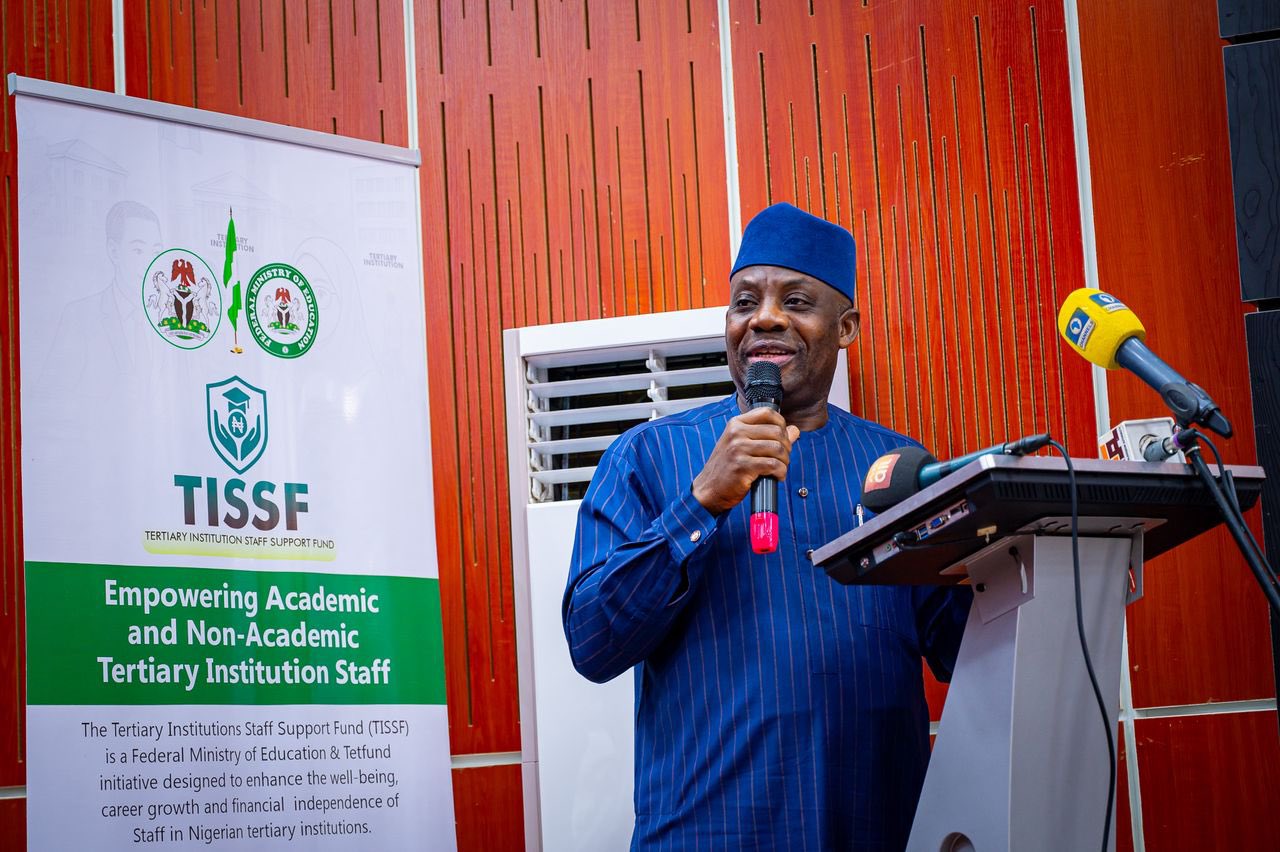
Through the Tertiary Institutions Staff Support Fund, academic and non-academic workers in public tertiary institutions can access financial support of up to ₦10m for housing, transportation, medical needs, education and other welfare requirements.
The document reported that ₦28bn had been disbursed to 15,000 staff members across 153 public tertiary institutions.
Q. Quality Assurance
The government said it was strengthening education standards, curriculum and learning outcomes through its quality assurance reforms.
A key component is the introduction of a new national curriculum, which includes the return of Nigerian History to classrooms and a stronger emphasis on Civic and Heritage Studies.
The initiative is intended to make learning more relevant and equip pupils with knowledge of their country’s history, identity and responsibilities.
R. Renewable Energy for Education
Through the Renewed Hope Energising Education Programme and the University Compressed Natural Gas Project, the government is providing cleaner and more reliable energy for tertiary institutions.
The document reported that solar mini-grids had been built in 37 federal universities and seven teaching hospitals.
It also listed 20 federal and state universities equipped with CNG refuelling stations.
S. Student Venture Capital Grant
The Student Venture Capital Grant provides equity-free funding to student entrepreneurs with innovative ideas in science, technology, engineering, mathematics and medical sciences.
The first cycle attracted 30,639 registrations from 404 tertiary institutions, with 65 finalists selected.
The document reported that more than ₦2.5bn had been disbursed to 45 student entrepreneurs, with each receiving up to ₦50m.
T. Technical and Vocational Education and Training
The Federal Ministry of Education’s TVET initiative provides practical skills training through Master 6, Master 12 and technical college pathways.
The programme is designed to connect vocational training with certification, employment and entrepreneurship.
The document reported more than 2.8 million applicants and 156,446 verified trainees.
It also listed over ₦65.7bn in stipends and start-up support disbursed to verified trainees, alongside ₦30.2bn paid to training centres.
U. University Financial Autonomy
The initiative is aimed at helping universities diversify their revenue sources, strengthen governance, commercialise research and reduce dependence on government funding.
Through a partnership with the Nigeria Higher Education Foundation, federal universities are also being supported to establish and strengthen advancement offices to engage alumni, attract philanthropic contributions and develop alternative funding sources.
V. Visibility
The ministry is improving public access to information on education programmes, institutions and reforms through websites, portals, dashboards and reports.
These include the NESRI website, the National Education Data and Information portal, the Digital National Education Management Information System, NELFUND’s monthly reports and the Federal Tertiary Institutions Governance Portal.
The document reported that the governance portal had onboarded 58 of 63 federal universities, 37 of 41 federal polytechnics and 27 of 29 federal colleges of education.
It also said more than four million learners had been assigned Learner National Identification Numbers, against a target of 40 million by 2027.
W. Workforce Expansion
The government is expanding professional training in specialised fields where Nigeria faces shortages of skilled personnel.
Through the National Committee for the Advancement of Occupational Therapy, Audiology and Speech Therapy Education, the ministry is working to expand degree programmes and strengthen clinical training in the three fields.
X. eXpanding Digital Access
Through the National Education Data Infrastructure, the government said more than 40 million learners and 215,000 schools had been mapped to improve education planning.
The document also reported that 16,000 learners had been enrolled in the first cohort of the Digital Technical Academy.
Other interventions include the deployment of 1,000 smart boards across the 36 states and the Federal Capital Territory, as well as the onboarding of 111 tertiary institutions onto AWS Academy.
Y. Youth Entrepreneurship
Through the Entrepreneurship, Innovation and Business Incubation Certification programme, the government is integrating entrepreneurship and innovation into tertiary education.
The programme is currently being implemented in 14 federal universities to equip students with business skills and help them turn ideas into viable ventures.
Z. Zero-Rated Education
The Federal Ministry of Education is working with the Nigerian Communications Commission and other partners to make approved educational platforms accessible at reduced or no data costs.
Through the Education Internet Exchange Point, learners and institutions are also expected to access educational materials and digital resources free of charge or at reduced costs.
Source: punchng.com
FOLLOW US ON:
FACEBOOK
WHATSAPP CHANNEL
TWITTER
PINTEREST
TIKTOK
YOUTUBE
LINKEDIN
INSTAGRAM