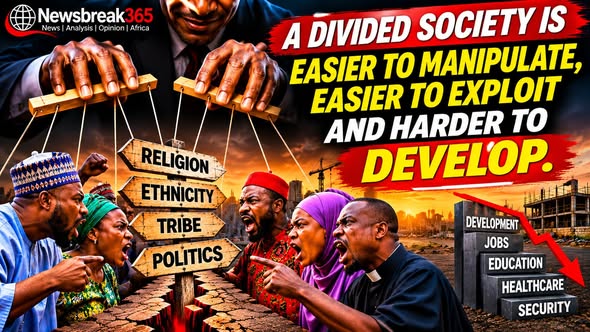
When people are busy fighting one another over religion, ethnicity, tribe and political differences, those benefiting from their division are busy consolidating their power. Is our inability to unite becoming the greatest obstacle to our collective progress?**
There is a dangerous reality that many societies, particularly across Africa, must confront: a divided population is much easier to control than a united one.
A society that spends more time fighting over differences than demanding accountability will struggle to make meaningful progress. When citizens are constantly distracted by tribal rivalries, religious intolerance, ethnic suspicion and political hostility, the real issues affecting their lives are pushed into the background.
And the question we must ask is uncomfortable: **Who benefits when ordinary people are busy fighting one another?**
## The Politics of Division: Keeping the People Distracted
Division is one of the oldest and most effective tools of manipulation.
History has repeatedly shown how those seeking to maintain power can exploit existing differences within communities. They turn ethnicity into a political weapon, religion into a battlefield and political loyalty into an excuse for defending incompetence.
Instead of judging leaders by their performance, some citizens judge them by their tribe, religion, region or political affiliation.
A politician can fail to provide employment, improve healthcare, build infrastructure or address insecurity, yet still enjoy unquestionable loyalty simply because he belongs to the same ethnic or religious group as his supporters.
Meanwhile, someone who raises legitimate questions about governance is labelled an enemy.
This is how accountability dies.
When loyalty becomes more important than competence, society pays the price.
## Religion, Ethnicity and Politics: When Differences Become Weapons
There is nothing inherently wrong with belonging to a particular religion, ethnic group, political party or cultural community.
Our differences are part of what makes human societies diverse and interesting.
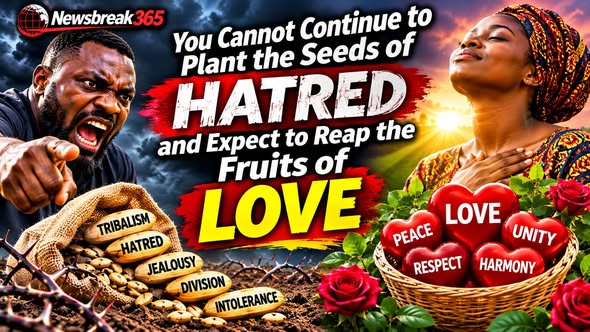
The problem begins when people use these differences to justify hatred, discrimination, intolerance and blind loyalty.
Why should someone who shares your religion automatically deserve your support, even when their actions harm society?
Why should someone from another ethnic group automatically become your enemy?
Why should political disagreement destroy friendships, families and communities?
Why should citizens defend wrongdoing simply because the offender belongs to their group?
These are questions that every society must confront honestly.
**Your tribe cannot eat your future. Your religion cannot replace good governance. And your political loyalty cannot pay the price of bad leadership.**
## While We Fight, Poverty and Corruption Continue
Consider the ordinary citizens struggling to survive.
The unemployed graduate is still searching for work. The struggling family is still battling rising living costs. The patient is still waiting for affordable healthcare. The young entrepreneur is still struggling to access opportunities.
Yet public conversations are frequently dominated by tribal arguments, religious controversies and political insults.
People who should be demanding better schools, functioning hospitals, reliable electricity, security, employment and economic opportunities are sometimes more interested in defending political personalities.
The tragedy is that suffering does not recognise political affiliation.
Poverty does not ask which tribe you belong to before entering your home. Unemployment does not discriminate between religious groups. Corruption does not spare people simply because they support the government.
When public resources are mismanaged, the consequences affect ordinary citizens across different communities.
So why should citizens allow artificial divisions to prevent them from demanding what they collectively deserve?
## A Divided People Are Easier to Exploit
Think about the power of a united population.
When citizens speak with one voice against corruption, demand transparency and insist on responsible leadership, ignoring them becomes more difficult.
But when those same citizens are divided into hostile camps, their collective strength weakens.
One group defends one politician. Another group attacks a different politician. One community blames another. Religious groups exchange accusations, while political supporters spend their energy insulting one another.
And in the middle of all this confusion, the people who should be answering difficult questions often escape serious scrutiny.
This is the danger of allowing division to dominate public life.
**A population that cannot unite around its common interests will struggle to defend those interests.**
## Development Requires More Than Buildings and Roads
True development is not measured by impressive government speeches, expensive political campaigns or isolated infrastructure projects.
It requires strong institutions, quality education, functional healthcare, economic opportunities, justice, security and responsible leadership.
It also requires citizens who understand that their collective future is bigger than their individual differences.
No nation can build a prosperous future when its people are constantly encouraged to distrust one another.
A country cannot achieve its full potential when competence is sacrificed on the altar of tribal loyalty, accountability is replaced by political worship and constructive criticism is treated as betrayal.
Development requires cooperation, critical thinking and a shared commitment to the common good.
## It Is Time to Stop Being Instruments of Our Own Division
Perhaps the most disturbing part of this problem is that division does not always need to be imposed from outside.
Sometimes, ordinary people willingly participate in it.
We spread hatred without questioning its consequences. We defend individuals who have failed us. We attack people simply because they hold different opinions. We allow politicians, religious figures and influential personalities to determine who deserves our friendship and who deserves our hostility.
We must begin to take responsibility for the society we are creating.
Disagree without hatred. Defend your beliefs without attacking other people’s identities. Question leaders regardless of their background. Demand accountability regardless of political affiliation.
Unity does not mean everyone must think alike. It means recognising that our shared future deserves more attention than the differences that separate us.
## Final Thoughts: Who Really Benefits From Our Division?
A divided society is easier to manipulate, easier to exploit and harder to develop.
That is not just a political statement. It is a warning about the consequences of allowing hatred, intolerance and blind loyalty to replace critical thinking and collective responsibility.
The greatest service citizens can render to their society is not defending a politician at all costs, protecting a religious personality from criticism or promoting ethnic superiority.
It is demanding justice, accountability, equal opportunities and responsible leadership.
We must stop allowing those who seek our loyalty to benefit from our divisions while ordinary people continue to bear the consequences.
**Our differences should never become the chains that prevent us from moving forward together.**
The question is no longer whether division is hurting society. The real question is whether we are willing to recognise it and do something about it.
—
### THE BIG QUESTION: LET’S DEBATE!
1. Do politicians deliberately exploit religious and ethnic differences to maintain political power?
2. Why do some people defend incompetent leaders simply because they belong to the same tribe or religion?
3. Can Africa achieve meaningful development without overcoming tribalism, religious intolerance and political divisions?
4. Are ordinary citizens equally responsible for sustaining the divisions that hold society back?
**Drop your opinion in the comment section. Don’t just agree or disagree — tell us why.**
*Newsbreak365 — Questioning Narratives, Challenging Perspectives.*
FOLLOW US ON:
FACEBOOK
WHATSAPP CHANNEL
TWITTER
PINTEREST
TIKTOK
YOUTUBE
LINKEDIN
INSTAGRAM