Connect with us

News

Kano gov mourns bandit attack victim

Published

on

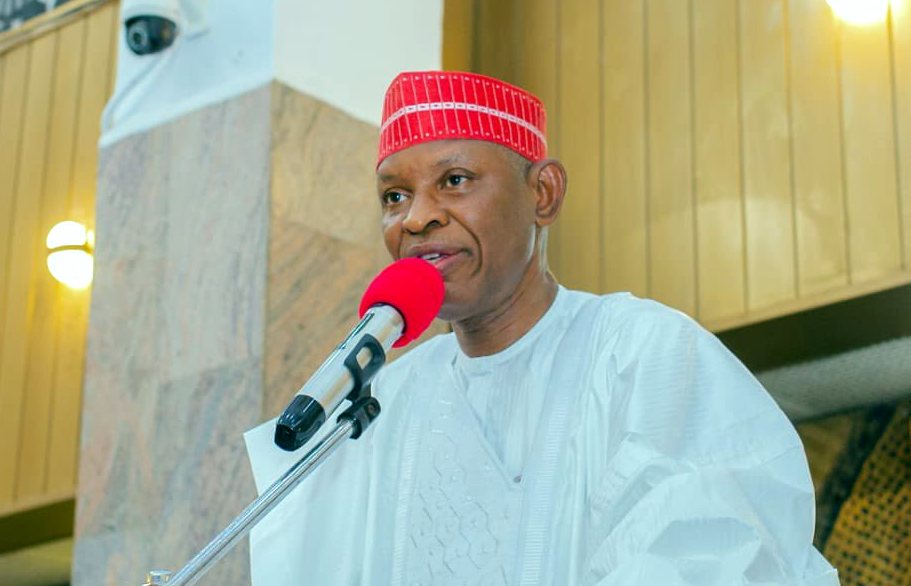
Kano State Governor, Abba Kabir Yusuf, on Tuesday, paid a condolence visit to the family of the late Zahra Allalai, the woman killed during the recent bandits’ attack on Kamaye village in Tsanyawa Local Government Area.

The development was contained in a statement issued on Wednesday and signed by the governor’s spokesperson, Sunusi Tofa.

Zahra’s killing occurred amid a series of coordinated assaults across settlements along the Kano–Katsina border, a corridor that has suffered repeated incursions and abductions in recent months.

Describing Zahra’s death as “a painful loss to her family, community, and to the entire state,” Yusuf prayed for Allah to grant her eternal rest and comfort her loved ones.

After the condolence visit, the governor proceeded to meet with troops of the Joint Task Force deployed across Shanono and Tsanyawa LGAs, where he received an operational briefing and assessed current security deployments.

At the Forward Operating Base in Faruruwa, Commander of 3 Brigade, Brigadier General A.M. Tukur, briefed the governor on recent encounters, including the November 1 ambush that claimed the lives of two soldiers and a vigilante and destroyed two military gun trucks.

Tukur explained that although the armed groups have shifted deeper into border communities, troops remain fully committed to protecting residents and clearing the area of criminal elements.

Yusuf described the situation as alarming, particularly the killing of Zahra Allalai and the continuing abductions in Tsanyawa.

“It is unfortunate that the infiltration is widening day by day. Bandits are killing people, rustling cattle, and kidnapping residents. But with the JTF deployed, the situation is improving,” he said.

See also  Lagos firm seeks IGP intervention over alleged land grabbers’ threat

He disclosed that he had briefed President Bola Ahmed Tinubu on the matter, adding that the President directed the Chief of Army Staff to send reinforcements with additional personnel and equipment.

“We will support you in whichever way necessary to neutralise this cancer,” the governor assured the troops.

Addressing residents of Tsanyawa, Yusuf pledged that the government would not relent until all abducted victims were safely reunited with their families.

“These security challenges are new to Kano. But by Allah’s grace, we will do whatever it takes to defeat the bandits,” he said.

He reaffirmed the administration’s commitment to providing logistics, welfare and operational support to security agencies while assuring residents that the affected communities would not be abandoned.

punch.ng

FOLLOW US ON:

FACEBOOK

TWITTER

PINTEREST

TIKTOK

YOUTUBE

LINKEDIN

TUMBLR

INSTAGRAM

Continue Reading
Click to comment

Leave a Reply

Your email address will not be published. Required fields are marked *

News

Workers demand N300,000 minimum wage

Published

on

The Federal Workers Forum has written to President Bola Tinubu and the National Assembly, demanding an immediate review of the salaries of federal civil servants and an increase in the minimum wage from N70,000 to N300,000.

The letter, dated September 2, 2026, and signed by the National Coordinator, FWF, Andrew Emelieze and General Secretary, Ogundele Ayodele, was addressed to the Senate President and Speaker of the House of Representatives through the Clerk of the National Assembly, with President Tinubu, the Chief Justice of Nigeria, and the Head of the Civil Service of the Federation also listed among the recipients.

The forum also proposed a salary of N1.5m for Level 17 officers, arguing that the current wage structure no longer reflects the economic realities confronting federal workers.

Backing its demand, the workers said in the letter, “We call for justice and immediate wage review now, adjust the federal minimum wage to N300,000 and a maximum wage of N1.5m for the Level 17 officers.”

The FWF said the demand was necessitated by what it described as the incomplete implementation of the N70,000 minimum wage approved in 2024, claiming that federal workers had yet to receive the full consequential adjustment and associated allowances.

The group stated, “It will surprise you to hear that the Federal Government has not fully implemented the new national minimum wage since July 2024. We have been in the battle for full consequential adjustment of the new minimum wage.”

According to the workers, the 2024 wage review increased the minimum wage from N30,000 to N70,000 but resulted in what they described as a flat N40,000 increase across all levels of the federal civil service.

The forum said, “Only N40,000 was added to the salaries of every federal worker across all levels.”

The latest demand comes amid continuing disagreements over the implementation of the 2024 minimum wage and related allowances.

See also  Israel Orders Evacuation Of Gaza City Tower Ahead Of Planned Strike

The N70,000 minimum wage replaced the previous N30,000 benchmark after negotiations between the Federal Government and organised labour, with the new wage framework subject to review after three years.

The FWF argued that the statutory three-year review period should not prevent the government from responding immediately to what it described as an emergency deterioration in workers’ purchasing power.

The forum said, “As a matter of fact, it is suicidal for the federal workers to continue in this ugly situation. Hence, based on the current cost-of-living crisis, it can only be a matter of justice that the federal wages be immediately reviewed to meet up with the current economic realities in Nigeria.”

The workers complained that the rising cost of food, transportation, accommodation, electricity, cooking gas and other necessities had made the N70,000 minimum wage inadequate.

“Federal workers have been enduring the situation, and everything has been frustrating and nauseating. We cannot cope again. Federal workers are dying in instalments; we are suffering in silence; our salary is too poor; it is not taking us home,” the letter stated.

The FWF further alleged that some federal workers had become heavily indebted to microfinance institutions and digital loan platforms in an attempt to meet their daily needs.

“Federal workers are now heavily indebted to microfinances and, most times, federal workers resort to phone loan apps to get transportation to work,” the group said.

The forum also claimed that some workers had resorted to using firewood because they could no longer afford cooking gas.

It argued that the worsening financial situation could affect workers’ productivity and create conditions conducive to corruption.

“While the Federal Government is making more money now, the federal workers are underpaid and subjected to unprecedented sufferings and hardship,” the workers said.

The forum also linked its demand to the wider increase in government revenues and expenditure, arguing that federal workers, whom it described as the “engine room of governance,” should benefit from improved national earnings.

It said, “The federal workers are the goose that lays the golden egg, but we are alienated from our labour.”

See also  FG opens diplomatic talks with Burkina Faso over detained aircraft, soldiers

The proposed salary structure attached to the letter provides for N300,000 for Level 1 Step 1 workers, rising progressively to N1.5m for Level 17 Step 1 officers.

Under the proposal, Level 2 workers would earn N330,000; Level 3, N360,000; Level 4, N390,000; Level 5, N420,000; Level 6, N450,000; and Level 7, N480,000.

The forum proposed N510,000 for Level 8; N550,000 for Level 9; N600,000 for Level 10; N700,000 for Level 12; N750,000 for Level 13; N800,000 for Level 14; N1m for Level 15; N1.2m for Level 16 and N1.5m for Level 17 officers.

The workers said their N300,000 minimum wage proposal was based on an estimated monthly expenditure covering feeding, transportation, accommodation, family support, electricity, cooking gas, phone and data, water and other utilities.

“Our projections here are fair, and we believe it can still be accommodated in the present budget based on the daily increased earnings and the excess crude oil sales earnings,” the forum said.

Among its other demands, the FWF called for payment of all outstanding salaries, promotion arrears and other entitlements owed federal workers.

It also demanded the immediate implementation and payment of arrears of the 40 per cent peculiar allowance, full consequential adjustment of the 2024 minimum wage, and the introduction of a permanent Cost of Living Allowance.

The workers further sought a Family Support Allowance, an end to stagnation in the civil service, declaration of vacancies for promotions, comprehensive health insurance for federal workers and pensioners, car and housing loan schemes, long-service awards and improved pension arrangements.

The forum also called for free education for the children of federal workers and pensioners in federal institutions, reduced taxation of workers’ allowances and tax relief measures.

See also  ‘Nigeria Must Go’ protest retaliation for ‘Ghana Must Go’ – SOG Precious

Beyond workers’ wages, the FWF appealed to the government to introduce a comprehensive social security programme for unemployed and underemployed Nigerians, provide free medical care for children, pregnant women and elderly citizens, and establish federal intervention programmes for the treatment of cancer and other life-threatening diseases.

It also called for stronger measures to tackle insecurity, including the release of kidnapped Nigerians.

The forum demanded an investigation into reports that part of workers’ contributory pension savings was being borrowed by the executive.

“We like to bring to the notice of the National Assembly that we are hearing rumours that part of our contributory pension savings is being borrowed by the executive. We are calling for investigations and an immediate stoppage cum refund if it is true,” it stated.

The workers also called for the return of petrol subsidy, price-control measures for essential goods and services, efforts to strengthen local production and industrialisation, and measures to address the declining purchasing power of Nigerians.

The FWF urged the National Assembly to take up its demands with the President, stressing that federal workers could not afford to wait until July 2027 before their salaries were reviewed.

It said, “Federal workers have suffered enough. It has been three years of torture, torment and agony for the federal workers since the removal of fuel subsidy.”

The forum concluded by appealing to the lawmakers and other government officials to treat its letter as an emergency intervention, saying improved wages were necessary to protect workers’ welfare and enhance their ability to effectively implement government policies.

The group stated, “It is our prayers that the National Assembly, being the representative of the people, take up our plea with the utmost responsibility and act accordingly to ensure a just society.”

Source: punchng.com

FOLLOW US ON:

FACEBOOK

TWITTER

PINTEREST

TIKTOK

YOUTUBE

LINKEDIN

INSTAGRAM

Continue Reading

News

Tenure countdown: States owe N5.3tn as 12 govs near exit

Published

on

Twelve state governors whose tenures will end in 2027 and early 2028 are set to leave behind a combined debt burden of about N5.3tn, comprising domestic and external obligations, findings by The PUNCH have shown.

The affected governors are Umaru Fintiri of Adamawa, Mai Mala Buni of Yobe, Abdullahi Sule of Nasarawa, AbdulRahman AbdulRazaq of Kwara, Dapo Abiodun of Ogun, Inuwa Yahaya of Gombe, Bala Mohammed of Bauchi, Babajide Sanwo-Olu of Lagos, Babagana Zulum of Borno, Seyi Makinde of Oyo, Hope Uzodimma of Imo and Douye Diri of Bayelsa.

Data obtained from the Debt Management Office showed that the 12 states had accumulated domestic debts of N2.16tn as of the first quarter of 2026, while their external obligations stood at about $2.33bn based on the latest available state-level external debt data.

Most of the governors are expected to complete their second terms in 2027, while Uzodimma and Diri will remain in office until January 15 and February 14, 2028, respectively.

The debt positions of the states have, however, followed different trajectories under the governors, with some reducing their domestic or external obligations despite the overall increase in the combined debt stock.

Lagos tops list

Lagos State carries by far the largest domestic debt burden among the 12 states.

The state’s domestic debt stood at N1.205tn as of the first quarter of 2026, according to the DMO, accounting for more than half of the N2.16tn combined domestic debt of the affected states.

At the other end of the scale is Nasarawa, whose domestic debt stood at N27.15bn, the lowest among the 12 states.

Lagos also recorded the highest external debt, with outstanding foreign obligations of $1.174bn in the DMO’s 2025 external debt profile.

Yobe had the lowest external debt at $46.67m.

See also  Alteration claims: National Assembly to re-gazzette tax laws, says Reps spokesperson

The combined obligations could increase further before the governors leave office if the states undertake fresh borrowing or updated DMO data show additional liabilities.

Debt management record

An analysis of the debt positions inherited by the governors shows a mixed record, with some administrations increasing both domestic and external obligations while others succeeded in reducing at least one component of their debt.

In Adamawa, Fintiri is expected to leave office with domestic debt of N64.7bn, down from N95.22bn when he assumed office. However, the state’s external debt increased to $124m from $100.614m.

Yobe’s Buni increased domestic debt to N98.60bn from N27.47bn. Its external obligations also rose to $46.67m from $26.911m.

Sule is expected to leave Nasarawa with domestic debt of N27.15bn, which is a reduction from N89.95bn when he came to office. His state has external debt of $60.82m.

In Imo, Uzodimma reduced domestic debt substantially to N81.65bn from N164.436bn inherited when he took office. However, external debt increased to $117.08m from $64.762m.

Kwara also recorded a reduction in domestic debt under AbdulRazaq, falling to N56.92bn from N59.58bn. External obligations, however, rose to $64.159m from $47.961m.

Abiodun of Ogun increased both domestic and external debt. Domestic obligations rose to N200.748bn from N97.050bn, while external debt increased to $217m from $102.154m in the first quarter of 2019.

Gombe’s Yahaya reduced domestic debt to N65.17bn from N76.895bn but increased external obligations to $88.7m from $36.960m.

In Bauchi, domestic debt climbed to N154.45bn from N93.320bn under Bala Mohammed, while external debt rose to $220.6m from $133.705m.

Zulum increased Borno’s domestic debt to N88.44bn from N78.259bn and external debt to $69.9m from $21.313m.

Bayelsa recorded one of the sharper reductions. Diri cut domestic debt to N50.17bn from N147.930bn and external debt to $55.5m from $59.551m.

Makinde also reduced Oyo’s domestic debt to N69.8bn from N94.140bn and external obligations to $87.5m from $136.531m.

See also  ‘Nigeria Must Go’ protest retaliation for ‘Ghana Must Go’ – SOG Precious

In Lagos, Sanwo-Olu increased domestic debt to N1.205tn from N542.231bn but reduced external obligations to $1.174bn from $1.421bn.

A Professor of Development Economics at Nnamdi Azikiwe University, Uche Nwogwugwu, said states could reduce their debt burden by investing borrowed funds in productive sectors capable of generating sufficient revenue to repay the obligations.

He said the lack of policy continuity remained a major obstacle, as successive administrations often abandoned existing strategies and introduced new ones instead of building on previous investments.

“Under the current arrangement, every government that comes wants to invent its own wheel. States can actually reduce their debts if they can identify productive investments and channel resources into them,” he said.

Nwogwugwu cited Imo’s investment drive in the gas sector as an example of an attempt to develop alternative sources of economic growth.

“Hope Uzodimma is being inventive in Imo State by trying to channel investments into gas. Alex Otti is also being very inventive by focusing on people-oriented programmes,” he said.

He warned that governments that prioritise projects without clear economic returns risk accumulating large debt burdens.

“Governments that work on publicist projects borrow very heavily. It is not rocket science because every state has something that it can invest in and generate returns,” he said.

According to him, borrowing is not inherently harmful if the funds are deployed into investments that generate returns and improve citizens’ welfare.

“Debt is a micro-unit of a nation. Every part of the state should feel both the cost and the benefits. States have to borrow. There is nothing wrong with states borrowing as far as the debts will be paid back,” he said.

Similarly, a Professor of International Economics, Jonathan Aremu, said borrowing could support economic development when funds were channelled into productive investments but could become a burden when used for projects that generated little or no economic returns.

See also  Rivers Assembly rejects political solution for Fubara

“I always say that there is nothing wrong with debt. If the debt is productive, there is nothing wrong with it. If you borrow N10m and it generates N20m, the debt is a good one,” Aremu said.

He said infrastructure that improves economic activity could constitute productive borrowing.

“If I can borrow and build a road that will help agricultural produce get to the market, the debt is a good one. If it is not producing anything, it is dead-weight debt. It means it is putting a lot of burden on the economy,” he said.

Aremu urged governments to assess the long-term economic impact of every borrowing decision, particularly its ability to generate revenue and improve living standards.

“You have to decide whether it is productive or a dead weight. One thing about debt is that it should not tamper with the sustainability of the economy. The government must consider whether it is productive, dead weight or whether it will improve the lives of the people in the future,” he said.

An emerging markets analyst, Ike Ibeabuchi, meanwhile, warned states against excessive reliance on external borrowing, particularly because the naira’s depreciation has significantly increased the local-currency cost of servicing foreign obligations.

He noted that the naira had weakened substantially from about N465/$ in May 2023 to around N1,326/$, making dollar-denominated obligations considerably more expensive when measured in naira.

“With naira depreciating, external debts are quite a big burden. If you must borrow, look for domestic sources or assets to sell,” he said.

Source: punchng.com

FOLLOW US ON:

FACEBOOK

TWITTER

PINTEREST

TIKTOK

YOUTUBE

LINKEDIN

INSTAGRAM

Continue Reading

News

North Is the biggest beneficiary of my economic reforms – Tinubu

Published

on

President Bola Tinubu has asserted that Northern Nigeria stands as the primary beneficiary of his administration’s economic reforms, maintaining that the removal of fuel subsidies rescued the nation from severe fiscal distress and redirected public funds toward critical infrastructure and productive sectors.

The President’s position was presented by the National Chairman of the All Progressives Congress (APC), Nentawe Yilwatda, who represented Tinubu on Tuesday at the second edition of the Policy Roundtable organized by the APC Professionals Forum in Abuja, titled The Asiwaju Scorecard Series.

Restating his administration’s economic trajectory, President Tinubu highlighted key macroeconomic indicators, noting that gross external reserves had reached approximately $52.7 billion by August 2026, while real Gross Domestic Product (GDP) grew by 4.43 percent in the second quarter of 2026 as inflation moderated toward 15.4 percent.

Linking these outcomes to the administration’s $1 trillion economy target by 2030, the President emphasized major infrastructure projects, including the Sokoto-Badagry Super Highway, the Lagos-Kano rail corridor, and the Ajaokuta-Kaduna-Kano (AKK) gas pipeline project—as transformative assets for the region.

“The biggest beneficiaries of this economy will be the Northern part of Nigeria, because they will now be trading with countries, trading with Niger, trading with Chad, trading with Burkina Faso, trading with Southern Sudan, trading with Northern Cameroon, trading with Central African Republic… The North is the next business destination of Nigeria,” the President stated.

The President’s claim, however, drew mixed reactions from prominent regional organizations.

The Arewa Consultative Forum (ACF) and the Middle Belt Forum (MBF) rejected the assessment, arguing that the economic policies have exacerbated poverty, inflation, and living costs across Northern communities.

See also  Lagos firm seeks IGP intervention over alleged land grabbers’ threat

Conversely, the Northern Christian Association of Nigeria (CAN) endorsed the administration’s progress, maintaining that President Tinubu’s structural reforms and infrastructure distribution represent a clear improvement over previous administrative outputs.

Addressing campaign proposals ahead of the 2027 general elections, the APC leadership also criticized opposition pledges—including statements by African Democratic Congress (ADC) presidential candidate Atiku Abubakar—to reinstate fuel subsidies.

Dr. Isa Yuguda, Chairman of the Board of Trustees for the APC Professionals Forum, warned that returning to the former subsidy framework would risk reviving systemic financial leakages and undermine the fiscal foundation currently funding national student loans, border security, and regional transport infrastructure.

FOLLOW US ON:

FACEBOOK

TWITTER

PINTEREST

TIKTOK

YOUTUBE

LINKEDIN

INSTAGRAM
Continue Reading

Trending