Connect with us

News

Senate backs death penalty for kidnappers, informants, others

Published

on

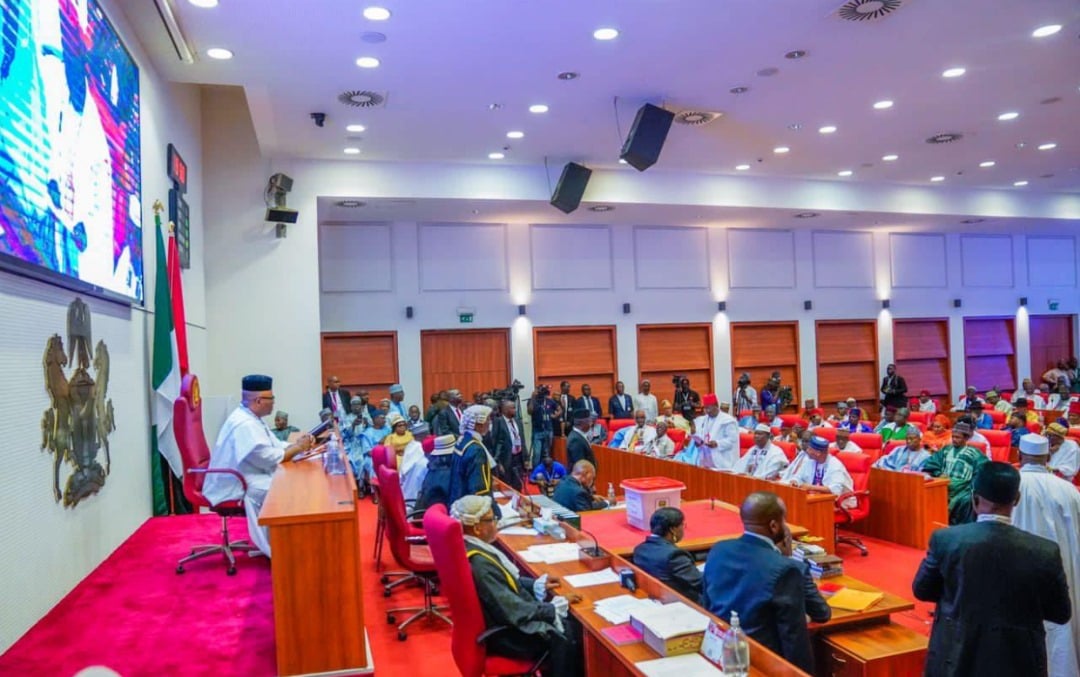
The Senate on Wednesday moved to tighten Nigeria’s anti-kidnapping laws by pushing for the death penalty for kidnappers — and anyone who finances, enables, or provides information to them — as lawmakers debated amendments to the 2022 Terrorism (Prevention and Prohibition) Act.

The proposal, sponsored by the Leader of the Senate, Opeyemi Bamidele, seeks to classify kidnapping, hostage-taking, and related crimes as terrorism, giving security agencies wider powers to track, disrupt, and prosecute criminal networks across the country.

The debate dominated Wednesday’s plenary, drawing contributions from key senators including Adams Oshiomhole, Orji Uzor Kalu, and Minority Leader Abba Moro.

The session was presided over by Senate President Godswill Akpabio.

After hours of deliberation, the Senate unanimously approved the amendment bill for further legislative work and referred it to the Committees on Judiciary, Human Rights and Legal Matters (lead committee), National Security and Intelligence, and Interior.

The committees are expected to report back within two weeks.

Leading debate on the bill, Bamidele said the purpose was to “designate kidnapping, hostage-taking and related offences as acts of terrorism and prescribe the death penalty for such offences without option of fine or alternative sentence.”

He warned that kidnapping had evolved into “coordinated, commercialised and militarised acts of violence perpetrated by organised criminal groups.”

“Kidnapping has instilled widespread fear in communities; undermined national economic activities and agricultural output; interrupted children’s education; bankrupted families forced to pay ransom; overstretched our security forces, and claimed countless innocent lives,” the Senate leader lamented.

See also  Iran warns of ceasefire violation as US plans to escort Hormuz ships

According to him, the patterns of brutality associated with kidnapping “now carry all the characteristics of terrorism,” making it necessary to treat the offence under the counter-terrorism framework.

Bamidele added that the bill would empower security agencies with “broader operational authority, intelligence capabilities, and prosecutorial tools” to pursue terrorists and their enablers.

He stressed that the death penalty would apply not only to kidnappers but also to “their informants, logistics providers, harbourers, transporters, and anyone who knowingly assists, facilitates, or supports kidnapping operations,” adding that “attempt, conspiracy or incitement to kidnap attracts the same penalty.”

“Nigerians are kidnapped on highways, in schools, in homes, on farms and in markets,” he said. “This is not a mere crime. It is terrorism in its purest form.”

Backing the amendment, Oshiomhole criticised deradicalisation programmes for terror suspects, arguing that many offenders returned to crime.

“We should not continue with deradicalisation programmes again,” he said. “No more de-radicalisation. If you are caught and convicted for acts of terrorism, then the penalty should be death.”

Kalu also supported the bill, insisting that informants and sponsors of kidnappers must “face the consequence.”

“Nigerians have suffered at the hands of kidnappers. Young girls have been raped. Women have become widows for no reason. This must not continue again,” he said.

Senate Minority Leader Moro described the bill as “a unanimous decision of the Senate,” noting that it was necessary to impose capital punishment “with the hope that kidnappers will face the penalty.”

Senator Victor Umeh, in his contribution, condemned the rising trend of abductions and the killing of victims even after ransom payments. He said financial institutions aiding such crimes must also be scrutinised.

See also  Security crisis: Tinubu, Macron hold talks as US fact-finders arrive

Last week, the Senate took a similarly tough stance as it debated a motion following the November 18 attack on Christ Apostolic Church, Eruku, in Ekiti LGA of Kwara State, where gunmen killed two worshippers and abducted 38 others.

Although all victims were later rescued, lawmakers said the incident exposed the spread of insurgent cells into the South and worsening insecurity in rural communities.

The debate stemmed from a motion by Senator Yisa Ashiru titled ‘Urgent Need to Address Escalating Insecurity in Kwara, Kebbi, and Niger States and Strengthen National Security Frameworks.’

Senators also raised concerns over rising school abductions, which have led to shutdowns in parts of Kebbi, Niger, Kwara, and all 47 Federal Unity Colleges nationwide.

The latest amendment effort signals a tougher legislative push as insecurity — particularly kidnapping for ransom — continues to devastate communities across the country.

punch.ng

FOLLOW US ON:

FACEBOOK

TWITTER

PINTEREST

TIKTOK

YOUTUBE

LINKEDIN

TUMBLR

INSTAGRAM

Continue Reading
Click to comment

Leave a Reply

Your email address will not be published. Required fields are marked *

News

PFIPC scandal: Gbajabiamila invited, not arrested – ICPC

Published

on

The Independent Corrupt Practices and Other Related Offences Commission has dismissed reports suggesting that the Chief of Staff to the President, Femi Gbajabiamila, was arrested over the Presidential Foreign Investment Promotion Council scandal, insisting that he only honoured an invitation from investigators.

The anti-graft agency clarified this in a statement posted on its Facebook page on Tuesday, following reports that Gbajabiamila visited the commission’s headquarters in Abuja on Monday in connection with the ongoing investigation into the purported PFIPC.

In the statement, the ICPC said the Chief of Staff voluntarily appeared before investigators and was not arrested.

“The Commission confirms that the Chief of Staff’s visit was on the invitation of its investigators and consistent with its ongoing efforts to gather all relevant facts in the matter.

“He was not arrested; he simply willingly honoured an invitation,” the statement read.

The commission said President Bola Tinubu had directed it to investigate how the PFIPC allegedly operated from the Federal Secretariat in Abuja for about two years under Adeniyi Adeyemi, who presented himself as the council’s Director-General.

According to the ICPC, Gbajabiamila arrived at its headquarters on Monday afternoon, responded to investigators’ enquiries and left after giving his statement.

“The Independent Corrupt Practices and Other Related Offences Commission (ICPC) confirms that the Chief of Staff to the President, Mr Femi Gbajabiamila, was at the Commission’s headquarters in Abuja on Monday, 20th July, 2026, to give a statement in connection with the ongoing investigation into the circumstances surrounding the purported Presidential Foreign Investment Promotion Council (PFIPC),” the statement said.

See also  PDP firestorm: Wike camp rejects expulsion as four states challenge Makinde

It added that investigations into the alleged fake agency were ongoing and that further updates would be provided as necessary.

PUNCH Online had earlier reported that Gbajabiamila appeared before the ICPC on Monday after Tinubu directed the commission to investigate the circumstances surrounding the PFIPC, an entity the Presidency has disowned as fraudulent.

The controversy has prompted parallel investigations by the House of Representatives, with several government agencies and officials appearing before lawmakers over how the purported council allegedly secured office space, budgetary allocation and other official documentation.

At a public hearing convened at the National Assembly Complex by the House of Representatives on Monday, the Central Bank of Nigeria admitted that it had opened two foreign-currency domiciliary accounts for the phantom agency.

Speaking before the House’s Ad-hoc Committee investigating the matter, chaired by Yusuf Gagdi and inaugurated by Speaker Tajudeen Abbas, the Director of CBN Banking Services Department, Hamisu Ibrahim, said the accounts, one in US dollars, the other in British pounds sterling, were opened following a mandate received from the Office of the Accountant-General of the Federation.

“On July 30, 2025, we received a mandate dated July 29, 2025 from the Office of the Accountant-General. We received the mandate to authorise two accounts, one a US dollar domiciliary account, the other a pound domiciliary account, for the Presidential Economic Advisory Council/Presidential Foreign Investment Promotion Council,” Ibrahim told the committee.

He explained the CBN’s verification process, saying, “The process of opening an account requires a mandate from the Office of the Accountant-General of the Federation.

See also  Delayed Electoral Act amendment could disrupt 2027 poll timetable – INEC

“Once we receive that mandate, we perform all the necessary verifications to confirm that this mandate is actually coming from that office.

“The department that handles the mandate is different from the department that actually does the account opening,” he said.

He, however, noted that no one came to activate the accounts after they were opened.

Adeyemi was arrested and is facing prosecution over the matter.

punch.ng

FOLLOW US ON:

FACEBOOK

TWITTER

PINTEREST

TIKTOK

YOUTUBE

LINKEDIN

Continue Reading

News

Uzodimma approves N25bn judges’ quarters, N1.9bn CBT centres for Imo

Published

on

Imo State Governor, Hope Uzodimma, has approved the construction of judges’ quarters valued at N25bn as part of efforts to improve the welfare of judicial officers in the state.

The governor also approved N1.9bn for the establishment of four computer-based test centres in Orlu Zone and the creation of a smart digital signage system to modernise the state’s infrastructure.

The approvals were announced on Tuesday by the Commissioner for Information, Public Orientation and Strategy, Declan Emelumba, while briefing journalists after the State Executive Council meeting presided over by the governor in Owerri.

Emelumba said the council approved N25bn for the construction of 40 duplexes for judges, alongside recreational facilities.

He said, “The Council approved N25 billion for the construction of 40 duplexes as judges’ quarters, complete with recreational facilities. The project is designed to provide a conducive living environment for judicial officers.”

The commissioner added that the council also approved the establishment of new computer-based test centres and a smart digital signage initiative.

“Also approved are the new computer-based test (CBT) centres and a smart digital signage initiative aimed at modernising infrastructure across the state,” he said.

According to him, the council approved N1.9bn for the establishment of four CBT centres in Orlu Zone to improve access to the Joint Admissions and Matriculation Board examinations and other computer-based tests.

He said N900m would be released immediately to commence work at two pilot centres located at Bishop Shanahan Okoye Secondary School and Community Secondary School, Omuma.

Emelumba further disclosed that the council approved the establishment of Imo Signage Asset Management Limited to regulate and deploy smart digital billboards through a public-private partnership.

See also  Typhoon kills 140 in Philippines

Speaking on the digital initiatives, the Commissioner for Digital Economy and E-Government, Chimezie Amadi, said the projects would be financed by private investors without financial commitment from the state government.

According to him, the initiative would be funded “at no cost to the Imo State Government,” adding that Internet of Things-enabled infrastructure would support a modern, digitally managed signage ecosystem.

punch.ng

FOLLOW US ON:

FACEBOOK

TWITTER

PINTEREST

TIKTOK

YOUTUBE

LINKEDIN

Continue Reading

News

You’re too big for REA chairmanship, Fayose ’s brother tells ex-governor

Published

on

Isaac Fayose has told his elder brother, Ayo Fayose, to hand off his newly announced Rural Electrification Agency chairmanship to his son. He said the former Ekiti State governor was too politically significant for such a role.

The younger Fayose made the remark in a video on his Instagram page on Monday, reacting to the Presidency’s announcement that his brother had been appointed chairman of the REA board alongside 25 others named into the leadership of 10 federal agencies and commissions.

According to a statement by the President’s Special Adviser on Information and Strategy, Bayo Onanuga, Fayose would chair the board alongside Ahmadu Abubakar and Ilyasu Ibrahim Makinta as non-executive directors, with the agency’s incumbent Director-General, Abba Abubakar Aliyu, and three executive directors retained.

Isaac opened his post by contrasting the chairmanship with more senior positions he believed his brother deserved, saying, “They said they gave my brother a DG, DG, not a minister, not ambassador.”

He argued that the appointment fell short of his brother’s stature, adding, “They said they gave him DG, head of parastatal, chairman of a committee. They no see give him minister, they no give him ambassador.”

Drawing a comparison with a government critic-turned-appointee, he said, “Even Reno Omokri sef, they gave him ambassador. They couldn’t give my brother ambassador,” and later pressed the point further, asking, “So why just chairman of a parastatal?”

Isaac linked the timing of the appointment to a weekend visit by former Labour Party presidential candidate, Peter Obi.

Prince Isaac Fayose. Credit: Facebook

He said, “They gave my brother DG because Obi came on Saturday to visit me. So they said, no, we must enter that family.”

See also  Anxiety as retired police officers, Sowore stage ‘mother of all protests’ in Abuja, others

PUNCH Online had reported that Isaac hailed Obi as Nigeria’s “incoming president” when the NDC candidate visited his home on Saturday, days after threatening to withdraw his backing, with Obi responding that many of those criticising Isaac online were not genuine supporters of the movement.

He said his brother had long maintained that he had no interest in government positions after leaving office, quoting him as having vowed that whenever he left government house, he would not become a minister, a director-general or a senator, and would return instead to face his private business.

He said, “But my brother told me, Ayodele Peter Fayose, told me, ‘Isaac, when I’m leaving this government house, whenever I leave this government house, I will not be a minister, I will not be DG, I will not be senator, I will not be anything. I will face my business.’”

Isaac noted that his brother had been financially independent long before holding public office, stating that he had been a billionaire from “when I was a baby, and had continued to do well in private business.”

He described the appointment as a “Greek gift” and questioned the timing directly, asking, “Why didn’t they give you appointment since? Why did they wait till Obi come?”

Addressing his brother, he said, “I know you will not take this. But if you take it, who am I? Who am I? Omo Oba.”

He then offered congratulations while telling him to pass the position on instead.

He said, “Congrats on your appointment. You better give your son. Please, don’t use that kind of appointment. You are too big for that. Afobaje ni e,” loosely translated as “you are a kingmaker.”

See also  ‘Sleeping Prince’ of Saudi Arabia dies after 20 years in coma

Beyond the appointment, Isaac used the post to restate his confidence in the opposition’s chances in the 2027 general election.

He said, “I am ready to see it through. And I know what we have on ground in Nigeria today. Election, we have 62 per cent, total vote cast, free and fair, credible.”

He dismissed suggestions that the vote would be manipulated, adding, “I’m not scared… They are scared of what they don’t know.”

punch.ng

FOLLOW US ON:

FACEBOOK

TWITTER

PINTEREST

TIKTOK

YOUTUBE

LINKEDIN

Continue Reading

Trending