Connect with us

News

Indian Army Places Emergency Order For PULS Rocket Systems As Artillery Recast Into Integrated Strike Formations

Published

on

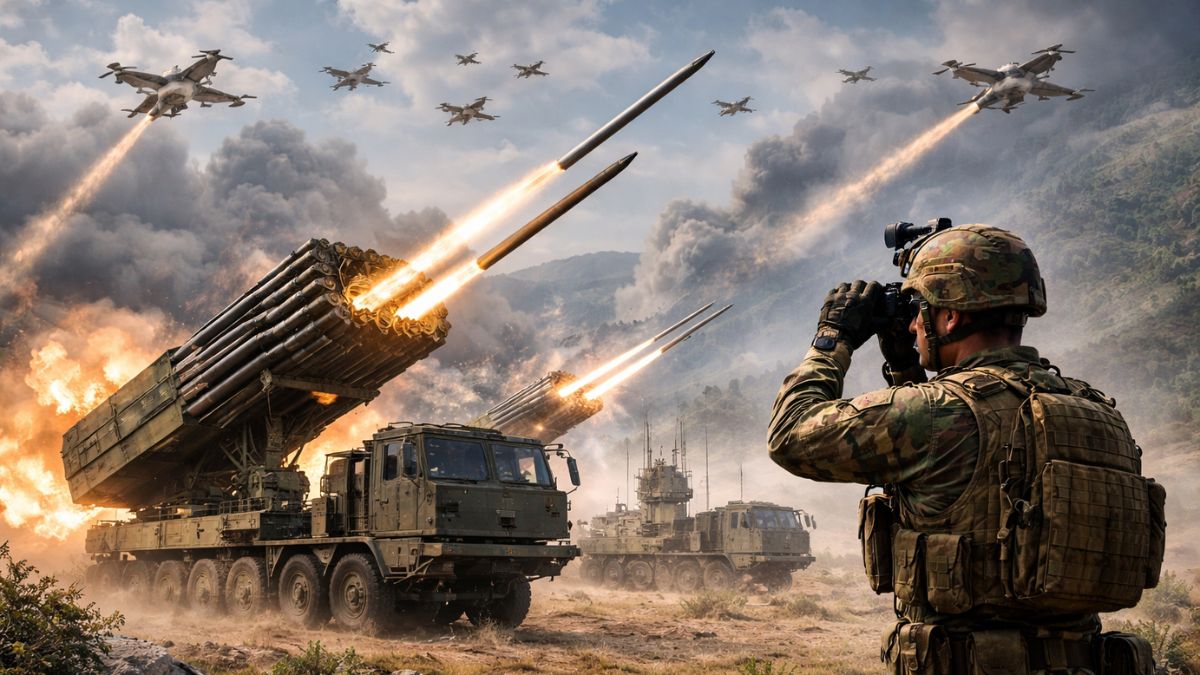
An emergency order for new rocket systems comes as the Army presses ahead with a wider overhaul of its artillery arm. Together the moves point to a shift towards precision long range strike and integrated formations that are redefining how India plans to fight on land.

In a major boost to India’s deep-strike and precision warfare capabilities, the Indian Army has placed a ₹292 crore emergency procurement order with indigenous defence manufacturer NIBE Limited for ground equipment, accessories and ammunition for its universal rocket launcher systems, even as the Army completes a sweeping transformation of its artillery arm into integrated strike formations.

Together, the twin developments underline a decisive shift in India’s land warfare doctrine: from gun-centric firepower to technology-driven, multi-domain strike capability.

What was the contract with NIBE for?

NIBE Limited informed stock exchanges that it has signed a supply contract with the Ministry of Defence for manufacturing and delivering equipment for Universal Rocket Launcher Systems capable of firing multiple rocket types, including long-range munitions with strike ranges of up to 150 km and 300 km.

According to Army sources, the systems relate to the Israeli-origin PULS (Precise & Universal Launching System), with procurement being executed under the Emergency Procurement (EP) route. Deliveries will be completed in tranches within 12 months.

What is the EP mechanism for procurement?

The EP mechanism, introduced after the 2020 standoff with the Chinese PLA in eastern Ladakh, allows fast-tracked acquisitions to meet urgent operational requirements.

Under current rules, Vice Chiefs of the Army, Navy, and Air Force can clear emergency capital procurements of up to ₹300 crore, enabling the services to rapidly plug critical capability gaps during heightened security situations.

See also  PHOTOS: Police confirm 23 d3ad, 108 injured in Maiduguri su!cide b0mbings

How does the PULS strengthen Army’s rocket forces?

The PULS-linked order is part of the Army’s long-term plan to significantly strengthen its rocket forces. In June 2025, reports confirmed the raising of two additional regiments of the indigenous Pinaka Multi-Barrel Rocket Launcher (MBRL) system.

In artillery parlance, a regiment consists of three batteries, each operating six launchers, making rocket artillery a central pillar of India’s long-range strike posture.

These rocket units fall under the Regiment of Artillery, raised in 1827 and popularly known as the “God of War,” the Army’s second-largest combat arm after infantry. Traditionally focused on massed gunfire, artillery is now undergoing its most far-reaching reorganisation in a century.

How is the Army raising specialised artillery regiments?

Months after announcing post-Operation Sindoor restructuring, the Ministry of Defence has begun equipping specialised artillery formations, known as Shaktibaan regiments, with loitering ammunition and swarm drones.

The Defence Acquisition Council (DAC) recently cleared procurement of loitering munitions for these units, which will be forward-deployed along the western front with Pakistan and the northern border with China. The Army plans to raise 25 such regiments.

What are the Shaktibaan regiments?

Unlike conventional artillery, Shaktibaan regiments will not rely on guns. Instead, they will operate loitering ammunition, both long- and medium-range, and swarm drones as primary means of attack, enabling rapid detection, decision-making, and engagement of targets.

Indigenous systems such as the Nagastra loitering munition are already available, while multiple drone swarms have been tested across varied altitudes.

What is the Divyaastra batteries concept?

Complementing Shaktibaan is the Divyaastra concept, created after Operation Sindoor (May 7–10, 2025). Five Divyaastra batteries have already been raised and validated during Exercise Divya Drishti in East Sikkim.

See also  Tinubu revokes pardon for Sanda, 140 high-profile inmates

These units blend long-range artillery guns, UAV-based surveillance, counter-drone systems, and AI-enabled fusion centres into a single, self-contained strike package.

What are Divyaastra batteries capabilities?

Divyaastra batteries can conduct deep-precision strikes, real-time surveillance, and independent operations. When reconnaissance drones detect enemy positions, data flows instantly into AI-enabled fusion centres, which recommend optimal engagement options — whether gunfire, loitering missile, or drone strike.

Integrated electronic warfare, laser-based kinetic kill systems, and the Akashteer Integrated Command and Control System provide layered air defence against hostile UAVs.

How do these rework the Indian Army’s artillery?

This evolution marks a fundamental reconceptualisation of Indian artillery. From 260 largely standardised gun formations, the arm is transitioning into agile, tech-heavy strike formations that integrate conventional firepower with unmanned systems and artificial intelligence.

A 2022 study on reorganisation and rightsizing of the Army had flagged the need for such changes, while ARTRAC has begun reorienting training and education across gunner schools and regimental centres.

Together, the emergency induction of PULS rocket systems and the rise of Shaktibaan and Divyaastra signal a new era, one where India’s artillery is no longer just supporting arms, but a decisive, autonomous strike force shaping the battlefield of the future.

Credits: RNAMEDIA.IN

FOLLOW US ON:

FACEBOOK

TWITTER

PINTEREST

TIKTOK

YOUTUBE

LINKEDIN

TUMBLR

INSTAGRAM

Continue Reading
Click to comment

Leave a Reply

Your email address will not be published. Required fields are marked *

News

Photos: Jonathan Visits Tinubu At Presidential Villa

Published

on

President Bola Ahmed Tinubu on Wednesday met former President Goodluck Jonathan at the Presidential Villa.

It was reports that this was disclosed by Tinubu’s Special Adviser on Information and Strategy, Bayo Onanuga.

A reason for the meeting has not been disclosed as at the time of filing this report.

Former President Goodluck Jonathan meets President Bola Ahmed Tinubu

Meanwhile, Jonathan has responded to erstwhile Vice President Atiku Abubakar over his submission on his competency during his time in office.

It was reports that Atiku, during a live television interview, claimed that Jonathan made many mistakes while he was President because he was inexperienced.

“I know Goodluck Jonathan very well. He is a decent young man, but also inexperienced, and I believe that contributed to his inability to manage the affairs of the country, particularly when he was faced with challenges,” he said.

Reacting to Atiku’s statement during the 2025 Association of Retired Career Ambassadors of Nigeria awards ceremony in Abuja on Monday, Jonathan said no one who becomes a governor or president would say he did not make mistakes.

He defended his administration, adding that he did his best while in office.

Jonathan said: “So not too long ago, a very senior politician said, ‘Oh, Jonathan was too young and probably that’s why he made mistakes.’

“If I made mistakes, yes, nobody who becomes a governor or a president will say you did not make mistakes. Even when you promote yourself to the level of a god, you become a deity.

See also  Tinubu revokes pardon for Sanda, 140 high-profile inmates

“All human beings must make mistakes. I became president in 2010 at the age of 53. I left in 2015 at the age of 58, and they say I was too young. Must it have been 100 years before I ran the affairs of the state?”

FOLLOW US ON:

FACEBOOK

TWITTER

PINTEREST

TIKTOK

YOUTUBE

LINKEDIN

INSTAGRAM

Continue Reading

News

Alleged coup plot: DSS moves detained Islamic cleric, Zaria to court for trial

Published

on

Sheik Abdukadir Sani Zaria, the Islamic scholar arrested by Defence Intelligence Agency, DIA, in connection with the alleged plot to overthrow the government of President Bola Tinubu has been moved to the Federal High Court in Abuja for prosecution.

He was brought to court with a retinue of security escorts and his personal associates.

Sani who has been in the detention facility of the DIA and later the Department of the State Service, DSS, since December 2025, was named among the six coup plotters on the charge sheet filed by the Federal Government and billed for arraignment in court today, Wednesday.

He is to be put on trial by the Office of the Attorney General of the Federation and Minister of Justice, AGF, along with five others, including military officers accused of plotting to wage war against the Federal Republic of Nigeria.

The Islamic cleric was named in counts 1, 2, 3,4, 6 and 7 of conspiring with others to commit felony while he was separately charged on count 9 of the 13-count charge.

Among the accusations against him were that he conspired to bring down a legitimate government, concealed information on the coup plot and rendered support to the coup plotters.

In count 9, the cleric was accused of retaining a sum of N2 million in his account with number 0005620270 domiciled at Jaiz Bank and transferred into the account by a Company, “A & A Express Link Concept” whose ownership was traced to one Colonel Mohammed Alhassan Ma’aji, said to be the arrow head of the coup plot.

See also  Malami, wife, son granted N200m bail in EFCC trial

His offense of terrorism financing was said to be contrary to section 18 (2) (d) of the Money Laundering Prevention and Prohibition Act 2022 and punishable under section 18 (3) of the same Act.

Justice Peter Odo Lifu of the Federal High Court in Abuja had on Monday ordered immediate unconditional release of the Islamic scholar from the custody of the
DIA and later the DSS.

The judge had imposed a fine of N2 million each on DIA and DSS to be paid to the cleric for breaching sections 35 and 36 of the Federal Republic of Nigeria’s Constitution in the ways and manners the 75 year old man was hauled into detention for more than four months without trial.

In a judgment on the fundamental rights suit instituted against DIA and others by the detained Islamic cleric,

Justice Lifu ordered the Economic and Financial Crimes Commission, EFCC, and Jaiz Bank to pay N1 million each as compensation to him for freezing his bank account without order of any law court.

Besides, the Federal High Court directed the DIA and DSS to tender a public apology to the detained islamic scholar for the breach of his fundamental rights.

Sheikh Sani Abdulladir Zaria was hauled into detention without order of court for allegedly associating with one of coup plotters against President Bola Ahmed Tinubu.

Justice Lifu had lambasted the DIA for its refusal to subordinate itself to civil rule and rule of law by refusing to produce the detained man in court when ordered to do so.

See also  Nigerians easily become UK citizens – Badenoch

He said that as agency established by law, the DIA should not place itself above the laws of the land in the discharge of its statutory functions.

The judge held that the provisions of Section 36(1)(5) and (6) of the 1999 Constitution avail him and “for all citizens.”

He noted that Nigeria, being a signatory to different international conventions on human rights, cannot afford to be held behind on such issues.

The judge noted that since December 11, 2025, the applicant was kept in “safe custody” without access to family and associates after an investigation was opened about him, on grounds described as security reasons.

Justice Lifu ordered the AGF to ensure immediate compliance with the judgment of the court.

The cleric had been hauled into the DIA custody since December last year following the discovery of N2 million in his Jaiz Bank account paid by one of the indicted coup plotters.

Although he agreed to forfeit the amount to the Federal Government to regain his freedom, the security agency held him to determine the level of his complicity in the alleged coup plot.

The Islamic cleric claimed innocence of the alleged crimes adding that the person who transferred the money into his account was just one of his disciples.

FOLLOW US ON:

FACEBOOK

TWITTER

PINTEREST

TIKTOK

YOUTUBE

LINKEDIN

INSTAGRAM

Continue Reading

News

IGP Disu meets NAPTIP DG, pledges stronger action against human trafficking

Published

on

The Inspector-General of Police Olatunji Rilwan Disu, has pledged stronger collaboration with the National Agency for the Prohibition of Trafficking in Persons, NAPTIP, in efforts to tackle human trafficking and organised crime.

The development was disclosed in a statement shared on April 22, 2026 on the official page of the Nigeria Police Force.

According to the statement, the commitment was made when the Director-General of NAPTIP, Binta Adamu Bello, paid a courtesy visit to the Force Headquarters in Abuja on April 21.

Discussions during the meeting focused on improving cooperation between both agencies, particularly in the areas of intelligence sharing, joint operations and capacity building.

The NAPTIP boss sought increased technical support and operational collaboration to strengthen the agency’s ability to address human trafficking and related crimes.

In his response, Disu assured that the police would support NAPTIP through intelligence-led strategies and coordinated operations aimed at dismantling criminal networks.

“The Force will deploy its operational and intelligence capabilities to support NAPTIP’s mandate,” the statement said.

Disu noted that specialised units, including the Intelligence Response Team and the police cybercrime unit, would provide technical assistance, while training programmes would also be expanded for NAPTIP personnel.

The two agencies agreed to sustain regular engagements to monitor progress and strengthen efforts against trafficking and organised crime across the country.

FOLLOW US ON:

FACEBOOK

TWITTER

PINTEREST

TIKTOK

YOUTUBE

LINKEDIN

INSTAGRAM
See also  Nigerians easily become UK citizens – Badenoch
Continue Reading

Trending