Connect with us

Education

Read how students can win FG’s ₦365m national laureate prize

Published

on

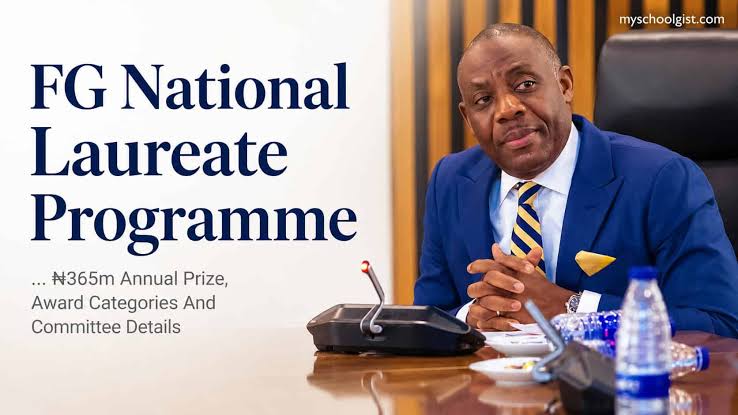
The Federal Government has opened the Tertiary Institutions National Laureate Prize, an annual ₦365 million scheme designed to reward and elevate outstanding research from Nigeria’s universities, polytechnics, monotechnics, and colleges of education.

Minister of Education, Dr Maruf Tunji Alausa, announced the opening of the prize on Thursday, following a press briefing with the Nigeria Education Repository and Databank National Laureate team.

He said the initiative aligns with President Bola Tinubu’s Renewed Hope Agenda by repositioning tertiary institutions as centres of research, innovation, enterprise and problem-solving rather than mere certificate-producing centres.

Prize structure

The annual prize fund of ₦365 million is structured as follows:

  • Undergraduate Star Prize: ₦35 million
  • Master’s Star Prize: ₦50 million
  • Doctoral Star Prize: ₦100 million
  • 15 Thematic Excellence Prizes: ₦12 million each, totalling ₦180 million

Across six thematic areas, one national thematic laureate is selected at each of the three academic levels — undergraduate, master’s and doctoral — producing 18 laureates in total.

Three of these receive the Star Prizes, while the remaining 15 receive the thematic awards.

The six thematic areas are Science, Engineering and Technology; Medicine and Health Sciences; Arts and Social Sciences; Agriculture; Law; and Teaching Innovation.

A special Dr Stella Adadevoh Prize, or Excellence Award, for Medicine and Medical Innovation honours the late physician whose actions helped contain Nigeria’s 2014 Ebola outbreak.

It is conferred on the laureate whose work and conduct best embody integrity, national service and protection of the public good.

Who is eligible?

The prize is open to students and researchers in every accredited tertiary institution in Nigeria — federal, state or private.

See also  FG unveils digital portal for teachers’ registration, licensing

Undergraduate dissertations or recognised equivalents, master’s theses and doctoral theses, or equivalents from polytechnics, monotechnics, colleges of education and similar institutions, are eligible if they demonstrate strong commercial potential, industrial application or clear developmental impact.

Works must meet research integrity and originality standards.

Every nominated work must first be deposited in the NERD system and issued a valid National Document Number.

An NDN confirms deposit but does not automatically enter a work into the competition.

How students can position themselves to win

Students cannot submit entries directly. Only institutions, through their formally constituted Institution Laureate Selection Committees, can nominate and enter works.

Each institution may submit up to 18 entries: up to six undergraduate, six master’s and six doctoral entries, or their equivalents, drawn from the six thematic areas, generally one per theme at each level.

To maximise their chances, students should:

  • Produce exceptional work with demonstrable commercial, industrial or developmental value that addresses national challenges.
  • Ensure the dissertation, project or thesis is fully submitted to NERD and assigned a valid NDN before the institutional selection window closes.
  • Actively engage their supervisor, co-supervisor, head of department and other academic leaders. Ask them to present their work to the Institution Laureate Selection Committee for independent review.

Institutional selection is the first gateway. High-quality research and proper NERD compliance can improve the prospects of nomination.

How institutions submit entries

Once an institution’s Laureate Selection Committee has chosen its strongest works, authorised members follow the submission process on the National Laureate portal.

Step 1: Log in to the National Laureate Committee portal. This assumes the institution has constituted its Laureate Selection Committee and directed its NERD Focal Officer to enrol and formally designate the appointed members on NERD. Committee members require this designation to access the Laureate portal using their existing NERD credentials.

See also  Engineering programmes to admit students by approved quotas – COREN

Step 2: On the Laureate Dashboard, click Manage Institution Entries from the top-right menu.

Step 3: The next page will display the dissertations, projects and theses submitted within the institution, grouped under the relevant academic levels: undergraduate, master’s and doctoral, or their recognised equivalents.

Step 4: Use the filters at the top of the page to search for a specific dissertation, project or thesis.

Step 5: Once the work the committee intends to enter is located, click View to review the submission details carefully and confirm that all information is correct.

Step 6: On the View page, click View Submission Evidence to confirm that all required departmental and institutional attestations have been supplied.

Step 7: Click Open Authoritative Student File to view the exact PDF of the dissertation, project or thesis as originally submitted.

Step 8: If everything is in order, click Back to Previous Page or Back to Dashboard to return to the relevant work.

Step 9: Tick the oath checkbox and read the declaration carefully before proceeding. By ticking the box, the committee is making the prescribed institutional declaration in respect of the entry.

Step 10: Click Submit Entry. This completes the submission process for that entry. The committee may then proceed to review and submit other eligible works.

Deadline for submission

The deadline for institutional entries is August 31, 2026.

What happens after institutional submission?

Entries progress through a three-tier process: Institution Committee, Regional (zonal) Committee, and National Committee.

The National Laureate Committee, chaired by Emeritus Professor Abubakar Sambo, oversees the final evaluation.

See also  It Was Like Being In Prison – Kemi Badenoch Speaks On Secondary School Experience In Nigeria

The process is designed to be transparent, competitive and merit-driven, with emphasis on academic excellence and impact.

Winners are expected to be honoured at a National Laureate Gala later in the year, previously indicated for November.

Source: punchng.com

FOLLOW US ON:

FACEBOOK

TWITTER

PINTEREST

TIKTOK

YOUTUBE

LINKEDIN

INSTAGRAM

Continue Reading
Click to comment

Leave a Reply

Your email address will not be published. Required fields are marked *

Education

WAEC result crisis worsens as official alleges irregularities, glitches

Published

on

The crisis surrounding the recently released West African Examinations Council 2026 results for school candidates has deepen following an allegations of glitches and irregularities by an official of the examination body.

The Head of Examinations at the WAEC office covering in Anambra, Olanrewaju Fadehan, made the allegations in a now viral video, claiming that candidates who sat the computer-based version of the examination were particularly affected.

Fadehan alleged that the problems were noticeable around the release of the results, which he said was initially expected to be announced between August 3 and 5, 2026, adding that WAEC had traditionally released results on Mondays.

He said, “Obviously, there was a problem because the press was eagerly waiting on Monday, the scheduled date. There was a need to quickly do some last-minute adjustments. Something was wrong.”

According to him, the alleged last-minute adjustments affected candidates who sat the computer-based examination, particularly in subjects including Mathematics, English and Igbo.

He also expressed concern over reports that some candidates from the South-East performed poorly in Igbo, despite the subject being widely spoken in the region.

Fadehan said schools that invested heavily in computer-based examination facilities were also affected, alleging that some spent over N60m establishing the facilities in anticipation of the transition to CBT.

“The call for a review this year is particularly disturbing, as it is alarming. Schools that subscribed to the CBT innovation of WAEC were badly hit. Some of them spent upwards of N60m and above to set up their CBT facilities,” he alleged.

See also  Minister Pledges Investment In Education For Youth Empowerment

He further alleged that some candidates were not provided with appropriate calculators during the examination, claiming that the development contributed to poor performance in mathematics and other calculation-based subjects.

Fadehan said he had raised concerns about the alleged irregularities during the examination and subsequently petitioned relevant authorities, including the WAEC Board, the House of Representatives Committee on Basic Education and Examining Bodies and the Minister of Education.

He alleged that rather than addressing his complaints, he was subjected to disciplinary proceedings and subsequently placed on interdiction.

“I call on the President of the Federal Republic of Nigeria, President Bola Ahmed Tinubu, to investigate the cause of failure of candidates, particularly those who chose the computer-based WAEC,” he said.

He also made allegations of financial impropriety against the management of the examination body, including claims concerning the supply of calculators, students’ identification cards and charges imposed on candidates and other service seekers.

He urged the federal government and other stakeholders to investigate the allegations, stressing that the integrity of the examination system was important to the future of Nigerian students.

When contacted for a reaction to the allegations on Thursday, the WAEC Head of Public Affairs, Moyosola Adesina, declined to comment on the matter.

“No comment for now,” she said.

The PUNCH reported on August 18 that the examination body is facing growing scrutiny over the integrity of its released WASSCE results for school candidates, as school administrators and education advocates allege grading anomalies and technical glitches linked to the expanded Computer-Based Testing rollout.

See also  It Was Like Being In Prison – Kemi Badenoch Speaks On Secondary School Experience In Nigeria

The concerns had followed complaints from school administrators and education advocates who claim that some high-performing students received lower grades than expected, based on their academic records and performance in other standardised assessments.

Source: punchng.com

FOLLOW US ON:

FACEBOOK

TWITTER

PINTEREST

TIKTOK

YOUTUBE

LINKEDIN

INSTAGRAM

Continue Reading

Education

FG halts foreign scholarships, redirects funds home

Published

on

The Federal Government is reviewing its foreign scholarship and bilateral education arrangements as part of efforts to eliminate unnecessary expenditure and redirect public resources towards strengthening Nigerian tertiary institutions, the Minister of Education, Dr Tunji Alausa, has said.

Alausa said the government could no longer justify spending scarce public funds to send students abroad to study programmes that are already available in Nigerian universities, polytechnics and colleges of education.

The minister disclosed this while explaining the rationale behind the Federal Government’s decision to review its overseas scholarship arrangements, stressing that the policy was driven by the need to build domestic capacity and ensure better value for public expenditure.

He recalled that shortly after assuming office, he was presented with a proposal involving about 100,000 Nigerian students travelling to Morocco to study courses taught in English, including mass communication and journalism.

According to him, the proposal raised serious concerns because the courses were already available in Nigeria, while the students would have had to spend their first year learning French before commencing their programmes.

Alausa said, “Number one, we have all those courses in Nigeria. And yet, number two, they were going to spend the first year learning French before they started the programme.”

He added that the cost of supporting such students abroad could not be justified when Nigeria had developed considerable capacity in its tertiary institutions over the years.

“And number three, in the position of a few million to support this in Nigeria, we support thousands of them,” he said.

See also  WAEC result crisis worsens as official alleges irregularities, glitches

The minister said the government therefore concluded that continuing the arrangement in its previous form would amount to an inefficient use of public resources.

“So the Bilateral Education Agreement was not making sense, again, to us in government. It was a way to waste government funds,” Alausa said.

He added, “And this President will not waste any public funds.”

The latest position builds on the Federal Government’s earlier decision to discontinue government-funded BEA scholarships while retaining support for students already enrolled under the previous arrangements.

The Federal Government has clarified that existing beneficiaries of the bilateral scholarship programme would not be abandoned and would continue to receive support until the completion of their studies, while new government-funded awards under the arrangement were discontinued following a review of the programme.

The policy does not amount to a blanket ban on Nigerians receiving scholarships from foreign governments.


Foreign governments willing to sponsor Nigerian students can continue to offer such opportunities, but the Federal Government intends to be more selective about committing Nigerian public funds to overseas education.

Alausa similarly explained that foreign countries willing to continue sponsoring Nigerian students could do so without necessarily requiring financial support from the Nigerian government.

The minister said the circumstances that justified sending large numbers of Nigerian students abroad decades ago had changed considerably.

“When those programmes were set up 20 years ago, they were meant to get students to go to the government colleges where we did not have capacity.

“But in the last 20 years, we’ve built a number of capacities in the tertiary institutions — universities, polytechnics and colleges,” he added.

See also  Ajaero faults partial implementation of minimum wage in Abia varsity

The scholarship review comes amid broader reforms by the Federal Ministry of Education aimed at repositioning Nigeria’s education system under President Bola Ahmed Tinubu’s Renewed Hope Agenda.

The reforms have focused increasingly on strengthening domestic tertiary institutions, expanding technical and vocational education and training, improving digital education, promoting research and innovation, and making education more responsive to the needs of the economy.

The Federal Government has also intensified efforts to strengthen technical and vocational education and training, with emphasis on modernising curricula, developing industry-relevant skills and improving the capacity of institutions to produce graduates who can contribute directly to economic development.

Alausa has repeatedly argued that education spending must produce measurable outcomes, particularly given the country’s competing development needs and limited public resources.

The push to retain more education spending within Nigeria also reflects the government’s broader objective of strengthening local institutions rather than relying excessively on overseas opportunities.

Alausa said the government’s approach was not simply about withdrawing foreign scholarships but ensuring that public resources were deployed where they would have the greatest impact.

He cited an instance involving scholarship beneficiaries who were expected to study abroad but were instead studying in Nigerian universities, saying such situations further demonstrated the need to review the system.

“So we have to start with Nigerians,” the minister said.

The Federal Government has simultaneously been strengthening domestic student support mechanisms, including scholarships and bursaries for Nigerian students and the Nigerian Education Loan Fund, which provides financial support to students in tertiary institutions.

Alausa said the government’s broader objective was to create a tertiary education system capable of producing the skills, research and innovations required for national development.

He recently inaugurated the Tertiary Institution National Gallery Prize Committee to recognise outstanding academic research and innovation, particularly research with potential for commercialisation and industrial application.

“We want undergraduate researchers to see a clear pathway from academic research to industrial application, enterprise, innovation, and national development,” he said.

The minister said Nigeria could no longer afford to measure the success of its education system simply by the number of certificates awarded.

“The most successful nations of the 21st century will not necessarily be those endowed with greater natural resources. They will be those that can systematically transform knowledge into solutions, research and intellectual capital into economic and industrial value,” Alausa said.

Source: punchng.com

FOLLOW US ON:

FACEBOOK

TWITTER

PINTEREST

TIKTOK

YOUTUBE

LINKEDIN

INSTAGRAM

Continue Reading

Education

Tinubu moves EFCC recoveries, N242bn unclaimed dividends to NELFUND

Published

on

President Bola Tinubu on Wednesday directed that all liquid funds recovered by the Economic and Financial Crimes Commission, along with unclaimed dividends from the Capital Market Trust Fund and the Dormant Account Trust Fund, be diverted to the Nigerian Education Loan Fund to guarantee its long-term financial sustainability.

Minister of Education, Dr Tunji Alausa, disclosed this while briefing State House correspondents after the Federal Executive Council meeting presided over by Tinubu at the Presidential Villa, Abuja, on Wednesday.

The meeting is the council’s first sitting since June 29.

Alausa said, “The President has now directed that all funds recovered by the Economic and Financial Crimes Commission be diverted to NELFUND to continue to support its funding.

“This was also approved by FEC: that all unclaimed dividends from the Capital Market Trust Fund and the Dormant Account Trust Fund should also be directed to NELFUND, so that NELFUND will be financially buoyant to meet its growing obligations today.

“Note, and the President was very clear, not seized properties, or recovered looted funds, but liquid funds, from the EFCC will now be transferred to NELFUND.”

Unclaimed dividends in Nigeria currently stand at approximately N242bn, according to the Securities and Exchange Commission, having grown steadily from about N158.4bn in 2019 to N190bn in 2023 due to outdated shareholder records, unresolved estate matters for deceased investors, and missing bank account linkages, among other factors.

The EFCC has separately recovered over N566bn and $411m in monetary assets over the years, though Alausa clarified that Wednesday’s directive applies strictly to cash recoveries and excludes seized properties or other non-liquid assets.

See also  Minister Pledges Investment In Education For Youth Empowerment

Alausa argued that Tinubu had fulfilled his campaign commitment with the establishment of the fund as he disclosed that the Fund has benefitted over 1.2 million Nigerian students.

He said, “Today, we have over 1.2 million Nigerian students benefiting from NELFUND, and NELFUND has disbursed over N93bn as stipends to students all across public institutions in the country, both federal and state.

“NELFUND has also disbursed over N250bn as institutional fees to all public institutions across the country, both federal and state.

“This has been a phenomenal blessing to Nigeria and to every Nigerian child. We thank the President for that.”

Alausa noted that the President had directed the Attorney-General of the Federation, Lateef Fagbemi (SAN), to work with the Ministry of Finance, the Ministry of Education and the Debt Management Office to operationalise the movement of the unclaimed dividend funds.

“That will work, and look at the existing Act that set up these two trust funds on how we can move the money legally to NELFUND, and also work with the chairman of the EFCC to look at the entire basket of recovered funds.

“The President was very clear: not seized properties, or recovered looted properties, but liquid funds recovered by the EFCC will now be transferred to NELFUND,” he said.

He added that any funds still subject to ongoing legal challenges would be excluded from the transfer.

“Every single fund that is still subject to a legal challenge will not be part of the money that will be transferred to NELFUND.

“The funds that will be transferred will be all cleared funds, unencumbered funds, looted funds that legally belong to Nigerians,” Alausa said.

See also  Honorary awards: TASUED dismisses claims of snubbing Gbenga Daniel

The minister also announced that the council approved the deployment of an Entrepreneurship, Innovation and Business Incubation Certification Programme across 14 federal universities, describing it as a technology-driven initiative designed to equip students with entrepreneurship, innovation, business incubation and enterprise development skills, alongside digital learning certification, mentorship and incubation support.

“This programme will kick off in 14 federal universities this year, and we hope to expand it to all other tertiary institutions.

“It’s a programme that has been tested at the University of Lagos.

“It’s shown to improve students’ ability to be job creators and not job seekers, to make them innovators, to make them entrepreneurs,” Alausa said.

The 14 universities approved for the programme are Ahmadu Bello University, Bayero University Kano, Nnamdi Azikiwe University, Obafemi Awolowo University, University of Abuja, University of Benin, University of Ibadan, University of Ilorin, University of Jos, University of Lagos, University of Maiduguri, University of Nigeria Nsukka, University of Port Harcourt and Usmanu Danfodiyo University.

Council also approved the augmentation of an existing contract for the completion of the National Library of Nigeria headquarters complex in Abuja.

The project was first initiated on April 29, 2006, with an original two-year completion timeline set for February 28, 2008, but construction work stopped in October 2008.

Alausa explained, “President Bola Tinubu, when he came in, mandated that we look for real funds to complete this national library.

“He directed that we source funds from the Tertiary Education Trust Fund. Also, Her Excellency Senator Oluremi Tinubu indicated that all gifts for her last birthday should be directed towards the completion of the National Library. She was able to help us raise about N25bn.”

See also  It Was Like Being In Prison – Kemi Badenoch Speaks On Secondary School Experience In Nigeria

He revealed that, combined with TETFund resources, the total augmentation approved for the project stands at approximately N155bn, comprising N118.309bn for construction works and about N37bn for furnishing the complex.

“We’re hoping that construction will flag off in the next few months.

“Abandoned for 18 years, President Bola Tinubu has now been able to mobilise funds together for work to start again at the National Library,” Alausa said.

The council also approved a memo for the establishment of the Academy for Gifted and Talented Children.

The approval transmutes the existing Suleja Academy, originally set up to nurture gifted Nigerian children but which had, over time, been operating merely as a federal government college, into an autonomous institution with its own governing board.

“The academy will now function as an autonomous academy that will have its own board and council. We’ve also diversified how funds will come to the academy from appropriation, from endowment, and from gifts.

“We need to do this because we have to look for every single genius in this country, bring them in, nurture them, and let them help create the Nigeria of tomorrow,” Alausa said, adding that the AGF had been tasked with drafting the executive bill for onward transmission to the National Assembly.

Source: punchng.com

FOLLOW US ON:

FACEBOOK

TWITTER

PINTEREST

TIKTOK

YOUTUBE

LINKEDIN

INSTAGRAM

Continue Reading

Trending