Connect with us

Sports

Nigeria end historic AFCON scoring streak

Published

on

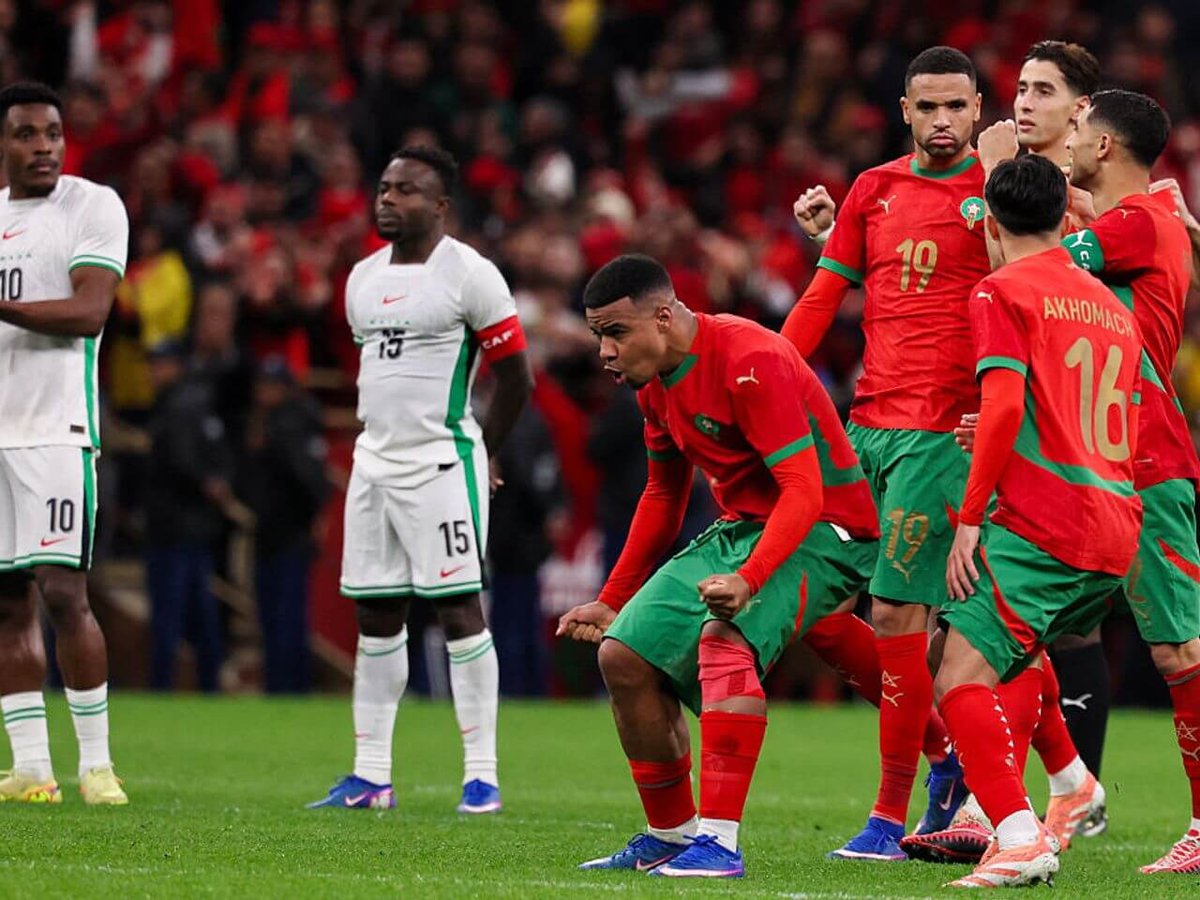
Nigeria’s Super Eagles saw their remarkable Africa Cup of Nations scoring run come to an end after being held to a goalless draw by hosts Morocco at the 2025 tournament, before suffering a 4-2 defeat in a penalty shoot-out, PUNCH Sports Extra reports.

The stalemate marked the first time Nigeria had failed to score at AFCON since their round of 16 exit against Tunisia in 2021, bringing to a close a sequence of 12 consecutive matches in which they had found the net at the continent’s biggest football event.

The last time the Super Eagles were blanked at AFCON was in Garoua, Cameroon, when Youssef Msakni’s goal secured a 1-0 victory for Tunisia in January 2021.

Since then, Nigeria had embarked on their longest scoring streak in the history of their AFCON participation, scoring consistently across two tournaments and establishing a reputation for efficiency and variety in attack.

The run began at the 2023 finals with a 1-1 group-stage draw against Equatorial Guinea, where Victor Osimhen scored Nigeria’s opener, and continued with a 1-0 win over Ivory Coast, sealed by William Troost-Ekong’s penalty.

An own goal from Opa Sanganté secured victory against Guinea-Bissau, before Ademola Lookman struck twice in a 2-0 round of 16 win over Cameroon.

Lookman was again decisive in the quarter-final against Angola, scoring the only goal, while Troost-Ekong converted another penalty in the semi-final draw with South Africa, a match Nigeria eventually won on penalties.

Despite taking the lead through Troost-Ekong in the final against Ivory Coast, the Super Eagles were denied the title as Franck Kessie and Sebastien Haller scored in the 62nd and 81st minutes to hand the hosts a 2-1 victory. Even in defeat, Nigeria’s scoring sequence remained intact.

That trend carried into the 2025 tournament in Morocco as Nigeria opened with a 2-1 win over Tanzania in Fez, with Semi Ajayi and Lookman on target, before edging Tunisia 3-2 thanks to goals from Osimhen, Wilfred Ndidi and Lookman.

See also  2026 WCQ: Nigeria’s W’Cup hopes on the line today, kickoff time

A 3-1 victory over Uganda followed, with Paul Onuachu opening the scoring and Raphael Onyedika netting twice, while the round of 16 brought a commanding 4-0 win over Mozambique, featuring goals from Lookman, Osimhen, Akor Adams and another Osimhen strike.

The quarter-final against Algeria in Marrakesh extended the streak to 12 matches, as Osimhen and Adams scored in a 2-0 win that took Nigeria’s goal tally for the tournament to 14.

That figure also represents the highest number of goals the Super Eagles have ever scored at a single AFCON edition, equalling the mark set by Cameroon and leaving them two short of the record 16 goals scored by Ivory Coast in 2008.

The goalless draw against Morocco not only ended the scoring run but also halted another landmark sequence, with Nigeria having scored at least two goals in each of their previous five matches at the tournament, the first time they had achieved such a feat at AFCON.

It was also only the second time in their history that the Super Eagles had scored in five consecutive matches at a single edition, the first being in 2000.

While the historic consecutive streak has now ended, Nigeria still have the opportunity to equal Ivory Coast’s record of 16 goals when they face Egypt in the third-place match on Saturday.

punch.ng

FOLLOW US ON:

FACEBOOK

TWITTER

PINTEREST

TIKTOK

YOUTUBE

LINKEDIN

TUMBLR

INSTAGRAM

Continue Reading
Click to comment

Leave a Reply

Your email address will not be published. Required fields are marked *

Sports

Tyson Fury Vows To Knock Out Anthony Joshua Within Seven Rounds

Published

on

Tyson Fury has vowed to knock out Anthony Joshua within seven rounds when the British heavyweights meet at Cardiff’s Principality Stadium on December 11, describing Joshua as a “stepping stone” towards a third fight with Oleksandr Usyk.

It was reports that Fury spoke for the first time since the long-awaited bout was confirmed on Thursday and predicted a one-sided victory over Joshua. The former heavyweight champion said he plans to use the fight to prepare for another meeting with Usyk, who defeated him twice on points in 2024.

“I’m just going to knock him out, one hundred per cent,” Fury said on the Furocity YouTube channel.

“I’m going to box the head off him and stop him inside six or seven rounds. I’m only using Joshua as a stepping stone, a warm-up to Usyk.”

Fury also questioned Joshua’s speed and stamina, claiming the former two-time world champion would struggle to cope with his style.

“Joshua, for me, is an old bum. A weightlifter. Too many weights, not enough speed. Too many weights, no cardio. So I will cut through him like a hot knife through butter,” he said.

Fury added that he wants a third fight with Usyk in the United States, where he believes he would receive a fair decision.

“I want Usyk. I want him in America, though, where I get a fair decision. I won the first two fights, and I will definitely get a decision there, where it is fair. But, listen, now I want to use Joshua as a heavy bag, then move on to Usyk. Give me a good warm-up before March next year.”

See also  Nigeria to face Gabon in World Cup play-offs

The Joshua fight follows several years of failed negotiations between the two British heavyweights. Fury also referred to Joshua declining a proposed face-off at Tottenham Hotspur Stadium earlier this year.

“He had his chance for a face-off. He was a little coward at Tottenham the other month, whenever it was. He did not want to get in the ring,” Fury said.

“We will see. I always never believed I would get him in the ring. So getting him in the ring now is like Christmas has come early for me. I can never envision him sitting next to me at a press conference. It is going to be an onslaught.”

Despite his strong pre-fight comments, Fury said he would accept the result and respect Joshua if he loses.

“All the talking aside, honestly, we are both going to get in there and both going to throw down. And I always say, look, may the best man win. If he knocks me out, I will shake his hand, and if I knock him out, I will shake his hand, either way,” he said.

Fury ended his message to Joshua by telling him to be ready for the December 11 showdown.

“I have got no messages at all. Turn up on the night. Stay sharp. On ball, on point, ready to rock and roll. Let’s go. Ready to train.”

FOLLOW US ON:

FACEBOOK

TWITTER

PINTEREST

TIKTOK

YOUTUBE

LINKEDIN

INSTAGRAM

Continue Reading

Sports

Raphinha replaces Neymar as Brazil’s No. 10

Published

on

Raphinha has officially been named Brazil’s new No. 10, the Brazilian Football Confederation  confirmed on Thursday, as the national team begins a new cycle without Neymar Jr.

The Barcelona winger will wear the iconic shirt in the Seleção’s upcoming friendlies against Australia and India.

The CBF released the full squad numbers ahead of Friday’s match against Australia in Townsville, the first fixture since Brazil’s Round-of-16 exit from the 2026 World Cup.

As reported by football transfer expert, Fabrizio Romano on X on Friday, Romano posted “OFFICIAL: Raphinha, Brazil’s new number 10 after Neymar Jr’s international retirement.”

Endrick takes the No. 9 previously worn by Matheus Cunha, while Estêvão has been assigned No. 11 and Vinícius Júnior retains No. 7.

Goalkeeper Hugo Souza will wear No. 1.

Neymar, Brazil’s all-time leading scorer with 80 goals in 130 appearances, retired from international football after the World Cup.

The 34-year-old had worn the No. 10 shirt across four World Cup tournaments before confirming his decision in late July, saying his time with the national team had passed.

Raphinha has previously worn the shirt during Neymar’s absences, including during World Cup qualifying.

Now, following Neymar’s retirement, the number becomes permanently associated with a new generation of the Seleção.

The No. 10 carries deep historical significance in Brazilian football. It has been worn by some of the country’s greatest players, including Pelé, Zico, Rivaldo, Ronaldinho, Kaká and Neymar.

Raphinha will now enter that lineage as Brazil begins a new era under head coach Carlo Ancelotti.

See also  Djokovic crashes out of US Open first round

His first appearance as Brazil’s official No. 10 comes against Australia in Townsville, with the Seleção’s next chapter already underway.

Source: punchng.com

FOLLOW US ON:
FACEBOOK

TWITTER

PINTEREST

TIKTOK

YOUTUBE

LINKEDIN

INSTAGRAM

Continue Reading

Sports

Why the World Cup Was the End for Many Head Coaches

Published

on

While fans of an unprecedented 48 nations cheered on their teams at this summer’s World Cup, Nigerians had to make do with looking on from afar as the Super Eagles missed out on a second consecutive tournament. Éric Chelle was the man brought in to revive Nigeria’s qualification hopes, but his team fell short in the CAF play-off final, drawing 1-1 with DR Congo before losing 4-3 on penalties in November 2025.

Unlike many of the coaches who did make it to the finals in North America, Chelle is still in his job. In June, Nigerian officials confirmed that he would remain in charge of the Super Eagles and would also take responsibility for the country’s U-23 side. The focus now turns to the 2027 Africa Cup of Nations cycle and to building a more stable national-team structure.

All the best online sports betting sites will now be taking predictions on Nigeria’s  chances of success in the qualification campaign for AFCON 2027. MyTopSportsbooks is the best place to find out about those betting sites. But what about all those coaches who lost their jobs this summer? At the last count, 17 national teams will be hiring a new leader in the weeks and months ahead. What caused this huge turnover of coaching talent?

The best online sports betting sites will now be taking predictions on Nigeria’s chances of success in the qualification campaign for AFCON 2027. But the aftermath of the World Cup has also been dominated by a remarkable number of coaching changes. Some managers had already decided that the tournament would mark the end of their tenure, while others paid the price for disappointing results.

See also  Akpeyi hails Japan keeper Suzuki after Dutch draw

The Time Was Right

One of the biggest departures was Didier Deschamps leaving France after 14 years in charge. His exit had been announced before the tournament, so the World Cup was always going to be his final competition with Les Bleus. France finished fourth after losing 6-4 to England in the third-place match, and Zinedine Zidane was appointed as Deschamps’ successor on July 28.

Carlos Queiroz had a very different summer with Ghana. Appointed in April, he guided the Black Stars into the Round of 32, where they lost 1-0 to Colombia. He initially left after the tournament when his short-term mandate ended, but that was not the end of the story: on September 2, the Ghana Football Association reappointed him for the next phase of the national team’s programme.

End of the Road

For several long-serving coaches, the World Cup marked the end of a natural cycle. Roberto Martínez left Portugal after their Round of 16 defeat by Spain and was replaced by Jorge Jesus in July. Zlatko Dalić also ended his long spell with Croatia after the tournament, with former national-team coach Slaven Bilić returning for a second spell in charge.

Mexico also moved into a new era. Javier Aguirre’s tenure ended after the World Cup and Rafael Márquez, who had worked as his assistant, was formally presented as the new national-team coach in September. Scotland made a change too, with Sébastien Pocognoli taking over from Steve Clarke after the tournament.

Jordan coach Jamal Sellami stepped down after his team’s historic World Cup debut ended with three defeats. The Jordan Football Association then appointed former Morocco coach Badou Zaki on a one-year contract. Australia, however, provides an important exception to the wider trend: Tony Popovic did not resign. He remains Socceroos coach through the 2027 Asian Cup after signing a contract extension before the World Cup and later declining a longer deal through 2030.

See also  WAFCON Semi-Final: Super Falcons Vow To Break South Africa’s Unbeaten Streak

Poor Results

Results inevitably accounted for a number of the post-tournament changes. Ronald Koeman stepped down as Netherlands head coach after the Oranje were eliminated by Morocco on penalties in the Round of 32. Miroslav Koubek also left Czechia by mutual agreement after a disappointing group-stage campaign.

Senegal’s Pape Thiaw was dismissed after his side’s Round of 32 defeat by Belgium. The Senegalese federation subsequently appointed Patrick Vieira in August, giving the former France international his first job as a senior national-team head coach.

Belgium took a different decision after reaching the quarter-finals. Rudi Garcia’s contract was not renewed, and the Belgian federation appointed Mark van Bommel on a two-year deal through UEFA EURO 2028. The change showed that even a relatively deep World Cup run did not guarantee continuity once federations began planning for the next cycle.

Figure 2 A soccer coach’s position is a perilous one, whatever the level – Source: Pexels

With Immediate Effect

Some dismissals came after the tournament, but Tunisia made its decision while the World Cup was still under way. Sabri Lamouchi was removed after a 5-1 defeat by Sweden in the opening group game. In came the charismatic Herve Renard, appointed for the remainder of the tournament in an attempt to rescue Tunisia’s campaign. The team then lost 4-0 to Japan and 3-1 to the Netherlands, and Renard announced the end of his short spell in charge in early July.

Tunisia then appointed Moïne Chaâbani as head coach later in July on a contract running to 2030. The sequence – Lamouchi out after one match, Renard in for the rest of the World Cup, and Chaâbani appointed for the longer term – was perhaps the clearest example of how quickly a national team’s plans can change around a major tournament.

See also  AFCON 2025: Nigeria, Tunisia set for group C showdown in Fès Saturday

Chelle to Stay

Nigeria’s absence from the World Cup was a major disappointment, especially after the Super Eagles had also missed the 2022 tournament. But the decision to retain Éric Chelle stands out against the wave of coaching changes elsewhere.

Chelle now has the chance to build on Nigeria’s third-place finish at the 2025 Africa Cup of Nations and prepare the team for the next continental campaign. After so much upheaval on national-team benches following the 2026 World Cup, continuity may prove to be one of Nigeria’s biggest advantages.

Source: punchng.com

FOLLOW US ON:

FACEBOOK

TWITTER

PINTEREST

TIKTOK

YOUTUBE

LINKEDIN

INSTAGRAM

Continue Reading

Trending