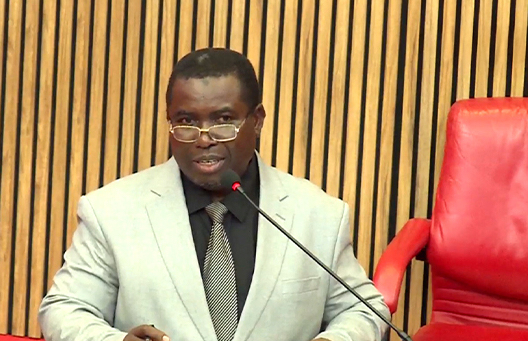
The Chairman of the Independent National Electoral Commission (INEC), Prof Joash Amupitan (SAN), has called for a more robust and adaptive legal framework to address emerging governance challenges in Nigeria’s fast-evolving digital landscape.
Amupitan made the call on Tuesday while chairing the 47th Founders’ Day Lecture of the Nigerian Institute of Advanced Legal Studies, held at the Ayo Ajomo Auditorium, University of Lagos.
The lecture was themed: “Civic Participation, Rule of Law and Accountable Governance in a Digital Era.”
He stated that technological advancement has significantly altered governance structures globally, stressing the need for Nigeria’s legal and institutional frameworks to keep pace in order to safeguard democratic processes.
“We are living in a time when technology is fundamentally reshaping governance.
“From digital platforms that amplify citizens’ voices to tools that enhance transparency, technology is creating vast opportunities for participation and accountability,” Amupitan said.
He, however, warned that the digital space also presented serious risks.
“We are confronted with misinformation, digital manipulation, data breaches and concerns around artificial intelligence. These developments test the resilience of our legal system,” he added.
The INEC boss emphasised that innovation must not outstrip regulation.
“Technological advancements must not outpace regulation or undermine democratic institutions. Nigeria needs a forward-looking legal framework that promotes transparency while preserving the integrity of governance,” he stated.
Reflecting on the significance of Founders’ Day, Amupitan described it as both a moment of reflection and a call to action.
According to him, institutions remain relevant not merely by their history but by their responsiveness and impact.
He commended NIALS for bridging the gap between legal theory and practice, urging it to intensify its engagement with emerging digital governance issues.
“As the leading centre of legal scholarship, NIALS must continue interrogating new issues, generating evidence-based insights and guiding the development of adaptive legal frameworks,” he said.
Delivering the keynote lecture, Senior Advocate of Nigeria, Mr Theodore Maiyaki, stressed the importance of civic participation while cautioning that technology could undermine democracy if not properly regulated.
He noted that digital transformation has redefined how societies interact and govern.
“Citizens no longer participate only through town halls or ballot boxes, but through hashtags, petitions, online campaigns and virtual communities,” he said.
Describing the digital era as both enabling and disruptive, Maiyaki warned that tools designed to expand access to information could also fuel misinformation, manipulation and surveillance.
“Technology can strengthen democracy or weaken it; empower citizens or control them. That is why safeguards are essential in any democratic system,” he said.
He stressed that civic engagement must go beyond elections. “Governance is not the exclusive domain of elected officials. Citizens must engage continuously. Democracy collapses when public voices go silent,” he added.
Maiyaki also expressed concern over declining elite participation in Nigeria’s political processes, particularly during party congresses, and called for greater commitment to democratic engagement.
On the rule of law, he maintained that it must translate into tangible benefits for citizens.
“It must go beyond theory and elite discourse to deliver functional schools, hospitals, jobs and basic amenities,” he said, noting that delays in justice delivery and perceived political interference had eroded public trust.
He called for stronger safeguards in digital governance, including enhanced data protection, cybersecurity, and transparency in the deployment of artificial intelligence.
“Digital innovation must strengthen transparency, not obscure it, because accountability is a public trust,” he stated.
In his remarks, the Dean of the Faculty of Law, University of Lagos, Prof Abiola Sanni (SAN), advocated closer collaboration between the faculty and NIALS to advance legal scholarship.
“We are committed to building productive linkages with NIALS, drawing inspiration from global models,” he said.
Sanni highlighted ongoing developments within the faculty, including improved infrastructure, digital libraries and modern lecture facilities, expressing optimism that they would enhance academic excellence and professional training.
Earlier, the Director-General of NIALS, Prof Abdulqadir Abikan, reiterated the institute’s commitment to supporting governance through research and policy engagement.
He traced the institute’s origin to the 1966 Nigerian Association of Law Teachers conference and paid tribute to past leaders whose contributions shaped its growth.
According to him, NIALS has continued to provide policy support in key areas such as criminal justice, environmental law, anti-money laundering and consumer protection.
He disclosed that a recent MacArthur-funded project produced policy bulletins, case digests and 23 draft court rules.
Abikan added that the institute trained 972 participants across 31 capacity-building programmes in 2025.
He acknowledged challenges, including inflation, staff attrition and infrastructure constraints, but noted ongoing efforts to address them.
He also announced the recovery of the institute’s property at Dolphin Estate after a protracted 16-year legal dispute.
The Director-General appealed to the Attorney-General of the Federation, Mr Lateef Fagbemi (SAN), for support in completing the institute’s permanent headquarters in Abuja.
Among dignitaries present at the event were Obi Prof Epiphany Azinge (SAN), the Asagba of Asaba; Lagos State Attorney-General and Commissioner for Justice, Mr Lawal Pedro (SAN); Justice Hakeem Oshodi; and Justice Modupe Nicole-Clay.
punch.ng
FOLLOW US ON:
FACEBOOK
TWITTER
PINTEREST
TIKTOK
YOUTUBE
LINKEDIN