
Connect with us

News

Lucky soul. He d!ed in Jihad – Sheikh Gumi reacts to Iran’s Supreme leader Khamenei’s d3ath

Published

on

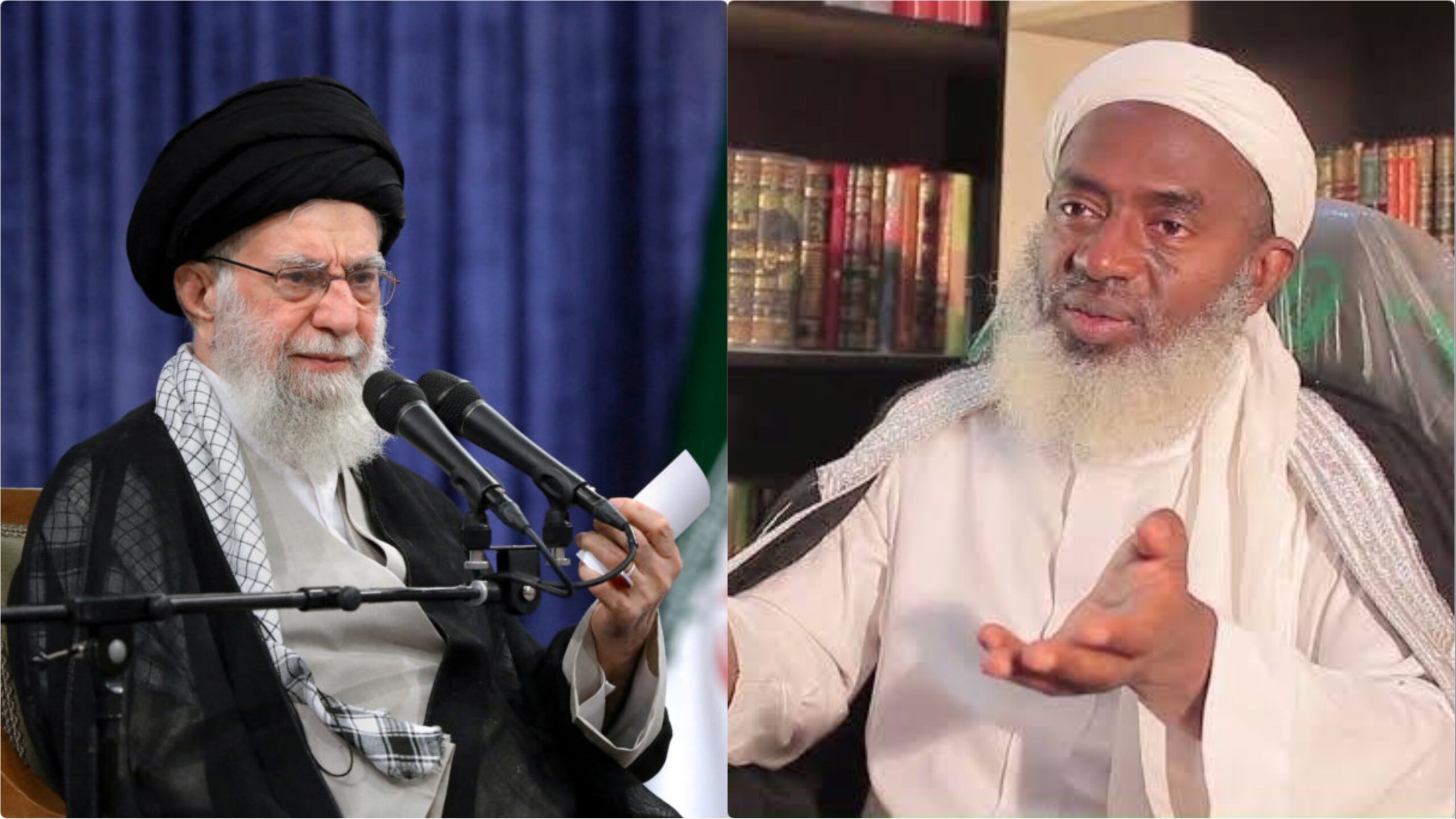
Kaduna-based Islamic scholar, Ahmad Gumi has reacted to the k!lling of Iran’s Supreme leader, Ayatollah Ali Khanenei, describing him as a “lucky soul who d!ed in Jihad.”

Khanenei was k!lled by US and Israeli missiles in Tehran on Saturday, February 28, 2026.

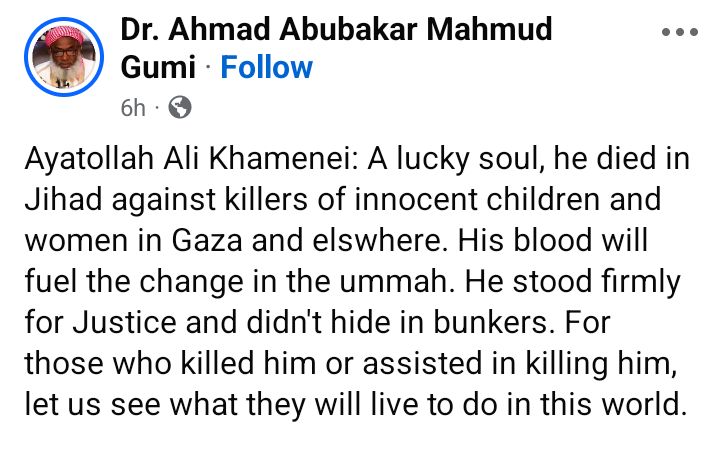
In a post shared on his verified Facebook page, Gumi said Khamenei’s blood “will fuel the change in the ummah.”

“A lucky soul, he d!ed in Jihad against k!llers of innocent children and women in Gaza and elsewhere,” Gumi wrote.

He added that the late Iranian leader’s blood “will fuel the change in the ummah,” noting that Khamenei “stood firmly for justice and didn’t hide in bunkers.

“For those who k!lled him or assisted in killing him, let us see what they will live to do in this world.”

FOLLOW US ON:

FACEBOOK

TWITTER

PINTEREST

TIKTOK

YOUTUBE

LINKEDIN

TUMBLR

INSTAGRAM

See also  How Alleged Coup Plotters Bought 32 SUVs, Gulf Cars For Covert Ops
Continue Reading
Click to comment

Leave a Reply

Your email address will not be published. Required fields are marked *

News

US ambassador posts vacant in Nigeria, 116 countries – Report

Published

on

The United States ambassadorial positions in Nigeria and 116 other countries are currently vacant, reflecting a broader diplomatic gap affecting countries across different regions of the world, according to official records released by the US Department of State.

The document, published on April 8, 2026, via the US Department of State’s website and titled “Ambassadorial Assignments Overseas” by the Office of Presidential Appointments, showed that Nigeria is among 117 countries yet to have a Senate-confirmed US ambassador.

The document was obtained by our correspondent on Thursday.

The affected countries spread across Africa, Europe, Asia, the Americas and Oceania.

In Africa, the vacancies exist in countries including Algeria, Angola, Benin, Burundi, Cabo Verde, Cameroon, Central African Republic, Chad, Comoros, Democratic Republic of the Congo, Côte d’Ivoire, Egypt, Eritrea, Eswatini, Gabon, The Gambia, Ghana, Guinea, Guinea-Bissau, Kenya, Lesotho, Liberia, Libya, Madagascar, Malawi, Mauritania, Mauritius, Mozambique, Niger, Nigeria, Republic of the Congo, Rwanda, Sao Tome and Principe, Senegal, Seychelles, Sierra Leone, Somalia, Sudan, Tanzania, and Togo.

Across Europe, the list includes countries such as Albania, Belarus, Bosnia and Herzegovina, Bulgaria, Germany, Hungary, Iceland, Kosovo, Moldova, Montenegro, North Macedonia, Norway, Russia, Serbia, the Slovak Republic, Slovenia and Ukraine.

In Asia and the Middle East, those affected include Afghanistan, Armenia, Azerbaijan, Burma, Cambodia, Indonesia, Iraq, the Republic of Korea, Kuwait, Laos, Malaysia, Maldives, Nepal,  Pakistan, Philippines, Qatar, Saudi Arabia, Sri Lanka, Syria, Tajikistan, Timor-Leste, United Arab Emirates and Vietnam.

In the Americas, the vacancies extend to countries such as Antigua and Barbuda, Barbados, Belize, Bolivia, Brazil, Colombia, Cuba, Commonwealth of Dominica, Ecuador, El Salvador, Grenada, Guatemala, Haiti, Honduras, Jamaica, Nicaragua, Paraguay, Saint Kitts and Nevis, Saint Lucia, Saint Vincent and the Grenadines, Suriname, Trinidad and Tobago and Venezuela.

See also  FRSC, Army collaborate on intelligence sharing, others

Meanwhile, in Oceania, several island nations are also without confirmed US ambassadors, including Australia, the Cook Islands, Fiji, Kiribati, the Marshall Islands, Nauru, New Zealand, Niue, Papua New Guinea, Samoa, the Solomon Islands, Tonga, Tuvalu, and Vanuatu.

This development followed earlier diplomatic changes reported in December 2025, when the administration of President Donald Trump recalled nearly 30 career diplomats from ambassadorial and senior embassy positions worldwide.

According to a report published in The Guardian, attributing it to AP, the move affected mission chiefs in at least 29 countries, including 15 in Africa.

The recalls were part of efforts to reshape US diplomatic representation in line with the administration’s foreign policy priorities.

Although such envoys typically serve at the pleasure of the president, the large-scale withdrawals raised concerns about gaps in the US diplomatic presence globally.

punch.ng

FOLLOW US ON:

FACEBOOK

TWITTER

PINTEREST

TIKTOK

YOUTUBE

LINKEDIN

Continue Reading

News

Tinubu signs ₦68.32trn 2026 budget, extends 2025 spending deadline

Published

on

President Bola Tinubu has signed the 2026 Appropriation Bill into law, authorising an aggregate expenditure of ₦68.32 trillion for the current fiscal year.

He also signed a separate bill extending the implementation period of the 2025 budget from March 31 to June 30, 2026.

The budget allocates ₦4.799 trillion for statutory transfers and ₦15.8 trillion for debt service.

It further sets aside ₦15.4 trillion for recurrent expenditure and ₦32.2 trillion for capital expenditure through the Development Fund.

The presidency made the disclosure in a statement signed by Special Adviser on Information and Strategy, Bayo Onanuga on Friday.

The statement read, “President Bola Ahmed Tinubu has assented to the 2026 Appropriation Bill, which provides for an aggregate expenditure of ₦68.32 trillion. He has also signed the bill extending the implementation period for the 2025 budget from March 31, 2026, to June 30, 2026.

“The N68.32 trillion budget for this year earmarks N4.799 trillion for statutory transfers and N15.8 trillion for debt service. It allocates N15.4 trillion to recurrent expenditure and N32.2 trillion to the Development Fund for Capital Expenditure.

“With capital expenditure accounting for about 50 per cent, the 2026 budget underscores the administration’s continued commitment to economic stability, national security, infrastructure development, and inclusive growth.

“The allocations reflect a strategic balance between statutory obligations, debt servicing, recurrent expenditure, and capital investments critical to driving productivity and improving the quality of life for Nigerians,” it added.

The 2026 Appropriation Act took effect on April 1, with the Federal Government commencing full implementation in line with what the presidency describes as the Renewed Hope Agenda.

See also  FRSC, Army collaborate on intelligence sharing, others

Tinubu also assented to the Appropriation (Repeal and Enactment) (Amendment) Bill, 2026, which extends the capital component of the 2025 Appropriation Act by three months to June 30.

The presidency said the extension would ensure the full utilisation of appropriated funds, particularly for critical infrastructure projects at advanced stages of implementation.

“The extension will ensure the full and effective utilisation of appropriated funds, particularly for critical infrastructure and development projects that are at advanced stages of implementation across the country.

“It will enable Ministries, Departments, and Agencies (MDAs) to consolidate ongoing works, enhance project completion rates, and maximise value for public expenditure,” the statement read.

Tinubu directed MDAs to ensure disciplined, transparent, and efficient utilisation of allocated resources, with strong emphasis on value for money and timely project delivery.

He commended the leadership and members of the National Assembly for what the presidency described as their “diligence, cooperation, and patriotism in expeditiously considering and passing the budget.”

“The President reaffirmed the importance of sustained collaboration between the Executive and Legislative arms of government in advancing national development objectives,” the statement noted.

Tinubu also assured Nigerians of his administration’s resolve to deepen fiscal reforms and boost revenue generation.

“He further assured Nigerians of his administration’s resolve to deepen fiscal reforms, enhance revenue generation, and prioritise investments that will stimulate economic growth, create jobs, and strengthen social protection mechanisms,” the statement read.

The budget, titled “The Budget of Consolidation, Renewed Resilience and Shared Prosperity,” was originally presented to a joint session of the National Assembly on December 19, 2025, at a proposed sum of ₦58.47 trillion.

See also  AFRIFF 2025 returns with Herbert Wigwe Awards for Excellence

It passed second reading in the House of Representatives on January 29, 2026, before going through further legislative scrutiny and emerging at ₦68.32 trillion at the point of assent.

During the second reading debate in January, House Leader Julius Ihonvbere had urged lawmakers to support the proposal, pointing to a projected 3.98 per cent economic growth rate for 2026, a projected drop in inflation to 14.45 per cent, improved revenues, and foreign direct investment growth.

He also cited a stabilisation of the naira at around ₦1,400 to the dollar and a rise in Nigeria’s external reserves to a seven-year high of approximately $47 billion.

When Tinubu presented the bill to lawmakers in December, he described it as a defining moment in Nigeria’s reform journey, acknowledging the pressures the process had placed on households and businesses while insisting the sacrifices were necessary.

“The path of reform is seldom smooth, but it is the surest route to lasting stability and shared prosperity,” he told the joint session.

He vowed that 2026 would mark a decisive shift to stronger budget execution discipline, announcing an end to the long-standing practice of running overlapping budgets and perpetual rollovers.

The budget’s four stated objectives are consolidating macroeconomic stability, improving the business and investment environment, promoting job-rich growth, and strengthening human capital development while protecting the vulnerable.

Key sectoral allocations include ₦5.41 trillion for defence and security, ₦3.56 trillion for infrastructure, ₦3.52 trillion for education, and ₦2.48 trillion for health.

Minister of Information Mohammed Idris, writing in a January op-ed, described the budget as a commitment to consolidate what was working in the administration’s reform programme and ensure that shared prosperity became “a lived reality for more Nigerians, faster.”

See also  FG declares Thursday, Friday public holidays for Eid-el-Fitr

He pointed to expanding business activity, improving investor confidence, easing inflation, and stronger external reserves as early indicators of progress, and highlighted ongoing infrastructure projects including the Coastal Highway, Sokoto–Badagry Expressway, and Ajaokuta–Kaduna–Kano Gas Pipeline as evidence of the administration’s delivery record.

punch.ng

FOLLOW US ON:

FACEBOOK

TWITTER

PINTEREST

TIKTOK

YOUTUBE

LINKEDIN

Continue Reading

News

Nigeria, 116 Nations Without US Ambassadors – Report

Published

on

Ambassadorial positions of the United States Department of State in Nigeria and 116 other countries are currently vacant, highlighting a widening diplomatic gap across multiple regions of the world.

Official records published on April 8, 2026, via the US Department of State’s website and titled “Ambassadorial Assignments Overseas” by the Office of Presidential Appointments, show that Nigeria is among 117 countries yet to have a Senate-confirmed US ambassador.

According to The PUNCH, the unfilled positions cut across Africa, Europe, Asia, the Americas and Oceania, affecting both key allies and strategic regions.

In Africa, the vacancies exist in countries including Algeria, Angola, Benin, Burundi, Cabo Verde, Cameroon, Central African Republic, Chad, Comoros, Democratic Republic of the Congo, Côte d’Ivoire, Egypt, Eritrea, Eswatini, Gabon, The Gambia, Ghana, Guinea, Guinea-Bissau, Kenya, Lesotho, Liberia, Libya, Madagascar, Malawi, Mauritania, Mauritius, Mozambique, Niger, Nigeria, Republic of the Congo, Rwanda, Sao Tome and Principe, Senegal, Seychelles, Sierra Leone, Somalia, Sudan, Tanzania, and Togo.

In Europe, the list includes countries such as Albania, Belarus, Bosnia and Herzegovina, Bulgaria, Germany, Hungary, Iceland, Kosovo, Moldova, Montenegro, North Macedonia, Norway, Russia, Serbia, the Slovak Republic, Slovenia and Ukraine.

In Asia and the Middle East, those affected include Afghanistan, Armenia, Azerbaijan, Burma, Cambodia, Indonesia, Iraq, the Republic of Korea, Kuwait, Laos, Malaysia, Maldives, Nepal, Pakistan, Philippines, Qatar, Saudi Arabia, Sri Lanka, Syria, Tajikistan, Timor-Leste, United Arab Emirates and Vietnam.

In the Americas, the vacancies extend to countries such as Antigua and Barbuda, Barbados, Belize, Bolivia, Brazil, Colombia, Cuba, Commonwealth of Dominica, Ecuador, El Salvador, Grenada, Guatemala, Haiti, Honduras, Jamaica, Nicaragua, Paraguay, Saint Kitts and Nevis, Saint Lucia, Saint Vincent and the Grenadines, Suriname, Trinidad and Tobago and Venezuela.

See also  AFRIFF 2025 returns with Herbert Wigwe Awards for Excellence

Meanwhile, in Oceania, several island nations are also without confirmed US ambassadors, including Australia, the Cook Islands, Fiji, Kiribati, the Marshall Islands, Nauru, New Zealand, Niue, Papua New Guinea, Samoa, the Solomon Islands, Tonga, Tuvalu, and Vanuatu.

This development followed earlier diplomatic changes reported in December 2025, when the administration of President Donald Trump recalled nearly 30 career diplomats from ambassadorial and senior embassy positions worldwide.

According to a report published in The Guardian, attributing it to AP, the move affected mission chiefs in at least 29 countries, including 15 in Africa.

FOLLOW US ON:

FACEBOOK

TWITTER

PINTEREST

TIKTOK

YOUTUBE

LINKEDIN

Continue Reading

Trending