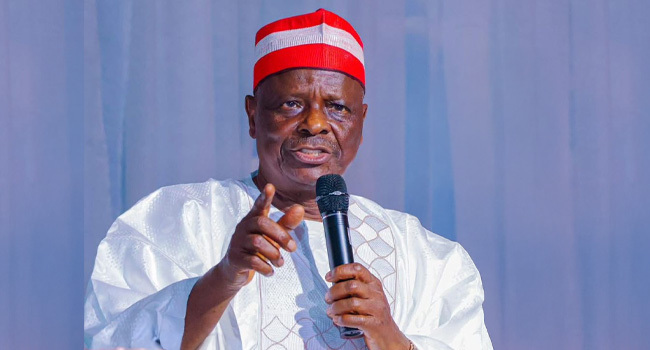
The All Progressives Congress and the New Nigeria Peoples Party have rejected the proposed visa bans and asset freezes recommended by United States lawmakers against ex-Kano State Governor, Senator Rabiu Kwankwaso, the Miyetti Allah Cattle Breeders Association of Nigeria and the Miyetti Allah Kautal Hore over alleged violations of religious freedoms in Nigeria.
The bill, titled, ‘The Nigeria Religious Freedom and Accountability Act of 2026,’ was introduced in the US House of Representatives by Rep Chris Smith alongside Reps Riley Moore, Brian Mast and Bill Huizenga.
The bill recommends visa bans and asset freezes under the Global Magnitsky Human Rights Accountability Act against individuals and entities accused of involvement in religious freedom abuses.
The APC criticised the proposed sanctions, insisting that the allegations alone could not justify curtailing Kwankwaso’s freedom of movement without a fair hearing and due process.
Speaking with The PUNCH on Wednesday, the APC Director of Publicity, Bala Ibrahim, described the United States as a symbol of democracy and cautioned its government against taking action solely based on allegations.
He stated, “I think they (the United States of America) cannot just act on allegations. America is the beacon of democracy. America is the beacon of freedom, and it ought to be seen to be behaving in that manner.
“Now, whatever the allegation against former Kano State Governor, Rabiu Musa Kwankwaso, and others is, it remains an allegation until it is proven.
“They cannot, on the strength of an allegation alone, go ahead to suggest a ban or restriction on the freedom of movement of an individual without substantiating it, without subjecting him to a fair hearing and trial.
“So I think that is a wrong move. It infringes on his right to a fair hearing, and I don’t support that.”
The NNPP, on the other hand, described the planned censure of its national leader as blackmail.
At a press conference in Abuja on Wednesday, the opposition party expressed shock over the inclusion of Kwankwaso in the proposed sanctions list, while dismissing any suggestions that he was responsible for religious freedoms violations.
The National Publicity Secretary of the party, Ladipo Johnson, stated, “We see this development as a contrived action against an innocent man who clearly has no relationship with religious fundamentalism in Nigeria.
“His record is there in the public domain, either in public office or in private life and it is advisable for people to investigate such things properly, before reaching such conclusions.”
Johnson noted that months before the latest development, Kwankwaso had reacted to the decision by US President Donald Trump to re-designate Nigeria as a Country of Particular Concern over alleged persecution of Christians.
He said, “The months before the latest development, Kwankwaso had openly reacted when President Donald Trump re-designated Nigeria as a Country of Particular Concern over alleged religious persecution.
“In a statement posted on his X handle at the time, Kwankwaso cautioned against what he described as oversimplified characterisations of Nigeria’s internal challenges.
“Kwankwaso stated that it was important to emphasise that our country is a sovereign nation whose people face different threats from outlaws across the country.”
However, in a post shared on X, US lawmaker Riley Moore had written to Kwankwaso saying, “Governor, do you care to comment on your own complicity in the death of Christians? You instituted Sharia law. You signed the law that makes so-called blasphemy punishable by death.”
Kano State, under Kwankwaso’s leadership, implemented the Islamic legal code, joining other northern states such as Zamfara, Sokoto, Katsina, Yobe, Jigawa and Borno.
Questioning the allegation, the NNPP asked, “But is this enough to accuse Kwankwaso of severe religious freedoms violations? Why were the other state governors who introduced Sharia in their states not accused as well? Is Rep Moore being fair or selective?
‘Isn’t the US in a good relationship with Qatar and Saudi Arabia (both Sharia countries)? Why is this coming just after our government apparently paid for a consultant in the US? Isn’t it strange that it is Kwankwaso, an opposition leader who has spoken out so many times about the insecurity under this administration, that the United States now seems to be turning on?”
The party also defended Kwankwaso’s record as governor, stating, “We recall that as Governor of Kano State, Senator Kwankwaso ensured that the Boko Haram sect was wiped out of the state, and his close relationships with Christian leaders in Kano and across the country attest to his credibility as a national leader and statesman.
“Even when he was pressured to introduce Sharia, he still lost his election because the predominantly Muslim voters punished him for supporting a Christian presidential candidate in the person of Chief Olusegun Obasanjo. Furthermore, in 2023, he ran his presidential campaign with a Christian Bishop, Isaac Idahosa, as his running mate.
“These are the facts, which we think, should guide the Congress and its leaders, particularly Reps Riley Moore and Chris Smith, to do a thorough investigation on the credibility of our leader, Senator Rabiu Musa Kwankwaso, so that Justice is done to his noble name and cleared of such undue embarrassment,” Johnson added.
The US Congress, in the bill, issued one of its strongest condemnations yet of religious persecution in the country, declaring that Nigeria accounts for 82 per cent of all Christians martyred globally and warning that the scale, coordination and impunity surrounding the violence now threaten regional stability and US foreign policy interests.
The bill calls for targeted sanctions on individuals and networks responsible for severe violations, and urges their designation as Foreign Terrorist Organisations.
The legislation specifically directs the Secretary of State to determine whether certain Fulani-ethnic militias qualify as Foreign Terrorist Organisations under section 219 of the U.S. Immigration and Nationality Act.
If such a designation is made, it would carry far-reaching consequences, including criminalising material support, expanding US law enforcement reach, and intensifying international pressure on any state or entity found to be aiding the groups.
Part of the bill read, “Appropriations Act, 2026, to enhance efforts, protect innocent lives; the United States should deliver humanitarian assistance, co-funded by the Government of Nigeria, through trusted faith-based and nongovernmental organisations in Nigeria’s middle belt states;
“The Department of State and the Department of the Treasury should impose targeted sanctions, including visa bans and asset freezes under the Global Magnitsky Human Rights Accountability Act, on individuals or entities responsible for severe religious freedom violations, including Fulani-ethnic nomad militias in Nigeria; Rabiu Musa Kwankwaso, former Kano State Governor; Miyetti Allah Cattle Breeders Association of Nigeria (MACBAN); and (D) Miyetti Allah Kautal Hore.
“The Secretary of State should determine whether certain Fulani-ethnic militias in Nigeria qualify as a foreign terrorist organisation under section 219 of the Immigration and Nationality Act (8 U.S.C. 1189).”
The lawmakers, citing multiple sources, including the Open Doors 2024 World Watch List, stated that between 50,000 and 125,000 Christians were martyred between 2009 and 2025, with more than 19,000 Christians, churches, and Christian-owned facilities attacked or destroyed in that period.
“Systemic religious persecution has persisted in Nigeria since at least 2009,” the lawmakers wrote, listing Boko Haram, the Islamic State West Africa Province (ISWAP), and Fulani-ethnic militant groups as key perpetrators.
The attacks, they said, include mass murder, kidnappings, rape, village destruction, and the forced displacement of entire communities.
From Benue and Plateau states in the Middle Belt to parts of the North-East and North-West, violence has become cyclical and brutal, the proposed bill further noted.
Between May 2023 and May 2025, the US lawmakers said the Fulani-ethnic militias alone carried out major massacres in Umogidi, Mgban, Yelwata, and during the Christmas Eve attacks of 2023 and 2024, as well as the Holy Week and Easter assaults of 2024 and 2025.
According to the bill, those incidents killed more than 9,500 people, mostly Christians and displaced over half a million others.
“These militias have conducted targeted killings, hostage-taking, hijackings, armed assaults, and massacres of civilians. Their actions meet the statutory definition of terrorist activity,” the legislation states.
Beyond armed attacks, the US lawmakers criticised Nigeria’s continued enforcement of blasphemy laws carrying the death penalty in 12 northern states under Sharia criminal codes.
They said these laws have been used to target Christians, minority Muslims, and dissenters.
The bill references cases such as Rhoda Jatau and Deborah Yakubu, who suffered mob violence, imprisonment, or death over alleged blasphemy, while known perpetrators often face no punishment.
It also highlights the case of Sunday Jackson, a Christian farmer from Adamawa State who was sentenced to death in 2021 after killing an armed herder in what was widely viewed as self-defence.
Jackson spent nearly a decade in prison before being pardoned in December 2025 in what the bill describes as a “show of good faith” by the Nigerian government.
Despite such isolated steps, the lawmakers said it remains unclear whether any meaningful investigations have led to prosecutions or convictions of jihadists and militia leaders responsible for mass atrocities, clergy targeted and witnesses intimidated.
The legislation notes that more than 250 religious leaders, both Christian clergy and Muslim imams, who advocated tolerance have been attacked or killed in the past decade.
It cites the killing of Father Sylvester Okechukwu in 2025 and pointed out that Christian leaders who testified before Congress, including Father Remigius Iyhula and Bishop Wilfred Anagbe, faced intimidation and harassment as a direct result of speaking out.
“The message to victims and witnesses has been chilling. Tell your story, and you may pay the price,” the Congressmen wrote.
They added that the humanitarian fallout is staggering. An estimated 3.5 to 5 million Nigerians are internally displaced, while over 343,000 remain refugees in the Lake Chad region.
The Act calls on the United States to co-fund humanitarian assistance with the Nigerian government, delivered through trusted faith-based and non-governmental organisations in the Middle Belt states.
It prioritises food, shelter, trauma care, and the safe and voluntary return of displaced persons to their ancestral lands, especially persecuted Christian communities.
The US Commission on International Religious Freedom has recommended Nigeria’s designation as a Country of Particular Concern every year since 2009.
US President Donald Trump also designated Nigeria a CPC in 2020 and again in October 2025, citing the scale of religiously motivated violence.
Lawmakers argue that the prior administration’s removal of Nigeria from the CPC list in 2021 coincided with a marked escalation in attacks.
“Designating Nigeria as a CPC enhances diplomatic tools, including sanctions, to pressure the government to halt persecution and protect vulnerable communities,” the bill states.
In a striking addition, the Act urges the US government to work with Nigeria to counter “hostile foreign exploitation,” including allegations that Chinese illegal mining operations in parts of Nigeria pay protection money to Fulani militias, thereby fueling insecurity.
The Secretary of State was encouraged to support disarmament programmes, counter-terrorism cooperation, and regional efforts to eliminate Foreign Terrorist Organisations that pose a direct threat to both Nigeria and the wider international community.
If passed, the Act will require the US Secretary of State to submit a comprehensive report within 90 days of enactment and annually thereafter until Nigeria is no longer designated a CPC.
Each report must include an assessment of Nigeria’s compliance with the International Religious Freedom Act of 1998; identification of individuals and entities sanctioned or under consideration for sanctions; details of US – Nigeria co-investments in humanitarian assistance, including amounts, recipients, and measurable outcomes; an evaluation of US security assistance and whether it risks enabling persecution; an assessment of conditions for internally displaced persons and recommendations for further executive or congressional action.
The Act states that “The United States stands in solidarity with Christians and all persecuted religious minorities in Nigeria.”
Meanwhile, the Miyetti Allah Cattle Breeders rejected its inclusion in the US list of religious freedom violators in Nigeria.
The National President of Miyetti Allah, Baba Ngelzarma, described the allegations as unfounded, insisting the association is not a terrorist organisation.
“In the past, when this report first came out, we had a series of engagements with the American embassy, with contingents of the Congress, and the rest. So, we have reacted verbally, and we have reacted with documentation and everything. We are not a terrorist group,” Ngelzarma said.
He maintained that the Nigerian government is fully aware of the association’s activities and its legal status.
“The Nigerian government knows much about the Miyetti Allah Cattle Breeders Association. We have never been involved in any form of terrorism. We have never taken responsibility for any form of terrorism,” he said.
Ngelzarma explained that the association, registered 42 years ago, represents cattle breeders across religious and ethnic lines and does not shield criminal elements.
He expressed surprise that the group was still being linked to terrorism despite previous engagements with international bodies.
“We represent the peaceful herders who are doing their peaceful and legitimate business. We don’t represent any criminal in the country. So, we are still surprised that this thing, despite all this thing, that this thing is still going on.’’
According to him, Miyetti Allah has held consultations with various international organisations, including humanitarian and interfaith groups, to clarify its position.
“We have had a series of engagements with international agencies such as the National Corps, the Centre for Humanitarian Dialogue, Interfaith Radiation Centre, and many other international agencies. We are never a terrorist group,” he added.
On the proposed visa bans and sanctions, Ngelzarma argued that the association does not deserve such punitive measures.
“Do we even deserve to be sanctioned? We don’t deserve to be sanctioned because we are not a criminal group. We don’t even deserve to be sanctioned. So, for what reason can you sanction us?” he queried.
He called on the Nigerian government to intervene diplomatically.
“We are citizens of Nigeria; we are under the Nigerian government. This association is under the Nigerian law, and this association has been issued a registration to operate legally. So, we deserve to be protected by our own government here at home. Whatever that should be with the Americans should be with the Nigerian government,” he said.
Ngelzarma urged the FG to engage the US government to address what he described as “misconceptions surrounding the security crisis in Nigeria.”
Similarly, the Miyetti Allah Cattle Breeders Association of Nigeria, Benue State chapter, described the visa ban proposed in the bill as a violation of the Universal Declaration of Human Rights.
The State Secretary of Benue MACBAN, Ibrahim Galma, who condemned the proposed bill, said that MACBAN was a legitimate association comprising Muslim and Christian members.
According to him, members of the association were also victims of terrorism, having lost their loved ones and cattle to bandits terrorising the country.
He said that the US is biased in its assessment of issues in Nigeria and asked Congress to send a delegation to Nigeria and visit some of the troubled communities before passing the bill into law.
Galma said, “We are not terrorists or bandits. Let me emphasise this: We are also victims of Boko Haram in Nigeria because we have lost members and cattle.
“Maybe, some people do not know that we have Christians as members of MACBAN in parts of Adamawa, Plateau and Bauchi. These people are non-Fulanis.
“We are not terrorists or bandits, it’s true that in every association, there are bad eggs, and this is not limited to MACBAN.’’
Galma advised the US Congress to respect the fundamental rights of every nation, individual and association as embedded in the Universal Declaration of Human Rights, urging the Congress to dispatch a delegation to Nigeria.
“The US should respect the fundamental human rights, or else it amounts to a breach of international standards such as the Universal Declaration of Human Rights.’’